Packaging Ultrasonic Welder Market Size and Growth
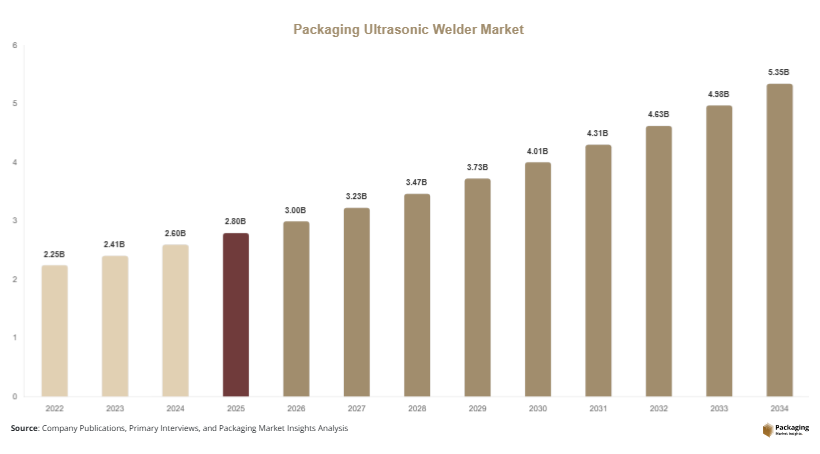
The global packaging ultrasonic welder market size was valued at approximately USD 2.8 billion in 2025 and is estimated to reach USD 3.0 billion in 2026. By 2034, the market is forecast to attain nearly USD 5.4 billion, registering a CAGR of 7.5% during 2025–2034. Packaging ultrasonic welders are widely used in food packaging, pharmaceutical packaging, medical device packaging, consumer goods, and industrial packaging applications because they provide high-speed sealing, low energy consumption, and precise joining capabilities. The packaging ultrasonic welder market is witnessing steady expansion due to rising automation across packaging operations and increasing demand for secure, contamination-free sealing solutions.
The market is growing due to the increasing adoption of automated packaging lines in manufacturing industries. Companies are integrating ultrasonic welding technologies into smart factories to improve production speed and reduce packaging waste. The ability of ultrasonic welders to seal thermoplastic materials without adhesives or additional heat sources is also supporting adoption across sustainable packaging operations. In addition, strict hygiene and safety regulations in pharmaceutical and food packaging industries are encouraging manufacturers to invest in contamination-free sealing technologies.
Key Highlights
- Asia Pacific dominated the market with a 39.8% share in 2025.
- North America is projected to grow at a CAGR of 7.9% during the forecast period.
- Automatic ultrasonic welders led the product type segment with a 36.7% share in 2024.
- Food packaging applications accounted for 41.5% of the market share in 2025 due to growing demand for hygienic sealing solutions.
- Food & beverage dominated the end-use industry segment with a 34.9% share in 2025.
- The US remained the dominant country with a market size of USD 510 million in 2025 and USD 548 million in 2026.
Explore more data points, trends and opportunities Download Free Sample Report
Market Trends
Integration of Smart Automation in Ultrasonic Welding Systems
The integration of smart automation technologies into packaging ultrasonic welders is emerging as a major market trend. Manufacturers are increasingly deploying AI-enabled monitoring systems, touchscreen interfaces, and cloud-connected welding platforms to improve operational efficiency. These technologies help operators track welding performance, energy usage, and maintenance schedules in real time. Smart ultrasonic welders also reduce downtime through predictive maintenance functions that identify component wear before system failure occurs. Industries such as pharmaceuticals and food packaging are rapidly adopting these advanced systems to maintain production consistency and regulatory compliance. The growing implementation of Industry 4.0 technologies across manufacturing facilities is expected to continue supporting this trend throughout the forecast period.
Rising Demand for Sustainable and Energy-Efficient Packaging Equipment
Sustainability goals across manufacturing industries are driving the adoption of energy-efficient ultrasonic welding technologies. Compared to conventional heat sealing methods, ultrasonic welding consumes less power and reduces material waste during packaging operations. Packaging companies are increasingly selecting ultrasonic systems because they eliminate the need for adhesives, solvents, and additional sealing materials. This trend is particularly strong in flexible packaging and recyclable material applications where manufacturers aim to lower environmental impact. Demand for sustainable packaging production lines is also encouraging equipment manufacturers to design compact and low-emission ultrasonic welding systems. As environmental regulations become stricter globally, energy-efficient ultrasonic welders are expected to gain broader market acceptance.
Market Drivers
Increasing Automation Across Packaging Manufacturing Facilities
The growing adoption of automated production lines is a major driver for the packaging ultrasonic welder market. Packaging manufacturers are under pressure to improve operational efficiency, reduce labor dependency, and increase output consistency. Ultrasonic welding systems support high-speed packaging operations while maintaining precise sealing quality. Automated ultrasonic welders are increasingly integrated with robotic packaging systems, conveyor lines, and digital inspection technologies. Industries such as consumer goods, pharmaceuticals, and food processing are heavily investing in advanced automation equipment to meet rising production demand. The ability of ultrasonic welding systems to perform reliable seals with minimal operator intervention is making them a preferred choice across modern packaging facilities worldwide.
Rising Demand for Hygienic and Secure Packaging Solutions
Demand for contamination-free packaging solutions is significantly contributing to market growth. Pharmaceutical, medical device, and food industries require secure sealing technologies that maintain product safety and packaging integrity. Ultrasonic welding creates strong seals without introducing external contaminants or excessive heat, making it suitable for sensitive products. Regulatory standards related to food safety and pharmaceutical packaging are encouraging manufacturers to adopt advanced sealing equipment. In addition, the increasing use of multilayer flexible packaging materials requires precise welding technologies capable of handling different substrate combinations. As consumer awareness regarding product safety continues to rise, manufacturers are expected to increase investments in ultrasonic welding systems that ensure hygienic packaging operations.
Market Restraint
High Initial Investment and Equipment Maintenance Costs
The high capital investment associated with packaging ultrasonic welding equipment remains a major restraint for market expansion. Advanced ultrasonic welding systems equipped with automation features, digital controls, and precision monitoring technologies require substantial upfront expenditure. Small and medium-sized packaging manufacturers often face financial limitations when upgrading from traditional sealing systems to ultrasonic welding equipment. In addition to equipment costs, companies must invest in skilled technicians, operator training, and regular maintenance services to ensure efficient system performance.
Maintenance complexity also affects adoption rates across cost-sensitive industries. Ultrasonic welding systems rely on specialized components such as transducers, boosters, and horns that require periodic calibration and replacement. Any malfunction in these components can interrupt production operations and increase downtime expenses. For example, packaging manufacturers operating in emerging economies may continue using conventional heat sealing equipment due to lower maintenance requirements and reduced installation costs. Furthermore, fluctuations in raw material prices and economic uncertainty can delay capital investments in advanced packaging machinery. Although ultrasonic welding technology offers long-term efficiency benefits, the high initial cost structure remains a challenge for widespread adoption among smaller enterprises and regional packaging facilities.
Market Opportunities
Expansion of Flexible Packaging Applications
The rapid expansion of flexible packaging applications presents strong growth opportunities for the packaging ultrasonic welder market. Flexible pouches, sachets, and multilayer films are increasingly used in food, beverage, pharmaceutical, and personal care industries due to their lightweight structure and extended shelf-life benefits. Ultrasonic welding systems provide precise and durable seals for these packaging formats while minimizing material deformation. Packaging companies are investing in advanced ultrasonic welding equipment to support high-speed production of recyclable and resealable packaging solutions. The increasing popularity of convenient packaging formats for e-commerce and retail applications is expected to create additional demand for ultrasonic sealing technologies during the forecast period.
Growth of Pharmaceutical and Medical Packaging Industries
The growing pharmaceutical and medical packaging industries are generating significant opportunities for ultrasonic welding equipment manufacturers. Medical packaging applications require sterile and contamination-free sealing solutions to maintain product safety and regulatory compliance. Ultrasonic welding systems are widely used for sealing medical pouches, surgical device packaging, diagnostic kits, and pharmaceutical blister packs. Rising healthcare investments, aging populations, and increasing demand for packaged medical products are supporting market growth. In addition, pharmaceutical manufacturers are expanding production capacity in emerging economies, creating new demand for automated packaging technologies. Equipment suppliers focusing on precision sealing systems and regulatory-compliant welding solutions are likely to benefit from long-term industry expansion.
Report Scope
| Report Metric | Details |
|---|---|
| Market Size in 2025 | USD 2.8 Billion |
| Market Size in 2026 | USD 3.0 Billion |
| Market Size in 2034 | USD 5.4 Billion |
| CAGR | 7.5% (2026-2034) |
| Base Year for Estimation | 2025 |
| Historical Data | 2022-2024 |
| Forecast Period | 2026-2034 |
| Report Coverage | Revenue Forecast, Competitive Landscape, Supply Chain Disruption, Growth Factors, Environment & Regulatory Landscape and Trends |
| Geographies Covered | North America, Europe, APAC, Middle East and Africa, LATAM |
| Countries Covered | U.S., Canada, U.K., Germany, France, Spain, Italy, Russia, Nordic, Benelux, Rest of Europe, China, South Korea, Japan, India, Australia, Singapore, Taiwan, South East Asia, Rest of Asia-Pacific, UAE, Turky, Saudi Arabia, South Africa, Egypt, Nigeria, Rest of MEA, Brazil, Mexico, Argentina, Chile, Colombia, Rest of LATAM |
Explore more data points, trends and opportunities Download Free Sample Report
Segmental Analysis
By Type
Automatic ultrasonic welders dominated the packaging ultrasonic welder market and accounted for nearly 58.3% of the market share in 2024. These systems are widely preferred due to their ability to deliver high-speed and accurate sealing performance in large-scale packaging operations. Industries such as food processing, pharmaceuticals, and consumer goods increasingly rely on automatic systems to reduce labor dependency and improve production consistency. The integration of programmable controls, touchscreen interfaces, and robotic compatibility further strengthens adoption. Automatic welders also minimize packaging defects and material waste, making them suitable for high-volume industrial environments. Growing investments in fully automated packaging lines across developed economies continue to support demand for advanced ultrasonic welding equipment.
Semi-automatic ultrasonic welders are projected to witness the fastest growth during the forecast period, expanding at a CAGR of 8.1%. Small and medium-sized manufacturers are increasingly adopting semi-automatic systems due to lower installation costs and operational flexibility. These systems provide an effective balance between manual control and automation, making them suitable for customized packaging applications and moderate production volumes. Rising adoption among regional packaging companies and contract packaging providers is supporting segment growth. Improvements in compact machine design, energy efficiency, and digital monitoring capabilities are also encouraging demand. Emerging economies are expected to create significant opportunities for semi-automatic welding equipment as manufacturers gradually transition toward automated packaging infrastructure.
By Application
Food and beverage packaging represented the dominant application segment and held approximately 44.7% of the global market share in 2024. The segment benefits from rising demand for flexible packaging formats such as pouches, sachets, and multilayer films. Ultrasonic welding systems are widely used in food packaging because they provide strong and hygienic seals without damaging sensitive materials. Increasing consumption of packaged snacks, frozen foods, dairy products, and ready-to-eat meals is accelerating equipment demand. Food manufacturers are also investing in automated packaging technologies to improve operational efficiency and comply with strict hygiene standards. The growing need for sustainable packaging production further supports ultrasonic welding adoption across food processing facilities worldwide.
Pharmaceutical packaging is expected to register the fastest CAGR of 8.5% during the forecast period. The growth is driven by increasing demand for sterile and tamper-resistant packaging solutions across healthcare industries. Ultrasonic welding technology is extensively used for sealing medical pouches, blister packs, diagnostic kits, and surgical device packaging due to its contamination-free sealing capabilities. Expanding pharmaceutical manufacturing activities in Asia Pacific and North America are contributing to segment growth. Regulatory compliance requirements related to packaging integrity and product safety are encouraging healthcare manufacturers to adopt advanced welding technologies. Continuous investments in medical packaging automation are expected to strengthen long-term demand for ultrasonic welding systems.
By End Use
Packaging manufacturers accounted for the largest share of the packaging ultrasonic welder market in 2024, contributing approximately 51.2% of total revenue. These companies utilize ultrasonic welding systems to support high-volume packaging production across multiple industries including food, healthcare, personal care, and consumer goods. The increasing shift toward flexible packaging materials and automated production lines is supporting demand within this segment. Packaging manufacturers prioritize ultrasonic welding technologies because they improve sealing consistency, reduce energy usage, and minimize production waste. Advanced systems equipped with digital monitoring and precision controls are becoming increasingly popular among large-scale production facilities seeking higher efficiency and quality assurance.
Pharmaceutical and medical companies are projected to witness the fastest growth rate, expanding at a CAGR of 8.7% through 2034. Rising healthcare expenditure, increasing demand for packaged medical products, and growth in diagnostic device manufacturing are supporting segment expansion. Ultrasonic welding systems provide precise sealing performance required for sterile medical packaging applications. Pharmaceutical companies are also investing in automated packaging technologies to improve production speed and meet regulatory requirements. The expansion of healthcare manufacturing facilities in emerging economies is expected to create additional opportunities for welding equipment suppliers. Growing adoption of disposable medical devices and packaged healthcare products further strengthens long-term market demand.
Packaging Ultrasonic Welder Market Segmentations
By Type
- Automatic Ultrasonic Welders
- Semi-Automatic Ultrasonic Welders
- Manual Ultrasonic Welders
By Application
- Food & Beverage Packaging
- Pharmaceutical Packaging
- Medical Device Packaging
- Consumer Goods Packaging
- Industrial Packaging
By End Use
- Packaging Manufacturers
- Pharmaceutical Companies
- Food Processing Companies
- Consumer Goods Manufacturers
- Medical Device Manufacturers
Regional Analysis
North America
North America accounted for approximately 27.4% of the global packaging ultrasonic welder market share in 2025 and is expected to expand at a CAGR of 6.9% during the forecast period. The region benefits from high adoption of industrial automation technologies and strong investments in advanced packaging machinery. Demand for contamination-free sealing solutions across pharmaceutical and food industries continues to support market growth. Manufacturers are also focusing on energy-efficient packaging systems to meet sustainability objectives.
The United States remained the dominant country in North America due to the presence of major packaging equipment manufacturers and advanced manufacturing infrastructure. Rising demand for medical packaging applications is a key growth factor supporting the market. Pharmaceutical companies across the country are investing in automated ultrasonic welding systems to improve packaging accuracy, reduce contamination risks, and comply with strict healthcare packaging regulations.
Europe
Europe represented nearly 24.1% of the global packaging ultrasonic welder market in 2025 and is projected to register a CAGR of 6.7% through 2034. Strong environmental regulations and growing demand for sustainable packaging production technologies are supporting market expansion across the region. Packaging manufacturers are increasingly replacing traditional sealing systems with ultrasonic welding equipment to reduce energy consumption and improve material efficiency in industrial operations.
Germany dominated the European market due to its advanced industrial automation sector and strong engineering capabilities. The country’s focus on Industry 4.0 adoption is a major growth factor driving ultrasonic welding demand. German manufacturers are integrating smart welding systems with robotic packaging lines to improve productivity, quality control, and operational flexibility across food, automotive, and healthcare packaging industries.
Asia Pacific
Asia Pacific held the largest market share of 40.9% in 2025 and is anticipated to witness the fastest regional growth with a CAGR of 8.3% during the forecast period. Rapid industrialization, expanding manufacturing activities, and increasing investments in automated packaging technologies are driving regional market growth. Countries across the region are experiencing rising demand for flexible packaging solutions in food, electronics, and pharmaceutical industries, further supporting ultrasonic welding equipment adoption.
China emerged as the dominant country in Asia Pacific due to its large-scale manufacturing base and growing packaging industry. Expanding electronics packaging production is a major growth factor supporting demand for ultrasonic welders. Chinese manufacturers are increasingly adopting automated sealing technologies to improve efficiency, reduce labor costs, and enhance packaging quality across export-oriented manufacturing operations.
Middle East & Africa
The Middle East & Africa region accounted for around 4.8% of the global packaging ultrasonic welder market share in 2025 and is projected to grow at a CAGR of 6.2% during the forecast period. The market is supported by gradual industrial diversification and rising investments in food processing and pharmaceutical manufacturing facilities. Packaging companies in the region are increasingly modernizing production infrastructure to improve operational efficiency and product safety standards.
Saudi Arabia dominated the regional market due to increasing investments in industrial automation and manufacturing expansion projects. Growth in packaged food production is a unique factor driving demand for ultrasonic welding systems in the country. Manufacturers are adopting automated sealing technologies to support higher production volumes and improve packaging consistency for domestic and export markets.
Latin America
Latin America captured approximately 2.8% of the global market share in 2025 and is forecast to grow at a CAGR of 7.1% through 2034. Expanding consumer goods manufacturing activities and increasing demand for flexible packaging solutions are supporting market development. Packaging companies are investing in modern machinery to improve productivity and meet growing demand from retail, food service, and pharmaceutical sectors across the region.
Brazil remained the leading country in Latin America due to its large food processing and consumer goods industries. Rising demand for packaged personal care products is a major growth factor supporting ultrasonic welding equipment adoption. Manufacturers are focusing on automated packaging operations to improve production efficiency and strengthen competitiveness in domestic and regional markets.
Competitive Landscape
The packaging ultrasonic welder market is moderately consolidated with the presence of several international and regional equipment manufacturers competing on technology innovation, automation capabilities, and pricing strategies. Leading companies are focusing on product development, strategic partnerships, and expansion of manufacturing capabilities to strengthen their market position. The industry is witnessing increasing investments in smart welding systems integrated with IoT connectivity and predictive maintenance technologies.
Herrmann Ultraschall remained a leading player in the market due to its extensive product portfolio and strong global distribution network. The company recently introduced advanced ultrasonic welding systems equipped with digital process monitoring and energy optimization features for high-speed packaging applications. Branson Ultrasonics, Sonics & Materials, Rinco Ultrasonics, and Emerson Electric are also actively expanding their packaging equipment offerings.
Manufacturers are increasingly targeting pharmaceutical and flexible packaging applications due to rising demand for contamination-free sealing solutions. Companies are also investing in compact and energy-efficient ultrasonic welding machines to address sustainability goals across industrial packaging operations. Competitive differentiation is largely based on sealing precision, automation integration, operational efficiency, and after-sales technical support services.
Key Players List
- Herrmann Ultraschall
- Branson Ultrasonics Corporation
- Emerson Electric Co.
- Sonics & Materials Inc.
- Rinco Ultrasonics AG
- Telsonic AG
- Dukane Corporation
- Sonic Italia Srl
- Weber Ultrasonics AG
- Schunk Sonosystems GmbH
- Mecasonic Group
- Forward Technology
- SEDECO Ultrasonics
- Kiefel GmbH
- Cera Engineering