Packaging Trends Market Size and Growth
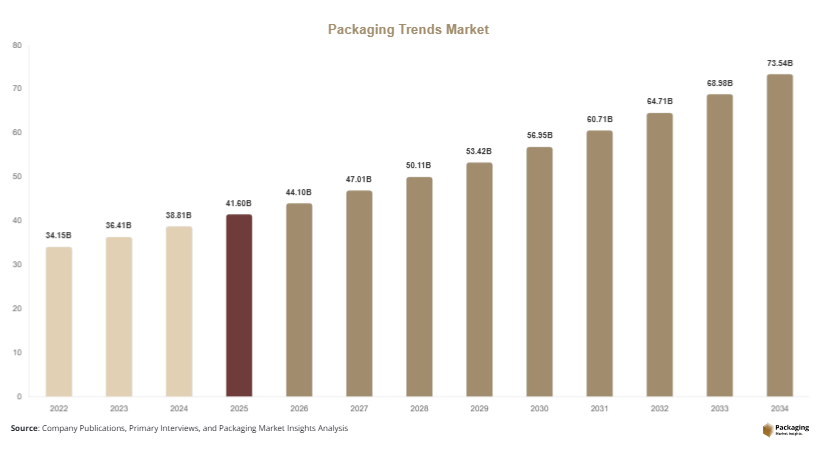
The global packaging trends market was valued at approximately USD 41.6 billion in 2025 and is estimated to reach USD 44.1 billion in 2026. By 2034, the market is projected to attain nearly USD 73.8 billion, expanding at a CAGR of 6.6% during 2025–2034. The market includes emerging trends such as sustainable packaging, smart packaging, minimalist designs, personalized packaging, reusable formats, and digital printing technologies across multiple end-use industries. The packaging trends market is evolving rapidly as manufacturers, retailers, and consumer brands adopt innovative packaging solutions to meet changing consumer expectations and sustainability requirements.
One of the primary growth factors driving the packaging trends market is the increasing consumer preference for environmentally responsible packaging. Consumers are actively choosing products packed in recyclable, biodegradable, and reusable materials, encouraging companies to redesign their packaging strategies. Governments across several countries are also implementing regulations aimed at reducing packaging waste and single-use plastics, further supporting market expansion.
Key Highlights
- Asia Pacific dominated the market with a 37.1% share in 2025.
- Latin America is projected to grow at the fastest CAGR of 7.0%.
- Sustainable packaging trends led the type segment with a 34.2% share.
- Paper-based packaging dominated the material segment with a 43.6% share.
- Food & beverage applications led the market with a 40.5% share.
- The US remained the dominant country with a market size of USD 8.4 billion in 2025 and USD 8.9 billion in 2026.
Explore more data points, trends and opportunities Download Free Sample Report
Market Trends
Rising Demand for Sustainable and Circular Packaging Solutions
Sustainability continues to shape the packaging trends market as businesses focus on reducing environmental impact and improving recyclability. Companies are increasingly shifting from traditional plastic packaging toward recyclable paper, compostable materials, and reusable packaging formats. Circular packaging systems that support material recovery and reuse are gaining traction across food, beverage, and personal care industries. Consumers are also demanding transparency regarding packaging materials and environmental impact, encouraging brands to adopt eco-friendly labeling practices. Governments are implementing stricter regulations on plastic waste management, pushing manufacturers to redesign packaging structures and minimize unnecessary materials. This trend is expected to drive long-term innovation and investment in sustainable packaging technologies.
Expansion of Smart and Connected Packaging Technologies
Smart packaging technologies are becoming a major trend across the global packaging industry. Brands are integrating QR codes, NFC tags, RFID labels, and temperature-monitoring sensors into packaging to improve supply chain visibility and consumer engagement. These technologies allow customers to access product information, verify authenticity, and interact with digital marketing content using smartphones. The pharmaceutical and food industries are increasingly using smart packaging to monitor storage conditions and ensure product safety during transportation. Connected packaging also helps businesses gather consumer insights and improve inventory management. Growing demand for traceability, anti-counterfeiting solutions, and personalized customer experiences is expected to accelerate the adoption of smart packaging trends worldwide.
Market Drivers
Growth of E-commerce and Direct-to-Consumer Packaging Requirements
The expansion of global e-commerce platforms is a major driver for the packaging trends market. Online retail has increased the demand for packaging solutions that provide product protection while also supporting brand presentation and customer experience. Companies are adopting lightweight and durable packaging materials to reduce shipping costs and improve logistics efficiency. At the same time, businesses are investing in visually attractive packaging designs to enhance the consumer unboxing experience and strengthen brand recognition. Subscription-based product delivery services and direct-to-consumer business models are also encouraging packaging innovation. As online shopping continues to grow across developed and emerging economies, demand for advanced packaging trends is expected to rise steadily.
Increasing Consumer Preference for Convenience and Premium Packaging
Consumers are increasingly looking for packaging that combines functionality, convenience, and attractive design. Features such as resealable closures, easy-open mechanisms, portable packaging formats, and portion-controlled containers are becoming important purchasing factors across food, healthcare, and household product categories. Premium packaging aesthetics are also influencing buying behavior, especially in cosmetics, beverages, and luxury goods industries. Companies are using innovative materials, digital printing, and customized designs to improve shelf appeal and customer engagement. This growing focus on convenience and product presentation is encouraging manufacturers to adopt modern packaging trends that enhance usability while supporting brand differentiation in competitive markets.
Market Restraint
High Costs Associated with Sustainable and Advanced Packaging Technologies
One of the major restraints affecting the packaging trends market is the high cost associated with adopting sustainable materials and advanced packaging technologies. Environmentally friendly packaging solutions such as biodegradable plastics, compostable materials, and recyclable multilayer structures often require higher manufacturing and sourcing expenses compared to traditional packaging materials. Additionally, integrating smart technologies such as RFID tracking, QR-based authentication systems, and sensor-enabled packaging increases production costs and requires specialized infrastructure investments. Small and medium-sized enterprises may struggle to implement these innovations due to limited budgets and technical capabilities. For example, regional food manufacturers often face challenges when transitioning from low-cost plastic packaging to sustainable alternatives because of increased operational expenses and supply chain adjustments. These cost barriers can delay adoption rates in price-sensitive markets and create challenges for businesses attempting to balance sustainability goals with profitability. Furthermore, fluctuating raw material prices and inconsistent recycling infrastructure in some regions may further limit market growth during the forecast period.
Market Opportunities
Growth of Personalized and Digital Packaging Solutions
The increasing use of digital printing and data-driven marketing strategies is creating significant opportunities in the packaging trends market. Brands are developing personalized packaging campaigns that target specific consumer groups, regional markets, and seasonal promotions. Digital printing technologies enable companies to produce short-run customized packaging designs without increasing production complexity. Personalized packaging improves customer engagement and enhances brand loyalty, particularly in beverage, cosmetics, and snack food industries. Social media trends are also supporting this opportunity, as visually appealing and customized packaging encourages online sharing and consumer interaction. The ability to create unique packaging experiences is expected to generate substantial growth opportunities for packaging manufacturers and design agencies.
Expansion of Reusable and Refillable Packaging Systems
Reusable and refillable packaging systems are emerging as an important opportunity within the market due to increasing environmental awareness and sustainability regulations. Retailers and consumer goods companies are introducing refill stations, reusable containers, and returnable packaging programs to reduce packaging waste and improve resource efficiency. This trend is particularly strong in personal care, household cleaning, and food service industries. Consumers are increasingly willing to participate in reusable packaging systems that offer convenience and environmental benefits. Advances in durable packaging materials and reverse logistics infrastructure are further supporting the adoption of refillable packaging solutions. Companies investing in these systems are expected to benefit from changing consumer preferences and long-term sustainability initiatives.
Report Scope
| Report Metric | Details |
|---|---|
| Market Size in 2025 | USD 41.6 Billion |
| Market Size in 2026 | USD 44.1 Billion |
| Market Size in 2034 | USD 73.8 Billion |
| CAGR | 6.6% (2026-2034) |
| Base Year for Estimation | 2025 |
| Historical Data | 2022-2024 |
| Forecast Period | 2026-2034 |
| Report Coverage | Revenue Forecast, Competitive Landscape, Supply Chain Disruption, Growth Factors, Environment & Regulatory Landscape and Trends |
| Geographies Covered | North America, Europe, APAC, Middle East and Africa, LATAM |
| Countries Covered | U.S., Canada, U.K., Germany, France, Spain, Italy, Russia, Nordic, Benelux, Rest of Europe, China, South Korea, Japan, India, Australia, Singapore, Taiwan, South East Asia, Rest of Asia-Pacific, UAE, Turky, Saudi Arabia, South Africa, Egypt, Nigeria, Rest of MEA, Brazil, Mexico, Argentina, Chile, Colombia, Rest of LATAM |
Explore more data points, trends and opportunities Download Free Sample Report
Segmental Analysis
By Trend Type
Sustainable packaging trends dominated the packaging trends market in 2024, accounting for approximately 34.2% of the total market share. Companies across food, beverage, healthcare, and personal care industries are prioritizing environmentally responsible packaging materials and designs to comply with sustainability goals and government regulations. Paper-based packaging, recyclable plastics, and compostable materials are increasingly replacing traditional single-use packaging solutions. Brands are also redesigning packaging structures to reduce material consumption and improve transportation efficiency. Consumer preference for environmentally conscious products is further strengthening demand for sustainable packaging innovations. Investments in recyclable multilayer packaging and biodegradable polymers continue to increase as businesses seek long-term sustainability improvements.
Smart packaging trends are projected to register the fastest CAGR of 7.5% during the forecast period. This segment includes packaging solutions integrated with technologies such as RFID tags, QR codes, temperature sensors, and augmented reality features. Businesses are increasingly adopting smart packaging to improve product traceability, anti-counterfeiting protection, and consumer interaction. The pharmaceutical and food industries are major adopters due to rising requirements for safety monitoring and supply chain transparency. Smart packaging also supports personalized marketing campaigns and customer engagement through digital interfaces. Advances in connected technologies and smartphone accessibility are expected to accelerate demand for intelligent packaging systems across global markets.
By Material
Paper-based packaging dominated the market in 2024 with approximately 43.6% share due to increasing demand for recyclable and biodegradable packaging materials. Paperboard cartons, corrugated boxes, and molded fiber packaging are widely used across food, electronics, and healthcare industries because they offer strong printability and environmental advantages. Companies are adopting paper-based packaging to reduce reliance on conventional plastics and meet sustainability regulations. Growing investments in moisture-resistant paper coatings and lightweight corrugated structures are improving packaging durability and functionality. Retailers and consumer goods companies are also using paper packaging to strengthen environmentally responsible brand positioning and improve consumer perception regarding sustainability initiatives.
Biodegradable materials are expected to witness the fastest growth during the forecast period, expanding at a CAGR of 7.2%. Increasing environmental concerns and regulatory restrictions on single-use plastics are encouraging businesses to adopt compostable and plant-based packaging solutions. Food service providers, cosmetic companies, and premium retail brands are actively investing in biodegradable packaging innovations to reduce environmental impact. Advances in material engineering are improving the strength, shelf life, and barrier properties of biodegradable packaging products. Consumer willingness to pay more for sustainable packaging is also supporting demand growth. This segment is expected to benefit from continued investment in circular economy initiatives and green packaging technologies.
By End-Use Industry
The food and beverage industry dominated the packaging trends market in 2024, accounting for approximately 40.5% of total market share. Packaging trends in this sector are heavily influenced by changing consumer lifestyles, convenience requirements, and sustainability concerns. Flexible pouches, recyclable beverage containers, resealable packaging, and smart labeling technologies are widely used to improve product freshness and consumer engagement. Companies are also adopting lightweight packaging formats to reduce transportation costs and carbon emissions. Growing demand for ready-to-eat meals, packaged snacks, and online grocery delivery services is further increasing investment in innovative packaging solutions. Product visibility, shelf appeal, and functionality remain important competitive factors within this segment.
Healthcare packaging applications are expected to grow at the fastest CAGR of 7.1% during the forecast period. Pharmaceutical companies and medical device manufacturers are increasingly adopting advanced packaging technologies to improve product safety, traceability, and regulatory compliance. Smart packaging with temperature indicators and tamper-evident features is becoming more common in pharmaceutical logistics and vaccine transportation. The increasing demand for biologics and temperature-sensitive medicines is also driving innovation in protective healthcare packaging. Sustainability initiatives within the healthcare sector are encouraging companies to adopt recyclable materials and lightweight packaging structures. Rising healthcare expenditure and expanding pharmaceutical production are expected to support long-term market growth.
Packaging Trends Market Segmentations
By Trend Type
- Sustainable Packaging
- Smart Packaging
- Personalized Packaging
- Minimalist Packaging
- Reusable Packaging
By Material
- Paper-Based Packaging
- Plastic Packaging
- Glass Packaging
- Metal Packaging
- Biodegradable Materials
By End-Use Industry
- Food & Beverage
- Healthcare
- Personal Care & Cosmetics
- Consumer Electronics
- Household Products
Regional Analysis
North America
North America accounted for approximately 29.8% of the global packaging trends market share in 2025 and is projected to expand at a CAGR of 6.1% during the forecast period. Strong consumer awareness regarding sustainability and advanced retail infrastructure are supporting market growth across the region. The widespread adoption of smart packaging technologies and premium packaging formats is also driving innovation among packaging manufacturers and consumer goods companies.
The United States dominates the North American market due to its large e-commerce sector and high demand for branded consumer products. A unique growth factor is the increasing use of subscription-based delivery services requiring customized and durable packaging formats. Companies are focusing on interactive packaging and sustainable material integration to improve customer engagement and reduce environmental impact.
Europe
Europe held nearly 25.2% of the packaging trends market share in 2025 and is expected to grow at a CAGR of 5.8% during the forecast period. The region benefits from strict environmental regulations aimed at reducing packaging waste and encouraging recyclable material adoption. European manufacturers are increasingly investing in lightweight packaging designs and reusable packaging systems to meet sustainability targets and consumer expectations.
Germany remains the dominant country in the European market due to its strong manufacturing sector and advanced packaging technology ecosystem. A unique growth factor is the growing demand for paper-based alternatives to plastic packaging in food and beverage applications. Companies are rapidly redesigning packaging structures to improve recyclability and reduce carbon emissions throughout supply chains.
Asia Pacific
Asia Pacific dominated the global packaging trends market with a 37.1% share in 2025 and is projected to grow at a CAGR of 7.2% during the forecast period. Rapid urbanization, expanding retail industries, and increasing consumption of packaged goods are major factors supporting market growth. The rise of online shopping platforms and changing consumer lifestyles are also increasing demand for innovative and convenient packaging solutions.
China is the dominant country in the Asia Pacific region because of its large manufacturing base and growing e-commerce industry. A unique growth factor is the increasing demand for flexible packaging and smart labeling technologies in food delivery services. Businesses are investing in digital packaging solutions to improve logistics efficiency and strengthen product traceability across domestic and international markets.
Middle East & Africa
The Middle East & Africa region accounted for approximately 4.7% of the global market share in 2025 and is expected to register a CAGR of 5.9% during the forecast period. Rising urbanization, expanding retail chains, and increasing packaged food consumption are supporting regional market development. International packaging companies are also expanding their presence in the region to meet growing consumer demand for modern packaging solutions.
The United Arab Emirates dominates the regional market due to strong retail infrastructure and rising demand for premium consumer products. A unique growth factor is the rapid growth of luxury cosmetics and fragrance industries requiring decorative and high-quality packaging solutions. Businesses are increasingly adopting premium packaging trends to improve product differentiation and customer appeal.
Latin America
Latin America represented nearly 3.2% of the packaging trends market share in 2025 and is projected to grow at the fastest CAGR of 7.0% during the forecast period. Growing urban populations, increasing packaged food consumption, and expanding retail modernization initiatives are driving market growth. Consumer demand for affordable and convenient packaging formats is also encouraging innovation across the region.
Brazil dominates the Latin American market due to its large food processing and beverage industries. A unique growth factor is the rising adoption of lightweight flexible packaging to reduce transportation costs and improve distribution efficiency. Companies are also using vibrant graphic packaging designs to improve shelf visibility and attract younger consumer groups.
Competitive Landscape
The packaging trends market is highly competitive, with global packaging manufacturers, material suppliers, and technology providers focusing on sustainability, digital innovation, and customized packaging solutions. Companies are investing heavily in recyclable materials, smart packaging integration, and lightweight packaging structures to strengthen their market presence and meet changing consumer expectations.
Amcor plc is considered one of the leading players in the market due to its broad packaging portfolio and extensive sustainability initiatives. In 2025, the company introduced advanced recyclable flexible packaging solutions designed for food and healthcare applications. Other major players include Berry Global Inc., Sealed Air Corporation, Mondi Group, and Smurfit Westrock. These companies continue to invest in research and development activities aimed at improving packaging functionality, reducing material usage, and integrating digital technologies.
Strategic partnerships, acquisitions, and expansion into emerging markets remain common growth strategies among leading companies. Increasing focus on circular economy models and smart packaging innovation is expected to intensify competition during the forecast period.
Key Players List
- Amcor plc
- Berry Global Inc.
- Sealed Air Corporation
- Mondi Group
- Smurfit Westrock
- DS Smith Plc
- Sonoco Products Company
- Huhtamaki Oyj
- Tetra Pak International S.A.
- Ball Corporation
- Crown Holdings Inc.
- WestRock Company
- Avery Dennison Corporation
- Graphic Packaging International LLC
- Stora Enso Oyj