Packaging Testing Market Size and Growth
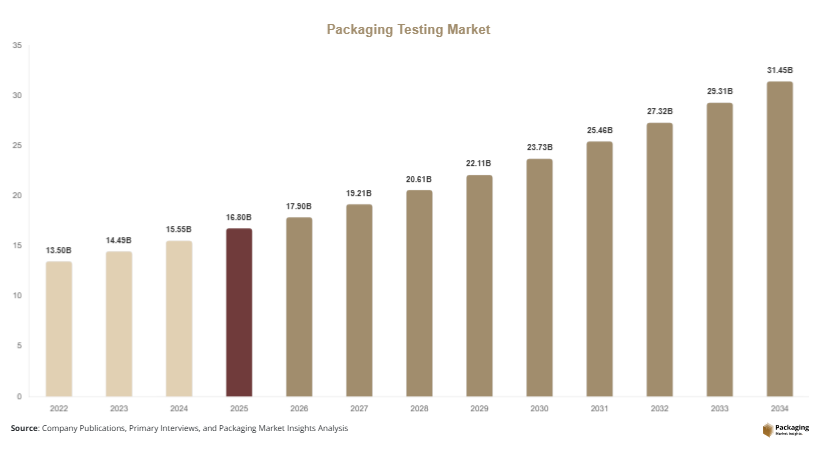
The global packaging testing market was valued at approximately USD 16.8 billion in 2025 and is projected to reach USD 17.9 billion in 2026. By 2034, the market is forecasted to reach nearly USD 31.6 billion, expanding at a CAGR of 7.3% during 2025–2034. Packaging testing services and equipment are widely used across industries including food & beverage, pharmaceuticals, cosmetics, consumer electronics, and industrial manufacturing to ensure product safety, durability, regulatory compliance, and transportation efficiency. The packaging testing market is experiencing sustained growth due to rising quality assurance requirements, increasing demand for sustainable packaging solutions, and the expansion of international trade involving packaged goods.
One of the major growth factors driving the packaging testing market is the increasing complexity of global supply chains. Products are now transported across longer distances and through varying environmental conditions, increasing the need for packaging validation and durability testing. Another important growth factor is the growing adoption of sustainable packaging materials. Manufacturers are increasingly using recyclable paper-based materials, biodegradable plastics, and lightweight packaging structures that require extensive performance testing before commercial deployment. Additionally, strict regulatory standards regarding food safety, pharmaceutical packaging integrity, and hazardous material transportation are encouraging businesses to invest in advanced packaging testing solutions.
Key Highlights
- Asia Pacific dominated the market with a 36.8% share in 2025.
- Latin America is projected to grow at the fastest CAGR of 7.8%.
- Physical testing led the type segment with a 41.2% share.
- Plastic packaging materials dominated with a 48.7% share.
- Food & beverage applications led the end-use segment with 39.4% share.
- The US remained the dominant country with a market size of USD 4.8 billion in 2025 and USD 5.1 billion in 2026.
Explore more data points, trends and opportunities Download Free Sample Report
Market Trends
Growing Adoption of Sustainable Packaging Validation Services
The increasing shift toward sustainable packaging is significantly influencing the packaging testing market. Manufacturers are introducing recyclable, compostable, and lightweight packaging materials to reduce environmental impact and comply with sustainability regulations. However, these alternative materials often require additional durability and safety testing to ensure they can withstand transportation and storage conditions. Packaging testing companies are increasingly providing validation services for biodegradable films, molded fiber packaging, and recycled-content plastics. For example, food manufacturers are conducting moisture resistance and compression testing for paper-based packaging replacing plastic containers. This trend is expected to create long-term demand for advanced material testing solutions as businesses continue transitioning toward sustainable packaging formats across retail and industrial applications.
Integration of Automation and Digital Simulation Technologies
Automation and digital testing technologies are becoming increasingly important across the packaging testing market. Laboratories and testing facilities are adopting automated drop testing systems, robotic compression testing equipment, and AI-enabled simulation software to improve testing efficiency and reduce operational errors. Digital twin technologies are also being used to simulate transportation and environmental conditions before physical testing begins. For instance, e-commerce packaging developers are utilizing software-based transit simulations to optimize packaging structures for long-distance shipping. This trend is expected to improve testing speed, reduce development costs, and support faster commercialization of new packaging solutions. Over the forecast period, smart testing platforms integrated with cloud-based analytics are likely to gain broader adoption across global packaging industries.
Market Drivers
Increasing Regulatory Requirements for Packaging Safety and Compliance
The implementation of strict packaging regulations across industries is one of the key drivers supporting the packaging testing market. Regulatory authorities require manufacturers to verify packaging integrity, chemical safety, contamination resistance, and transportation durability before products enter commercial markets. Food and pharmaceutical companies, in particular, must comply with stringent standards related to packaging migration, sterility, and child safety. As a result, businesses are increasingly investing in certified testing services to ensure compliance and avoid product recalls. For example, pharmaceutical companies are conducting seal integrity and environmental testing for temperature-sensitive medicines distributed through global supply chains. These regulatory pressures are expected to continue driving demand for advanced packaging validation solutions over the forecast period.
Rapid Expansion of E-commerce and Global Product Distribution
The rapid growth of e-commerce and cross-border trade is significantly increasing demand for packaging testing services. Products shipped through online retail channels are exposed to multiple handling stages, vibration conditions, and transportation environments before reaching consumers. Companies are therefore investing in packaging performance testing to minimize transit damage and reduce return rates. Major e-commerce retailers require suppliers to comply with standardized transit testing protocols before products can be distributed through fulfillment networks. Consumer electronics brands, for instance, conduct vibration and drop testing for packaging used in smartphone and laptop shipments. As global shipping activity continues expanding, demand for transit-tested and impact-resistant packaging solutions is expected to increase steadily.
Market Restraint
High Testing Costs and Infrastructure Requirements
One of the major restraints affecting the packaging testing market is the high cost associated with advanced testing infrastructure and certification procedures. Packaging testing laboratories require specialized equipment such as vibration simulators, environmental chambers, compression analyzers, and automated testing systems, which involve significant capital investment. Small and medium-sized manufacturers may find it difficult to afford comprehensive testing programs, especially when launching new sustainable packaging materials that require multiple validation stages. In addition, compliance testing for pharmaceutical and food packaging often involves recurring certification expenses and long approval timelines. For example, small packaging producers in developing economies may rely on limited in-house testing capabilities instead of third-party laboratories due to budget constraints. These financial challenges can limit testing adoption among smaller businesses and slow market expansion in cost-sensitive regions.
Market Opportunities
Expansion of Sustainable Packaging Materials Testing
The growing use of sustainable packaging materials is creating major opportunities for packaging testing service providers. Recyclable plastics, paper-based structures, compostable polymers, and plant-derived packaging materials require extensive performance validation to ensure commercial reliability. Testing companies are increasingly offering customized services for moisture resistance, biodegradability, and transportation durability assessment. Food and beverage companies transitioning toward fiber-based packaging are conducting advanced compression and shelf-life testing to maintain product safety and freshness. Future opportunities are expected to emerge from carbon footprint analysis and lifecycle testing services supporting sustainability-focused packaging strategies. As environmental regulations become stricter globally, demand for sustainable packaging testing solutions is likely to increase significantly.
Growth of Smart and Connected Packaging Applications
The expansion of smart packaging technologies is creating additional growth opportunities within the packaging testing market. Packaging solutions incorporating RFID tags, QR codes, temperature indicators, and freshness sensors require specialized testing to ensure electronic functionality and environmental stability. Pharmaceutical and healthcare companies are increasingly adopting connected packaging systems for temperature-sensitive medicines and supply chain monitoring applications. Testing laboratories are therefore expanding capabilities related to sensor validation, electromagnetic compatibility testing, and digital packaging performance analysis. Future growth is expected to be driven by intelligent packaging applications in food safety monitoring, anti-counterfeiting systems, and automated logistics operations. As connected packaging technologies become more common, advanced testing services will play a critical role in supporting commercialization and regulatory approval processes.
Report Scope
| Report Metric | Details |
|---|---|
| Market Size in 2025 | USD 16.8 Billion |
| Market Size in 2026 | USD 17.9 Billion |
| Market Size in 2034 | USD 31.6 Billion |
| CAGR | 7.3% (2026-2034) |
| Base Year for Estimation | 2025 |
| Historical Data | 2022-2024 |
| Forecast Period | 2026-2034 |
| Report Coverage | Revenue Forecast, Competitive Landscape, Supply Chain Disruption, Growth Factors, Environment & Regulatory Landscape and Trends |
| Geographies Covered | North America, Europe, APAC, Middle East and Africa, LATAM |
| Countries Covered | U.S., Canada, U.K., Germany, France, Spain, Italy, Russia, Nordic, Benelux, Rest of Europe, China, South Korea, Japan, India, Australia, Singapore, Taiwan, South East Asia, Rest of Asia-Pacific, UAE, Turky, Saudi Arabia, South Africa, Egypt, Nigeria, Rest of MEA, Brazil, Mexico, Argentina, Chile, Colombia, Rest of LATAM |
Explore more data points, trends and opportunities Download Free Sample Report
Segmental Analysis
By Type
Physical testing dominated the packaging testing market in 2024, accounting for approximately 41.2% of the total market share. This segment includes drop testing, compression testing, vibration testing, and impact resistance analysis used to evaluate packaging durability during transportation and storage. Manufacturers across food, electronics, and industrial sectors rely heavily on physical testing to minimize product damage and reduce logistics-related losses. E-commerce companies, in particular, are conducting extensive transit simulations to ensure packaging can withstand automated warehouse handling and long-distance shipping conditions. Physical testing also remains essential for export packaging validation because international transportation often exposes products to varying climatic and mechanical stresses. Increasing demand for lightweight packaging materials is further strengthening the need for advanced structural integrity testing across multiple industries.
Environmental testing is projected to be the fastest-growing subsegment, expanding at a CAGR of 8.1% during the forecast period. This testing category evaluates packaging performance under extreme temperature, humidity, pressure, and climatic conditions. Pharmaceutical companies are increasingly using environmental simulation testing for temperature-sensitive medicines and biologics distributed through cold chain logistics networks. Food manufacturers are also investing in shelf-life and moisture resistance testing for sustainable packaging materials replacing conventional plastics. Future growth is expected to be supported by increasing global trade activities and the rising adoption of smart environmental monitoring systems within packaging laboratories. As sustainable packaging innovations continue entering the market, environmental testing demand is likely to increase significantly.
By Material
Plastic packaging materials held the dominant market share of 48.7% in 2024 due to their widespread use across food, beverage, pharmaceutical, and consumer goods industries. Plastic packaging requires extensive testing for tensile strength, chemical migration, impact resistance, and environmental durability to ensure regulatory compliance and product protection. Flexible plastic packaging used in snack foods, beverages, and medical products undergoes multiple quality assurance procedures before commercialization. In addition, manufacturers are increasingly testing recycled plastic materials and lightweight plastic structures to improve sustainability while maintaining performance standards. The continued use of multilayer plastic films and flexible packaging solutions in high-volume consumer industries remains a major factor supporting segment dominance within the packaging testing industry.
Paper & paperboard materials are expected to be the fastest-growing segment, registering a CAGR of 7.9% during the forecast period. Growing sustainability initiatives and restrictions on single-use plastics are encouraging manufacturers to adopt recyclable fiber-based packaging alternatives. However, paper packaging often requires advanced compression, moisture resistance, and durability testing to ensure commercial viability. E-commerce retailers are increasingly using corrugated paper-based packaging systems that require drop and vibration testing for transportation applications. Future growth opportunities are expected to emerge from molded fiber packaging, compostable cartons, and high-strength paper structures designed for industrial and food packaging applications. These developments are likely to drive substantial demand for specialized paper packaging testing services.
By End-Use
Food & beverage dominated the end-use segment in 2024, accounting for approximately 39.4% of the global packaging testing market share. Food packaging requires extensive testing to ensure contamination prevention, shelf-life stability, sealing performance, and transportation durability. Beverage companies conduct pressure and leakage testing for bottles, cans, and flexible pouches to maintain product integrity during storage and distribution. Additionally, growing consumer demand for convenience foods and ready-to-eat meals is increasing the use of flexible and sustainable packaging formats requiring advanced validation procedures. Regulatory standards related to food-contact materials are also encouraging companies to invest in migration testing and chemical safety analysis. These factors continue supporting strong demand for packaging testing services within the food industry.
Pharmaceutical packaging is expected to be the fastest-growing end-use segment, expanding at a CAGR of 8.2% through 2034. Increasing production of biologics, vaccines, and temperature-sensitive medicines is driving demand for specialized packaging validation services. Pharmaceutical companies require comprehensive testing for sterile barriers, child-resistant closures, tamper evidence, and environmental resistance. Several healthcare manufacturers are also adopting smart packaging systems with temperature indicators and tracking technologies that require advanced performance analysis. Future market growth is expected to be supported by expanding cold chain logistics networks and rising investments in biologics manufacturing across Asia Pacific and North America. The growing complexity of pharmaceutical packaging regulations is likely to further strengthen demand for testing services globally.
Packaging Testing Market Segmentations
By Type
- Physical Testing
- Environmental Testing
- Chemical Testing
- Microbiological Testing
- Barrier Property Testing
By Material
- Plastic Packaging
- Paper & Paperboard Packaging
- Glass Packaging
- Metal Packaging
By End-User
- Food & Beverage
- Pharmaceuticals
- Consumer Electronics
- Cosmetics & Personal Care
- Industrial Goods
Regional Analysis
North America
North America accounted for approximately 29.8% of the global packaging testing market share in 2025 and is projected to expand at a CAGR of 6.6% during the forecast period. The region benefits from advanced manufacturing industries, strong regulatory oversight, and widespread adoption of automated packaging technologies. Food, pharmaceutical, and consumer electronics companies in the United States and Canada are increasingly investing in packaging durability and compliance testing to reduce transportation damage and improve product safety. The expansion of e-commerce logistics networks is also contributing to market demand, particularly for transit simulation and environmental testing services. Growing investment in sustainable packaging innovation continues supporting demand for material validation and recyclability testing solutions across the region.
The United States dominates the North American market due to its extensive pharmaceutical, food processing, and retail industries. One unique growth driver is the rising adoption of Amazon ISTA-certified transit testing programs among packaging suppliers and e-commerce manufacturers. Major fulfillment networks are requiring suppliers to conduct standardized drop, vibration, and compression testing before products are approved for distribution. Additionally, increasing investment in connected packaging technologies for healthcare and cold chain logistics is creating demand for advanced sensor and environmental testing capabilities. These developments are expected to strengthen the long-term outlook for the U.S. packaging testing industry.
Europe
Europe represented nearly 25.7% of the global packaging testing market share in 2025 and is expected to grow at a CAGR of 6.4% through 2034. The region is strongly influenced by sustainability regulations, packaging waste reduction targets, and strict food safety standards. Packaging manufacturers across Germany, France, and the United Kingdom are conducting advanced testing for recyclable materials and lightweight packaging structures. Rising exports of pharmaceuticals, processed foods, and industrial products are also increasing demand for transportation and environmental testing services. Additionally, several European countries are implementing circular economy initiatives encouraging the adoption of reusable packaging systems requiring repeated performance validation.
Germany remains the dominant country within the European market due to its strong industrial manufacturing and export sectors. A key growth factor is the increasing demand for packaging validation in automotive component and industrial machinery exports. German manufacturers are investing in vibration and climatic testing solutions to ensure packaging durability during long-distance transportation. Several packaging laboratories are also expanding capabilities related to recyclable material analysis and chemical migration testing for food-contact packaging applications. The growth of sustainable packaging innovation hubs across Germany is expected to further strengthen demand for specialized packaging testing services.
Asia Pacific
Asia Pacific held the largest market share of 36.8% in 2025 and is projected to register a CAGR of 8.0% during the forecast period. Rapid industrialization, export growth, and increasing manufacturing activities are driving strong demand for packaging testing services across the region. Countries including China, India, Japan, and South Korea are witnessing increasing adoption of packaging quality assurance systems in food processing, pharmaceuticals, and consumer electronics industries. The expansion of e-commerce platforms and cross-border shipping operations is also increasing demand for transit-tested packaging solutions. Furthermore, governments in several Asian countries are strengthening packaging safety regulations to improve export competitiveness and consumer protection standards.
China dominates the Asia Pacific market due to its extensive manufacturing base and rapidly expanding export sector. One unique growth driver is the increasing production of consumer electronics requiring impact-resistant packaging validation for international shipments. Chinese manufacturers are investing heavily in automated testing laboratories equipped with vibration simulators, climatic chambers, and compression analyzers to meet global packaging standards. The growing use of recyclable packaging materials among domestic e-commerce companies is also contributing to demand for sustainable packaging testing services. These trends are expected to support continued market expansion across China during the forecast period.
Middle East & Africa
The Middle East & Africa accounted for approximately 3.9% of the global packaging testing market share in 2025 and is expected to grow at a CAGR of 6.8% through 2034. Increasing food imports, healthcare investments, and industrial packaging demand are supporting regional market growth. Countries in the Gulf Cooperation Council are expanding logistics infrastructure and implementing stricter food packaging safety regulations to strengthen import quality standards. Packaging testing services are increasingly used for shelf-life analysis, environmental testing, and transportation validation across food and pharmaceutical sectors. Additionally, the expansion of organized retail and e-commerce activities is increasing the need for reliable packaging quality assurance systems throughout the region.
The United Arab Emirates remains the leading market in the region due to its role as a major logistics and re-export hub. One distinctive growth driver is the increasing demand for packaging validation services supporting imported food and luxury consumer products. Several UAE-based laboratories are investing in environmental simulation equipment to test packaging performance under high-temperature storage and transportation conditions common across the Middle East. Rising pharmaceutical imports and cold chain distribution activities are also contributing to stronger demand for advanced packaging integrity testing solutions across the country.
Latin America
Latin America represented around 3.8% of the global packaging testing market share in 2025 and is anticipated to register the fastest CAGR of 7.8% during the forecast period. Rising food exports, increasing pharmaceutical manufacturing, and expanding e-commerce activities are supporting regional market growth. Countries such as Brazil, Mexico, and Argentina are investing in packaging quality infrastructure to improve export competitiveness and comply with international trade standards. The growing use of flexible packaging and sustainable packaging materials is also increasing demand for material validation and transportation testing services. Additionally, retail modernization and online grocery delivery services are creating new opportunities for transit packaging analysis.
Brazil dominates the Latin American market due to its large food processing and consumer goods industries. A unique growth factor is the increasing export of processed agricultural products requiring advanced shelf-life and contamination testing for packaging systems. Brazilian packaging manufacturers are investing in moisture resistance and compression testing technologies to improve product stability during long-distance exports. Several multinational food companies operating in Brazil are also conducting sustainable packaging trials involving recyclable and paper-based materials. These developments are expected to strengthen regional demand for advanced packaging testing services over the coming years.
Competitive Landscape
The packaging testing market is moderately consolidated, with major players focusing on laboratory expansion, digital testing technologies, and sustainability-focused validation services. SGS SA remains one of the leading companies in the market due to its broad global testing network, regulatory expertise, and advanced packaging analysis capabilities. The company recently expanded its sustainable packaging testing services for recyclable and biodegradable materials used in consumer goods and food packaging applications.
Other major companies include Bureau Veritas, Intertek Group plc, Eurofins Scientific, and TÜV SÜD. These organizations are investing in automated testing laboratories, AI-enabled simulation technologies, and environmental testing infrastructure to improve testing accuracy and operational efficiency. Strategic partnerships with packaging manufacturers and e-commerce retailers are becoming increasingly common. Several companies are also expanding regional laboratories across Asia Pacific and Latin America to meet rising export-related testing demand. Increasing emphasis on sustainable packaging compliance and connected packaging technologies is expected to intensify competition among market participants during the forecast period.
Key Players List
- SGS SA
- Bureau Veritas
- Intertek Group plc
- Eurofins Scientific
- TÜV SÜD
- UL Solutions
- Smithers
- DDL Inc.
- ALS Limited
- Westpak Inc.
- Mérieux NutriSciences
- NSF International
- Labthink Instruments Co., Ltd.
- Qualitest International Inc.
- Pacific Testing Laboratories