Packaging Robots Market Size and Growth
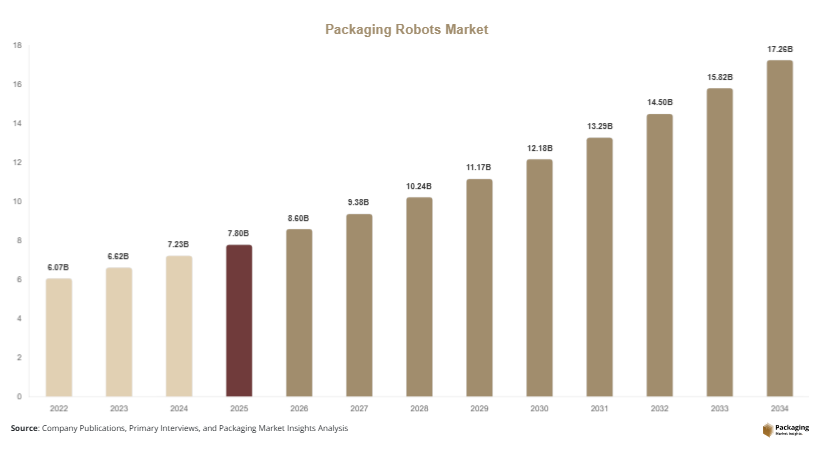
The global packaging robots market size is estimated at approximately USD 7.8 billion in 2025, and it is projected to reach USD 8.6 billion in 2026. The market is expected to expand significantly over the next decade, reaching USD 18.9 billion by 2034, registering a compound annual growth rate (CAGR) of 9.1% between 2025 and 2034. This growth reflects rising demand for automated packaging solutions across food and beverage, pharmaceuticals, e-commerce, consumer goods, and logistics industries.
The packaging robots market is experiencing steady growth as manufacturing industries increasingly adopt automation to improve packaging efficiency, reduce operational costs, and maintain product consistency. Packaging robots are widely used for tasks such as palletizing, pick-and-place, case packing, labeling, and product sorting. These robotic systems help manufacturers streamline operations and handle high production volumes while maintaining accuracy and speed.
Key Highlights
- Market size estimated at USD 7.8 billion in 2025
- Expected to reach USD 18.9 billion by 2034
- CAGR of 9.1% (2025–2034)
- Strong adoption in food & beverage and e-commerce sectors
- Increasing demand for automation and smart packaging solutions
Explore more data points, trends and opportunities Download Free Sample Report
Market Trends
Integration of Artificial Intelligence and Vision Systems
A major trend shaping the packaging robots market is the integration of artificial intelligence and advanced machine vision technologies. Modern packaging robots are increasingly equipped with AI-based systems that enable real-time decision making, product identification, and adaptive handling. Vision-guided robots can detect product orientation, identify defects, and adjust packaging operations accordingly. This capability significantly improves packaging accuracy and reduces material waste.
Manufacturers are implementing intelligent robotic systems that learn from production data and optimize packaging processes over time. These systems can adapt to different packaging formats without requiring extensive reprogramming. AI-powered robots are particularly valuable in industries such as food processing and pharmaceuticals where product variety and strict quality standards require flexible automation solutions.
Adoption of Collaborative Packaging Robots
Collaborative robots, commonly known as cobots, are gaining traction in packaging operations. Unlike traditional industrial robots, cobots are designed to work safely alongside human operators without the need for extensive safety barriers. This flexibility makes them suitable for small and medium manufacturing facilities that require automation but have limited floor space.
Cobots are increasingly used for tasks such as product sorting, labeling, and lightweight packaging operations. Their ease of programming and quick deployment make them attractive for manufacturers that frequently change product lines. As a result, collaborative robotics is emerging as an important trend influencing the future development of the packaging robots market, especially in sectors that require adaptable production processes.
Market Drivers
Growing Demand for Automation in Manufacturing
The rising demand for automation in manufacturing facilities is a primary driver of the packaging robots market. Industries are focusing on improving operational efficiency and reducing production costs through advanced automation technologies. Packaging robots help streamline repetitive tasks such as palletizing, case packing, and product handling. These robots can operate continuously without fatigue, allowing companies to maintain high productivity levels.
Automation also improves quality control during packaging processes. Robots can perform precise movements and maintain consistent packaging standards across thousands of units. This consistency is especially important for industries such as pharmaceuticals and consumer goods where packaging accuracy directly affects product safety and brand reputation.
Expansion of E-Commerce and Logistics Industries
The rapid expansion of e-commerce platforms is significantly contributing to the growth of the packaging robots market. Online retailers require highly efficient packaging and order fulfillment systems to process large volumes of shipments within short timeframes. Packaging robots enable automated sorting, packing, and palletizing, allowing warehouses to handle increasing order volumes efficiently.
Logistics companies are also adopting robotic packaging systems to improve warehouse operations and reduce shipping delays. Robots integrated with warehouse management software can identify products, select appropriate packaging materials, and prepare shipments for distribution. As global e-commerce sales continue to rise, demand for automated packaging solutions is expected to increase further.
Market Restraint
High Initial Investment and Integration Costs
Despite strong growth potential, the packaging robots market faces challenges related to high initial investment costs. Implementing robotic packaging systems requires substantial capital expenditure for equipment purchase, installation, and system integration. Small and medium-sized manufacturers may find it difficult to justify these costs, particularly when existing manual processes are still operational.
The integration of packaging robots with existing production lines also requires technical expertise and infrastructure upgrades. Companies may need to redesign factory layouts, implement advanced control systems, and train employees to operate robotic equipment. These additional costs can delay automation adoption in certain industries.
Furthermore, maintenance and system upgrades can add to the overall operational expenses of robotic systems. While robots reduce labor costs over time, the initial investment remains a major barrier for organizations with limited budgets. For example, smaller food processing companies often rely on semi-automated packaging equipment because fully robotic systems require higher upfront spending.
As a result, cost concerns continue to influence the adoption rate of packaging robots, particularly in developing economies where capital availability is limited.
Market Opportunities
Expansion of Smart Factories
The development of smart factories presents a significant opportunity for the packaging robots market. Industry 4.0 technologies are transforming manufacturing environments through connected machines, real-time data monitoring, and automated production systems. Packaging robots integrated with sensors and cloud-based analytics can provide valuable insights into production performance.
Smart robotic packaging systems can monitor packaging speed, detect equipment issues, and optimize workflow automatically. This level of automation improves productivity and reduces downtime. As manufacturers increasingly implement smart factory solutions, the demand for intelligent packaging robots is expected to expand.
Rising Demand in Emerging Economies
Emerging economies in Asia, Latin America, and the Middle East are creating new growth opportunities for the packaging robots market. Rapid industrialization and expansion of consumer goods industries are driving the need for efficient packaging operations. Many companies in these regions are upgrading their manufacturing facilities to meet global production standards.
Additionally, governments in emerging markets are encouraging the adoption of automation technologies to improve manufacturing competitiveness. Investment incentives, industrial modernization programs, and growing export industries are supporting the demand for robotic packaging systems. As manufacturing infrastructure continues to develop in these regions, the market for packaging robots is expected to grow steadily.
Report Scope
| Report Metric | Details |
|---|---|
| Market Size in 2025 | USD 7.8 Billion |
| Market Size in 2026 | USD 8.6 Billion |
| Market Size in 2034 | USD 18.9 Billion |
| CAGR | 9.1% (2026-2034) |
| Base Year for Estimation | 2025 |
| Historical Data | 2022-2024 |
| Forecast Period | 2026-2034 |
| Report Coverage | Revenue Forecast, Competitive Landscape, Supply Chain Disruption, Growth Factors, Environment & Regulatory Landscape and Trends |
| Geographies Covered | North America, Europe, APAC, Middle East and Africa, LATAM |
| Countries Covered | U.S., Canada, U.K., Germany, France, Spain, Italy, Russia, Nordic, Benelux, Rest of Europe, China, South Korea, Japan, India, Australia, Singapore, Taiwan, South East Asia, Rest of Asia-Pacific, UAE, Turky, Saudi Arabia, South Africa, Egypt, Nigeria, Rest of MEA, Brazil, Mexico, Argentina, Chile, Colombia, Rest of LATAM |
Explore more data points, trends and opportunities Download Free Sample Report
Segmental Analysis
By Type
Articulated robots dominated the packaging robots market in 2024, accounting for approximately 38% of the total market share. These robots are widely used in packaging applications because of their flexibility and wide range of motion. Articulated robots can perform complex tasks such as palletizing, product sorting, and case packing with high precision. Their ability to handle heavy loads and operate in high-speed production environments makes them particularly suitable for industries such as food processing, consumer goods, and logistics. Manufacturers also prefer articulated robots because they can be integrated easily into existing production lines.
Delta robots are expected to be the fastest-growing subsegment, projected to expand at a CAGR of about 12.4% during the forecast period. These robots are known for their high-speed pick-and-place capabilities and lightweight design. Delta robots are widely used in industries that require rapid packaging of small items, including pharmaceuticals and packaged food products. Their ability to perform precise movements at high speeds improves packaging efficiency and reduces production bottlenecks. Increasing demand for high-speed packaging solutions in the food and beverage sector is driving the adoption of delta robots.
By Application
Palletizing and depalletizing represented the dominant application segment in the packaging robots market, accounting for nearly 41% of the market share in 2024. These processes involve stacking products onto pallets for storage or transportation. Robotic palletizing systems can handle heavy loads and perform repetitive stacking tasks efficiently. Manufacturers rely on these systems to improve packaging consistency and reduce the physical strain associated with manual palletizing. The ability of robots to operate continuously also helps manufacturers meet high production demands in industries such as beverages, consumer goods, and industrial products.
Pick-and-place applications are expected to witness the fastest growth with a CAGR of around 11.8% during the forecast period. These robots are designed to quickly move products from one location to another within packaging lines. Pick-and-place robots are particularly useful for handling fragile or irregularly shaped items. The increasing demand for flexible packaging solutions and high-speed sorting systems is driving the growth of this segment. Industries such as electronics, pharmaceuticals, and packaged foods are adopting pick-and-place robots to improve operational efficiency.
By End-Use Industry
The food and beverage industry dominated the packaging robots market in 2024, accounting for approximately 36% of total market share. The industry relies heavily on automated packaging systems to maintain product safety, improve efficiency, and meet large-scale production requirements. Packaging robots are widely used for palletizing beverage bottles, packaging snack products, and handling packaged foods. Automation helps food manufacturers maintain hygiene standards while reducing contamination risks during packaging operations.
The pharmaceutical industry is projected to be the fastest-growing end-use segment, expanding at a CAGR of about 11.2% through 2034. Pharmaceutical companies require highly precise packaging systems to ensure accurate labeling and secure product handling. Robots equipped with vision systems can verify packaging details and ensure compliance with strict regulatory requirements. Increasing global demand for medicines and healthcare products is encouraging pharmaceutical manufacturers to adopt advanced robotic packaging solutions.
Packaging Robots Market Segmentations
Type
- Articulated Robots
- Delta Robots
- Cartesian Robots
- SCARA Robots
- Collaborative Robots
Application
- Palletizing & Depalletizing
- Pick-and-Place
- Case Packing
- Labeling
- Product Sorting
End-Use Industry
- Food & Beverage
- Pharmaceuticals
- Consumer Goods
- Electronics
- Logistics & Warehousing
Regional Analysis
North America
North America accounted for approximately 32% of the global packaging robots market share in 2025. The region is expected to grow at a CAGR of around 8.4% during the forecast period. The presence of advanced manufacturing infrastructure and strong adoption of industrial automation technologies contributes to regional market growth. Food processing companies and logistics providers are increasingly implementing robotic packaging systems to improve efficiency and reduce operational costs.
The United States dominates the North American market due to its strong manufacturing sector and high investment in robotics technology. One unique growth factor in the country is the rapid expansion of automated fulfillment centers used by e-commerce companies. These facilities rely heavily on robotic packaging systems to manage high order volumes and improve delivery speed.
Europe
Europe held nearly 27% of the packaging robots market share in 2025, supported by widespread automation in manufacturing industries. The region is expected to record a CAGR of approximately 8.2% through 2034. Industries such as food processing, pharmaceuticals, and consumer goods are adopting robotic packaging systems to maintain high production standards and comply with strict regulatory requirements.
Germany is the dominant country in the European market. The country’s strong industrial automation ecosystem and advanced engineering capabilities support the adoption of packaging robots. A unique growth factor in Germany is the integration of robotics within highly automated production facilities that focus on precision manufacturing and export-oriented production.
Asia Pacific
Asia Pacific represents one of the fastest-growing regions in the packaging robots market, accounting for approximately 25% of global share in 2025. The region is projected to expand at a CAGR of nearly 11.5% during the forecast period. Rapid industrialization, increasing manufacturing output, and rising demand for packaged consumer goods are major factors driving market growth.
China leads the regional market due to its extensive manufacturing base and strong government support for automation technologies. A key growth factor in China is the increasing deployment of robotics in large-scale manufacturing facilities to enhance productivity and reduce labor dependency.
Middle East & Africa
The Middle East & Africa region accounted for around 9% of the global packaging robots market share in 2025. The market is expected to grow at a CAGR of about 9.3% through 2034. Industrial diversification and investment in manufacturing infrastructure are supporting the adoption of automated packaging solutions.
The United Arab Emirates plays a significant role in the regional market. A unique growth factor in the country is the rapid expansion of logistics hubs and distribution centers that require efficient packaging and shipment handling systems.
Latin America
Latin America captured approximately 7% of the packaging robots market share in 2025. The region is expected to grow at a CAGR of around 8.7% during the forecast period. Growth is supported by increasing investments in manufacturing automation and expanding food processing industries.
Brazil dominates the regional market due to its large food and beverage manufacturing sector. A unique growth factor in the country is the rising adoption of robotic palletizing systems in large-scale food processing facilities to improve packaging speed and reduce manual handling.
Competitive Landscape
The packaging robots market is moderately consolidated with several global robotics manufacturers competing through technological innovation, product development, and strategic partnerships. Companies are focusing on developing advanced robotic systems equipped with artificial intelligence, machine vision, and smart sensors to improve packaging efficiency.
One of the leading companies in the market is ABB Ltd., which offers a wide range of packaging robots designed for palletizing, pick-and-place, and case packing operations. The company continues to expand its robotics portfolio by integrating digital automation technologies into its robotic systems.
Other major players include FANUC Corporation, KUKA AG, Yaskawa Electric Corporation, and Universal Robots. These companies are investing in research and development to enhance robotic flexibility and speed. Many manufacturers are also forming partnerships with logistics companies and packaging solution providers to expand their market presence.
Key Players List
- ABB Ltd.
- FANUC Corporation
- KUKA AG
- Yaskawa Electric Corporation
- Universal Robots
- Mitsubishi Electric Corporation
- Kawasaki Heavy Industries
- Omron Corporation
- Epson Robots
- Staubli International AG
- Denso Corporation
- Bosch Rexroth AG
- Rockwell Automation
- Schneider Electric
- Toshiba Machine Co., Ltd.