Packaging Resin Market Size and Growth
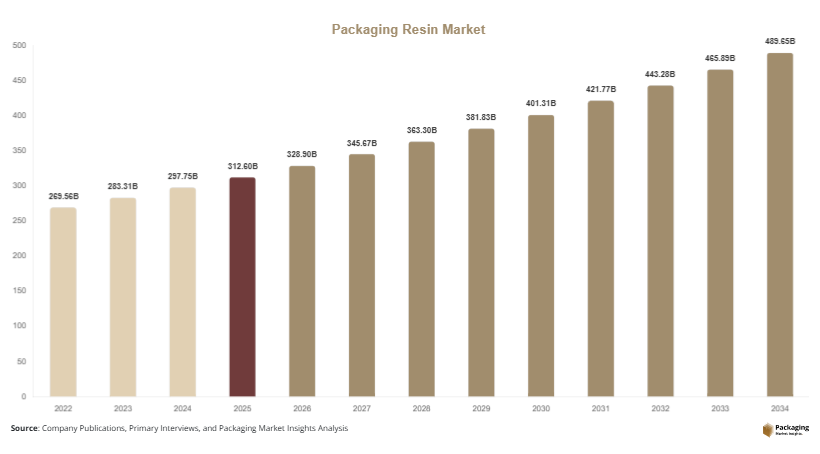
In 2025, the global packaging resin market size is estimated at USD 312.6 billion and is projected to reach USD 328.9 billion in 2026. The market is expected to grow to approximately USD 489.7 billion by 2034, expanding at a CAGR of 5.1% during the forecast period from 2025 to 2034. The increasing consumption of packaged food, beverages, pharmaceuticals, and personal care products is supporting consistent demand for packaging resins globally. The packaging resin market is witnessing steady expansion driven by the growing demand for lightweight, durable, and cost-efficient packaging solutions across multiple industries.
One of the primary growth factors is the rapid expansion of the food and beverage industry, which relies heavily on flexible and rigid plastic packaging solutions made from polyethylene, polypropylene, and PET resins. Another significant factor is the rising demand for sustainable and recyclable packaging materials, which is encouraging manufacturers to develop bio-based and recycled resins. Additionally, the surge in e-commerce activities worldwide is increasing the need for protective packaging materials, further contributing to market growth.
Key Highlights
- Asia Pacific dominated the market with a 38.2% share in 2025, while Latin America is projected to grow at the fastest CAGR of 6.4%.
- Polyethylene led the type segment with a 34.7% share, while biodegradable resins are expected to grow at a CAGR of 6.8%.
- Flexible packaging dominated with a 55.6% share, while rigid packaging is forecasted to grow at a CAGR of 5.3%.
- Food & beverage applications led the segment with 46.2% share, while healthcare packaging is expected to grow at a CAGR of 6.1%.
- China remained the dominant country with a market size of USD 58.3 billion in 2025 and USD 61.2 billion in 2026.
Explore more data points, trends and opportunities Download Free Sample Report
Market Trends
Growing Adoption of Sustainable and Recyclable Resin Materials
The packaging resin market is experiencing a shift toward sustainable materials as environmental concerns continue to shape industry practices. Manufacturers are increasingly adopting recycled resins and bio-based alternatives to reduce reliance on fossil fuel-derived plastics. This trend is driven by stricter regulations on plastic waste and growing consumer awareness regarding eco-friendly packaging. Companies are investing in research and development to create resins that maintain performance while offering recyclability and biodegradability. Additionally, brands are incorporating post-consumer recycled content into packaging to meet sustainability goals and enhance brand value. The transition toward circular economy models is expected to play a crucial role in long-term market development.
Rising Demand for High-Performance Barrier Resins
Another key trend is the increasing demand for high-performance barrier resins that extend product shelf life and improve packaging efficiency. Advanced resin formulations such as multi-layer films and modified polymers are gaining traction across food, pharmaceutical, and industrial packaging applications. These materials provide superior resistance to moisture, oxygen, and contaminants, ensuring product integrity during storage and transportation. The growing need for extended shelf life in packaged food and ready-to-eat meals is further supporting this trend. Moreover, innovations in resin blending and coating technologies are enabling manufacturers to develop packaging solutions that combine strength, flexibility, and protection, making them suitable for diverse end-use applications.
Market Drivers
Expansion of Food and Beverage Industry
The rapid growth of the global food and beverage industry is a major driver for the packaging resin market. Increasing consumption of processed and packaged foods is creating consistent demand for flexible and rigid packaging solutions made from various resin types. Urbanization, changing dietary habits, and rising disposable income levels are contributing to the growth of packaged food consumption. Packaging resins play a vital role in maintaining product freshness, safety, and shelf life. Furthermore, innovations in packaging formats such as pouches, trays, and bottles are increasing the usage of advanced resins. This expansion is expected to continue as convenience foods gain popularity across emerging and developed economies.
Growth of E-commerce and Logistics Sector
The expansion of the e-commerce sector is significantly influencing the demand for packaging resins. Online retail requires durable and protective packaging to ensure safe product delivery across long distances. Packaging resins such as polyethylene and polypropylene are widely used in protective films, cushioning materials, and shipping containers. The rising number of online shoppers and increasing cross-border trade are driving the need for efficient packaging solutions. Additionally, the demand for lightweight packaging to reduce shipping costs is further encouraging the use of advanced resin materials. This trend is expected to sustain growth in the packaging resin market over the forecast period.
Market Restraint
Environmental Concerns and Regulatory Pressure
Environmental concerns related to plastic waste and stringent government regulations are posing challenges to the packaging resin market. Increasing awareness about the environmental impact of single-use plastics has led to stricter policies aimed at reducing plastic consumption and promoting recycling. Governments across various regions are implementing bans, taxes, and recycling mandates, which are affecting the demand for conventional resin-based packaging. For example, restrictions on single-use plastic bags and packaging materials in several countries are pushing manufacturers to rethink their product strategies. This has resulted in higher production costs due to the need for sustainable alternatives and compliance with environmental standards. Additionally, limited recycling infrastructure in certain regions further complicates waste management, impacting market growth.
Market Opportunities
Development of Bio-Based and Biodegradable Resins
The development of bio-based and biodegradable resins presents significant opportunities for market players. As sustainability becomes a priority, companies are focusing on producing resins derived from renewable sources such as corn starch, sugarcane, and other biomass materials. These resins offer reduced environmental impact and are gaining acceptance across industries. The increasing adoption of eco-friendly packaging by major brands is expected to drive demand for such materials. Furthermore, advancements in polymer science are improving the performance characteristics of biodegradable resins, making them suitable for a wider range of applications. This trend is likely to open new growth avenues in the coming years.
Increasing Demand from Healthcare and Pharmaceutical Packaging
The healthcare and pharmaceutical sectors are emerging as key growth areas for packaging resins. The need for sterile, safe, and durable packaging solutions is driving the demand for high-quality resin materials. Packaging resins are used in medical devices, drug containers, and protective packaging for pharmaceutical products. The rising global demand for healthcare products, especially after increased focus on public health systems, is supporting market expansion. Additionally, stringent regulations regarding product safety and hygiene are encouraging the use of advanced resin materials with superior barrier properties. This growing demand is expected to create new opportunities for manufacturers in the packaging resin market.
Report Scope
| Report Metric | Details |
|---|---|
| Market Size in 2025 | USD 312.6 Billion |
| Market Size in 2026 | USD 328.9 Billion |
| Market Size in 2034 | USD 489.7 Billion |
| CAGR | 5.1% (2026-2034) |
| Base Year for Estimation | 2025 |
| Historical Data | 2022-2024 |
| Forecast Period | 2026-2034 |
| Report Coverage | Revenue Forecast, Competitive Landscape, Supply Chain Disruption, Growth Factors, Environment & Regulatory Landscape and Trends |
| Geographies Covered | North America, Europe, APAC, Middle East and Africa, LATAM |
| Countries Covered | U.S., Canada, U.K., Germany, France, Spain, Italy, Russia, Nordic, Benelux, Rest of Europe, China, South Korea, Japan, India, Australia, Singapore, Taiwan, South East Asia, Rest of Asia-Pacific, UAE, Turky, Saudi Arabia, South Africa, Egypt, Nigeria, Rest of MEA, Brazil, Mexico, Argentina, Chile, Colombia, Rest of LATAM |
Explore more data points, trends and opportunities Download Free Sample Report
Segmental Analysis
By Type
Polyethylene emerged as the dominant subsegment in 2024, accounting for a 34.7% share of the packaging resin market. Its widespread use in flexible packaging applications such as films, bags, and pouches is driving its dominance. Polyethylene offers advantages such as durability, flexibility, and cost-effectiveness, making it suitable for a wide range of applications. Additionally, its compatibility with recycling processes is supporting its continued demand. The increasing consumption of packaged food and beverages is further contributing to the growth of this segment.
Biodegradable resins are expected to be the fastest-growing subsegment, with a projected CAGR of 6.8% during the forecast period. The rising focus on sustainability and environmental protection is driving demand for eco-friendly materials. Biodegradable resins are gaining traction in applications where single-use packaging is common. Advancements in material science are improving their performance, making them more competitive with traditional resins. This growth is supported by regulatory initiatives and increasing consumer awareness.
By Application
Flexible packaging dominated the application segment in 2024, holding a 55.6% market share. The demand for lightweight and cost-efficient packaging solutions is driving the adoption of flexible packaging formats. These materials offer advantages such as reduced material usage, improved shelf life, and convenience. The growing popularity of ready-to-eat meals and on-the-go consumption is further supporting this segment.
Rigid packaging is projected to grow at a CAGR of 5.3% during the forecast period. The demand for durable and protective packaging solutions in industries such as healthcare and personal care is driving this growth. Rigid packaging provides structural integrity and enhanced protection for sensitive products. Innovations in resin materials are improving the performance and sustainability of rigid packaging solutions.
By End-Use
The food and beverage industry dominated the end-use segment in 2024, accounting for a 46.2% market share. The increasing demand for packaged and processed food products is driving the need for advanced packaging materials. Packaging resins play a crucial role in maintaining product freshness and safety. The expansion of retail and distribution networks is further supporting the growth of this segment.
The healthcare sector is expected to grow at a CAGR of 6.1% during the forecast period. The demand for sterile and high-quality packaging solutions is driving the use of advanced resin materials. Packaging resins are widely used in medical devices and pharmaceutical products. The increasing focus on healthcare infrastructure and safety standards is supporting the growth of this segment.
Packaging Resin Market Segmentations
By Type
- Polyethylene
- Polypropylene
- Polyethylene Terephthalate
- Polystyrene
- Biodegradable Resins
By Application
- Flexible Packaging
- Rigid Packaging
- Protective Packaging
- Industrial Packaging
By End-User
- Food & Beverage
- Healthcare
- Personal Care
- Consumer Goods
- Industrial
Regional Analysis
North America
North America accounted for approximately 24.5% of the global packaging resin market share in 2025 and is projected to grow at a CAGR of 4.6% during the forecast period. The region benefits from a well-established packaging industry and high consumption of packaged goods. Strong demand from food, beverage, and healthcare sectors continues to support resin usage across various applications. Technological advancements in polymer processing and increasing focus on sustainable materials are also contributing to market growth.
The United States dominates the North American market due to its large consumer base and advanced manufacturing capabilities. One unique growth factor is the rapid adoption of recycled resins driven by regulatory initiatives and corporate sustainability commitments. Companies are investing in recycling infrastructure and developing innovative materials to meet environmental standards, which is influencing the regional market dynamics.
Europe
Europe held a market share of 21.8% in 2025 and is expected to grow at a CAGR of 4.4% during the forecast period. The region is characterized by stringent environmental regulations and strong emphasis on sustainability. The demand for eco-friendly packaging solutions is driving the adoption of recyclable and biodegradable resins. Additionally, the presence of established packaging companies supports steady market growth.
Germany is the dominant country in the European market, supported by its advanced industrial base and strong focus on innovation. A unique growth factor in this region is the implementation of circular economy policies, which encourage recycling and reuse of materials. This approach is driving investments in sustainable resin production and influencing market trends.
Asia Pacific
Asia Pacific dominated the packaging resin market with a 38.2% share in 2025 and is projected to grow at a CAGR of 5.9% through 2034. Rapid industrialization, urbanization, and population growth are major factors driving demand in the region. The increasing consumption of packaged food and beverages is significantly contributing to market expansion.
China is the leading country in the region, supported by its large manufacturing sector and high production capacity. A unique growth factor is the expansion of e-commerce platforms, which is driving demand for packaging materials. The growing middle-class population and changing consumer preferences are further supporting the market growth.
Middle East & Africa
The Middle East & Africa region accounted for 7.6% of the global market share in 2025 and is expected to grow at a CAGR of 5.0% during the forecast period. The region is witnessing increasing demand for packaging solutions due to rising industrial activities and growing consumer markets. Investments in infrastructure and manufacturing are also contributing to market growth.
Saudi Arabia is a key contributor to the regional market, driven by its expanding petrochemical industry. A unique growth factor is the availability of raw materials for resin production, which supports local manufacturing and reduces dependency on imports. This advantage is helping the region strengthen its position in the global market.
Latin America
Latin America held a market share of 7.9% in 2025 and is projected to grow at the fastest CAGR of 6.4% during the forecast period. The region is experiencing growth due to increasing demand for packaged goods and expanding retail sector. Rising disposable income and urbanization are further supporting market expansion.
Brazil is the dominant country in Latin America, driven by its large population and growing consumer base. A unique growth factor is the increasing adoption of flexible packaging solutions, which require advanced resin materials. This trend is expected to boost market growth in the region.
Competitive Landscape
The packaging resin market is characterized by intense competition among key players focusing on innovation, sustainability, and expansion strategies. Major companies are investing in research and development to enhance product performance and meet environmental standards. Strategic collaborations and mergers are common as companies aim to strengthen their market presence.
A leading player in the market is ExxonMobil Corporation, which continues to expand its product portfolio with advanced resin solutions. The company recently introduced new high-performance polyethylene grades designed for recyclable packaging applications. Other major players are focusing on developing bio-based resins and improving recycling technologies. The competitive landscape is expected to evolve as sustainability becomes a key differentiator.
Key Players List
- ExxonMobil Corporation
- Dow Inc.
- LyondellBasell Industries Holdings B.V.
- SABIC
- BASF SE
- INEOS Group
- Chevron Phillips Chemical Company
- Formosa Plastics Corporation
- TotalEnergies SE
- Braskem S.A.
- Reliance Industries Limited
- Mitsubishi Chemical Group Corporation
- Borealis AG
- Westlake Corporation
- LG Chem Ltd.