Packaging Printing Market Report Size and Growth
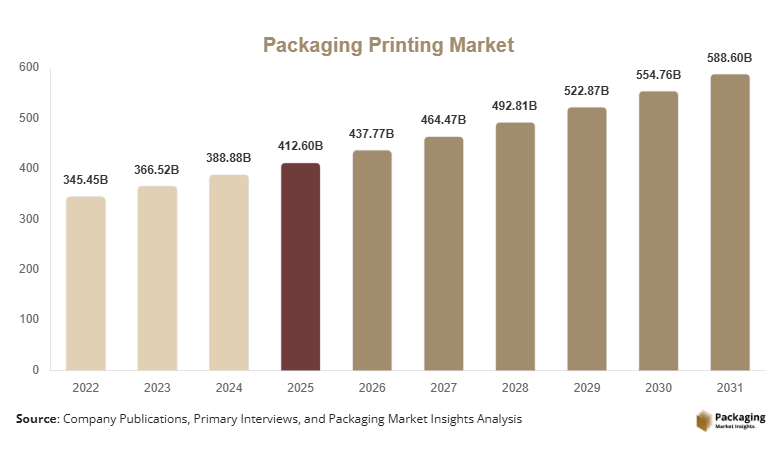
The Packaging Printing Market was valued at USD 412.6 billion in 2025 and is projected to reach USD 587.4 billion by 2030, expanding at a compound annual growth rate (CAGR) of 6.1% between 2025 and 2031. Packaging printing refers to the process of applying text, graphics, or designs to packaging materials such as paper, plastic, metal, and glass. The market plays a critical role in product identification, branding, regulatory compliance, and consumer engagement across multiple industries including food & beverages, pharmaceuticals, personal care, and consumer goods.
Growth in global retail consumption has supported the expansion of the Packaging Printing Market. Manufacturers are increasingly focusing on visually appealing packaging that enhances shelf presence and communicates product value to consumers. The rapid development of digital printing technologies has also improved production efficiency, enabling short-run printing and customized packaging designs. Additionally, advancements in eco-friendly inks and sustainable substrates have strengthened the industry’s outlook as companies aim to meet environmental standards while maintaining print quality and durability.
Brand owners are prioritizing packaging as a strategic marketing tool. High-resolution graphics, smart labels, and variable data printing are becoming common across industries. These innovations help companies improve product differentiation while meeting regulatory labeling requirements. As a result, packaging printing remains an essential component of modern packaging supply chains.
Key Highlights
- Asia Pacific accounted for the largest share of the Packaging Printing Market at 41.3% in 2025, while Latin America is expected to register the fastest growth with a CAGR of 7.4% through 2031.
- Within printing technologies, flexographic printing represented the leading segment with 38.6% share in 2024, while digital printing is projected to grow at the fastest CAGR of 8.3%.
- By material type, paper & paperboard packaging printing dominated with 44.2% share in 2024, while plastic-based packaging printing will expand at 7.1% CAGR.
- China, the dominant country in the Asia Pacific region, recorded USD 68.4 billion in 2024 and increased to USD 72.9 billion in 2025 in packaging printing revenue
Explore more data points, trends and opportunities Download Free Sample Report
Latest Market Trends
Expansion of Digital Printing in Packaging
Digital printing technologies are transforming the Packaging Printing Market by enabling flexible production processes and high-quality graphics. Traditional printing methods such as flexography and gravure require complex plate preparation, which increases setup time and cost. Digital printing eliminates these steps, allowing manufacturers to produce smaller batches with minimal waste. This capability supports the growing demand for customized packaging and limited-edition product releases.
Brands are increasingly using digital printing to create personalized packaging designs that improve consumer engagement. Variable data printing enables companies to include unique codes, messages, or graphics on each package. This approach supports promotional campaigns and product authentication strategies. As printing equipment becomes more cost-efficient, digital printing adoption across food, beverage, and cosmetics packaging is expanding.
Sustainable Printing Materials and Eco-Friendly Inks
Environmental sustainability has become a significant trend in the Packaging Printing Market. Packaging producers are shifting toward recyclable substrates and water-based inks to reduce environmental impact. Regulations in several regions encourage the use of eco-friendly materials that minimize chemical emissions and support recycling processes.
Printing technology providers are introducing biodegradable inks and energy-efficient printing systems that reduce production waste. Brand owners are responding to consumer demand for environmentally responsible packaging solutions by adopting these technologies. As sustainability continues to shape purchasing decisions, environmentally friendly packaging printing methods are expected to gain broader adoption across multiple industries.
Market Drivers
Rising Demand for Branded Consumer Packaging
Brand visibility remains a major driver for the Packaging Printing Market. Companies are increasingly investing in high-quality printed packaging to enhance product recognition and consumer trust. Printed packaging communicates essential information such as ingredients, safety instructions, and product benefits while reinforcing brand identity.
The competitive nature of retail markets encourages manufacturers to adopt advanced printing solutions that create distinctive designs. Eye-catching graphics and innovative label formats help products stand out on retail shelves. As brand owners continue to emphasize packaging as a marketing tool, demand for advanced packaging printing services continues to increase.
Growth of Organized Retail and Packaged Goods
The expansion of organized retail networks has contributed to the growth of the Packaging Printing Market. Supermarkets, convenience stores, and e-commerce platforms rely heavily on packaged products with clear labeling and visual appeal. Packaging printing ensures that products meet labeling standards while maintaining a consistent brand presentation.
Retailers require packaging designs that communicate product details quickly to consumers. This need drives demand for high-resolution printing technologies capable of producing detailed graphics and readable text. As global consumption of packaged goods rises, the need for efficient and scalable packaging printing solutions continues to grow.
Market Restraints
Volatility in Raw Material Prices
Fluctuations in the cost of raw materials represent a key restraint in the Packaging Printing Market. Printing operations depend on materials such as paperboard, plastic films, inks, and adhesives. Variations in commodity prices can affect production costs and profit margins for printing companies.
Price volatility is influenced by global supply chain disruptions, energy costs, and regulatory changes. When material prices increase, packaging printers may face challenges maintaining competitive pricing while ensuring consistent product quality. These cost pressures can slow investment in new equipment and limit operational expansion for smaller printing providers.
Market Opportunities
Smart Packaging and Interactive Printing
The integration of digital technologies into packaging is creating new opportunities in the Packaging Printing Market. Smart packaging solutions incorporate printed QR codes, NFC tags, and augmented reality markers that allow consumers to interact with products through smartphones.
Packaging printing companies are developing specialized techniques to produce these interactive elements at scale. Smart packaging enhances consumer engagement and supports product traceability throughout the supply chain. As companies adopt digital marketing strategies linked to packaging, demand for advanced printing capabilities will expand.
Expansion of Pharmaceutical Packaging
Pharmaceutical packaging represents an emerging opportunity for packaging printing providers. Regulatory requirements require accurate labeling, serialization, and tamper-evident packaging features. Printing technologies capable of producing precise text and security features are essential for pharmaceutical packaging compliance.
The pharmaceutical sector also requires specialized inks and materials that maintain print clarity under various storage conditions. As global pharmaceutical production increases, the demand for reliable packaging printing solutions in this sector will continue to grow.
Report Scope
| Report Metric | Details |
|---|---|
| Market Size in 2025 | USD 412.6 Billion |
| Market Size in 2026 | USD 437.77 Billion |
| Market Size in 2031 | USD 588.60 Billion |
| CAGR | 6.1% (2026-2031) |
| Base Year for Estimation | 2025 |
| Historical Data | 2022-2024 |
| Forecast Period | 2026-2031 |
| Report Coverage | Revenue Forecast, Competitive Landscape, Supply Chain Disruption, Growth Factors, Environment & Regulatory Landscape and Trends |
| Geographies Covered | North America, Europe, APAC, Middle East and Africa, LATAM |
| Countries Covered | U.S., Canada, U.K., Germany, France, Spain, Italy, Russia, Nordic, Benelux, Rest of Europe, China, South Korea, Japan, India, Australia, Singapore, Taiwan, South East Asia, Rest of Asia-Pacific, UAE, Turky, Saudi Arabia, South Africa, Egypt, Nigeria, Rest of MEA, Brazil, Mexico, Argentina, Chile, Colombia, Rest of LATAM |
Explore more data points, trends and opportunities Download Free Sample Report
Segmental Analysis
By Printing Technology
Flexographic printing represented the dominant technology in the Packaging Printing Market, accounting for 38.6% of total revenue in 2024. This technology has been widely used for printing on flexible packaging materials, corrugated boxes, and labels. Flexography offers high production speeds and consistent print quality, making it suitable for large-scale packaging operations. Its compatibility with a variety of substrates has also supported widespread adoption across packaging manufacturers.
Digital printing will represent the fastest-growing technology segment, with a projected CAGR of 8.3% through 2031. Growth will be driven by its ability to support short-run production and customized packaging designs. Digital printing equipment will enable manufacturers to produce packaging with variable graphics and personalized information. This flexibility will make digital printing an attractive option for brands seeking differentiated packaging solutions.
By Material
Paper and paperboard represented the largest material segment in the Packaging Printing Market, capturing 44.2% share in 2024. These materials have been widely used for packaging applications such as cartons, labels, and corrugated boxes. Paper-based materials offer strong printability and support high-resolution graphics, which makes them suitable for product branding.
Plastic packaging printing will experience the fastest growth, with an estimated CAGR of 7.1% through 2031. Plastic films and flexible packaging materials will gain popularity due to their lightweight properties and durability. Printing technologies will adapt to these materials to produce clear graphics and labeling on flexible packaging surfaces.
By Application
Food and beverage packaging represented the largest application segment, accounting for 48.7% of the Packaging Printing Market in 2024. This sector relies heavily on printed packaging to communicate nutritional information, branding elements, and regulatory labels. The high consumption of packaged food products has sustained demand for large-scale packaging printing operations.
Pharmaceutical packaging will be the fastest-growing application segment, expanding at a CAGR of 7.5% through 2031. Growth will be driven by increasing pharmaceutical production and the need for precise labeling requirements. Packaging printing technologies will support the creation of tamper-evident labels and detailed product information required for regulatory compliance.
Packaging Printing Market Segmentations
By Printing Technology
- Flexographic Printing
- Gravure Printing
- Digital Printing
- Offset Printing
- Screen Printing
By Material
- Paper & Paperboard
- Plastic
- Metal
- Glass
By Application
- Food & Beverage
- Pharmaceuticals
- Personal Care & Cosmetics
- Household Products
- Industrial Packaging
Regional Analysis
North America
North America accounted for 23.4% of the Packaging Printing Market in 2025 and represented a significant share of global demand. The regional market is projected to expand at a CAGR of 5.4% between 2025 and 2033. Growth will be supported by continued technological innovation in printing equipment and automation systems. Packaging manufacturers in the region are investing in advanced printing platforms that improve efficiency and reduce waste. The presence of established consumer goods industries has also sustained demand for high-quality packaging printing services.
The United States represented the dominant country within North America. One key growth factor has been the widespread adoption of automated packaging production lines across manufacturing facilities. Automation allows packaging printers to integrate printing processes directly with packaging assembly operations, improving production speed and reducing labor requirements. This operational efficiency enables manufacturers to maintain consistent print quality while meeting large-scale packaging demands from major consumer brands.
Europe
Europe held 21.1% of the Packaging Printing Market share in 2025. The region will expand at a CAGR of 5.2% through 2033. European packaging printers operate within a highly regulated environment that emphasizes product labeling accuracy and traceability. Compliance with labeling standards has increased demand for high-precision printing technologies capable of producing detailed graphics and text on a variety of substrates.
Germany has emerged as the dominant country within the European Packaging Printing Market. A significant growth factor in the country has been the strong presence of industrial equipment manufacturers specializing in printing technologies. German companies have developed advanced printing machinery that improves productivity and supports complex packaging designs. The integration of engineering expertise with packaging production has strengthened the country’s position as a key contributor to regional market expansion.
Asia Pacific
Asia Pacific represented the largest share of the Packaging Printing Market at 41.3% in 2025. The region is expected to grow at a CAGR of 6.8% between 2025 and 2033, making it one of the fastest-growing regions globally. Rapid industrialization and expanding manufacturing capacity across several countries have increased demand for packaging printing services. The growth of regional consumer goods industries has also contributed to sustained market expansion.
China remains the dominant country within the Asia Pacific Packaging Printing Market. A major factor supporting growth has been the large-scale production capacity of packaging materials and printed packaging products. Chinese manufacturing clusters provide integrated supply chains that combine printing services with packaging production. This integrated approach enables companies to reduce production costs and improve turnaround times for large packaging orders.
Middle East & Africa
The Middle East & Africa region accounted for 7.2% of the Packaging Printing Market in 2025. The market will grow at a CAGR of 6.0% through 2033. Expansion in food processing and consumer goods manufacturing has increased demand for printed packaging solutions across the region. Governments are encouraging local manufacturing development, which has created opportunities for packaging printing providers.
Saudi Arabia emerged as the dominant country within the region. Growth in the country has been influenced by the development of industrial zones that support manufacturing and packaging production. These zones provide infrastructure and investment incentives that encourage packaging companies to establish printing operations locally. As industrial diversification initiatives continue, the demand for packaging printing services in the country will expand.
Latin America
Latin America held 7.0% of the Packaging Printing Market share in 2025 and is expected to grow at the fastest CAGR of 7.4% through 2033. The region has experienced increasing demand for packaged consumer products, which has encouraged investments in packaging production capacity. Printing providers are expanding their capabilities to meet rising demand from local manufacturing industries.
Brazil dominated the regional market due to its well-developed consumer goods industry. A key growth factor has been the increasing adoption of flexible packaging formats across several product categories. Flexible packaging requires high-quality printing for product branding and labeling, which supports demand for specialized printing technologies. As the country’s manufacturing sector expands, packaging printing services will continue to grow.
Competitive Landscape
The Packaging Printing Market is moderately fragmented with the presence of global packaging companies and specialized printing service providers. Leading companies compete through technological innovation, production capacity expansion, and partnerships with consumer goods manufacturers.
Amcor plc represents one of the major market participants due to its extensive packaging production capabilities and integrated printing services. The company recently expanded its packaging printing operations by investing in advanced digital printing technologies that enable customized packaging production. Other companies are focusing on expanding their global manufacturing presence and introducing new printing solutions that improve production efficiency.
Competitive strategies in the market include investments in automation, development of sustainable printing materials, and expansion into emerging markets where packaged goods consumption continues to increase.
Key players in the Packaging Printing Market
- Amcor plc
- Mondi Group
- Sonoco Products Company
- WestRock Company
- Berry Global Inc.
- Sealed Air Corporation
- Huhtamaki Oyj
- International Paper Company
- Graphic Packaging International
- Smurfit Kappa Group
- DS Smith Plc
- Constantia Flexibles
- Coveris Holdings
- ProAmpac LLC
- Stora Enso Oyj
- Uflex Limited