Packaging Inspection Systems Market Size and Growth
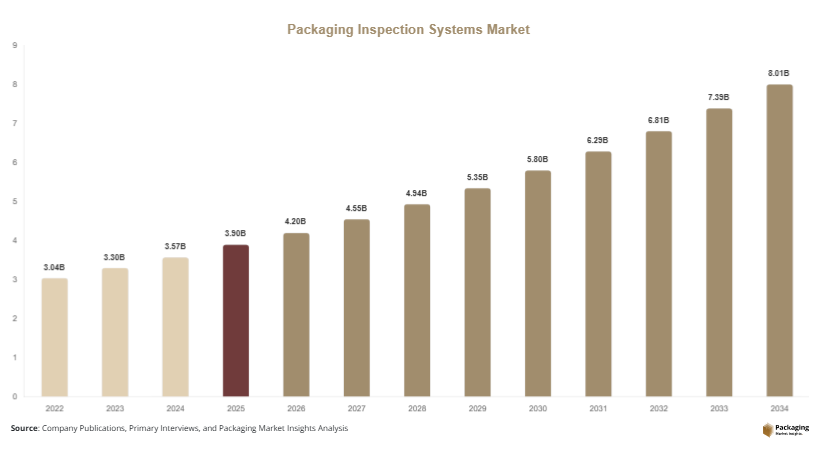
The global packaging inspection systems market size was valued at USD 3.9 billion in 2025 and is projected to reach USD 4.2 billion in 2026, further expanding to approximately USD 8.6 billion by 2034, registering a CAGR of 8.4% during 2025–2034. The increasing need for automated quality control processes is driving the market expansion. The packaging inspection systems market is witnessing consistent growth as industries increasingly prioritize product quality, safety, and regulatory compliance. Packaging inspection systems are used to detect defects, contaminants, labeling errors, and packaging integrity issues across production lines. These systems incorporate advanced technologies such as vision inspection, X-ray detection, metal detection, and checkweighing to ensure that products meet required standards before reaching consumers.
One of the primary growth factors is the rising demand for food safety and compliance with stringent regulatory standards. Governments and regulatory bodies across regions are enforcing strict guidelines for packaging quality and contamination control. Packaging inspection systems help manufacturers meet these standards by identifying defects such as foreign particles, improper sealing, and labeling inaccuracies.
Key Highlights:
- Asia Pacific dominated the market with a 34.8% share in 2025, while Latin America is projected to grow at the fastest CAGR of 9.2%.
- Automated inspection systems led the type segment with a 52.3% share, while manual systems are expected to grow at a CAGR of 6.9%.
- Vision inspection technology dominated with a 41.6% share, while X-ray inspection systems are forecasted to grow at a CAGR of 9.1%.
- Food and beverage applications led the segment with 36.9% share, while pharmaceuticals are expected to grow at a CAGR of 8.8%.
- China remained the dominant country with a market size of USD 0.8 billion in 2025 and USD 0.9 billion in 2026.
Explore more data points, trends and opportunities Download Free Sample Report
Market Trends
Increasing Integration of AI and Machine Vision Technologies
The packaging inspection systems market is undergoing transformation with the integration of artificial intelligence and machine vision technologies. These advanced systems enable real-time defect detection, pattern recognition, and predictive analysis, improving accuracy and efficiency. AI-powered inspection systems can learn from historical data and adapt to changing production conditions, reducing false positives and improving detection rates. Machine vision systems are widely used for label verification, fill-level inspection, and surface defect detection. The integration of these technologies is particularly beneficial in high-speed production environments where manual inspection is not feasible. As manufacturers continue to adopt digital transformation strategies, the demand for AI-driven inspection systems is expected to increase significantly.
Growing Demand for Non-Destructive Testing and Inspection Methods
Non-destructive testing methods are gaining prominence in the packaging inspection systems market as they allow manufacturers to inspect products without compromising their integrity. Technologies such as X-ray inspection and advanced imaging systems enable detection of internal defects, foreign contaminants, and structural inconsistencies. These methods are widely used in industries such as food and pharmaceuticals, where product safety is critical. The ability to perform comprehensive inspections without damaging the product enhances operational efficiency and reduces waste. As regulatory requirements become more stringent, the adoption of non-destructive inspection technologies is expected to grow, supporting market expansion.
Market Drivers
Rising Regulatory Compliance Requirements Across Industries
The increasing enforcement of regulatory standards is a major driver of the packaging inspection systems market. Industries such as food, pharmaceuticals, and consumer goods are subject to strict quality and safety regulations. Compliance with these standards requires robust inspection processes to detect defects and ensure product integrity. Packaging inspection systems provide reliable and consistent results, helping manufacturers meet regulatory requirements. Failure to comply with these standards can result in product recalls, financial losses, and damage to brand reputation. As regulatory frameworks continue to evolve, the demand for advanced inspection systems is expected to increase.
Growing Adoption of Automation in Manufacturing Processes
The shift toward automation in manufacturing is driving the demand for packaging inspection systems. Automated inspection systems improve efficiency, reduce labor costs, and enhance accuracy compared to manual inspection methods. These systems can operate continuously and handle high production volumes, making them suitable for modern manufacturing environments. The integration of inspection systems with production lines enables real-time monitoring and data analysis, allowing manufacturers to identify and address issues promptly. This trend is particularly significant in industries with high production volumes, such as food and beverages, where efficiency and quality are critical.
Market Restraint
High Initial Investment and Maintenance Costs
The high initial investment required for packaging inspection systems is a significant restraint for market growth. Advanced systems incorporating AI, machine vision, and X-ray technologies involve substantial capital expenditure. In addition to installation costs, ongoing maintenance and calibration are necessary to ensure optimal performance. These costs can be a barrier for small and medium-sized enterprises, limiting their ability to adopt advanced inspection solutions. For example, implementing an X-ray inspection system in a production line requires specialized equipment and trained personnel, increasing operational costs. This financial burden may slow the adoption of packaging inspection systems, particularly in cost-sensitive markets.
Market Opportunities
Expansion of Smart Manufacturing and Industry 4.0
The growth of smart manufacturing and Industry 4.0 presents significant opportunities for the packaging inspection systems market. The integration of IoT, data analytics, and automation technologies is transforming manufacturing processes. Packaging inspection systems can be integrated into smart production lines to provide real-time data and insights. This enables predictive maintenance, process optimization, and improved quality control. Companies investing in smart manufacturing technologies can enhance efficiency and reduce operational costs. The adoption of Industry 4.0 practices is expected to drive demand for advanced inspection systems.
Increasing Demand in Emerging Markets
Emerging markets offer substantial growth opportunities for the packaging inspection systems market. Rapid industrialization, urbanization, and increasing consumer demand are driving the adoption of advanced manufacturing technologies in these regions. Countries in Asia Pacific, Latin America, and the Middle East are investing in infrastructure and production capabilities, creating demand for inspection systems. Additionally, the growth of the food and pharmaceutical industries in these regions is driving the need for quality control solutions. Companies that expand their presence in emerging markets can benefit from these growth opportunities.
Report Scope
| Report Metric | Details |
|---|---|
| Market Size in 2025 | USD 3.9 Billion |
| Market Size in 2026 | USD 4.2 Billion |
| Market Size in 2034 | USD 8.6 Billion |
| CAGR | 8.4% (2026-2034) |
| Base Year for Estimation | 2025 |
| Historical Data | 2022-2024 |
| Forecast Period | 2026-2034 |
| Report Coverage | Revenue Forecast, Competitive Landscape, Supply Chain Disruption, Growth Factors, Environment & Regulatory Landscape and Trends |
| Geographies Covered | North America, Europe, APAC, Middle East and Africa, LATAM |
| Countries Covered | U.S., Canada, U.K., Germany, France, Spain, Italy, Russia, Nordic, Benelux, Rest of Europe, China, South Korea, Japan, India, Australia, Singapore, Taiwan, South East Asia, Rest of Asia-Pacific, UAE, Turky, Saudi Arabia, South Africa, Egypt, Nigeria, Rest of MEA, Brazil, Mexico, Argentina, Chile, Colombia, Rest of LATAM |
Explore more data points, trends and opportunities Download Free Sample Report
Segmental Analysis
By Type
Automated inspection systems dominated the market, accounting for 52.3% share in 2024. These systems are widely used due to their efficiency, accuracy, and ability to handle high production volumes. They are essential in modern manufacturing environments.
Manual inspection systems are expected to be the fastest-growing segment, with a CAGR of 6.9%. They are still used in smaller production setups and for specialized applications.
By Technology
Vision inspection systems dominated the market with a 41.6% share in 2024. These systems are widely used for detecting surface defects and verifying labels.
X-ray inspection systems are the fastest-growing segment, with a CAGR of 9.1%. They provide advanced detection capabilities for internal defects and contaminants.
By Application
Food and beverage applications dominated the market, accounting for 36.9% share in 2024. The need for quality control and safety is driving demand.
Pharmaceutical applications are expected to be the fastest-growing segment, with a CAGR of 8.8%. Strict regulations are contributing to growth.
Packaging Inspection Systems Market Segmentations
By Type
- Automated Inspection Systems
- Manual Inspection Systems
By Technology
- Vision Inspection Systems
- X-ray Inspection Systems
- Metal Detection Systems
- Checkweighers
By Application
- Food & Beverage
- Pharmaceuticals
- Consumer Goods
- Industrial Products
Regional Analysis
North America
North America accounted for approximately 27.9% of the market share in 2025 and is expected to grow at a CAGR of 7.8%. The region benefits from advanced manufacturing infrastructure and strong regulatory frameworks that emphasize product safety and quality. The presence of established players further supports market growth.
The United States dominates the regional market due to its large industrial base and technological advancements. A unique growth factor is the increasing adoption of AI-powered inspection systems in food and pharmaceutical industries.
Europe
Europe held a market share of 24.6% in 2025 and is projected to grow at a CAGR of 8.0%. The region is characterized by stringent regulations and a strong focus on quality assurance. The demand for advanced inspection systems is driven by compliance requirements.
Germany is the leading country in the European market, supported by its strong manufacturing sector. A unique growth factor is the adoption of automation in industrial processes.
Asia Pacific
Asia Pacific accounted for 34.8% of the market share in 2025 and is expected to grow at the fastest CAGR of 8.9%. Rapid industrialization and increasing production volumes are driving market growth in the region.
China is the dominant country, driven by its large manufacturing base. A unique growth factor is the increasing demand for quality control in export-oriented industries.
Middle East & Africa
The Middle East & Africa region accounted for a 6.1% share in 2025 and is expected to grow at a CAGR of 8.5%. The market is expanding due to increasing investments in industrial infrastructure.
The United Arab Emirates leads the regional market. A unique growth factor is the growth of logistics and supply chain sectors.
Latin America
Latin America held a market share of 6.6% in 2025 and is projected to grow at a CAGR of 9.2%. The region is witnessing increased adoption of automated inspection systems.
Brazil is the dominant country, supported by its industrial growth. A unique growth factor is the expansion of the food processing industry.
Competitive Landscape
The packaging inspection systems market is characterized by strong competition, with key players focusing on technological innovation and strategic partnerships. Companies are investing in research and development to enhance system capabilities and improve accuracy.
Mettler-Toledo International Inc. is a leading player in the market and has recently introduced advanced AI-based inspection systems to improve defect detection. Other major players such as Thermo Fisher Scientific Inc., Ishida Co., Ltd., Anritsu Corporation, and Minebea Intec GmbH are also expanding their product offerings and global presence.
Key Players List
- Mettler-Toledo International Inc.
- Thermo Fisher Scientific Inc.
- Ishida Co., Ltd.
- Anritsu Corporation
- Minebea Intec GmbH
- Loma Systems
- Sesotec GmbH
- Bizerba SE & Co. KG
- WIPOTEC-OCS GmbH
- A&D Company, Limited
- Cognex Corporation
- Omron Corporation
- Keyence Corporation
- Danaher Corporation
- Bosch Packaging Technology