Packaging And Labeling Translation Service Market Size and Growth
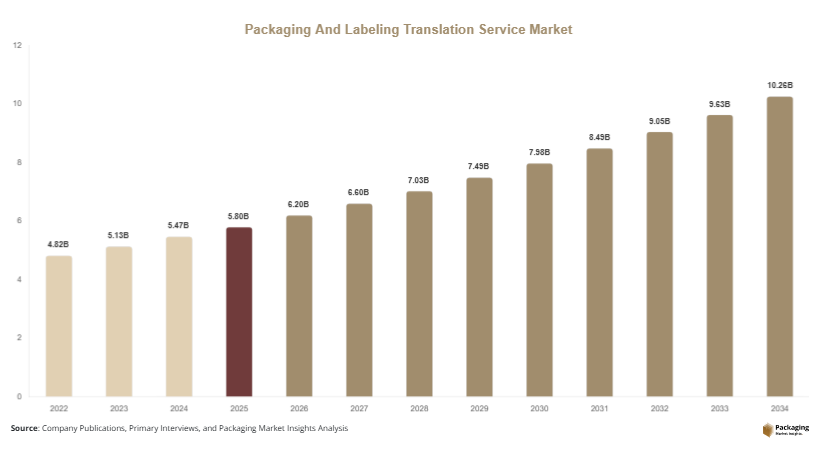
The global packaging and labeling translation service market was valued at approximately USD 5.8 billion in 2025 and is projected to reach USD 6.2 billion in 2026. By 2034, the market is expected to attain nearly USD 10.9 billion, expanding at a CAGR of 6.5% during 2025–2034. Packaging and labeling translation services involve the translation, localization, regulatory adaptation, and multilingual formatting of packaging content to meet regional legal and consumer communication requirements. The packaging and labeling translation service market is experiencing consistent growth due to the increasing globalization of consumer goods, pharmaceuticals, food products, and industrial materials.
One of the major factors driving the packaging and labeling translation service market is the rapid expansion of international trade and cross-border e-commerce. Companies operating in multiple countries must provide product information in local languages to comply with regional labeling regulations and improve customer understanding. Packaging translation services help businesses adapt nutritional information, safety instructions, ingredients, dosage guidelines, and product descriptions for diverse global markets.
Key Highlights
- Asia Pacific dominated the market with a 35.8% share in 2025.
- Latin America is projected to grow at the fastest CAGR of 7.0%.
- Regulatory labeling translation services led the type segment with a 36.4% share.
- Pharmaceutical applications dominated the market with a 39.1% share.
- Multilingual packaging solutions accounted for 44.3% of service demand.
- The US remained the dominant country with a market size of USD 1.3 billion in 2025 and USD 1.4 billion in 2026.
Explore more data points, trends and opportunities Download Free Sample Report
Market Trends
Growing Adoption of AI-Assisted Translation and Localization Platforms
Artificial intelligence-assisted translation platforms are becoming increasingly important within the packaging and labeling translation service market. Companies are adopting machine translation systems integrated with human review processes to improve translation speed, consistency, and cost efficiency. AI-powered terminology databases and translation memory systems help maintain uniformity across multilingual packaging content, particularly in regulated industries such as pharmaceuticals and food processing. Businesses are also using cloud-based localization tools to manage packaging updates simultaneously across multiple regions. The growing volume of multilingual product launches and cross-border e-commerce activities is accelerating demand for automated translation workflows. This trend is expected to improve operational efficiency while supporting faster global product distribution and compliance management.
Expansion of Smart Labels and Digital Packaging Translation Services
Smart labels and interactive packaging technologies are creating new trends in the market. Companies are increasingly integrating QR codes, NFC-enabled labels, and digital instruction systems into packaging formats to provide multilingual product information directly through mobile devices. Translation service providers are adapting by offering digital localization solutions that include app-based instructions, online manuals, and interactive content translation. Pharmaceutical and electronics manufacturers are particularly adopting smart labeling systems to improve regulatory compliance and customer support. Businesses are also using digital packaging translation tools to update content in real time without redesigning physical packaging. This trend is expected to increase demand for integrated digital language management solutions across industries.
Market Drivers
Increasing International Trade and Global Product Distribution
The rapid expansion of international trade and cross-border product distribution is a major driver supporting the packaging and labeling translation service market. Manufacturers are increasingly entering foreign markets, requiring multilingual packaging and region-specific labeling compliance. Food products, pharmaceuticals, cosmetics, and industrial goods must display accurate product information in local languages to meet regulatory standards and consumer communication requirements. Translation service providers help companies localize ingredient lists, safety instructions, dosage information, and marketing claims for multiple geographic markets. The growth of online retail platforms and international shipping networks is further increasing demand for multilingual packaging solutions. Businesses are investing in professional translation services to reduce compliance risks and improve customer trust across global markets.
Rising Regulatory Requirements for Product Labeling Compliance
Strict labeling regulations across healthcare, food, and consumer goods industries are another major driver influencing market growth. Governments and regulatory agencies require companies to provide clear, accurate, and localized product information to protect consumer safety and ensure transparency. Pharmaceutical companies, in particular, must comply with multilingual labeling requirements related to dosage instructions, contraindications, and storage conditions. Incorrect or incomplete translations can result in legal penalties, product recalls, and supply chain disruptions. As regulatory frameworks continue evolving across global markets, businesses are increasingly relying on specialized translation service providers to manage compliance documentation and multilingual packaging workflows efficiently.
Market Restraint
Challenges Related to Translation Accuracy and Regulatory Complexity
One of the major restraints affecting the packaging and labeling translation service market is the challenge of maintaining translation accuracy across multiple languages and regulatory environments. Packaging and labeling content often includes technical terminology, legal disclaimers, dosage instructions, and safety warnings that require precise translation to avoid consumer misunderstanding and regulatory violations. Minor translation errors can lead to product recalls, shipment delays, legal liabilities, and damage to brand reputation. For example, incorrect pharmaceutical dosage translations or inaccurate allergen labeling in food products can create serious health and safety risks for consumers. Regulatory standards also vary significantly across countries, making multilingual compliance management more complex for global manufacturers. Translation providers must continuously update terminology databases and maintain industry-specific expertise to ensure accuracy. Additionally, the increasing demand for faster product launches creates pressure on translation workflows, sometimes reducing review time and increasing the risk of inconsistencies. These operational challenges may limit service efficiency and increase quality control costs across the industry during the forecast period.
Market Opportunities
Expansion of Digital Content Localization Services
The increasing use of digital packaging and online product information systems presents significant growth opportunities for translation service providers. Companies are integrating QR codes, augmented reality packaging, and cloud-based product information systems into their packaging strategies, creating demand for multilingual digital content localization. Translation providers can expand beyond traditional packaging translation by offering app localization, online instruction translation, and multilingual customer support integration. This opportunity is especially strong in electronics, healthcare, and food industries where digital product information is becoming more common. Businesses investing in integrated digital localization services are expected to strengthen customer communication and improve international brand engagement.
Rising Demand for Translation Services in Emerging Markets
Emerging economies offer strong growth opportunities for the packaging and labeling translation service market due to increasing industrialization, expanding retail sectors, and rising international trade activities. Companies entering markets in Asia Pacific, Latin America, and Africa require localized packaging solutions to meet regional language and compliance requirements. Consumer goods manufacturers are increasingly adapting packaging designs and marketing messages for local populations, creating additional demand for professional translation and localization services. Governments in several emerging economies are also implementing stricter labeling regulations to improve product safety and consumer awareness. These factors are expected to support long-term market expansion for translation service providers.
Report Scope
| Report Metric | Details |
|---|---|
| Market Size in 2025 | USD 5.8 Billion |
| Market Size in 2026 | USD 6.2 Billion |
| Market Size in 2034 | USD 10.9 Billion |
| CAGR | 6.5% (2026-2034) |
| Base Year for Estimation | 2025 |
| Historical Data | 2022-2024 |
| Forecast Period | 2026-2034 |
| Report Coverage | Revenue Forecast, Competitive Landscape, Supply Chain Disruption, Growth Factors, Environment & Regulatory Landscape and Trends |
| Geographies Covered | North America, Europe, APAC, Middle East and Africa, LATAM |
| Countries Covered | U.S., Canada, U.K., Germany, France, Spain, Italy, Russia, Nordic, Benelux, Rest of Europe, China, South Korea, Japan, India, Australia, Singapore, Taiwan, South East Asia, Rest of Asia-Pacific, UAE, Turky, Saudi Arabia, South Africa, Egypt, Nigeria, Rest of MEA, Brazil, Mexico, Argentina, Chile, Colombia, Rest of LATAM |
Explore more data points, trends and opportunities Download Free Sample Report
Segmental Analysis
By Type
Regulatory labeling translation services dominated the packaging and labeling translation service market in 2024, accounting for approximately 36.4% of the total market share. These services involve the translation and localization of legally required packaging information, including dosage instructions, ingredient declarations, warning labels, and compliance documentation. Pharmaceutical, food, and chemical industries are the primary users of regulatory labeling translation services because they operate under strict international compliance standards. Businesses prefer specialized regulatory translation providers because accuracy and consistency are critical for avoiding legal penalties and product recalls. Increasing globalization of consumer goods and rising international trade activities are further supporting demand for multilingual regulatory packaging services. Companies are also integrating digital compliance management systems to streamline multilingual approval workflows and improve labeling accuracy.
AI-assisted localization services are expected to grow at the fastest CAGR of 7.4% during the forecast period. Businesses are increasingly adopting artificial intelligence and machine learning tools to automate translation workflows, reduce turnaround time, and improve terminology consistency across global packaging operations. AI-assisted systems allow companies to manage high volumes of multilingual packaging updates more efficiently while reducing manual translation costs. Translation memory databases and automated terminology management tools are becoming especially important in pharmaceutical and food industries where regulatory precision is essential. The increasing need for rapid product launches and simultaneous multilingual packaging adaptation is expected to accelerate demand for AI-driven localization solutions over the coming years.
By Application
Pharmaceutical applications dominated the market in 2024, accounting for approximately 39.1% of total market share. Pharmaceutical packaging and labeling require precise translation of dosage instructions, contraindications, ingredient lists, and storage guidelines to comply with international healthcare regulations. Companies operating across multiple countries must ensure that product labels are localized accurately to protect patient safety and maintain regulatory approval. The increasing production of biologics, vaccines, and specialty medicines is further increasing the complexity of multilingual pharmaceutical labeling requirements. Translation service providers specializing in healthcare compliance are therefore experiencing rising demand for regulatory-focused packaging translation solutions. Digital health labeling and electronic patient information systems are also contributing to growth within this application segment.
Cosmetics and personal care applications are projected to witness the fastest growth, registering a CAGR of 7.2% during the forecast period. Beauty and skincare brands are increasingly expanding into international markets, requiring multilingual packaging designs and localized marketing content. Product labels often include ingredient information, safety instructions, usage guidelines, and promotional claims that must comply with regional consumer protection regulations. Companies are investing in professional localization services to improve brand consistency and customer engagement across different cultural markets. The rapid growth of e-commerce beauty platforms and international direct-to-consumer sales is further accelerating demand for multilingual packaging adaptation services within this segment.
By Service Mode
Multilingual packaging solutions dominated the packaging and labeling translation service market in 2024 with approximately 44.3% share due to increasing demand for region-specific product communication and regulatory compliance. These services include multilingual text formatting, packaging artwork localization, and translation management across multiple geographic markets. Consumer goods manufacturers prefer multilingual packaging systems because they improve operational efficiency and reduce the need for separate packaging production runs for each country. Food, beverage, pharmaceutical, and electronics companies are particularly reliant on multilingual packaging solutions to support international product distribution. Growing export activities and expanding global retail networks are expected to continue supporting demand for comprehensive multilingual packaging services.
Digital smart labeling solutions are projected to grow at the fastest CAGR of 7.3% during the forecast period. Smart labeling technologies such as QR codes, NFC-enabled instructions, and digital product authentication systems require multilingual digital content management and localization capabilities. Businesses are increasingly integrating cloud-based translation systems into smart packaging platforms to enable real-time content updates and multilingual customer interaction. Pharmaceutical and electronics industries are among the leading adopters of digital smart labels due to increasing demand for interactive product support and traceability. Advances in mobile technology and digital packaging innovation are expected to create substantial growth opportunities for translation providers specializing in smart labeling solutions.
Packaging And Labeling Translation Service Market Segmentations
By Type
- Regulatory Labeling Translation
- Packaging Localization Services
- AI-Assisted Localization Services
- Multilingual Compliance Translation
By Application
- Pharmaceuticals
- Food & Beverage
- Cosmetics & Personal Care
- Consumer Electronics
- Industrial Products
By Service Mode
- Multilingual Packaging Solutions
- Digital Smart Labeling Solutions
- Cloud-Based Translation Management
- On-Demand Localization Services
Regional Analysis
North America
North America accounted for approximately 30.1% of the global packaging and labeling translation service market share in 2025 and is projected to grow at a CAGR of 6.0% during the forecast period. Strong pharmaceutical manufacturing activities, expanding cross-border trade, and strict product labeling regulations are supporting market growth across the region. Businesses are increasingly investing in multilingual packaging management systems and AI-assisted localization technologies to improve compliance efficiency and reduce operational risks.
The United States dominates the North American market because of its large healthcare, food processing, and consumer goods industries. A unique growth factor is the increasing use of digital smart labels requiring multilingual mobile-compatible product information. Companies are adopting cloud-based translation management systems to support faster product launches and real-time packaging updates across international distribution networks.
Europe
Europe represented nearly 25.3% of the global market share in 2025 and is expected to register a CAGR of 5.8% during the forecast period. Strict European Union regulations related to multilingual product labeling and consumer safety are major contributors to market growth. Manufacturers across pharmaceuticals, cosmetics, and food sectors are increasingly outsourcing translation workflows to specialized service providers to ensure compliance and improve operational efficiency.
Germany dominates the European market due to its strong export-oriented manufacturing sector and advanced regulatory compliance infrastructure. A unique growth factor is the increasing demand for multilingual sustainable packaging labels across food and industrial applications. Businesses are integrating localized environmental information and recycling instructions into packaging formats to align with regional sustainability policies and consumer expectations.
Asia Pacific
Asia Pacific dominated the packaging and labeling translation service market with a 35.8% share in 2025 and is projected to expand at a CAGR of 7.1% during the forecast period. Rapid industrialization, growing exports, and increasing international product distribution are driving market growth throughout the region. Expanding pharmaceutical production and rising e-commerce activities are also contributing to increasing demand for multilingual packaging and localization services.
China remains the dominant country in the Asia Pacific region because of its large manufacturing base and extensive export activities. A unique growth factor is the increasing requirement for multilingual packaging adaptation for international consumer goods exports. Manufacturers are investing in AI-assisted translation systems and localization software to manage large-scale multilingual packaging operations efficiently across global markets.
Middle East & Africa
The Middle East & Africa region accounted for approximately 4.5% of the global market share in 2025 and is projected to grow at a CAGR of 5.7% during the forecast period. Rising imports of packaged consumer goods, expanding healthcare infrastructure, and increasing retail modernization are supporting regional market growth. International companies are also increasing investments in multilingual packaging compliance to improve market access and customer communication.
The United Arab Emirates dominates the regional market due to its strong logistics infrastructure and growing international trade activities. A unique growth factor is the increasing demand for Arabic-English bilingual packaging across food, cosmetics, and pharmaceutical products. Businesses are focusing on localized labeling strategies to improve regulatory compliance and strengthen product acceptance among regional consumers.
Latin America
Latin America represented nearly 4.3% of the packaging and labeling translation service market share in 2025 and is expected to grow at the fastest CAGR of 7.0% during the forecast period. Expanding retail industries, increasing pharmaceutical imports, and rising consumer awareness regarding product information are supporting market expansion. Businesses are increasingly adopting multilingual packaging strategies to improve product accessibility across Spanish- and Portuguese-speaking markets.
Brazil dominates the Latin American market due to its growing pharmaceutical and packaged food industries. A unique growth factor is the increasing demand for localized packaging content for export-oriented agricultural and processed food products. Companies are investing in professional translation services to comply with international labeling standards and improve global product competitiveness.
Competitive Landscape
The packaging and labeling translation service market is moderately fragmented, with global language service providers, localization technology companies, and regulatory compliance specialists competing through digital innovation, multilingual expertise, and industry-specific service offerings. Companies are increasingly investing in AI-assisted translation systems, cloud-based localization platforms, and automated terminology management tools to improve efficiency and reduce turnaround time.
TransPerfect is recognized as one of the leading companies in the market because of its extensive global localization network and specialized regulatory translation services for pharmaceutical and consumer goods industries. In 2025, the company expanded its AI-powered packaging localization platform to support multilingual smart labeling and digital packaging integration. Other major players include Lionbridge Technologies, RWS Holdings plc, LanguageLine Solutions, and Welocalize Inc. These companies continue investing in automation technologies and regional expansion strategies to strengthen market competitiveness.
Strategic partnerships between translation providers, packaging manufacturers, and regulatory consulting firms are increasing as businesses seek integrated multilingual packaging management solutions. Growing demand for digital packaging localization and regulatory compliance services is expected to intensify market competition during the forecast period.
Key Players List
- TransPerfect
- Lionbridge Technologies
- RWS Holdings plc
- LanguageLine Solutions
- Welocalize Inc.
- SDL plc
- Acolad Group
- STAR Group
- Keywords Studios
- CyraCom International
- Propio Language Services
- Tomedes Ltd.
- ALTA Language Services
- Morningside Translations
- The Translation People