Packaging Additives Market Size and Growth
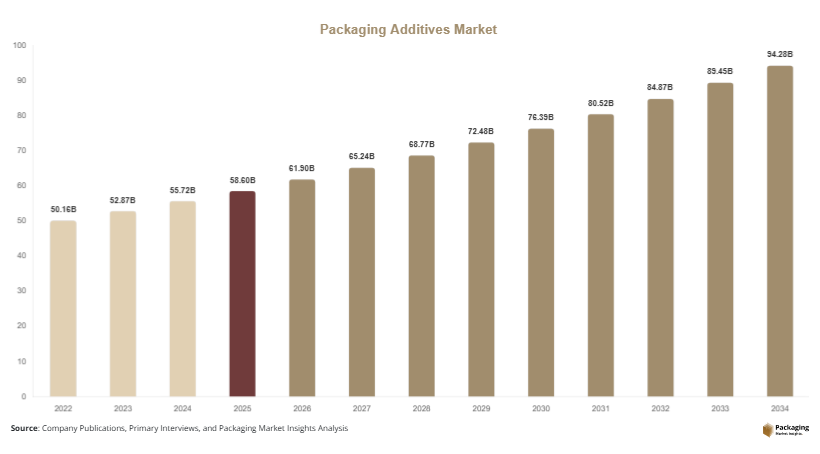
The global packaging additives market size was valued at USD 58.6 billion in 2025 and is expected to reach USD 61.9 billion in 2026. The market is projected to grow to approximately USD 94.7 billion by 2034, registering a CAGR of 5.4% during 2025–2034. The consistent growth trajectory reflects increasing reliance on high-performance packaging solutions that can extend shelf life, improve safety, and meet regulatory standards.
The packaging additives market is experiencing steady expansion, driven by increasing demand for enhanced packaging performance, sustainability requirements, and technological advancements in material science. Packaging additives are essential components used to improve the functionality, durability, appearance, and processing of packaging materials such as plastics, paper, and metals. These additives include antioxidants, UV stabilizers, anti-fog agents, antimicrobial agents, and slip additives, which are widely utilized across food, beverage, healthcare, and industrial packaging applications.
Key Highlights:
- Asia Pacific dominated the market with a 37.4% share in 2025, while Latin America is projected to grow at the fastest CAGR of 6.2%.
- Antioxidants led the type segment with a 29.6% share, while antimicrobial additives are expected to grow at a CAGR of 6.5%.
- Plastic packaging dominated with a 52.3% share, while paper-based packaging is forecasted to grow at a CAGR of 5.9%.
- Food & beverage applications led the segment with 43.1% share, while healthcare packaging is expected to grow at a CAGR of 6.3%.
- China remained the dominant country with a market size of USD 11.2 billion in 2025 and USD 11.9 billion in 2026.
Explore more data points, trends and opportunities Download Free Sample Report
Market Trends
Increasing Adoption of Active and Intelligent Packaging Additives
The packaging additives market is witnessing growing adoption of active and intelligent packaging solutions that enhance product functionality beyond traditional containment. Active packaging additives such as oxygen scavengers, moisture absorbers, and antimicrobial agents are being widely integrated to extend shelf life and maintain product integrity. Intelligent additives, including indicators and sensors, help monitor product condition, such as temperature and freshness, during storage and transportation.
This trend is particularly significant in the food and pharmaceutical sectors, where product quality and safety are critical. As consumer awareness increases and supply chains become more complex, manufacturers are investing in additive technologies that provide real-time data and improved protection. The integration of such advanced additives is expected to drive innovation and create new growth opportunities within the packaging ecosystem.
Shift Toward Sustainable and Bio-Based Additives
Sustainability is becoming a central focus in the packaging additives market, leading to increased demand for bio-based and environmentally friendly additives. Manufacturers are developing additives derived from renewable sources to reduce dependence on fossil fuels and lower carbon footprints. These additives are designed to enhance the recyclability and biodegradability of packaging materials.
Regulatory pressure and corporate sustainability goals are driving this transition. Companies are adopting eco-friendly additives to comply with environmental standards and meet consumer expectations. The use of biodegradable additives in packaging materials is gaining traction, especially in Europe and North America. This trend is expected to reshape product development strategies and encourage investment in green technologies.
Market Drivers
Growing Demand for Packaged Food and Beverage Products
The increasing consumption of packaged food and beverages is a major driver of the packaging additives market. Changing lifestyles, urbanization, and rising disposable incomes are contributing to higher demand for convenience foods and ready-to-eat products. Packaging additives play a crucial role in preserving food quality, extending shelf life, and ensuring safety.
Additives such as antioxidants and antimicrobial agents help prevent spoilage and contamination, making them essential in food packaging. The expansion of the food processing industry and the growth of retail and e-commerce channels are further supporting demand. As consumers prioritize convenience and product quality, the use of advanced packaging additives is expected to increase significantly.
Expansion of E-commerce and Logistics Industry
The rapid growth of e-commerce and global logistics networks is driving demand for robust and reliable packaging solutions. Packaging additives enhance the strength, durability, and performance of packaging materials, making them suitable for transportation and handling. Anti-static, slip, and impact-resistant additives are widely used to protect products during shipping.
With the rise of online shopping, packaging requirements have become more complex, requiring materials that can withstand varying environmental conditions. Additives that improve barrier properties and mechanical strength are in high demand. This driver is expected to remain strong as e-commerce continues to expand globally, influencing packaging design and material selection.
Market Restraint
Regulatory Challenges and Compliance Costs
The packaging additives market faces significant challenges due to stringent regulatory requirements and compliance costs. Governments and regulatory bodies have implemented strict guidelines to ensure the safety and environmental impact of packaging materials. Additives used in food and pharmaceutical packaging must meet rigorous safety standards, which can limit the use of certain chemicals.
Compliance with these regulations often requires extensive testing, certification, and documentation, increasing operational costs for manufacturers. For example, restrictions on certain additives due to health concerns can lead to reformulation and additional research expenses. Smaller companies may face difficulties in meeting these requirements, affecting market competition. This restraint is expected to influence market dynamics and encourage the development of safer and more sustainable additive solutions.
Market Opportunities
Development of Smart Packaging Technologies
The development of smart packaging technologies presents significant opportunities for the packaging additives market. Additives that enable features such as freshness indicators, temperature monitoring, and tamper detection are gaining popularity. These technologies enhance consumer trust and improve supply chain transparency.
Industries such as pharmaceuticals and food are increasingly adopting smart packaging to ensure product quality and safety. The integration of digital technologies with packaging materials is creating new possibilities for innovation. Companies investing in smart additive solutions are likely to gain a competitive advantage and expand their market presence.
Growth in Emerging Markets
Emerging markets offer substantial growth opportunities due to increasing industrialization, urbanization, and population growth. Countries in Asia Pacific, Latin America, and Africa are experiencing rising demand for packaged goods, which drives the need for packaging additives.
Improving economic conditions and expanding retail sectors are supporting market growth in these regions. Government initiatives to promote manufacturing and infrastructure development are also contributing to demand. Companies are focusing on expanding their operations in emerging markets to capitalize on growth opportunities and strengthen their global footprint.
Report Scope
| Report Metric | Details |
|---|---|
| Market Size in 2025 | USD 58.6 Billion |
| Market Size in 2026 | USD 61.9 Billion |
| Market Size in 2034 | USD 94.7 Billion |
| CAGR | 5.4% (2026-2034) |
| Base Year for Estimation | 2025 |
| Historical Data | 2022-2024 |
| Forecast Period | 2026-2034 |
| Report Coverage | Revenue Forecast, Competitive Landscape, Supply Chain Disruption, Growth Factors, Environment & Regulatory Landscape and Trends |
| Geographies Covered | North America, Europe, APAC, Middle East and Africa, LATAM |
| Countries Covered | U.S., Canada, U.K., Germany, France, Spain, Italy, Russia, Nordic, Benelux, Rest of Europe, China, South Korea, Japan, India, Australia, Singapore, Taiwan, South East Asia, Rest of Asia-Pacific, UAE, Turky, Saudi Arabia, South Africa, Egypt, Nigeria, Rest of MEA, Brazil, Mexico, Argentina, Chile, Colombia, Rest of LATAM |
Explore more data points, trends and opportunities Download Free Sample Report
Segmental Analysis
By Type
Antioxidants dominated the packaging additives market in 2024, accounting for approximately 29.6% of the total share. These additives are widely used to prevent oxidation and degradation of packaging materials, especially plastics. Their ability to enhance durability and extend shelf life makes them essential in food and beverage packaging applications.
Antimicrobial additives are expected to grow at the fastest CAGR of 6.5% during the forecast period. These additives help inhibit the growth of microorganisms, ensuring product safety and hygiene. Increasing demand for safe and hygienic packaging in healthcare and food industries is driving growth in this segment.
By Material
Plastic packaging dominated the market in 2024, holding a 52.3% share. The widespread use of plastics in packaging applications is driven by their versatility, cost-effectiveness, and ease of processing. Additives are essential in enhancing the performance and properties of plastic materials.
Paper-based packaging is expected to grow at a CAGR of 5.9%. The shift toward sustainable packaging solutions is driving demand for paper materials, which require additives to improve strength, moisture resistance, and printability. This trend is expected to support segment growth.
By Application
Food & beverage applications accounted for 43.1% of the market share in 2024, driven by high demand for packaging solutions that ensure product safety and quality. Additives play a crucial role in maintaining freshness and extending shelf life in this segment.
Healthcare packaging is expected to grow at a CAGR of 6.3%. The increasing demand for safe and sterile packaging solutions in pharmaceutical and medical applications is driving the use of specialized additives. This segment is expected to witness steady growth.
Packaging Additives Market Segmentations
By Type
- Antioxidants
- Antimicrobial Additives
- UV Stabilizers
- Anti-fog Additives
- Slip & Anti-block Additives
By Material
- Plastic
- Paper
- Metal
By Application
- Food & Beverage
- Healthcare
- Consumer Goods
- Industrial Packaging
Regional Analysis
North America
North America accounted for approximately 23.1% of the global packaging additives market share in 2025 and is projected to grow at a CAGR of 4.7% during the forecast period. The region benefits from advanced packaging technologies and strong demand from food, beverage, and healthcare industries. The presence of established players and continuous innovation in additive formulations support steady growth.
The United States dominates the North American market due to high consumption of packaged goods and advanced manufacturing capabilities. A unique growth factor in the region is the increasing adoption of sustainable packaging solutions, supported by regulatory initiatives and consumer awareness regarding environmental impact.
Europe
Europe held a 20.4% market share in 2025 and is expected to grow at a CAGR of 4.5%. The region is characterized by strict environmental regulations and a strong focus on sustainability. Demand for eco-friendly packaging additives is increasing across industries, driving innovation and product development.
Germany is the leading country in Europe, supported by its strong industrial base and technological expertise. A unique growth factor is the implementation of circular economy policies, which promote recycling and the use of sustainable materials in packaging applications.
Asia Pacific
Asia Pacific dominated the market with a 37.4% share in 2025 and is projected to grow at a CAGR of 5.9%. Rapid urbanization, industrialization, and population growth are key factors driving demand in the region. The expanding food processing and e-commerce sectors are major contributors to market growth.
China leads the Asia Pacific market due to its large manufacturing base and high demand for packaging materials. A key growth factor is the increasing consumption of packaged food and beverages, supported by rising disposable incomes and changing lifestyles.
Middle East & Africa
The Middle East & Africa region accounted for 9.2% of the market share in 2025 and is expected to grow at a CAGR of 5.2%. The region is experiencing growth in industrial activities and infrastructure development, which supports demand for packaging materials and additives.
Saudi Arabia dominates the market, driven by its strong petrochemical industry. A unique growth factor is the expansion of local manufacturing capabilities, which is increasing the production and use of packaging additives in the region.
Latin America
Latin America held a 9.9% market share in 2025 and is projected to grow at the fastest CAGR of 6.2%. The region is witnessing increased demand for packaged goods and expansion of retail and e-commerce sectors.
Brazil is the leading country in Latin America, supported by its growing population and improving economic conditions. A key growth factor is the increasing adoption of modern packaging technologies in the food and beverage industry, which drives demand for additives.
Competitive Landscape
The packaging additives market is moderately competitive, with key players focusing on product innovation, sustainability, and strategic expansion. Companies are investing in research and development to create advanced additive solutions that meet evolving industry requirements.
BASF SE is one of the leading players in the market, known for its extensive product portfolio and strong global presence. The company has recently introduced new sustainable additive solutions aimed at improving recyclability and reducing environmental impact.
Other major players include Clariant AG, Songwon Industrial Co., Ltd., Adeka Corporation, and Croda International Plc. These companies are focusing on expanding their production capacities and entering new markets to strengthen their position. Strategic collaborations and acquisitions are also common strategies in the market.
Key Players List
- BASF SE
- Clariant AG
- Songwon Industrial Co., Ltd.
- Adeka Corporation
- Croda International Plc
- Evonik Industries AG
- Solvay S.A.
- Arkema S.A.
- SABIC
- Dow Inc.
- ExxonMobil Corporation
- Lanxess AG
- Ampacet Corporation
- PolyOne Corporation (Avient Corporation)
- Mitsui Chemicals, Inc.