On-Demand Color Label Market Size and Growth
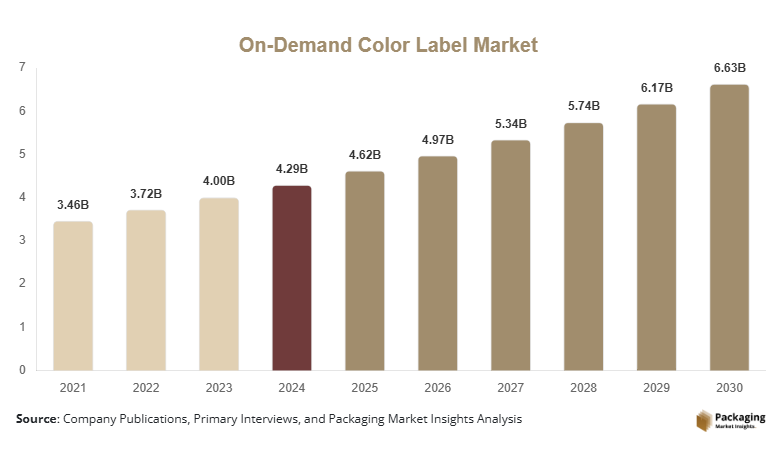
The global on-demand color label market size was valued at USD 4.29 billion in 2024 and is projected to grow from USD 4.62 billion in 2025 to reach approximately USD 6.62 billion by 2030, expanding at a CAGR of 7.5% during the forecast period (2025–2030).
The on-demand color label market growth is primarily driven by increasing demand for variable data printing, rising regulatory labeling requirements across food and pharmaceutical industries, and the growing adoption of just-in-time manufacturing and digital packaging solutions.
On-demand color labeling enables manufacturers to print high-resolution, full-color labels internally, eliminating dependence on pre-printed inventories and significantly reducing waste, lead times, and operational costs. As product lifecycles shorten and SKU complexity rises globally, on-demand labeling has become a strategic tool for improving supply chain agility and compliance accuracy. The market is transitioning from basic operational labeling to advanced applications such as serialization, traceability, and smart packaging, strengthening its long-term growth outlook.
Key Market Insights
- On-demand color labeling is increasingly replacing pre-printed labels, as manufacturers seek flexibility, cost optimization, and rapid design change capabilities.
- Food & beverage and pharmaceutical industries dominate demand, driven by frequent regulatory updates, multilingual labeling needs, and traceability requirements.
- North America leads the global market, supported by early adoption of digital printing technologies, stringent labeling regulations, and the strong presence of technology providers.
- Asia-Pacific is the fastest-growing regional market, fueled by expanding manufacturing output, export-driven labeling demand, and government-led industrial modernization initiatives.
- Medium-volume printing systems represent the largest adoption segment, offering the best balance between cost efficiency and operational flexibility.
- Advancements in pigment ink technology and ERP-integrated labeling software are reshaping competitive differentiation and accelerating enterprise-level adoption.
Explore more data points, trends and opportunities Download Free Sample Report
Market Drivers
Increasing Need for Variable Data and Product Customization
Manufacturers today manage thousands of SKUs with frequent changes in design, language, and compliance requirements. On-demand color labeling allows instant modifications without halting production lines, making it indispensable for modern manufacturing environments.
Growth in Regulated Industries
Particularly pharmaceuticals and food & beverage. Stricter labeling laws related to traceability, safety warnings, and export documentation have increased the complexity of labeling operations. On-demand solutions enable batch-specific and region-specific labeling, significantly reducing compliance risks and recall costs.
Market Restraint
High Initial Capital Investment
Remains a restraint for small manufacturers. Industrial-grade color label printers, inks, and maintenance costs can be significant, especially in price-sensitive markets. Another restraint is ink durability and substrate compatibility limitations, particularly in harsh industrial or chemical environments. While pigment ink technology has improved, certain applications still require specialized substrates or coatings, increasing operational complexity.
Market Opportunities
Expansion of Regulatory and Compliance Labeling
Particularly within pharmaceuticals, chemicals, and food exports. Governments worldwide continue to mandate more detailed labeling requirements, including multilingual content, traceability codes, allergen disclosures, and batch-level data. On-demand color labeling allows manufacturers to dynamically update compliance information without scrapping inventory, creating strong adoption incentives among regulated industries.
Technology integration with Industry 4.0 and Smart Manufacturing Systems
On-demand color label printers increasingly integrate with ERP, MES, and WMS platforms, enabling real-time data printing, serialization, and digital traceability. This creates strong value for logistics, e-commerce, and industrial manufacturers seeking automation, error reduction, and real-time inventory visibility. Vendors that offer software-hardware ecosystems rather than standalone printers are well-positioned to capture premium market segments.
Report Scope
| Report Metric | Details |
|---|---|
| Market Size in 2024 | USD 4.29 Billion |
| Market Size in 2025 | USD 4.62 Billion |
| Market Size in 2030 | USD 6.62 Billion |
| CAGR | 7.5% (2025-2030) |
| Base Year for Estimation | 2024 |
| Historical Data | 2021-2023 |
| Forecast Period | 2025-2030 |
| Report Coverage | Revenue Forecast, Competitive Landscape, Supply Chain Disruption, Growth Factors, Environment & Regulatory Landscape and Trends |
| Geographies Covered | North America, Europe, APAC, Middle East and Africa, LATAM |
| Countries Covered | U.S., Canada, U.K., Germany, France, Spain, Italy, Russia, Nordic, Benelux, Rest of Europe, China, South Korea, Japan, India, Australia, Singapore, Taiwan, South East Asia, Rest of Asia-Pacific, UAE, Turky, Saudi Arabia, South Africa, Egypt, Nigeria, Rest of MEA, Brazil, Mexico, Argentina, Chile, Colombia, Rest of LATAM |
Explore more data points, trends and opportunities Download Free Sample Report
Segmental Analysis
By Printing Technology
The Pigment Inkjet subsegment accounted for the largest share of approximately 38% of the global on-demand color label market in 2024. This dominance is primarily attributed to its superior print durability, water and chemical resistance, and suitability for regulatory and compliance-driven labeling applications. Pigment inkjet technology is widely adopted across food & beverage, pharmaceuticals, and industrial labeling, where label longevity and legibility are critical. Its compatibility with a broad range of substrates, including films and synthetic materials, further strengthens its market leadership.
The Thermal Inkjet (TIJ) subsegment is projected to be the fastest-growing printing technology, registering a CAGR of around 11.5% from 2025 to 2030. Growth is driven by its lower upfront costs, compact design, and ease of integration into existing production lines. TIJ is increasingly preferred by small and mid-sized manufacturers seeking affordable, high-quality color labeling solutions for short-run and variable data applications.
By Label Format
The Pressure-Sensitive Labels subsegment held a dominant 52% share of the global market in 2024, making it the leading label format. This substantial share is driven by the versatility, ease of application, and broad compatibility of pressure-sensitive labels across multiple end-use industries. These labels are widely used for branding, compliance, and logistics labeling, particularly in high-mix production environments where flexibility and fast changeovers are essential.
The Linerless Labels subsegment is expected to grow at the fastest CAGR of approximately 12.2% during 2025–2030. Growth is supported by increasing sustainability initiatives, as linerless labels reduce material waste and improve operational efficiency. Adoption is rising in food service, logistics, and retail sectors, where cost savings and environmental benefits are becoming key procurement criteria.
By Substrate Type
The Film-Based Labels (PP, PE, PET) subsegment accounted for approximately 46% of the market share in 2024, driven by strong demand for durable, moisture-resistant, and tear-resistant labels. Film substrates are extensively used in food packaging, chemicals, and logistics applications, where exposure to harsh environments necessitates enhanced performance. The growing adoption of pigment inks has further accelerated the use of film-based substrates in on-demand color labeling.
The Specialty Substrates subsegment is projected to witness the highest growth rate, with a CAGR of around 11.8% through 2030. This growth is attributed to rising demand for premium labeling solutions, security features, and high-end branding applications. Foils and synthetic papers are increasingly utilized in cosmetics, electronics, and specialty food packaging, where differentiation and aesthetics play a critical role.
By Printing Volume
The Medium-Volume Printing subsegment dominated the market with a 41% share in 2024, as it offers the optimal balance between cost efficiency, print speed, and operational flexibility. Medium-volume systems are widely adopted by mid-sized manufacturers that require frequent label changes without the complexity and cost of high-volume industrial presses. This segment benefits from growing adoption across food processing, pharmaceuticals, and private-label manufacturing.
The High-Volume Printing subsegment is anticipated to grow at the fastest CAGR of approximately 10.9% from 2025 to 2030. Growth is fueled by increasing automation in large manufacturing facilities and the need for scalable digital labeling solutions capable of handling high throughput with minimal downtime.
By End-Use Industry
The Food & Beverage subsegment accounted for the largest share of approximately 34% of the global on-demand color label market in 2024. This leadership is driven by high SKU proliferation, frequent regulatory updates, and growing demand for customized packaging. On-demand color labeling allows food manufacturers to manage allergen information, nutritional labeling, and regional compliance efficiently, making it a critical solution for the industry.
The Logistics & E-commerce subsegment is projected to register the fastest growth, expanding at a CAGR of around 12.5% through 2030. Rapid growth in global e-commerce, cross-border trade, and last-mile delivery operations has intensified demand for flexible, high-mix labeling solutions. On-demand color labels enable real-time printing of shipping labels, branding elements, and return information, positioning this segment as a key growth driver for the market.
On-Demand Color Label Market Segmentations
By Printing Technology
- Thermal Inkjet (TIJ)
- Dye Inkjet
- Pigment Inkjet
- Laser (Electrophotographic)
- Hybrid Digital Printing
By Label Format
- Pressure-Sensitive Labels
- Shrink Sleeve Labels
- Linerless Labels
- In-Mold Labels
- Wraparound Labels
By Substrate Type
- Paper-Based Labels (Coated & Uncoated)
- Film-Based Labels (PP, PE, PET)
- Specialty Substrates (Foils, Synthetic Paper)
By Printing Volume
- Low-Volume Printing
- Medium-Volume Printing
- High-Volume Printing
By End-Use Industry
- Food & Beverage
- Pharmaceuticals & Healthcare
- Cosmetics & Personal Care
- Chemicals & Industrial Goods
- Logistics & E-commerce
- Consumer Electronics
Regional Analysis
North America
North America remains the largest regional market for on-demand color labels, accounting for approximately 34% of global market share in 2024, with the United States representing the dominant contributor. Strong regulatory enforcement in food safety, pharmaceuticals, and chemicals has accelerated the adoption of digitally printed labels that support compliance and traceability. High labor costs and a strong focus on automation have further driven manufacturers to invest in in-house labeling solutions that improve operational efficiency.
Demand in North America is also supported by the growth of e-commerce and third-party logistics providers, where high-mix, low-volume labeling is critical. Technological maturity, availability of advanced pigment inks, and strong after-sales support infrastructure continue to reinforce the region’s leadership position.
Europe
Europe represents a mature but steadily growing market, accounting for nearly 29% of global demand. Countries such as Germany, the U.K., France, and Italy are major adopters, driven by stringent EU labeling regulations, sustainability mandates, and strong private label penetration. European manufacturers are highly receptive to linerless labels, recyclable substrates, and waste-reduction initiatives, positioning the region as a leader in sustainable on-demand labeling practices. Growth is further supported by increasing pharmaceutical exports and the expansion of small-batch specialty food producers, which rely heavily on flexible, short-run labeling capabilities.
Asia-Pacific
Asia-Pacific is the fastest-growing regional market, expanding at a CAGR of approximately 13%, led by China, Japan, India, and South Korea. Rapid industrialization, export-oriented manufacturing, and rising domestic consumption are driving strong demand for on-demand color labels. China’s focus on advanced manufacturing under national industrial policies and India’s growth in food processing and pharmaceuticals are key demand catalysts.
Small and mid-sized manufacturers in the region are increasingly adopting medium-volume on-demand printers to improve responsiveness and reduce reliance on external print vendors. Expanding e-commerce logistics and cross-border trade further accelerate growth.
Latin America
Latin America accounts for around 5% of the global market, with Brazil and Mexico leading adoption. Growth is supported by increasing packaged food production, pharmaceutical manufacturing, and logistics activity. While price sensitivity remains a challenge, demand for cost-effective, medium-volume on-demand labeling systems is steadily rising as manufacturers seek to reduce inventory waste and improve regulatory compliance.
Middle East & Africa
The Middle East & Africa region holds approximately 3% of global market share, supported by pharmaceutical imports, food processing expansion, and industrial labeling demand. Countries such as Saudi Arabia, the UAE, and South Africa are emerging as regional hubs for advanced packaging technologies, supported by government diversification initiatives and growing manufacturing bases.
Competitive Landscape
The on-demand color label market is moderately consolidated, with the top five companies collectively accounting for approximately 46% of global market share. Competition is primarily based on print quality, ink durability, software integration capabilities, total cost of ownership, and global service support. While established players dominate enterprise and regulated industries, smaller technology-focused companies are gaining traction in niche and mid-volume segments.
Key Players in the On-Demand Color Label Market
- Epson
- Primera Technology
- Afinia Label
- AstroNova
- Domino Printing Sciences
- Markem-Imaje
- SATO Holdings
- Brother Industries
- VIPColor Technologies
- GoDEX International
- Toshiba TEC
- Canon
- OKI Data
- TSC Auto ID
- Epson Atmix