Omnichannel Packaging Market Size and Growth
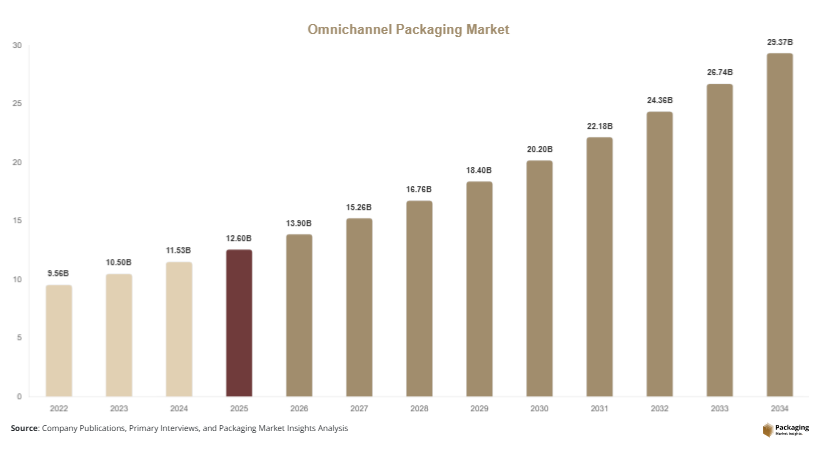
The global omnichannel packaging market size was estimated at USD 12.6 billion in 2025 and is projected to reach USD 13.9 billion in 2026. Over the forecast period, the market is expected to grow steadily and reach approximately USD 29.4 billion by 2034, expanding at a compound annual growth rate (CAGR) of 9.8% between 2025 and 2034. Growth is supported by the rising integration of digital commerce platforms with traditional retail formats, increasing demand for durable shipping-ready packaging, and the need for sustainable materials that support both retail display and logistics operations.
The omnichannel packaging market has gained strategic importance as retailers integrate physical stores, e-commerce platforms, and direct-to-consumer channels into unified supply chains. Omnichannel packaging solutions are designed to support product protection, brand visibility, logistics efficiency, and customer experience across multiple retail formats. As retail distribution models evolve, packaging providers are developing flexible solutions that can function efficiently in warehouses, fulfillment centers, and last-mile delivery systems.
Key Highlights
- The Omnichannel Packaging Market is projected to reach USD 29.4 billion by 2034, growing at a CAGR of 9.8% from 2025 to 2034.
- Growth is driven by the rising demand for integrated retail and e-commerce packaging solutions and increasing adoption of sustainable and recyclable packaging materials.
- Investments in automated fulfillment centers and logistics infrastructure are further accelerating the adoption of omnichannel packaging systems across global retail networks.
Explore more data points, trends and opportunities Download Free Sample Report
Market Trends
Rising Adoption of Sustainable Omnichannel Packaging
Sustainability has become a central trend shaping the omnichannel packaging market. Retailers and consumer goods companies are prioritizing packaging materials that reduce environmental impact while maintaining durability across logistics networks. Paper-based corrugated packaging, molded fiber trays, and recyclable flexible packaging formats are increasingly replacing traditional plastic-heavy materials. These alternatives provide sufficient strength for transportation while supporting sustainability targets and regulatory compliance.
In omnichannel supply chains, a single packaging format often moves through multiple touchpoints such as warehouses, retail shelves, and home delivery. This requires packaging solutions that balance strength, recyclability, and lightweight properties. Companies are investing in eco-design strategies that reduce material usage and improve recyclability rates. As environmental awareness among consumers grows, brands are using sustainable omnichannel packaging as a way to reinforce their environmental commitments and strengthen brand perception.
Integration of Smart and Connected Packaging
Another important trend in the omnichannel packaging market is the integration of smart technologies into packaging systems. QR codes, RFID tags, and digital tracking labels are increasingly embedded into packaging structures to improve product traceability and supply chain visibility. These technologies help retailers monitor product movement across distribution centers, stores, and consumer delivery networks.
Connected packaging also supports enhanced customer engagement. By scanning digital labels, consumers can access product information, authentication details, or promotional content. This approach strengthens brand interaction while providing supply chain data to manufacturers and retailers. As omnichannel retail systems become more complex, smart packaging technologies are expected to play a growing role in improving logistics efficiency and product transparency.
Market Drivers
Expansion of E-Commerce and Hybrid Retail Models
The rapid growth of e-commerce platforms and hybrid retail strategies is a major driver of the omnichannel packaging market. Retailers are increasingly adopting integrated systems that combine online ordering, in-store pickup, and direct home delivery. These operational models require packaging solutions that are versatile enough to move seamlessly across multiple distribution channels.
Traditional retail packaging was primarily designed for store shelf display, while shipping packaging focused on logistics protection. Omnichannel packaging bridges these requirements by enabling a single package to serve both purposes. As retailers continue to expand digital sales channels, demand for packaging that supports fast fulfillment, product safety, and efficient handling is increasing. This trend is expected to remain a key growth driver as online retail penetration continues to rise globally.
Growth of Automated Fulfillment Centers
Automation in warehouses and fulfillment centers is another important driver supporting market growth. Large retailers and logistics providers are investing in automated storage systems, robotic picking technologies, and conveyor-based sorting systems. These facilities require standardized packaging formats that are compatible with automated handling equipment.
Omnichannel packaging solutions are designed to maintain structural integrity while moving through automated logistics systems. Lightweight corrugated boxes, modular packaging sizes, and reinforced packaging designs help reduce product damage and improve operational efficiency. As supply chains increasingly adopt automation technologies to handle rising order volumes, demand for specialized omnichannel packaging formats is expected to expand.
Market Restraint
High Packaging Design and Supply Chain Integration Costs
Despite strong growth prospects, the omnichannel packaging market faces challenges related to the high cost of packaging design and supply chain integration. Developing packaging solutions that function across multiple retail channels requires extensive research, testing, and customization. Companies must ensure that packaging performs effectively during warehouse handling, transportation, shelf display, and final delivery to consumers.
These requirements often lead to higher material costs and longer product development cycles. Packaging must meet durability standards for logistics operations while also maintaining visual appeal for retail environments. In addition, businesses frequently need to redesign existing packaging lines to align with omnichannel distribution models. This can involve investments in new machinery, packaging automation equipment, and redesigned supply chain processes.
Small and medium-sized retailers may face greater challenges in adopting omnichannel packaging due to limited resources and budget constraints. For example, a retailer transitioning from traditional store-based sales to integrated online fulfillment may need to replace its packaging systems entirely. These costs can slow adoption, particularly in emerging markets where logistics infrastructure and packaging technology investments remain limited.
Market Opportunities
Growth of Direct-to-Consumer Brands
The rapid expansion of direct-to-consumer (DTC) brands presents a significant opportunity in the omnichannel packaging market. DTC companies rely heavily on digital platforms to reach consumers, which increases the importance of packaging for product protection and brand experience. Packaging often serves as the first physical interaction between the brand and the customer.
Omnichannel packaging solutions allow DTC brands to create visually appealing packaging that is also optimized for logistics and transportation. Features such as easy-open designs, protective inserts, and printed branding elements enhance the customer experience while ensuring product safety. As more brands shift toward digital-first sales strategies, demand for customized omnichannel packaging solutions is expected to increase significantly.
Advancements in Digital Printing Technologies
Advancements in digital printing technologies are creating new opportunities within the omnichannel packaging market. Digital printing enables brands to produce high-quality graphics, personalized packaging designs, and short production runs with greater flexibility. This capability is particularly valuable for omnichannel retail systems where packaging needs may vary across different distribution channels.
Digital printing also allows companies to integrate marketing content, product information, and tracking features directly onto packaging surfaces. Retailers can modify designs quickly to support seasonal promotions or regional marketing campaigns. As printing technologies continue to improve in terms of cost efficiency and speed, adoption of digitally printed omnichannel packaging solutions is expected to expand across multiple industries.
Report Scope
| Report Metric | Details |
|---|---|
| Market Size in 2025 | USD 12.6 Billion |
| Market Size in 2026 | USD 13.9 Billion |
| Market Size in 2034 | USD 29.4 Billion |
| CAGR | 9.8% (2026-2034) |
| Base Year for Estimation | 2025 |
| Historical Data | 2022-2024 |
| Forecast Period | 2026-2034 |
| Report Coverage | Revenue Forecast, Competitive Landscape, Supply Chain Disruption, Growth Factors, Environment & Regulatory Landscape and Trends |
| Geographies Covered | North America, Europe, APAC, Middle East and Africa, LATAM |
| Countries Covered | U.S., Canada, U.K., Germany, France, Spain, Italy, Russia, Nordic, Benelux, Rest of Europe, China, South Korea, Japan, India, Australia, Singapore, Taiwan, South East Asia, Rest of Asia-Pacific, UAE, Turky, Saudi Arabia, South Africa, Egypt, Nigeria, Rest of MEA, Brazil, Mexico, Argentina, Chile, Colombia, Rest of LATAM |
Explore more data points, trends and opportunities Download Free Sample Report
Segmental Analysis
By Material Type
The corrugated packaging segment dominated the omnichannel packaging market in 2024, accounting for approximately 46% of the total market share. Corrugated materials are widely used because they offer strong structural protection while remaining lightweight and cost-efficient. These properties make corrugated packaging suitable for both retail display and transportation. In omnichannel distribution systems, corrugated boxes can move directly from fulfillment centers to retail shelves or consumer deliveries without requiring additional repackaging. Retailers also benefit from the flexibility of corrugated materials, which can be customized into different shapes and sizes to meet specific product requirements.
Corrugated packaging also supports sustainable packaging strategies. Many manufacturers are using recycled fiber materials to produce corrugated packaging solutions, which helps reduce environmental impact. The ability to print high-quality branding graphics on corrugated surfaces further strengthens its role in omnichannel retail systems. As retailers continue to adopt packaging designs that balance protection, cost efficiency, and branding, corrugated packaging is expected to maintain its dominant position within the market.
The paper-based flexible packaging segment is projected to be the fastest-growing subsegment, expanding at a CAGR of around 11.5% during the forecast period. This growth is driven by the increasing demand for lightweight packaging materials that reduce shipping costs while maintaining adequate product protection. Paper-based flexible packaging formats are particularly suitable for small consumer goods and apparel products that are commonly sold through e-commerce channels.
Another factor supporting the growth of this segment is the rising demand for sustainable alternatives to plastic packaging. Paper-based flexible packaging solutions are easier to recycle and often require less material during production. As sustainability becomes a key priority for retailers and packaging manufacturers, demand for paper-based flexible omnichannel packaging solutions is expected to expand significantly across global markets.
By Packaging Type
The shipping boxes segment held the largest share of the omnichannel packaging market in 2024, representing nearly 39% of the total market share. Shipping boxes are essential components of omnichannel logistics systems because they provide structural protection during storage, transportation, and delivery. Many retailers are adopting shipping-ready packaging formats that can transition directly from distribution centers to retail shelves or home delivery shipments.
Shipping boxes also support operational efficiency in automated fulfillment centers. Standardized box sizes allow warehouses to optimize storage space and improve sorting efficiency. Retailers often design these boxes with reinforced edges and cushioning inserts to minimize product damage during shipping. As online retail volumes continue to increase globally, shipping boxes are expected to remain the most widely used packaging type within omnichannel distribution systems.
The protective mailers segment is projected to be the fastest-growing packaging type, with an expected CAGR of approximately 12.1% during the forecast period. Protective mailers are widely used for lightweight consumer goods such as clothing, books, and small electronics. These packaging solutions are compact, flexible, and easy to handle, making them suitable for high-volume e-commerce shipping operations.
Growth in this segment is supported by the expansion of last-mile delivery services and increasing consumer preference for convenient home delivery. Protective mailers also reduce packaging material usage compared to traditional boxes, which helps lower shipping costs and improve sustainability. As retailers seek efficient packaging solutions for small parcel deliveries, the demand for protective mailers is expected to increase steadily.
By End-Use Industry
The consumer electronics segment dominated the omnichannel packaging market in 2024, accounting for approximately 32% of total market share. Consumer electronics products require durable packaging that protects sensitive components during transportation while maintaining attractive retail presentation. Omnichannel packaging solutions designed for electronics often include protective inserts, anti-static materials, and reinforced structures that prevent damage during shipping.
The growth of online electronics retail has significantly increased the demand for omnichannel packaging solutions. Retailers frequently ship electronics directly from warehouses to consumers, which requires packaging that can withstand long-distance transportation. In addition, product packaging must provide a premium unboxing experience that reflects the brand’s value proposition. These factors have contributed to the strong adoption of omnichannel packaging within the electronics industry.
The apparel and fashion segment is expected to be the fastest-growing end-use category, expanding at a CAGR of around 11.8% through 2034. Apparel products are increasingly sold through online platforms, which requires packaging that protects items while maintaining a visually appealing presentation. Lightweight packaging materials such as protective mailers and flexible paper packaging are widely used in this segment.
Another growth factor is the rising popularity of direct-to-consumer fashion brands that rely heavily on online sales channels. These brands often use customized packaging designs to create a unique brand identity and improve customer engagement. As digital fashion retail continues to expand globally, demand for omnichannel packaging solutions tailored to apparel products is expected to grow steadily.
Omnichannel Packaging Market Segmentations
Material Type
- Corrugated Packaging
- Plastic Packaging
- Paper-Based Flexible Packaging
- Molded Fiber Packaging
Packaging Type
- Shipping Boxes
- Protective Mailers
- Pouches and Bags
- Inserts and Protective Packaging
End-Use Industry
- Consumer Electronics
- Apparel and Fashion
- Food and Beverage
- Personal Care and Cosmetics
- Household Products
Regional Analysis
North America
North America accounted for approximately 34% of the omnichannel packaging market share in 2025, making it the largest regional market. The region is expected to maintain strong momentum, with a projected CAGR of around 9.2% during the forecast period. Growth is supported by the widespread adoption of e-commerce platforms, advanced logistics infrastructure, and high consumer demand for fast delivery services. Retailers across the United States and Canada are investing heavily in packaging systems that can operate efficiently across multiple distribution channels.
The United States dominates the North American market due to its large e-commerce ecosystem and sophisticated fulfillment networks. One unique growth factor in the country is the rapid expansion of automated distribution centers operated by major retailers and logistics companies. These facilities require packaging solutions that are compatible with automated picking and sorting systems. As automation continues to expand, demand for standardized omnichannel packaging formats is expected to increase.
Europe
Europe held nearly 26% of the global omnichannel packaging market share in 2025 and is projected to grow at a CAGR of approximately 8.7% through 2034. The region benefits from strong retail infrastructure and increasing investments in sustainable packaging technologies. European retailers are focusing on reducing packaging waste while maintaining efficient logistics systems that support both online and offline sales channels.
Germany represents the leading country in the European market due to its strong manufacturing base and advanced logistics networks. A unique growth factor in Germany is the emphasis on circular economy initiatives that promote recyclable packaging materials. Government regulations encouraging sustainable packaging are pushing manufacturers to develop environmentally friendly omnichannel packaging solutions that comply with regional environmental standards.
Asia Pacific
Asia Pacific represented roughly 24% of the omnichannel packaging market share in 2025 and is expected to record the fastest CAGR of around 11.2% during the forecast period. Rapid urbanization, growing internet penetration, and the expansion of digital retail platforms are key factors supporting market growth across the region. Countries such as China, India, and Japan are witnessing increasing demand for packaging solutions that can support large-scale e-commerce logistics networks.
China leads the regional market due to its extensive e-commerce ecosystem and high volume of online retail transactions. A unique growth factor in China is the widespread adoption of integrated logistics platforms that connect online marketplaces with large fulfillment centers. These platforms require efficient packaging solutions that support high shipping volumes while minimizing transportation costs, which is accelerating the demand for omnichannel packaging systems.
Middle East & Africa
The Middle East & Africa accounted for approximately 9% of the omnichannel packaging market share in 2025 and is forecast to grow at a CAGR of about 8.5% through 2034. Market expansion in this region is driven by the gradual development of e-commerce infrastructure and the increasing presence of international retail brands. As digital retail platforms expand, packaging solutions that support both traditional stores and online delivery channels are gaining importance.
The United Arab Emirates is the dominant market in the region due to its advanced retail sector and rapidly growing logistics infrastructure. One unique growth factor in the country is the expansion of cross-border e-commerce distribution hubs that serve multiple regional markets. These hubs require durable and standardized packaging formats that can support international shipping and long-distance transportation.
Latin America
Latin America accounted for around 7% of the global omnichannel packaging market share in 2025 and is projected to grow at a CAGR of nearly 8.9% over the forecast period. The region is experiencing increasing adoption of online shopping platforms and digital payment systems. Retailers are gradually integrating online and offline sales channels, which is creating demand for packaging solutions that support multi-channel distribution.
Brazil leads the Latin American market due to its large consumer base and expanding e-commerce sector. A unique growth factor in Brazil is the growth of last-mile delivery services in major urban centers. Logistics providers are investing in packaging systems that can protect products during urban delivery operations while maintaining efficient handling processes across distribution centers.
Competitive Landscape
The omnichannel packaging market is moderately competitive, with several global packaging manufacturers investing in innovation, sustainable materials, and digital printing technologies. Leading companies are focusing on developing packaging solutions that improve logistics efficiency while supporting branding and customer engagement across multiple retail channels.
One of the market leaders is International Paper, which has expanded its omnichannel packaging portfolio through investments in sustainable corrugated packaging technologies. The company recently introduced new packaging designs aimed at improving supply chain efficiency for e-commerce retailers.
Other major companies are strengthening their market presence through partnerships with logistics providers and retail brands. These collaborations enable packaging manufacturers to develop customized solutions tailored to specific supply chain requirements. Continuous innovation in material science, packaging automation, and digital printing technologies is expected to remain a key competitive strategy among major industry participants.
Key Players List
- International Paper
- Smurfit Kappa Group
- DS Smith
- Mondi Group
- WestRock Company
- Amcor Plc
- Sealed Air Corporation
- Stora Enso
- Georgia-Pacific
- Sonoco Products Company
- Packaging Corporation of America
- UFP Packaging
- Pregis Corporation
- Huhtamaki
- Ranpak Holdings