Nutraceutical Flexible Packaging Market Size and Growth
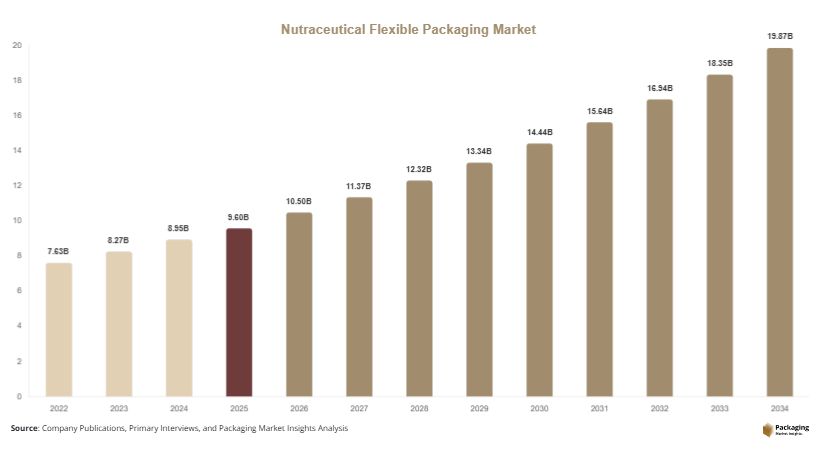
The global nutraceutical flexible packaging market size was valued at approximately USD 9.6 billion in 2025 and is projected to reach USD 10.5 billion in 2026. Over the forecast period, the market is expected to grow to nearly USD 19.8 billion by 2034, expanding at a CAGR of 8.3% from 2025 to 2034. This growth reflects the increasing importance of packaging solutions that ensure product safety, extend shelf life, and enhance consumer convenience. The nutraceutical flexible packaging market is experiencing consistent growth due to the rising demand for health supplements, functional foods, and dietary products across both developed and emerging economies.
One of the primary growth factors is the rising awareness of preventive healthcare, which has led to increased consumption of nutraceutical products such as vitamins, protein supplements, probiotics, and herbal extracts. Flexible packaging solutions, including pouches, sachets, and stick packs, are widely used due to their lightweight nature and cost efficiency. Another key factor is the growing demand for convenience-oriented packaging formats. Consumers prefer easy-to-use, resealable, and portable packaging, which is effectively provided by flexible packaging technologies. Additionally, advancements in barrier materials and printing technologies are enabling manufacturers to improve product protection while enhancing brand visibility.
Key Highlights:
- Asia Pacific dominated the market with a 38.7% share in 2025, while Latin America is projected to grow at the fastest CAGR of 9.1%.
- Pouches led the type segment with a 46.5% share, while stick packs are expected to grow at a CAGR of 9.4%.
- Plastic-based packaging dominated with a 54.2% share, while paper-based packaging is forecasted to grow at a CAGR of 8.1%.
- Dietary supplements applications led the segment with 49.3% share, while functional foods packaging is expected to grow at a CAGR of 8.8%.
- China remained the dominant country with a market size of USD 2.7 billion in 2025 and USD 3.0 billion in 2026.
Explore more data points, trends and opportunities Download Free Sample Report
Market Trends
Increasing Demand for Sustainable and Eco-Friendly Packaging
The nutraceutical flexible packaging market is witnessing a steady shift toward sustainable and eco-friendly packaging solutions. Manufacturers are focusing on reducing environmental impact by adopting recyclable, compostable, and biodegradable materials. Flexible packaging formats use less raw material compared to rigid packaging, making them a preferred choice for companies aiming to reduce their carbon footprint. Additionally, regulatory policies and consumer awareness are encouraging brands to transition toward sustainable packaging alternatives. Innovations such as mono-material laminates and bio-based films are gaining traction, enabling recyclability without compromising product protection. This trend is expected to strengthen as environmental concerns continue to influence purchasing decisions.
Growth of Single-Serve and On-the-Go Packaging Formats
The increasing preference for convenience is driving the adoption of single-serve and on-the-go packaging formats in the nutraceutical industry. Consumers are seeking portable and easy-to-use packaging for supplements and functional foods, particularly in urban areas with busy lifestyles. Formats such as sachets, stick packs, and small pouches offer precise portion control and ease of consumption. These packaging solutions are also suitable for travel and outdoor activities, enhancing their appeal among consumers. The rise of personalized nutrition further supports this trend, as single-serve packaging allows customization of product dosage and usage. This trend is expected to drive innovation in packaging design and materials.
Market Drivers
Rising Consumption of Nutraceutical Products
The increasing consumption of nutraceutical products is a major factor driving the nutraceutical flexible packaging market. Growing awareness of health and wellness has led consumers to incorporate dietary supplements and functional foods into their daily routines. Flexible packaging solutions provide the necessary protection against moisture, oxygen, and light, ensuring product quality and shelf life. Additionally, the versatility of flexible packaging allows manufacturers to offer a wide range of product formats, catering to diverse consumer preferences. As the nutraceutical industry continues to expand, the demand for efficient and innovative packaging solutions is expected to rise.
Expansion of E-Commerce and Direct-to-Consumer Channels
The rapid growth of e-commerce platforms is another key driver for the market. Online sales of nutraceutical products have increased significantly, requiring packaging solutions that ensure product safety during transportation. Flexible packaging offers advantages such as lightweight design, durability, and cost efficiency, making it suitable for e-commerce applications. Additionally, direct-to-consumer business models are gaining popularity, allowing brands to deliver products directly to customers. This trend is driving demand for packaging solutions that enhance user experience while maintaining product integrity, supporting market growth.
Market Restraint
Challenges Related to Recycling and Material Complexity
The nutraceutical flexible packaging market faces challenges related to recycling and material complexity. Many flexible packaging solutions use multi-layer materials to achieve high barrier properties, making them difficult to recycle. This creates environmental concerns and limits the adoption of flexible packaging in regions with strict sustainability regulations. Additionally, the lack of adequate recycling infrastructure in certain regions further complicates waste management. For example, multi-layer pouches used for nutraceutical products may not be easily processed in standard recycling systems, leading to increased landfill waste. These challenges can hinder market growth and require ongoing innovation to develop more sustainable packaging solutions.
Market Opportunities
Increasing Demand for Personalized Nutrition Products
The growing trend of personalized nutrition presents significant opportunities for the nutraceutical flexible packaging market. Consumers are increasingly seeking customized dietary solutions based on their health needs and lifestyle preferences. Flexible packaging solutions, such as single-serve sachets and stick packs, enable manufacturers to offer personalized product formats. This trend is driving innovation in packaging design, allowing brands to differentiate their products and enhance consumer engagement. As personalized nutrition continues to gain traction, the demand for flexible packaging solutions is expected to increase.
Advancements in Smart Packaging Technologies
Technological advancements in packaging are creating new opportunities for market growth. Smart packaging solutions, such as QR codes, temperature indicators, and interactive labels, are being integrated into flexible packaging to enhance product transparency and traceability. These technologies allow consumers to access detailed information about product origin, ingredients, and usage instructions. Additionally, smart packaging can improve supply chain management by enabling real-time tracking and monitoring. As the nutraceutical industry becomes more data-driven, the adoption of smart packaging solutions is expected to rise, supporting market expansion.
Report Scope
| Report Metric | Details |
|---|---|
| Market Size in 2025 | USD 9.6 Billion |
| Market Size in 2026 | USD 10.5 Billion |
| Market Size in 2034 | USD 19.8 Billion |
| CAGR | 8.3% (2026-2034) |
| Base Year for Estimation | 2025 |
| Historical Data | 2022-2024 |
| Forecast Period | 2026-2034 |
| Report Coverage | Revenue Forecast, Competitive Landscape, Supply Chain Disruption, Growth Factors, Environment & Regulatory Landscape and Trends |
| Geographies Covered | North America, Europe, APAC, Middle East and Africa, LATAM |
| Countries Covered | U.S., Canada, U.K., Germany, France, Spain, Italy, Russia, Nordic, Benelux, Rest of Europe, China, South Korea, Japan, India, Australia, Singapore, Taiwan, South East Asia, Rest of Asia-Pacific, UAE, Turky, Saudi Arabia, South Africa, Egypt, Nigeria, Rest of MEA, Brazil, Mexico, Argentina, Chile, Colombia, Rest of LATAM |
Explore more data points, trends and opportunities Download Free Sample Report
Segmental Analysis
By Type
Pouches accounted for the largest share of the market in 2024, contributing approximately 46.5% of total revenue. This dominance is attributed to their versatility and convenience, making them suitable for a wide range of nutraceutical products. Pouches offer excellent barrier properties, protecting products from moisture and oxygen. They are also lightweight and cost-effective, reducing transportation costs. The availability of resealable options further enhances their appeal among consumers, supporting segment growth.
Stick packs are expected to grow at the fastest CAGR of 9.4% during the forecast period. This growth is driven by increasing demand for single-serve packaging solutions that offer convenience and portability. Stick packs are widely used for powdered supplements and functional beverages, providing precise portion control. The rise of on-the-go consumption and personalized nutrition is further supporting the growth of this segment.
By Material
Plastic-based packaging dominated the market in 2024 with a share of approximately 54.2%. This dominance is due to its durability, flexibility, and cost efficiency. Plastic materials provide excellent barrier properties, ensuring product safety and shelf life. The widespread availability and adaptability of plastic materials make them suitable for various packaging formats, supporting their strong market position.
Paper-based packaging is expected to grow at a CAGR of 8.1% during the forecast period. This growth is driven by increasing demand for sustainable packaging solutions. Paper-based materials offer an eco-friendly alternative to plastic, reducing environmental impact. Advances in coating technologies are improving the barrier properties of paper-based packaging, making them suitable for nutraceutical applications.
By Application
Dietary supplements accounted for the largest share of the market in 2024, contributing approximately 49.3% of total revenue. The increasing consumption of vitamins, minerals, and protein supplements is driving demand for flexible packaging solutions. Packaging plays a crucial role in maintaining product quality and extending shelf life, supporting segment growth.
Functional foods are expected to grow at the fastest CAGR of 8.8% during the forecast period. This growth is driven by rising demand for health-oriented food products. Flexible packaging solutions provide convenience and protection, making them suitable for functional food applications. The expansion of this segment is expected to drive demand for innovative packaging solutions.
Nutraceutical Flexible Packaging Market Segmentations
By Product Type
- Pouches
- Sachets
- Stick Packs
By Application
- Dietary Supplements
- Functional Foods
- Functional Beverages
By Material
- Plastic
- Paper
- Aluminum Foil
Regional Analysis
North America
North America accounted for approximately 26.4% of the nutraceutical flexible packaging market in 2025 and is projected to grow at a CAGR of 7.5% through 2034. The region benefits from high consumer awareness of health and wellness products, which drives demand for nutraceuticals and associated packaging solutions. The presence of established manufacturers and advanced packaging technologies further supports market growth. Additionally, strong e-commerce penetration is contributing to increased demand for flexible packaging solutions.
The United States dominates the regional market due to its large consumer base and well-developed nutraceutical industry. A unique growth factor in this region is the increasing adoption of direct-to-consumer sales models, which require efficient and durable packaging solutions. This trend is expected to drive market expansion in the coming years.
Europe
Europe held a market share of around 21.7% in 2025 and is expected to grow at a CAGR of 7.2% during the forecast period. The region’s growth is driven by stringent environmental regulations and increasing demand for sustainable packaging solutions. The nutraceutical industry in Europe is also expanding, contributing to market growth.
Germany is a leading country in the region, supported by its strong manufacturing base. A unique growth factor is the emphasis on eco-friendly packaging materials, which is driving innovation and adoption of recyclable and biodegradable packaging solutions.
Asia Pacific
Asia Pacific dominated the market with a 38.7% share in 2025 and is projected to grow at a CAGR of 9.0% through 2034. The region’s growth is driven by increasing consumer awareness of health and wellness, as well as rising disposable incomes. The expansion of the nutraceutical industry and growing demand for convenient packaging solutions further support market growth.
China is the dominant country in the region, supported by its large population and growing healthcare awareness. A unique growth factor is the rapid expansion of e-commerce platforms, which increases demand for flexible packaging solutions for nutraceutical products.
Middle East & Africa
The Middle East & Africa region accounted for approximately 6.8% of the market in 2025 and is expected to grow at a CAGR of 7.8% over the forecast period. The region is witnessing increasing adoption of nutraceutical products due to rising health awareness and improving economic conditions. This is driving demand for flexible packaging solutions.
The United Arab Emirates is a key market in this region. A unique growth factor is the growing demand for premium health products, which require high-quality packaging solutions to ensure product safety and appeal.
Latin America
Latin America held a market share of 6.4% in 2025 and is projected to grow at the fastest CAGR of 9.1% during the forecast period. The region is experiencing growth in the nutraceutical industry, driven by increasing health awareness and changing lifestyles. This is supporting demand for flexible packaging solutions.
Brazil dominates the regional market due to its large population and expanding healthcare sector. A unique growth factor is the increasing adoption of dietary supplements, which drives demand for efficient and convenient packaging solutions.
Competitive Landscape
The nutraceutical flexible packaging market is moderately competitive, with several global and regional players focusing on innovation and sustainability. Companies are investing in advanced materials and technologies to enhance product performance and meet evolving consumer demands. Strategic collaborations and product launches are common strategies used to strengthen market presence.
Amcor plc is a leading player in the market, known for its extensive range of flexible packaging solutions. The company has recently introduced recyclable packaging materials aimed at reducing environmental impact. Other key players are also focusing on sustainability initiatives and expanding their product portfolios to address changing market requirements.
Key Players List
- Amcor plc
- Berry Global Inc.
- Sealed Air Corporation
- Mondi Group
- Huhtamaki Oyj
- Sonoco Products Company
- Coveris Holdings S.A.
- Glenroy, Inc.
- ProAmpac LLC
- Constantia Flexibles Group GmbH
- Clondalkin Group Holdings B.V.
- Uflex Ltd.
- Winpak Ltd.
- Transcontinental Inc.
- Cosmo Films Ltd.