Nonwoven Packaging Market Size and Growth
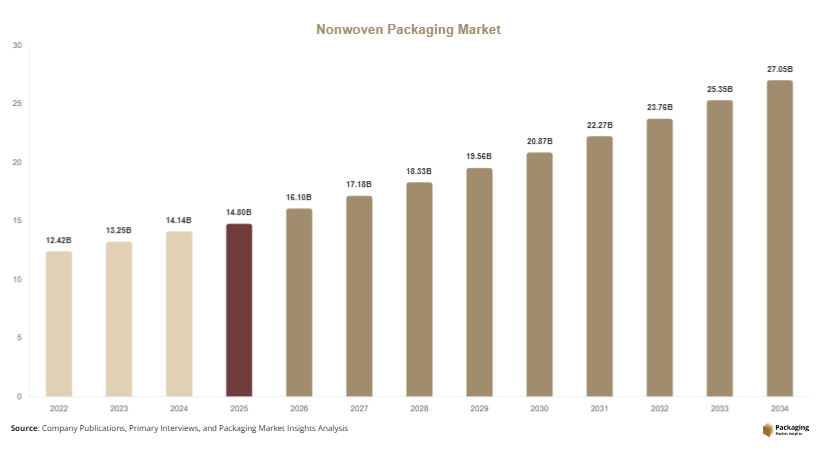
The market size was valued at approximately USD 14.8 billion in 2025 and is projected to reach USD 16.1 billion in 2026. With continuous expansion across retail, healthcare, and industrial sectors, the market is expected to reach USD 28.7 billion by 2034, registering a CAGR of 6.7% during the forecast period (2025–2034).
One of the primary growth factors is the rising demand for eco-friendly packaging solutions. Nonwoven materials, especially those made from polypropylene, offer recyclability and reusability, aligning with global sustainability goals. Governments and regulatory bodies are promoting alternatives to single-use plastics, which is further boosting the adoption of nonwoven packaging products.
Key Highlights:
- The market is projected to reach USD 28.7 billion by 2034, reflecting steady expansion across multiple end-use industries. Increasing applications in retail, healthcare, and industrial packaging are supporting long-term growth.
- The market is expected to grow at a CAGR of 6.7% from 2025 to 2034, indicating consistent development over the forecast period. Rising demand for cost-effective and durable packaging materials is contributing to this growth.
- There is a growing demand for sustainable packaging solutions as industries shift toward eco-friendly alternatives. Regulatory pressure and consumer awareness are encouraging the use of recyclable and reusable nonwoven materials.
- The increasing adoption of nonwoven packaging in healthcare and retail sectors is driving market expansion. These materials offer hygiene, durability, and flexibility, making them suitable for a wide range of applications.
- Advancements in nonwoven manufacturing technologies are enhancing product quality and performance. Innovations such as improved fiber bonding and material strength are expanding the scope of nonwoven packaging solutions.
Explore more data points, trends and opportunities Download Free Sample Report
Market Trends
Increasing Adoption of Sustainable and Reusable Packaging
Sustainability has become a central focus across industries, leading to a noticeable shift toward reusable and recyclable packaging materials. Nonwoven packaging is gaining traction as it offers durability and can be reused multiple times compared to traditional plastic packaging. Consumers are increasingly favoring eco-conscious brands, prompting companies to adopt nonwoven materials for shopping bags, promotional packaging, and product wrapping.
In addition, regulatory pressure to reduce plastic waste is encouraging manufacturers to invest in biodegradable and recyclable nonwoven materials. Retailers and e-commerce companies are adopting these materials to align with environmental goals while maintaining packaging efficiency. This trend is expected to remain strong as sustainability continues to influence purchasing decisions and corporate strategies.
Expansion in E-commerce and Retail Packaging Applications
The rapid growth of e-commerce has significantly influenced the demand for innovative packaging solutions. Nonwoven materials are being increasingly used for protective packaging due to their lightweight structure and strength. These materials help reduce shipping costs while ensuring product safety during transportation.
Retailers are also using nonwoven packaging for branding and marketing purposes. Customized designs, prints, and logos can be easily applied, enhancing brand visibility. The growing preference for visually appealing and functional packaging solutions is driving the integration of nonwoven materials in retail packaging. As online shopping continues to expand, the demand for such packaging solutions is expected to grow steadily.
Market Drivers
Rising Demand from Healthcare and Hygiene Applications
The healthcare sector plays a crucial role in driving the growth of the nonwoven packaging market. Nonwoven materials are widely used in medical packaging due to their ability to provide sterile and contamination-free environments. These materials are used in surgical kits, face masks, and medical wraps, ensuring safety and hygiene.
The increasing focus on infection control and hygiene standards has led to higher demand for disposable and protective packaging solutions. Hospitals and healthcare facilities are adopting nonwoven packaging to maintain strict sanitation protocols. Additionally, the growing awareness of personal hygiene and health safety is further supporting the demand for nonwoven materials in packaging applications.
Growth in Industrial and Agricultural Packaging
Industrial and agricultural sectors are increasingly utilizing nonwoven packaging materials due to their durability and versatility. These materials are used for packaging fertilizers, seeds, and industrial goods, offering protection against moisture and external damage. Their lightweight nature also reduces transportation costs, making them a preferred choice in logistics.
In agriculture, nonwoven packaging is used for crop protection and storage, helping improve product shelf life. The rising demand for efficient packaging solutions in these sectors is contributing to market growth. As industries continue to prioritize cost-effective and reliable packaging options, the adoption of nonwoven materials is expected to increase further.
Market Restraint
Fluctuating Raw Material Prices
One of the key challenges in the nonwoven packaging market is the volatility in raw material prices, particularly polypropylene. These fluctuations can significantly impact production costs and profit margins for manufacturers. Since nonwoven materials are largely derived from petrochemical sources, changes in crude oil prices directly influence the cost structure.
This price instability creates uncertainty for manufacturers and may limit investment in new production facilities. Smaller players, in particular, may struggle to maintain competitive pricing in the market. Additionally, fluctuations in raw material availability can disrupt supply chains, affecting production timelines and delivery schedules.
For example, during periods of high crude oil prices, manufacturers may face increased costs, which are often passed on to end-users. This can reduce demand, especially in price-sensitive markets. As a result, companies are exploring alternative raw materials and cost optimization strategies to mitigate this challenge.
Market Opportunities
Development of Biodegradable Nonwoven Materials
The growing emphasis on environmental sustainability presents significant opportunities for the development of biodegradable nonwoven materials. Manufacturers are investing in research and development to create eco-friendly alternatives that can decompose naturally without harming the environment.
These innovations are expected to open new avenues in industries such as food packaging and retail. Companies that adopt biodegradable materials can enhance their brand image and meet regulatory requirements more effectively. As consumer awareness continues to grow, the demand for such solutions is expected to increase significantly.
Expansion in Emerging Markets
Emerging economies offer substantial growth opportunities for the nonwoven packaging market. Rapid urbanization, increasing disposable incomes, and expanding retail sectors are driving the demand for modern packaging solutions in these regions.
Countries in Asia Pacific, Latin America, and Africa are witnessing increased adoption of nonwoven packaging due to its cost-effectiveness and versatility. Government initiatives to promote sustainable practices are also supporting market growth. As infrastructure improves and industries expand, the demand for nonwoven packaging is expected to rise, creating new opportunities for market players.
Report Scope
| Report Metric | Details |
|---|---|
| Market Size in 2025 | USD 14.8 Billion |
| Market Size in 2026 | USD 16.1 Billion |
| Market Size in 2034 | USD 28.7 Billion |
| CAGR | 6.7% (2026-2034) |
| Base Year for Estimation | 2025 |
| Historical Data | 2022-2024 |
| Forecast Period | 2026-2034 |
| Report Coverage | Revenue Forecast, Competitive Landscape, Supply Chain Disruption, Growth Factors, Environment & Regulatory Landscape and Trends |
| Geographies Covered | North America, Europe, APAC, Middle East and Africa, LATAM |
| Countries Covered | U.S., Canada, U.K., Germany, France, Spain, Italy, Russia, Nordic, Benelux, Rest of Europe, China, South Korea, Japan, India, Australia, Singapore, Taiwan, South East Asia, Rest of Asia-Pacific, UAE, Turky, Saudi Arabia, South Africa, Egypt, Nigeria, Rest of MEA, Brazil, Mexico, Argentina, Chile, Colombia, Rest of LATAM |
Explore more data points, trends and opportunities Download Free Sample Report
Segmental Analysis
By Material Type
Polypropylene-based nonwoven materials dominated the market in 2024, accounting for over 60% of the total market share. These materials are widely used due to their durability, flexibility, and cost-effectiveness. Polypropylene nonwoven fabrics offer excellent resistance to moisture and chemicals, making them suitable for various packaging applications.
Biodegradable nonwoven materials are expected to be the fastest-growing segment, with a projected CAGR of 7.8%. The increasing demand for eco-friendly packaging solutions is driving this growth. Manufacturers are focusing on developing sustainable materials to meet regulatory requirements and consumer preferences.
By Product Type
Bags and sacks dominated the market in 2024, holding a significant share due to their widespread use in retail and industrial applications. These products are preferred for their strength, reusability, and cost efficiency. The growing demand for shopping bags and promotional packaging is contributing to this segment’s growth.
Wraps and protective packaging are expected to be the fastest-growing segment, with a CAGR of 7.2%. The increasing demand for protective packaging in e-commerce and logistics is driving this growth. These materials provide cushioning and protection, ensuring product safety during transportation.
By End-Use Industry
The retail sector dominated the market in 2024, accounting for a large share due to the widespread use of nonwoven packaging in shopping bags and promotional materials. The increasing focus on branding and sustainability is driving demand in this segment.
The healthcare sector is expected to be the fastest-growing segment, with a CAGR of 7.5%. The rising demand for sterile packaging and hygiene products is contributing to this growth. The increasing focus on infection control and safety is further supporting the adoption of nonwoven materials in healthcare packaging.
Nonwoven Packaging Market Segmentations
Material Type
- Polypropylene
- Polyethylene
- Polyester
- Biodegradable Materials
Product Type
- Bags & Sacks
- Wraps
- Pouches
- Protective Packaging
End-Use Industry
- Retail
- Healthcare
- Agriculture
- Industrial
- Food & Beverage
Regional Analysis
North America
North America accounted for a significant share of the nonwoven packaging market in 2025, holding approximately 28% of the global market. The region is expected to grow at a CAGR of 5.9% during the forecast period. Strong demand from healthcare, retail, and industrial sectors is driving market growth. The presence of established manufacturers and advanced production technologies further supports the market expansion in this region.
The United States dominates the North American market due to its well-developed healthcare infrastructure and strong focus on sustainability. The increasing adoption of reusable packaging solutions and strict regulations on plastic usage are encouraging the use of nonwoven materials. Additionally, the growth of e-commerce platforms is further boosting demand for efficient packaging solutions.
Europe
Europe held around 24% of the global market share in 2025 and is projected to grow at a CAGR of 6.1%. The region is characterized by stringent environmental regulations and a strong emphasis on sustainability. These factors are driving the adoption of nonwoven packaging materials across various industries.
Germany is the leading country in the European market, driven by its robust manufacturing sector and focus on innovation. The country is actively investing in sustainable packaging solutions, including biodegradable nonwoven materials. The increasing demand for eco-friendly packaging in retail and food sectors is contributing to market growth.
Asia Pacific
Asia Pacific is the fastest-growing region, accounting for approximately 32% of the market share in 2025, with a projected CAGR of 7.5%. Rapid industrialization, urbanization, and population growth are driving the demand for nonwoven packaging materials in this region.
China leads the Asia Pacific market due to its large manufacturing base and expanding retail sector. The country is witnessing increased demand for cost-effective and durable packaging solutions. Government initiatives promoting sustainable practices are also supporting the adoption of nonwoven materials.
Middle East & Africa
The Middle East & Africa region accounted for around 8% of the market share in 2025 and is expected to grow at a CAGR of 6.3%. The market is driven by increasing investments in infrastructure and industrial development.
Saudi Arabia dominates the region due to its growing industrial sector and focus on diversification. The demand for nonwoven packaging is increasing in sectors such as agriculture and construction. The adoption of modern packaging solutions is supporting market growth.
Latin America
Latin America held approximately 8% of the global market share in 2025 and is projected to grow at a CAGR of 6.4%. The region is experiencing growth due to expanding retail and agricultural sectors.
Brazil is the leading country in Latin America, driven by its strong agricultural industry. The demand for nonwoven packaging in agriculture and food sectors is increasing. The focus on cost-effective and durable packaging solutions is supporting market expansion.
Competitive Landscape
The nonwoven packaging market is moderately fragmented, with several global and regional players competing based on product quality, innovation, and pricing strategies. Leading companies are focusing on expanding their product portfolios and investing in sustainable materials to gain a competitive edge.
Berry Global Group is a key leader in the market, known for its extensive range of nonwoven packaging solutions. The company has recently invested in developing recyclable and biodegradable materials to meet growing sustainability demands. Other major players are also focusing on strategic partnerships, mergers, and acquisitions to strengthen their market position.
Companies are increasingly investing in research and development to improve material performance and reduce environmental impact. The competitive landscape is expected to remain dynamic, with innovation playing a crucial role in shaping market growth.
Key Players List
- Berry Global Group, Inc.
- Freudenberg Group
- Ahlstrom Corporation
- Toray Industries, Inc.
- Kimberly-Clark Corporation
- DuPont de Nemours, Inc.
- Johns Manville Corporation
- Fitesa S.A.
- Mitsui Chemicals, Inc.
- Avgol Industries Ltd.
- TWE Group GmbH
- Glatfelter Corporation
- PFNonwovens Group
- Suominen Corporation
- Fibertex Nonwovens A/S