Nonwoven Fabrics Market Size and Growth
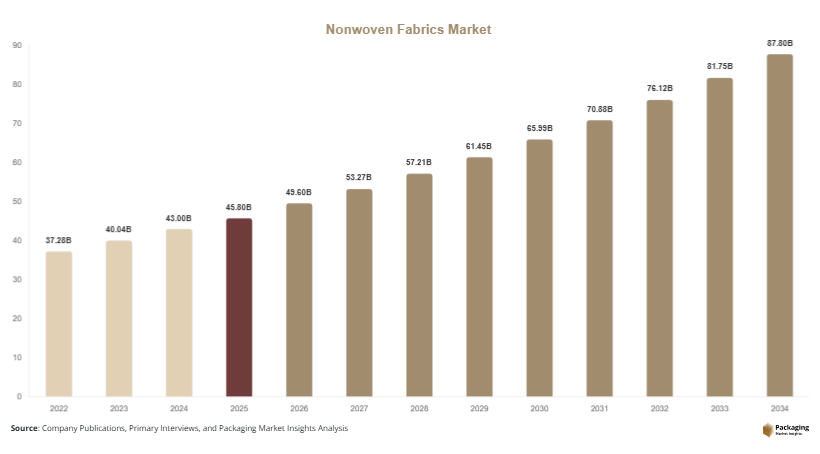
The global nonwoven fabrics market size is USD 45.8 billion in 2025 and is projected to grow to USD 49.6 billion in 2026, supported by increasing demand across medical, hygiene, automotive, construction, and filtration industries. Analysts forecast a CAGR of 7.4% from 2025 to 2034, expecting the market to reach USD 90.2 billion by 2034.
Growth in the nonwoven fabrics market is primarily driven by increasing global healthcare awareness, which has accelerated demand for disposable hygiene products such as face masks, baby diapers, and adult incontinence products. Additionally, urbanization and rising living standards are contributing to higher consumption of nonwoven fabrics in construction, home furnishings, and automotive interiors. Technological advancements in fiber bonding techniques, such as spunbond, meltblown, and needle-punched processes, are enhancing product performance, durability, and cost efficiency.
Key Highlights:
- The market is projected to reach USD 90.2 billion by 2034, expanding at a CAGR of 7.4% during 2025–2034. This reflects steady growth driven by increasing industrial and healthcare demand.
- Rising demand across hygiene, medical, automotive, and filtration industries is significantly contributing to market expansion. These sectors rely on nonwoven fabrics for performance, safety, and cost efficiency.
- Continuous technological advancements and sustainability trends are accelerating adoption. Innovations in eco-friendly materials and high-performance fabrics are supporting long-term market growth.
Explore more data points, trends and opportunities Download Free Sample Report
Market Trends
Growth of Biodegradable and Eco-Friendly Nonwoven Fabrics
The demand for biodegradable and eco-friendly nonwoven fabrics is rapidly increasing due to heightened environmental awareness and stricter regulatory frameworks worldwide. Manufacturers are shifting from petroleum-based fibers to renewable sources such as PLA (polylactic acid) and bamboo fibers. These sustainable materials are increasingly used in disposable hygiene products, medical masks, and packaging applications. This trend not only reduces environmental impact but also appeals to consumers who prioritize eco-conscious choices. The adoption of biodegradable nonwovens is further supported by government initiatives and incentives promoting sustainable manufacturing. Research and development activities are focused on improving durability, cost-effectiveness, and softness of eco-friendly fabrics, making them suitable for a wide range of applications. As global sustainability standards continue to evolve, biodegradable nonwoven fabrics are expected to capture a significant portion of the market, driving innovation and long-term growth.
Integration of Advanced Functionalities in Nonwoven Fabrics
Nonwoven fabrics are increasingly being engineered with advanced functionalities such as antimicrobial properties, water repellency, flame resistance, and filtration efficiency. These functional enhancements are particularly important in healthcare, filtration, and industrial applications. For example, antimicrobial nonwoven fabrics are critical for surgical gowns, hospital bedding, and air filters, reducing infection risks and improving hygiene standards. Innovations in chemical treatments, fiber blending, and surface coatings are enabling manufacturers to customize fabrics for specific end-use requirements. As industries continue to demand high-performance, multifunctional fabrics, this trend is expected to drive adoption across multiple sectors, promoting product differentiation and premium pricing.
Market Drivers
Growing Demand for Hygiene and Medical Products
One of the primary drivers of the nonwoven fabrics market is the rising global demand for hygiene and medical products. Nonwoven fabrics are extensively used in disposable face masks, surgical gowns, wipes, diapers, and adult incontinence products. Increasing public health awareness and heightened hygiene standards, particularly following global health crises, have boosted production and consumption of nonwoven materials. These fabrics provide superior filtration, breathability, and fluid resistance, making them essential in medical and healthcare applications. Moreover, the expanding healthcare infrastructure in emerging economies is fueling demand for nonwoven fabrics in hospitals, clinics, and homecare products. The convenience, cost-effectiveness, and disposable nature of nonwoven fabrics further encourage their adoption in hygiene and medical applications, ensuring steady market growth.
Expansion in Industrial and Automotive Applications
Industrial and automotive sectors are witnessing increased utilization of nonwoven fabrics due to their lightweight, durable, and versatile nature. Nonwoven materials are used in automotive interiors, insulation, geotextiles, and filtration products, offering benefits such as sound absorption, thermal insulation, and structural reinforcement. The rise of urbanization, infrastructure development, and automotive production globally contributes to higher nonwoven fabric consumption. Additionally, advancements in production technologies such as spunbond, meltblown, and hydroentanglement enable customization to meet specific performance requirements. The integration of nonwoven fabrics in filtration systems, including air, liquid, and oil filters, is also expanding rapidly, driven by industrial regulations and environmental standards. These applications provide a consistent growth pathway, complementing demand from healthcare and hygiene segments.
Market Restraint
High Raw Material Costs and Supply Volatility
Despite the promising growth, the nonwoven fabrics market faces constraints due to high raw material costs and supply volatility. Polypropylene, polyester, and other synthetic polymers constitute the majority of nonwoven fabrics, and fluctuations in petrochemical prices directly impact production costs. This creates challenges for manufacturers, especially small- and medium-sized enterprises (SMEs), in maintaining competitive pricing while ensuring consistent product quality.
Supply chain disruptions, such as shipping delays and raw material shortages, further exacerbate the situation, affecting production schedules and delivery timelines. For example, during periods of global supply chain uncertainty, manufacturers may face difficulties in sourcing high-quality fibers, leading to production bottlenecks and increased operational costs. Price-sensitive industries like hygiene and packaging may experience slower adoption due to cost constraints, limiting overall market expansion. Companies are actively exploring alternative raw materials, recycled fibers, and regional sourcing strategies to mitigate these risks. Nevertheless, raw material cost volatility remains a significant restraint that could slow growth and impact profitability, particularly in highly competitive markets.
Market Opportunities
Rising Adoption in Filtration and Protective Applications
The increasing demand for high-performance filtration and protective products offers significant opportunities for nonwoven fabrics. Nonwoven materials are ideal for air and liquid filtration, personal protective equipment (PPE), and industrial filtration systems due to their porous structure, durability, and customizable fiber arrangement. For instance, meltblown nonwoven fabrics are critical in manufacturing face masks and respirators, providing effective filtration efficiency. As environmental regulations tighten and industries prioritize air and water quality, the adoption of nonwoven fabrics in filtration applications is expected to accelerate. Manufacturers can leverage this trend by developing high-performance, functionalized fabrics tailored to specific industrial and healthcare requirements.
Growth in Emerging Economies
Emerging economies present a substantial growth opportunity for the nonwoven fabrics market. Rising disposable income, urbanization, and expanding healthcare infrastructure in countries such as India, China, Brazil, and Indonesia are driving demand for hygiene, medical, and industrial products made from nonwoven materials. Governments are also supporting manufacturing initiatives and sustainable practices, encouraging local production and adoption. The growing e-commerce sector in these regions further increases demand for nonwoven packaging and protective materials. By targeting these high-potential markets with cost-effective, high-quality products, manufacturers can achieve substantial market penetration and revenue growth over the next decade.
Report Scope
| Report Metric | Details |
|---|---|
| Market Size in 2025 | USD 45.8 Billion |
| Market Size in 2026 | USD 49.6 Billion |
| Market Size in 2034 | USD 90.2 Billion |
| CAGR | 7.4% (2026-2034) |
| Base Year for Estimation | 2025 |
| Historical Data | 2022-2024 |
| Forecast Period | 2026-2034 |
| Report Coverage | Revenue Forecast, Competitive Landscape, Supply Chain Disruption, Growth Factors, Environment & Regulatory Landscape and Trends |
| Geographies Covered | North America, Europe, APAC, Middle East and Africa, LATAM |
| Countries Covered | U.S., Canada, U.K., Germany, France, Spain, Italy, Russia, Nordic, Benelux, Rest of Europe, China, South Korea, Japan, India, Australia, Singapore, Taiwan, South East Asia, Rest of Asia-Pacific, UAE, Turky, Saudi Arabia, South Africa, Egypt, Nigeria, Rest of MEA, Brazil, Mexico, Argentina, Chile, Colombia, Rest of LATAM |
Explore more data points, trends and opportunities Download Free Sample Report
Segmental Analysis
By Type
The spunbond nonwoven fabrics segment dominated the market in 2024, accounting for nearly 42% of total revenue. Spunbond fabrics are lightweight, durable, and cost-effective, making them suitable for disposable hygiene products, surgical gowns, geotextiles, and packaging applications. The high tensile strength and versatility of spunbond fabrics allow manufacturers to produce large volumes at lower costs. Their resistance to tearing and ability to combine with other layers, such as meltblown fabrics, makes them ideal for filtration, medical, and industrial applications. Additionally, innovations in fiber bonding techniques and surface treatments enhance fabric performance, durability, and softness, maintaining strong demand for spunbond nonwovens.
The meltblown nonwoven fabrics segment is the fastest-growing, with a CAGR of 9.5% from 2025 to 2034. Meltblown fabrics are widely used in face masks, respirators, filtration systems, and protective clothing due to their fine fiber structure and high filtration efficiency. Rising demand in healthcare, industrial filtration, and environmental protection applications drives growth. Manufacturers are investing in improved production technologies to enhance filtration performance, reduce fiber diameter, and achieve better cost efficiency. The growing awareness of air quality and protective equipment requirements globally further accelerates the adoption of meltblown nonwoven fabrics.
By Application
The hygiene and medical segment dominated in 2024, holding around 48% market share. Products such as diapers, adult incontinence products, surgical gowns, masks, wipes, and feminine hygiene items extensively use nonwoven fabrics. Superior fluid absorption, softness, and breathability make these fabrics ideal for disposable hygiene and medical products. Rising awareness of hygiene and preventive healthcare globally, particularly in emerging economies, has boosted demand. Manufacturers are leveraging innovative fiber compositions, layered structures, and functional finishes to meet end-user requirements, reinforcing segment dominance.
The filtration segment is the fastest-growing application, projected to record a CAGR of 8.8% from 2025 to 2034. Industrial, HVAC, automotive, and water filtration systems increasingly rely on nonwoven fabrics for their high porosity, strength, and filtration efficiency. Environmental regulations and rising concerns about air and water pollution are further accelerating adoption. Manufacturers are investing in engineered nonwoven fabrics to enhance particulate capture, durability, and chemical resistance. The growing emphasis on clean air and water solutions presents a lucrative opportunity for expansion in filtration applications.
By End-Use
The automotive end-use segment accounted for the largest share in 2024, representing approximately 35% of the market. Nonwoven fabrics are extensively used in automotive interiors, insulation, carpeting, and acoustic materials. Lightweight, cost-effective, and durable fabrics help improve vehicle performance, fuel efficiency, and passenger comfort. Rising automotive production globally, particularly in Asia Pacific, supports consistent demand. Manufacturers focus on developing flame-resistant, sound-absorbing, and eco-friendly nonwoven fabrics to meet automotive standards and consumer expectations.
The construction and building segment is projected to grow at the fastest rate, with a CAGR of 9.2% from 2025 to 2034. Nonwoven fabrics are used in roofing, insulation, geotextiles, and wall coverings. They offer benefits such as thermal insulation, water resistance, and structural reinforcement. Rapid urbanization, government infrastructure investments, and rising construction activities in emerging economies are driving adoption. Additionally, lightweight and recyclable nonwoven fabrics align with sustainable construction practices, further supporting segment growth.
Nonwoven Fabrics Market Segmentations
By Type
- Spunbond Nonwoven Fabrics
- Meltblown Nonwoven Fabrics
- Needle-Punched Nonwoven Fabrics
- Wet-Laid Nonwoven Fabrics
By Application
- Hygiene & Medical
- Filtration
- Industrial & Automotive
- Construction & Building
By End-Use
- Healthcare & Hygiene
- Automotive
- Industrial
- Construction & Building
Regional Analysis
North America
North America accounted for approximately 32% of the global nonwoven fabrics market in 2025, with a projected CAGR of 6.5% from 2025 to 2034. The region benefits from advanced healthcare infrastructure, strong automotive and industrial sectors, and high consumer awareness about hygiene and safety. Rising adoption of disposable medical products, protective apparel, and filtration systems drives consistent demand for nonwoven fabrics. Strategic investments in R&D by key players are enhancing product performance and cost efficiency, further supporting growth in the region.
The United States dominates the North American market due to its robust healthcare and hygiene industries. A unique growth factor is the widespread use of nonwoven fabrics in surgical gowns, masks, and wipes, driven by stringent safety standards and public health policies. Moreover, increasing industrial and automotive applications, including insulation and filtration, contribute to market expansion. Manufacturers are leveraging advanced production techniques to meet growing demand while maintaining high-quality standards, reinforcing the U.S. market’s leading position.
Europe
Europe held approximately 28% of the global market in 2025, with an estimated CAGR of 6.8% during 2025–2034. The region is characterized by strict regulations for healthcare, hygiene, and environmental sustainability, encouraging adoption of high-quality nonwoven fabrics. Industrial, automotive, and construction applications also support consistent demand. The focus on product standardization and eco-friendly materials strengthens Europe’s position in the global market.
Germany leads the European market, driven by a robust manufacturing sector and healthcare infrastructure. A unique growth factor is the integration of nonwoven fabrics in industrial filtration and automotive interiors, particularly in high-performance vehicles. German manufacturers are investing in sustainable production technologies and functionalized fabrics to meet regulatory standards, improve efficiency, and reduce environmental impact, ensuring continued market growth.
Asia Pacific
Asia Pacific accounted for approximately 25% of the global market in 2025, with a projected CAGR of 8.2% through 2034. Rapid industrialization, rising population, urbanization, and growing disposable income contribute to increasing nonwoven fabric demand in hygiene, medical, and industrial applications. Expansion of healthcare infrastructure and rising public health awareness also drive consumption.
China dominates the Asia Pacific market due to its massive manufacturing base and growing healthcare and hygiene industries. A unique growth factor is the government’s support for domestic production of disposable medical and hygiene products. Rising demand for face masks, diapers, and adult incontinence products, coupled with strong export potential, positions China as a key growth driver for the regional nonwoven fabrics market.
Middle East & Africa
The Middle East & Africa region accounted for 8% of the global market in 2025, with a CAGR of 6.0% during 2025–2034. Demand is driven by healthcare expansion, construction activities, and industrial applications. Nonwoven fabrics are increasingly used in protective apparel, filtration, and hygiene products in hospitals and industrial facilities.
United Arab Emirates (UAE) dominates the region due to its advanced healthcare infrastructure and strategic position as a logistics hub. A unique growth factor is the high adoption of protective and filtration products in industrial sectors, combined with rising consumer awareness regarding hygiene and safety. Local manufacturers are expanding production capabilities to meet growing demand across healthcare and industrial applications.
Latin America
Latin America contributed approximately 7% of the global market in 2025, with an expected CAGR of 7.1% through 2034. The region benefits from increasing healthcare awareness, urbanization, and industrialization, supporting nonwoven fabric demand. Expanding automotive and construction industries further drive market growth.
Brazil is the dominant country in Latin America due to its large healthcare sector and growing consumer hygiene market. A unique growth factor is the adoption of nonwoven fabrics in disposable medical and hygiene products, such as masks, diapers, and wipes. Government initiatives supporting local production and environmental sustainability also encourage the use of biodegradable and recyclable fabrics.
Competitive Landscape
The nonwoven fabrics market is moderately consolidated, with leading players focusing on technological advancements, strategic acquisitions, and geographic expansion. Berry Global, Inc. is recognized as a market leader, actively investing in innovative nonwoven solutions for hygiene, healthcare, and industrial applications. Recently, Berry Global launched a biodegradable spunbond fabric line, catering to the growing demand for eco-friendly and sustainable materials, strengthening its market position.
Other key players include Freudenberg Group, Ahlstrom-Munksjö, Kimberly-Clark Corporation, and Oerlikon Nonwoven GmbH. These companies are leveraging R&D to develop high-performance fabrics with advanced functionalities, such as antimicrobial, flame-retardant, and filtration-enhanced properties. Collaborations with healthcare, hygiene, and automotive industries are enabling the integration of nonwoven fabrics in innovative applications. Strategic investments in emerging markets further support revenue growth, allowing these companies to expand product portfolios and improve competitiveness in the global nonwoven fabrics market.
Key Players List
- Berry Global, Inc.
- Freudenberg Group
- Ahlstrom-Munksjö
- Kimberly-Clark Corporation
- Oerlikon Nonwoven GmbH
- DuPont de Nemours, Inc.
- Johns Manville
- Sandler AG
- Avgol Industries
- Suominen Corporation
- Pegas Nonwovens
- Fitesa S.A.
- Toray Industries, Inc.
- Lydall, Inc.
- Glatfelter