Non Recyclable Plastic Packaging Market Size and Growth
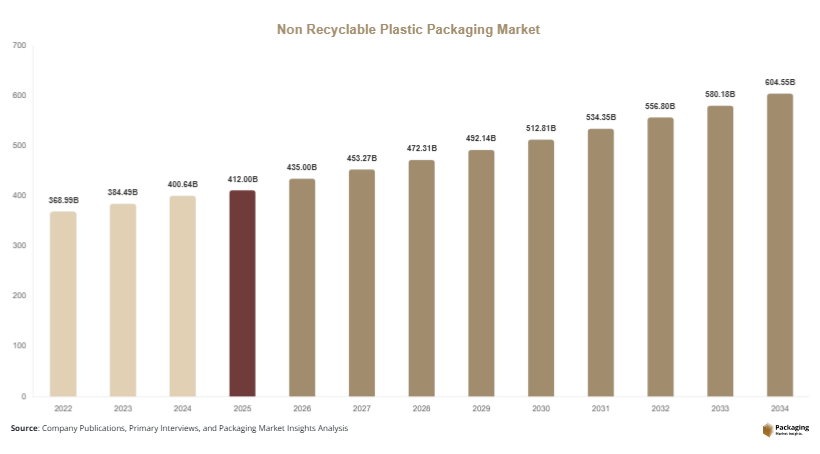
The global non recyclable plastic packaging market size was valued at approximately USD 412 billion in 2025 and is projected to reach USD 435 billion in 2026, reflecting steady demand across food packaging, personal care, industrial goods, and consumer retail sectors. Over the forecast period from 2025 to 2034, the market is expected to grow at a CAGR of 4.2%, reaching around USD 620 billion by 2034. Despite rising sustainability concerns, non recyclable plastics remain deeply embedded in global supply chains due to their affordability and functional advantages. The non recyclable plastic packaging market continues to hold a substantial position in the global packaging industry due to its widespread use in low-cost, high-volume applications.
One of the primary growth factors is the continued demand for low-cost packaging solutions. Non recyclable plastics such as multi-layer films, composite laminates, and certain polyethylene blends are widely used because they offer strong barrier properties at a relatively low cost. These materials are particularly important in emerging economies where cost sensitivity plays a major role in packaging decisions.
Key Highlights:
- The market size reached USD 412 billion in 2025, supported by strong demand across multiple end-use industries including food, e-commerce, and industrial packaging. This reflects the continued reliance on cost-efficient plastic packaging solutions globally.
- It is projected to reach USD 620 billion by 2034, driven by steady consumption growth and ongoing dependence on flexible and multilayer plastic formats. Expansion in emerging economies further supports long-term market growth.
- The market is expected to register a CAGR of 4.2% during 2025–2034, indicating stable but moderate expansion. Growth is sustained by high-volume packaging requirements across global supply chains.
- Strong demand from food, e-commerce, and industrial packaging sectors continues to be a key growth driver. These industries rely heavily on durable, lightweight, and scalable packaging materials for mass distribution.
- Continued use is supported by cost efficiency and strong barrier performance of non recyclable plastics. These properties make them suitable for preserving product quality and reducing packaging costs.
- Limited global recycling infrastructure further supports sustained adoption of these materials. In many regions, lack of advanced waste processing systems results in continued reliance on conventional plastic packaging formats.
Explore more data points, trends and opportunities Download Free Sample Report
Market Trends
Growth of Multi-Layer Non Recyclable Packaging Structures
A key trend in the non recyclable plastic packaging market is the increasing use of multi-layer laminated structures. These packaging formats combine different plastic materials to enhance barrier properties, strength, and shelf life. Common applications include snack packaging, dairy products, and pharmaceutical blister packs. These multi-layer systems are difficult to separate during recycling, making them non recyclable by design. Manufacturers continue to adopt these structures due to their superior performance in preserving product freshness and preventing contamination. Additionally, advancements in lamination technology have improved sealing efficiency, making these materials more reliable for long-distance transportation and storage applications.
Expansion of Flexible Packaging in Mass Consumption Segments
Flexible packaging made from non recyclable plastics is witnessing increasing adoption in mass consumption industries. Products such as sachets, pouches, and wrappers are widely used in personal care, food, and household product segments. These formats offer convenience, lightweight properties, and low production costs, making them suitable for high-volume markets. The trend is particularly strong in emerging economies, where single-use packaging formats dominate retail distribution. Despite environmental concerns, flexible non recyclable plastics continue to grow due to their affordability and compatibility with automated filling and sealing systems used in large-scale manufacturing.
Market Drivers
Rising Demand for Affordable Packaging Solutions
Cost efficiency remains one of the strongest drivers of the non recyclable plastic packaging market. Manufacturers and brand owners prioritize packaging solutions that reduce production and logistics expenses. Non recyclable plastics offer low material costs and high production scalability, making them suitable for mass-market products. In price-sensitive markets, particularly in Asia and Africa, these materials remain dominant due to limited access to advanced recycling infrastructure and higher costs of alternative materials. The ability to produce large volumes at low cost ensures continued adoption across food, beverage, and consumer goods industries.
Expansion of Packaged Food and Beverage Industry
The global expansion of the packaged food and beverage sector significantly drives demand for non recyclable plastic packaging. Products such as frozen foods, instant meals, snacks, and beverages require packaging that ensures long shelf life and product integrity. Non recyclable plastics provide excellent moisture, oxygen, and contamination barriers, making them suitable for these applications. Urbanization, changing lifestyles, and increasing demand for convenience foods further strengthen this trend. The growing penetration of supermarkets and online grocery platforms also contributes to rising packaging consumption globally.
Market Restraint
Environmental Regulations and Plastic Waste Concerns
One of the major restraints in the non recyclable plastic packaging market is increasing environmental pressure and regulatory restrictions. Governments across Europe, North America, and parts of Asia are introducing bans or taxes on non recyclable and single-use plastics. These regulations aim to reduce landfill waste and marine pollution, directly impacting market growth.
The environmental impact of non recyclable plastics is significant due to their long degradation cycle and inability to be processed through conventional recycling systems. For example, multi-layer packaging used in snack foods and ready-to-eat meals often ends up in landfills because it cannot be efficiently separated into recyclable components. This has led to rising criticism from environmental organizations and consumers, forcing companies to explore alternative materials. As regulatory frameworks tighten, manufacturers face increasing pressure to redesign packaging systems, which may raise operational costs and reduce reliance on traditional non recyclable formats.
Market Opportunities
Innovation in Cost-Optimized Barrier Materials
Despite environmental concerns, opportunities exist in developing improved non recyclable plastic materials with enhanced performance characteristics. Manufacturers are investing in advanced polymer blends that offer better barrier properties, reduced thickness, and improved durability. These innovations help reduce material usage while maintaining packaging efficiency. Such developments are particularly relevant for food preservation and industrial packaging applications. Additionally, companies are exploring additives that enhance strength and heat resistance, enabling broader use in extreme conditions. This allows manufacturers to maintain cost advantages while improving functionality.
Growth in Emerging Retail and Informal Markets
Emerging markets present significant opportunities for non recyclable plastic packaging due to expanding retail networks and informal distribution channels. In many developing economies, low-cost packaging remains essential for small-scale producers and local brands. Products sold in kiosks, street markets, and rural retail outlets often rely heavily on single-use plastic packaging due to affordability and availability. Increasing urbanization and rising consumer spending further expand demand. As retail penetration increases, especially in Asia Pacific and Africa, non recyclable plastics will continue to play a major role in packaging ecosystems.
Report Scope
| Report Metric | Details |
|---|---|
| Market Size in 2025 | USD 412 Billion |
| Market Size in 2026 | USD 435 Billion |
| Market Size in 2034 | USD 620 Billion |
| CAGR | 4.2% (2026-2034) |
| Base Year for Estimation | 2025 |
| Historical Data | 2022-2024 |
| Forecast Period | 2026-2034 |
| Report Coverage | Revenue Forecast, Competitive Landscape, Supply Chain Disruption, Growth Factors, Environment & Regulatory Landscape and Trends |
| Geographies Covered | North America, Europe, APAC, Middle East and Africa, LATAM |
| Countries Covered | U.S., Canada, U.K., Germany, France, Spain, Italy, Russia, Nordic, Benelux, Rest of Europe, China, South Korea, Japan, India, Australia, Singapore, Taiwan, South East Asia, Rest of Asia-Pacific, UAE, Turky, Saudi Arabia, South Africa, Egypt, Nigeria, Rest of MEA, Brazil, Mexico, Argentina, Chile, Colombia, Rest of LATAM |
Explore more data points, trends and opportunities Download Free Sample Report
Segmental Analysis
By Material Type
Multi-layer plastics dominated the market in 2024, accounting for approximately 44% share. These materials are widely used in food packaging, snack wrappers, and pharmaceutical blister packs due to their superior barrier properties. Their ability to extend shelf life and prevent contamination makes them highly valuable for manufacturers. However, their complex structure makes them non recyclable, contributing to environmental concerns.
Polyethylene-based non recyclable packaging is expected to grow fastest at a CAGR of 4.8%. This growth is driven by increasing use in flexible packaging, industrial wrapping, and retail applications. Its low cost, ease of processing, and high availability make it a preferred choice in emerging markets.
By Packaging Type
Flexible packaging dominated the market in 2024 with around 52% share. It includes pouches, sachets, and wraps used across food, personal care, and household products. Its lightweight nature and cost efficiency drive widespread adoption in mass consumer markets.
Rigid packaging is expected to grow fastest at a CAGR of 4.1%, driven by demand for durable containers in beverages, industrial goods, and pharmaceuticals. Its structural strength supports product safety during storage and transportation.
By End-Use Industry
Food and beverage dominated in 2024 with approximately 48% share. The sector relies heavily on non recyclable plastics for packaging processed foods, snacks, and beverages due to their barrier protection and affordability.
E-commerce and logistics is expected to grow fastest at a CAGR of 5.3%, driven by increasing online retail penetration and demand for protective packaging solutions such as wraps and mailer films.
Non Recyclable Plastic Packaging Market Segmentations
By Material Type
- Multi-Layer Plastics
- Polyethylene (PE)
- Polypropylene (PP)
- Composite Laminates
By Packaging Type
- Flexible Packaging
- Rigid Packaging
- Semi-Rigid Packaging
By End-Use Industry
- Food & Beverage
- E-commerce & Logistics
- Personal Care & Household
- Industrial Applications
Regional Analysis
North America
North America accounted for approximately 22% market share in 2025, with a CAGR of 3.6% during the forecast period. The region shows moderate demand driven by food processing, e-commerce packaging, and industrial applications. However, regulatory pressure is gradually influencing material substitution trends.
The United States dominates the region due to its large consumer base and advanced packaging industry. A key growth factor is the continued demand for packaged convenience foods, which rely heavily on barrier-rich plastic packaging formats for shelf stability.
Europe
Europe held around 24% market share in 2025, with a CAGR of 3.2%. The region is strongly influenced by strict environmental policies and sustainability targets, which are limiting growth of non recyclable plastics.
Germany leads the region due to its strong manufacturing and food processing industries. A unique growth factor is the use of high-performance laminated packaging in industrial exports, which still relies on non recyclable materials for durability.
Asia Pacific
Asia Pacific accounted for approximately 38% market share in 2025, with the highest CAGR of 5.1%. Rapid urbanization, population growth, and expansion of packaged goods consumption drive strong demand across the region.
China dominates the market due to large-scale manufacturing and food distribution networks. A key growth factor is the widespread use of low-cost flexible packaging in fast-moving consumer goods and retail sectors.
Middle East & Africa
The Middle East & Africa region held about 8% market share in 2025, growing at a CAGR of 4.0%. Demand is driven by food imports, retail expansion, and urban population growth.
Saudi Arabia leads the region due to strong retail modernization and food distribution systems. A unique growth factor is the reliance on imported packaged food products requiring durable plastic packaging for long-distance transport.
Latin America
Latin America accounted for approximately 8% market share in 2025, with a CAGR of 4.3%. Growth is supported by expanding food processing industries and increasing retail penetration.
Brazil dominates the region due to its large consumer base and agricultural processing industry. A key growth factor is the strong demand for low-cost flexible packaging in processed food distribution networks.
Competitive Landscape
The non recyclable plastic packaging market is highly competitive and fragmented, with global players focusing on cost optimization and production efficiency. Companies are investing in high-speed manufacturing lines and advanced polymer technologies to maintain competitiveness. Competition is largely based on pricing, material performance, and supply chain reach.
Amcor plc is a leading player in the market, with strong global operations and diversified plastic packaging solutions. The company has recently expanded its flexible packaging production capacity to meet growing demand from food and retail sectors. Other key players are focusing on regional expansion and product customization strategies.
Key Players List
- Amcor plc
- Berry Global Inc.
- Sealed Air Corporation
- Sabic
- ExxonMobil Chemical
- Dow Inc.
- LyondellBasell Industries
- INEOS Group
- Huhtamaki Oyj
- Uflex Limited
- Coveris Holdings
- Plastipak Holdings
- Bemis Company (Amcor)
- Sigma Plastics Group
- Winpak Ltd.