Non Cushioned Mailers Market Size and Growth
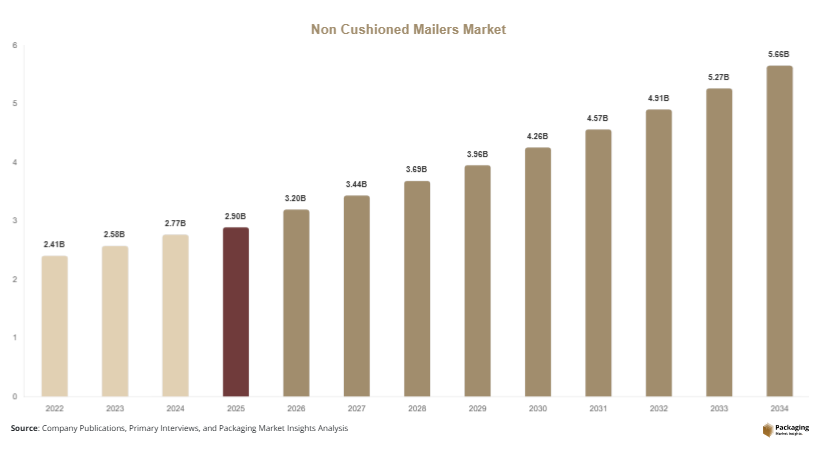
The non cushioned mailers market is expanding steadily due to rising demand for lightweight, cost-effective, and sustainable packaging solutions across e-commerce, retail, and logistics industries. Non cushioned mailers, typically made from paper or polyethylene without internal padding, are widely used for shipping documents, apparel, books, and other non-fragile goods. In 2025, the market size is estimated at USD 2.9 billion, increasing to approximately USD 3.2 billion in 2026. By 2034, the market is projected to reach USD 6.1 billion, registering a compound annual growth rate (CAGR) of 7.4% from 2025 to 2034.
One of the primary growth factors is the rapid expansion of e-commerce platforms, which require efficient and economical packaging for high-volume shipments. Non cushioned mailers provide a cost-effective solution for shipping lightweight items, helping businesses reduce packaging and transportation costs. Another key factor is the increasing focus on sustainability. Paper-based mailers are recyclable and biodegradable, aligning with environmental regulations and consumer preferences for eco-friendly packaging.
Key Highlights:
- The market is projected to reach USD 6.1 billion by 2034, reflecting steady expansion driven by increasing demand for efficient packaging. Growth is supported by rising adoption across logistics, retail, and online delivery sectors.
- The market is expected to grow at a CAGR of 7.4% during 2025–2034. This growth rate indicates strong momentum due to evolving packaging needs and increasing shipment volumes.
- Adoption in e-commerce and retail sectors is growing significantly. Businesses are using non cushioned mailers for lightweight and non-fragile products to improve efficiency and reduce packaging complexity.
- Demand for sustainable and lightweight packaging is increasing steadily. Paper-based mailers and recyclable materials are gaining traction due to environmental concerns and regulatory requirements.
- There is a rising focus on cost-effective shipping solutions across industries. Non cushioned mailers help reduce packaging weight and material usage, leading to lower transportation and operational costs.
Explore more data points, trends and opportunities Download Free Sample Report
Market Trends
Growing Adoption of Eco-Friendly and Paper-Based Mailers
The shift toward sustainable packaging is a prominent trend in the non cushioned mailers market. Companies are increasingly adopting paper-based mailers made from recycled materials to reduce environmental impact. These mailers are biodegradable and align with global sustainability goals, making them attractive to both businesses and consumers. Regulatory pressures and corporate sustainability commitments are encouraging the transition from plastic to paper-based alternatives. Additionally, advancements in paper strength and coating technologies are improving durability, enabling wider application across industries. This trend is expected to reshape material preferences and drive innovation in eco-friendly packaging solutions.
Integration of Customization and Branding in Mailer Packaging
Customization and branding are becoming important aspects of non cushioned mailers. Businesses are using mailers as a marketing tool by incorporating logos, designs, and personalized messages. This trend is particularly significant for e-commerce and DTC brands that aim to enhance customer experience. Advanced printing technologies are enabling high-quality and cost-effective customization. Additionally, tailored mailer sizes are helping reduce material usage and improve packaging efficiency. As competition intensifies, companies are leveraging customized mailers to differentiate their products and strengthen brand identity.
Market Drivers
Expansion of E-commerce and Online Retail
The rapid growth of e-commerce is a major driver of the non cushioned mailers market. Online retailers require efficient packaging solutions to handle large volumes of shipments. Non cushioned mailers are ideal for shipping lightweight and non-fragile items, offering cost savings and ease of handling. The increasing number of online shoppers and the expansion of digital marketplaces are driving demand for these mailers. Additionally, the growth of same-day and next-day delivery services is increasing the need for quick and efficient packaging solutions, further supporting market growth.
Demand for Cost-Effective and Lightweight Packaging Solutions
Businesses are focusing on reducing packaging and shipping costs, which is driving the adoption of non cushioned mailers. These mailers are lightweight and require less material compared to traditional packaging solutions, resulting in lower transportation costs. They also reduce the need for additional protective materials, simplifying the packaging process. As companies strive to improve operational efficiency and profitability, the demand for cost-effective packaging solutions is expected to increase, supporting the growth of the market.
Market Restraint
Limited Protection for Fragile Products
One of the key restraints in the non cushioned mailers market is their limited ability to protect fragile items. Unlike cushioned mailers or boxes with protective inserts, non cushioned mailers do not provide adequate cushioning against impact or pressure. This limits their application to non-fragile goods such as documents, clothing, and books. For example, electronics or glass items require more protective packaging solutions, which reduces the adoption of non cushioned mailers in certain industries. Additionally, damage during transit can lead to product returns and increased costs for businesses. This limitation poses a challenge for market growth, particularly in segments requiring higher levels of protection.
Market Opportunities
Growth of Direct-to-Consumer Brands and Subscription Services
The rise of direct-to-consumer brands and subscription-based services presents significant opportunities for the non cushioned mailers market. These businesses require efficient and cost-effective packaging solutions for regular shipments. Non cushioned mailers are well-suited for delivering products such as apparel, books, and small accessories. The growing popularity of subscription boxes and recurring delivery services is increasing demand for these mailers. Additionally, the ability to customize mailers for branding purposes enhances customer engagement, creating further growth opportunities.
Technological Advancements in Material Strength and Design
Advancements in material technology are creating opportunities for the development of stronger and more durable non cushioned mailers. Innovations such as reinforced paper and improved sealing mechanisms are enhancing product performance. These advancements allow mailers to handle a wider range of products while maintaining cost efficiency. Additionally, the integration of tamper-evident features and water-resistant coatings is improving security and reliability. As technology continues to evolve, the application scope of non cushioned mailers is expected to expand, supporting market growth.
Report Scope
| Report Metric | Details |
|---|---|
| Market Size in 2025 | USD 2.9 Billion |
| Market Size in 2026 | USD 3.2 Billion |
| Market Size in 2034 | USD 6.1 Billion |
| CAGR | 7.4% (2026-2034) |
| Base Year for Estimation | 2025 |
| Historical Data | 2022-2024 |
| Forecast Period | 2026-2034 |
| Report Coverage | Revenue Forecast, Competitive Landscape, Supply Chain Disruption, Growth Factors, Environment & Regulatory Landscape and Trends |
| Geographies Covered | North America, Europe, APAC, Middle East and Africa, LATAM |
| Countries Covered | U.S., Canada, U.K., Germany, France, Spain, Italy, Russia, Nordic, Benelux, Rest of Europe, China, South Korea, Japan, India, Australia, Singapore, Taiwan, South East Asia, Rest of Asia-Pacific, UAE, Turky, Saudi Arabia, South Africa, Egypt, Nigeria, Rest of MEA, Brazil, Mexico, Argentina, Chile, Colombia, Rest of LATAM |
Explore more data points, trends and opportunities Download Free Sample Report
Segmental Analysis
By Material Type
The paper segment dominated the non cushioned mailers market in 2024, accounting for approximately 65% of the total market share. Paper mailers are widely preferred due to their eco-friendly nature and recyclability. They align with sustainability goals and regulatory requirements, making them a popular choice among businesses. Additionally, paper mailers offer adequate strength for shipping non-fragile items and can be easily customized for branding purposes. The growing demand for sustainable packaging solutions is further supporting the dominance of this segment.
The plastic segment is expected to be the fastest-growing, with a projected CAGR of 7.9% during the forecast period. Plastic mailers offer advantages such as water resistance and durability, making them suitable for various applications. The increasing demand for flexible and lightweight packaging solutions is driving the growth of this segment. Additionally, advancements in recyclable plastics are addressing environmental concerns, supporting market expansion.
By Application
The e-commerce segment held the largest share in 2024, accounting for nearly 60% of the market. The rapid growth of online retail is driving demand for efficient packaging solutions. Non cushioned mailers are widely used for shipping clothing, accessories, and documents. Their lightweight nature and cost-effectiveness make them ideal for high-volume shipments. The increasing number of online shoppers and the expansion of e-commerce platforms are further supporting the growth of this segment.
The retail segment is projected to be the fastest-growing, with a CAGR of 7.8% during the forecast period. Retail businesses are increasingly adopting non cushioned mailers for packaging and shipping products. The growing trend of omnichannel retail is driving demand for efficient packaging solutions. Additionally, the focus on enhancing customer experience through branded packaging is supporting the growth of this segment.
By End-Use
The logistics and shipping segment dominated the market in 2024, holding around 62% share. This segment includes courier services and distribution centers that require efficient packaging solutions. Non cushioned mailers help reduce shipping costs and improve operational efficiency. The increasing demand for fast and reliable delivery services is driving the adoption of these mailers.
The direct-to-consumer segment is expected to witness the fastest growth, with a CAGR of 8.1%. DTC brands rely on efficient packaging solutions to deliver products directly to customers. Non cushioned mailers offer cost-effective and customizable options, making them suitable for this segment. The growth of DTC brands and subscription services is further supporting market expansion.
Non Cushioned Mailers Market Segmentations
Material Type
- Paper Mailers
- Plastic Mailers
Application
- E-commerce Shipments
- Retail Packaging
- Others
End-Use
- Logistics & Shipping
- Direct-to-Consumer (DTC) Brands
Regional Analysis
North America
North America accounted for approximately 33% of the non cushioned mailers market share in 2025 and is expected to grow at a CAGR of 7.0% during the forecast period. The region’s strong e-commerce infrastructure and high consumer spending are key factors driving market growth. Companies in North America are increasingly adopting lightweight packaging solutions to reduce shipping costs and improve efficiency.
The United States dominates the regional market due to its large online retail sector. A unique growth factor in this region is the increasing demand for sustainable packaging solutions. Businesses are adopting paper-based mailers to meet environmental regulations and consumer preferences, supporting market expansion.
Europe
Europe held around 27% market share in 2025 and is projected to grow at a CAGR of 6.8%. The region’s focus on sustainability and regulatory compliance is influencing the non cushioned mailers market. Companies are prioritizing eco-friendly packaging solutions to reduce environmental impact.
Germany is a leading country in the European market, supported by its strong logistics and manufacturing sectors. A key growth factor is the increasing adoption of recyclable packaging materials. This is driving demand for paper-based non cushioned mailers across the region.
Asia Pacific
Asia Pacific accounted for approximately 25% market share in 2025 and is expected to register the highest CAGR of 8.5%. Rapid urbanization, population growth, and expanding e-commerce activities are driving market growth in this region.
China dominates the Asia Pacific market due to its large manufacturing base and growing online retail sector. A unique growth factor is the rapid expansion of logistics networks. This is increasing the adoption of efficient packaging solutions, including non cushioned mailers.
Middle East & Africa
The Middle East & Africa region held about 8% market share in 2025 and is projected to grow at a CAGR of 7.6%. The region is experiencing growth due to improving economic conditions and increasing consumer awareness.
The United Arab Emirates is a key market in this region, driven by its growing e-commerce sector. A unique growth factor is the increasing adoption of modern retail and logistics practices, supporting market growth.
Latin America
Latin America accounted for nearly 7% market share in 2025 and is expected to grow at a CAGR of 7.3%. The region’s expanding e-commerce sector and improving infrastructure are contributing to market growth.
Brazil dominates the Latin American market due to its large population and growing retail industry. A key growth factor is the increasing demand for affordable packaging solutions. Businesses are adopting non cushioned mailers to reduce costs and improve efficiency.
Competitive Landscape
The non cushioned mailers market is moderately competitive, with several global and regional players focusing on product innovation and sustainability. Companies are investing in advanced materials and manufacturing processes to improve product quality and performance. Strategic partnerships and acquisitions are common as companies aim to expand their market presence.
Sealed Air Corporation is a leading player in the market, known for its innovative packaging solutions. The company has recently introduced eco-friendly mailers made from recycled materials to meet sustainability goals. Other key players are also focusing on developing customizable and cost-effective solutions to meet evolving customer demands. The competitive landscape is driven by continuous innovation and a strong emphasis on sustainability.
Key Players List
- Sealed Air Corporation
- Pregis LLC
- 3M Company
- Uline Inc.
- International Paper Company
- WestRock Company
- Smurfit Kappa Group
- DS Smith Plc
- Mondi Group
- Polyair Inter Pack Inc.
- ProAmpac LLC
- Novolex Holdings Inc.
- Storopack Hans Reichenecker GmbH
- EcoEnclose LLC
- PAC Worldwide Corporation