Mushroom Packaging Market Size and Growth
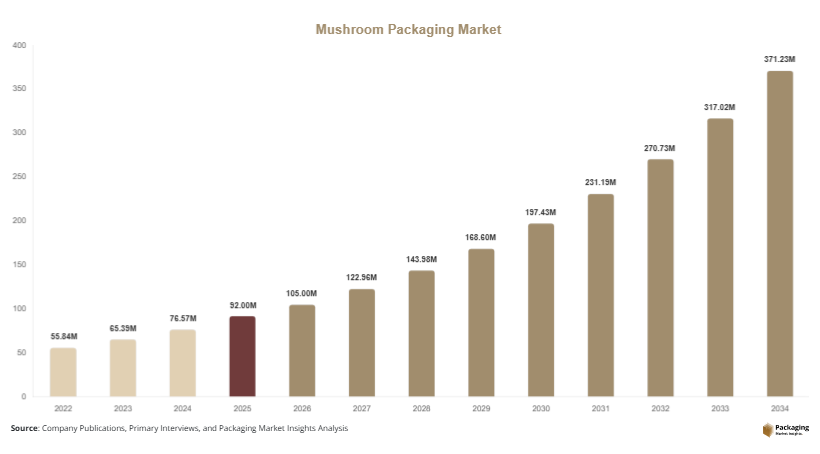
In 2025, the global mushroom packaging market size is estimated to reach approximately USD 92 million, reflecting rising demand from consumer electronics, food and beverage, and personal care sectors. The market is projected to grow to nearly USD 105 million in 2026, supported by increasing commercialization of biodegradable packaging materials. Over the forecast period from 2025 to 2034, the market is expected to reach about USD 410 million, registering a compound annual growth rate (CAGR) of approximately 17.1%. This growth trajectory highlights the increasing importance of circular economy practices and the development of innovative packaging technologies.
The mushroom packaging market Size is witnessing steady expansion as industries seek sustainable alternatives to conventional plastic and foam-based packaging materials. Mushroom packaging, also known as mycelium packaging, is produced using agricultural waste bonded with fungal mycelium. This material offers biodegradable, compostable, and lightweight characteristics that support environmentally responsible packaging practices. As regulatory frameworks tighten around single-use plastics and consumers increasingly prefer eco-friendly products, mushroom-based packaging solutions are gaining traction across multiple industries.
Key Highlights
- Global mushroom packaging market Size estimated at USD 92 million in 2025
- Market projected to reach USD 410 million by 2034
- Expected CAGR of 17.1% during 2025–2034
- Increasing demand for biodegradable and compostable packaging materials
- Rising adoption across electronics, food, and consumer goods industries
Explore more data points, trends and opportunities Download Free Sample Report
Market Trends
Expansion of Sustainable Packaging Solutions
A major trend influencing the mushroom packaging market size is the rapid shift toward sustainable packaging solutions across multiple industries. Companies are increasingly seeking materials that reduce environmental impact while maintaining performance characteristics required for product protection. Mushroom packaging provides a viable alternative to petroleum-based foams such as polystyrene because it decomposes naturally and can be produced from agricultural byproducts. This trend is particularly visible among electronics and consumer goods manufacturers that aim to reduce packaging waste in their supply chains.
Additionally, large retailers and global brands are committing to sustainability targets that include reducing plastic packaging usage. Mushroom packaging helps organizations meet these targets by offering compostable protective packaging solutions that require fewer synthetic inputs during manufacturing. The trend is expected to strengthen as consumers continue to prioritize eco-conscious products and as governments introduce policies supporting biodegradable packaging materials.
Increasing Adoption in Consumer Electronics Packaging
Another significant trend shaping the mushroom packaging market is its growing use in the consumer electronics sector. Electronic products require protective packaging capable of absorbing shocks during shipping and handling. Mushroom packaging has demonstrated suitable cushioning properties that can protect fragile items such as laptops, smartphones, and audio equipment.
Manufacturers in the electronics industry are exploring mycelium-based packaging to replace molded foam inserts traditionally used in shipping boxes. This transition helps reduce environmental impact while maintaining structural integrity during transportation. Furthermore, electronics brands increasingly use sustainable packaging as part of their brand messaging, emphasizing environmental responsibility. As the global electronics market continues to expand and e-commerce shipments increase, the adoption of mushroom packaging in this sector is expected to grow steadily.
Market Drivers
Rising Environmental Regulations on Plastic Packaging
Government regulations targeting plastic waste are a key driver of the mushroom packaging market size. Many countries have introduced restrictions on single-use plastics and expanded polystyrene packaging due to concerns about pollution and landfill accumulation. These regulations encourage manufacturers to adopt biodegradable materials that can minimize environmental harm.
Mushroom packaging provides an attractive alternative because it is derived from natural materials and decomposes within a short period when composted. As environmental policies continue to evolve, industries are shifting toward bio-based packaging materials to comply with regulations. This shift is expected to support consistent demand for mycelium-based packaging products across multiple sectors including electronics, cosmetics, and consumer goods.
Growing Consumer Preference for Eco-Friendly Products
Another important driver is the rising consumer preference for environmentally responsible products. Consumers increasingly evaluate brands based on sustainability practices, including packaging materials. Companies are responding by introducing packaging solutions that reduce environmental impact while maintaining functionality.
Mushroom packaging aligns with these consumer expectations by offering compostable and renewable packaging materials. Brands using such packaging often highlight sustainability in marketing campaigns, which can enhance brand loyalty and customer engagement. As environmental awareness grows globally, the adoption of biodegradable packaging solutions like mushroom packaging is likely to accelerate, supporting long-term market growth.
Market Restraint
High Production Costs Compared to Conventional Materials
Despite its environmental advantages, one of the primary restraints affecting the mushroom packaging market size is the relatively high production cost compared with conventional packaging materials. Manufacturing mushroom packaging requires specialized facilities for cultivating mycelium and controlling environmental conditions during the growth process. These requirements increase operational costs compared with traditional foam production methods.
Additionally, production cycles for mushroom packaging can be longer because the material must grow naturally before being processed into final packaging shapes. This growth period may limit manufacturing speed and scalability in comparison with petroleum-based materials that can be produced rapidly using industrial processes.
The cost difference becomes particularly significant for small and medium-sized manufacturers that operate within tight margins. Some companies may hesitate to adopt mushroom packaging due to concerns about pricing competitiveness and supply consistency. For example, consumer electronics manufacturers shipping high volumes of products may still rely on conventional molded foam inserts because they are less expensive and widely available.
However, ongoing research and technological improvements are expected to gradually reduce production costs. As more companies invest in biofabrication technology and production capacity expands, economies of scale could help address this restraint over time.
Market Opportunities
Integration of Circular Economy Packaging Models
One major opportunity for the mushroom packaging market size lies in the adoption of circular economy packaging models. Many companies are transitioning from linear production systems toward circular frameworks where materials can be reused, recycled, or composted after use. Mushroom packaging supports this approach because it can be composted and returned to the natural environment without creating waste.
Organizations aiming to reduce landfill contributions are increasingly integrating biodegradable packaging solutions into their logistics systems. For example, companies involved in e-commerce distribution can implement compostable packaging programs that allow customers to dispose of packaging materials through organic waste streams. This approach strengthens brand sustainability initiatives and can reduce environmental footprints.
As corporate sustainability commitments grow stronger, mushroom packaging providers may find new opportunities to collaborate with logistics providers, retailers, and packaging companies seeking eco-friendly alternatives.
Expansion in Food and Beverage Packaging Applications
Another significant opportunity is the growing adoption of mushroom packaging in the food and beverage industry. The sector is under pressure to reduce plastic waste, particularly in packaging used for fresh produce, ready-to-eat meals, and beverage containers. Mushroom-based packaging materials offer biodegradable solutions that can meet environmental requirements while maintaining product protection.
Furthermore, consumers often associate natural packaging materials with healthier and environmentally responsible food products. This perception can enhance brand value and support product differentiation in competitive retail markets. Food companies exploring innovative packaging solutions may adopt mushroom packaging to reduce reliance on plastics and improve sustainability credentials.
As the global food industry continues to expand and regulatory oversight increases, mushroom packaging solutions tailored for food applications could represent a growing segment of the overall market.
Report Scope
| Report Metric | Details |
|---|---|
| Market Size in 2025 | USD 92 Million |
| Market Size in 2026 | USD 105 Million |
| Market Size in 2034 | USD 410 Million |
| CAGR | 17.1% (2026-2034) |
| Base Year for Estimation | 2025 |
| Historical Data | 2022-2024 |
| Forecast Period | 2026-2034 |
| Report Coverage | Revenue Forecast, Competitive Landscape, Supply Chain Disruption, Growth Factors, Environment & Regulatory Landscape and Trends |
| Geographies Covered | North America, Europe, APAC, Middle East and Africa, LATAM |
| Countries Covered | U.S., Canada, U.K., Germany, France, Spain, Italy, Russia, Nordic, Benelux, Rest of Europe, China, South Korea, Japan, India, Australia, Singapore, Taiwan, South East Asia, Rest of Asia-Pacific, UAE, Turky, Saudi Arabia, South Africa, Egypt, Nigeria, Rest of MEA, Brazil, Mexico, Argentina, Chile, Colombia, Rest of LATAM |
Explore more data points, trends and opportunities Download Free Sample Report
Segmental Analysis
By Type
The protective packaging segment dominated the mushroom packaging market in 2024, accounting for approximately 62% of the global market share. Protective packaging solutions include molded inserts, cushioning components, and corner protectors designed to safeguard products during transportation. These packaging formats are widely used in the consumer electronics and home appliance sectors where fragile items require strong shock absorption properties. Mushroom-based protective packaging is particularly attractive because it can replicate the structural performance of expanded polystyrene while offering biodegradable characteristics. As companies focus on reducing plastic waste, the demand for molded mycelium inserts and protective cushioning solutions is increasing steadily across global logistics networks.
The insulated packaging segment is projected to be the fastest-growing subsegment with a CAGR of approximately 18.6% between 2025 and 2034. Insulated mushroom packaging materials are gaining attention in sectors that require temperature-sensitive product protection, including food delivery, pharmaceuticals, and cosmetics. Mycelium-based materials can be engineered to provide insulation properties while remaining compostable and environmentally friendly. The growing popularity of meal delivery services and temperature-controlled shipping is expected to support adoption of insulated mushroom packaging. Additionally, advancements in mycelium engineering are enabling manufacturers to develop materials with improved thermal resistance and durability.
By Application
The electronics packaging segment held the largest share of the mushroom packaging market in 2024, representing around 46% of total revenue. Electronic devices such as laptops, speakers, and consumer appliances require protective inserts to prevent damage during transportation. Mushroom packaging offers cushioning properties that protect fragile components while minimizing environmental impact. Electronics manufacturers are increasingly adopting biodegradable packaging to reduce plastic waste and strengthen sustainability commitments. As global electronics production and e-commerce shipments continue to grow, mushroom packaging solutions designed specifically for electronic products are becoming more common in supply chains.
The food packaging segment is expected to record the highest CAGR of approximately 18.2% during the forecast period. Food companies are under pressure to reduce plastic packaging waste and comply with environmental regulations. Mushroom-based packaging materials can serve as compostable alternatives for trays, containers, and protective inserts used in food packaging. Additionally, consumers often perceive natural packaging materials as healthier and environmentally responsible. This perception can encourage food brands to adopt mushroom packaging as part of sustainable packaging initiatives. Growth in organic food markets and environmentally conscious retail channels is likely to support the expansion of this segment.
By End-Use Industry
The consumer goods industry accounted for the largest share of the mushroom packaging market in 2024, capturing approximately 41% of global demand. Consumer goods manufacturers frequently require protective packaging materials for products such as cosmetics, household items, and personal care products. Mushroom packaging provides an environmentally friendly solution that aligns with sustainability strategies adopted by many consumer brands. Companies are increasingly replacing plastic foam packaging with biodegradable alternatives to reduce environmental impact. This transition is particularly evident among premium brands seeking to enhance sustainability messaging through packaging innovation.
The e-commerce industry is projected to be the fastest-growing end-use segment with a CAGR of around 19.1% between 2025 and 2034. Online retail has expanded rapidly over the past decade, creating significant demand for protective shipping materials. Mushroom packaging offers a sustainable solution for cushioning products during transit while minimizing packaging waste. E-commerce companies are exploring compostable packaging options to reduce environmental impact and improve brand perception. As online shopping continues to grow worldwide, the adoption of mushroom packaging within logistics and fulfillment operations is expected to increase significantly.
Mushroom Packaging Market Segmentations
Type
- Protective Packaging
- Insulated Packaging
- Customized Molded Packaging
Application
- Electronics Packaging
- Food Packaging
- Personal Care Packaging
- Furniture Packaging
End-Use Industry
- Consumer Goods
- Food & Beverage
- E-commerce
- Electronics
Regional Analysis
North America
North America holds a notable share of the mushroom packaging market size, accounting for approximately 34% of the global market in 2025. The region is projected to grow at a CAGR of around 16.4% through 2034, supported by strong demand for sustainable packaging solutions across several industries. Companies in the United States and Canada are actively investing in biodegradable packaging technologies as part of their sustainability strategies. Increasing regulatory pressure to reduce plastic waste also supports the adoption of alternative packaging materials across manufacturing sectors.
The United States represents the dominant country within North America. One major growth factor driving the market in the country is the strong presence of technology and consumer electronics companies that ship products globally. These companies are exploring environmentally friendly packaging materials to reduce environmental impact and improve corporate sustainability performance. As electronics shipments continue to rise alongside e-commerce expansion, the demand for protective mushroom packaging is expected to grow.
Europe
Europe accounts for nearly 29% of the global mushroom packaging market share in 2025 and is expected to register a CAGR of about 17.3% during the forecast period. The region has been at the forefront of environmental regulation related to packaging waste and plastic pollution. Policies introduced by the European Union encourage manufacturers to adopt biodegradable packaging materials and reduce reliance on petroleum-based plastics.
Germany is one of the dominant countries contributing to regional growth. A key factor driving the market in Germany is the strong emphasis on circular economy practices within the manufacturing sector. German companies increasingly prioritize sustainable packaging materials to align with environmental policies and consumer expectations. This commitment supports continued adoption of mushroom packaging across consumer goods and industrial packaging applications.
Asia Pacific
Asia Pacific represents a rapidly expanding region for the mushroom packaging market size, accounting for around 21% of global revenue in 2025. The region is projected to record the fastest CAGR of approximately 18.5% through 2034 due to growing manufacturing activity and increasing environmental awareness. Countries such as China, Japan, South Korea, and India are exploring sustainable packaging solutions to address rising waste management challenges.
China is the leading contributor to regional market growth. One major growth factor is the expansion of the electronics manufacturing sector, which generates high demand for protective packaging materials. As Chinese manufacturers export large volumes of consumer electronics, sustainable packaging solutions are becoming increasingly attractive. Mushroom packaging offers protective performance while helping companies meet environmental regulations and reduce packaging waste.
Middle East & Africa
The Middle East & Africa region accounted for approximately 8% of the global mushroom packaging market share in 2025. The market is expected to grow at a CAGR of around 15.2% through 2034 as sustainability initiatives gain momentum across industries. Governments and private organizations in the region are increasingly exploring biodegradable materials to reduce environmental pollution and landfill waste.
United Arab Emirates is one of the dominant markets within the region. A key growth factor is the expansion of sustainable logistics and retail sectors. Companies operating in the UAE are adopting environmentally friendly packaging materials as part of broader sustainability programs. These initiatives aim to reduce environmental impact while supporting the country’s long-term sustainability goals.
Latin America
Latin America accounted for around 8% of the global mushroom packaging market size in 2025 and is projected to grow at a CAGR of nearly 16.1% through 2034. Increasing environmental awareness and regulatory initiatives aimed at reducing plastic waste are encouraging the adoption of biodegradable packaging solutions. Industries such as agriculture, consumer goods, and electronics are exploring alternative packaging materials to support sustainability objectives.
Brazil is the leading country driving regional market growth. One unique factor supporting the adoption of mushroom packaging is the availability of agricultural waste that can be used as raw material for mycelium cultivation. This abundance of biomass resources creates opportunities for local production of mushroom-based packaging materials, supporting regional supply chains and reducing dependence on imported packaging solutions.
Competitive Landscape
The competitive landscape of the mushroom packaging market size is characterized by the presence of specialized biofabrication companies and sustainable packaging manufacturers. Market participants focus on research and development, strategic partnerships, and production capacity expansion to strengthen their market positions. Innovation in mycelium cultivation technology plays an important role in improving product performance and manufacturing efficiency.
Ecovative Design is considered one of the leading companies in the mushroom packaging market. The company has developed proprietary mycelium-based materials that are used for protective packaging solutions across multiple industries. In recent years, Ecovative Design expanded its production capacity and collaborated with consumer brands to commercialize compostable packaging products.
Other companies are also investing in research and product development to improve material properties such as durability, insulation, and moisture resistance. Partnerships between packaging companies and consumer product manufacturers are becoming more common as businesses seek sustainable alternatives to traditional plastic packaging materials.
Key Players
- Ecovative Design
- Mushroom Packaging (Ecovative brand)
- Grown Bio
- Magical Mushroom Company
- BioFab
- MycoWorks
- Mushroom Material
- Paradise Packaging Company
- MadeRight
- Mycelium Packaging Solutions
- Greener Packaging
- Sustainable Bioproducts
- MycoComposite Technologies
- Mycelium Packaging Ltd
- Biohm