Multi Depth Corrugated Boxes Market Size and Growth
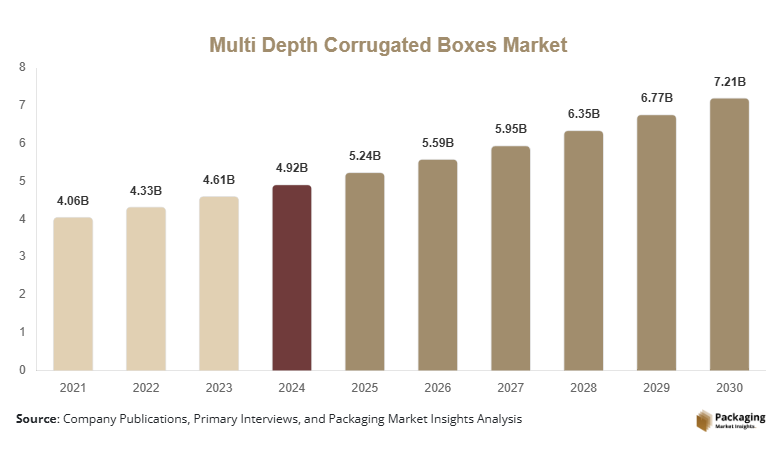
The global multi depth corrugated boxes market size was valued at USD 4.92 billion in 2024 and is projected to grow from USD 5.24 billion in 2025 to reach approximately USD 7.22 billion by 2030, expanding at a CAGR of 6.6% during the forecast period (2025–2030). The multi depth corrugated boxes market growth is primarily driven by the rapid expansion of e-commerce and omnichannel retail, rising demand for right-sized packaging solutions, and increasing focus on cost optimization and sustainability across global supply chains.
Multi depth corrugated boxes allow height adjustment through multiple score lines or perforations, enabling shippers to minimize void space, reduce filler material usage, and improve freight efficiency. These benefits are making such boxes increasingly attractive to fulfillment centers, logistics operators, and manufacturers seeking to reduce packaging SKUs while maintaining flexibility. Additionally, sustainability regulations and extended producer responsibility frameworks are accelerating the shift toward fiber-based, recyclable packaging formats, strengthening long-term market fundamentals.
Key Market Insights
- Multi depth corrugated boxes are becoming a preferred solution for inventory rationalization, helping enterprises reduce the number of box SKUs by up to 50% while maintaining packaging flexibility.
- E-commerce and third-party logistics dominate global demand, supported by rising parcel volumes, same-day delivery models, and automated fulfillment centers.
- Single wall and C-flute configurations lead global adoption, offering an optimal balance between strength, cost efficiency, and lightweight performance.
- Asia-Pacific accounts for the largest share of global demand, driven by manufacturing exports, domestic consumption growth, and expanding logistics infrastructure.
- North America remains the most technology-driven market, with high adoption of automated packaging lines and sustainability-led packaging redesigns.
- Material lightweighting and automation-compatible box designs are reshaping product development and competitive differentiation.
Explore more data points, trends and opportunities Download Free Sample Report
Latest Market Trends
Right-Sized Packaging and Automation Compatibility Gaining Momentum
Manufacturers and large-scale shippers are increasingly prioritizing packaging formats that integrate seamlessly with automated packing systems. Multi depth corrugated boxes are being redesigned with precision scoring and consistent fold-down performance to support high-speed automated lines. This trend is especially strong in large fulfillment centers handling high order volumes, where packaging speed, dimensional accuracy, and material efficiency directly impact operating costs. As warehouse automation expands globally, demand for automation-friendly multi depth boxes is accelerating.
The multi depth corrugated boxes market is also benefiting from the broader shift toward sustainable logistics. By reducing empty space and filler material, these boxes lower shipping emissions and material waste. Many brand owners are incorporating packaging reduction targets into ESG strategies, making multi depth corrugated boxes a strategic enabler rather than a commodity packaging choice.
Market Drivers
Rapid Expansion of E-commerce and Third-Party Logistics (3PL) Networks
Fulfillment centers increasingly prioritize packaging formats that reduce handling time, storage footprint, and shipping inefficiencies. Multi depth corrugated boxes address these needs by offering flexibility without compromising stacking strength or protection, making them a preferred solution for high-velocity distribution environments.
Cost Optimization Across Supply Chains
Rising transportation costs, labor shortages, and warehouse space constraints have forced enterprises to rethink packaging strategies. Multi depth boxes enable companies to reduce freight costs by minimizing dimensional weight penalties and decreasing the need for multiple box inventories. This has made them especially attractive to SMEs and large retailers alike.
Market Restraint
Volatility in Raw Material Prices
Particularly, kraft paper and recycled OCC remain a challenge. Fluctuations in input costs can compress margins for manufacturers and make long-term pricing contracts difficult. Another restraint is capital intensity and equipment requirements. Producing high-precision multi depth boxes requires advanced scoring, die-cutting, and quality control systems. Smaller manufacturers may face barriers to entry due to high upfront CapEx and technical expertise requirements.
Market Opportunities
E-commerce and Omnichannel Fulfillment Optimization
Global e-commerce parcel volumes continue to grow at high single-digit rates, creating strong demand for right-sized packaging solutions. Multi depth boxes enable fulfillment centers to reduce the number of box SKUs by up to 40–60%, lower void fill usage, and improve dimensional weight efficiency. For both incumbents and new entrants, offering standardized multi-depth box portfolios tailored for automated packing lines presents a major growth lever.
Sustainability-Driven Packaging Substitution
Governments and brand owners are actively pushing to replace plastic-based secondary packaging with fiber-based alternatives. Multi depth corrugated boxes align strongly with circular economy goals due to recyclability, lightweighting potential, and reduced material waste. As EPR regulations tighten across Europe, North America, and parts of Asia, demand for material-efficient corrugated solutions that minimize overpackaging is expected to accelerate. This creates room for premium pricing and value-added innovation in board optimization and design.
Report Scope
| Report Metric | Details |
|---|---|
| Market Size in 2024 | USD 4.92 Billion |
| Market Size in 2025 | USD 5.24 Billion |
| Market Size in 2030 | USD 7.22 Billion |
| CAGR | 6.6% (2025-2030) |
| Base Year for Estimation | 2024 |
| Historical Data | 2021-2023 |
| Forecast Period | 2025-2030 |
| Report Coverage | Revenue Forecast, Competitive Landscape, Supply Chain Disruption, Growth Factors, Environment & Regulatory Landscape and Trends |
| Geographies Covered | North America, Europe, APAC, Middle East and Africa, LATAM |
| Countries Covered | U.S., Canada, U.K., Germany, France, Spain, Italy, Russia, Nordic, Benelux, Rest of Europe, China, South Korea, Japan, India, Australia, Singapore, Taiwan, South East Asia, Rest of Asia-Pacific, UAE, Turky, Saudi Arabia, South Africa, Egypt, Nigeria, Rest of MEA, Brazil, Mexico, Argentina, Chile, Colombia, Rest of LATAM |
Explore more data points, trends and opportunities Download Free Sample Report
Segmental Analysis
By Material
The corrugated cardboard subsegment accounted for a dominant share of approximately 52% of the global multi depth corrugated boxes market in 2024. This leadership is primarily driven by its superior structural strength, cushioning properties, and cost efficiency, making it the preferred material for shipping, storage, and industrial packaging applications. Corrugated cardboard’s ability to withstand stacking pressure while remaining lightweight has positioned it as the default choice for e-commerce fulfillment centers and industrial supply chains globally. Additionally, its high recyclability aligns strongly with sustainability mandates, further reinforcing demand.
The recycled paper subsegment is projected to register the fastest growth, with an estimated CAGR of 7.1% from 2025 to 2033. Growth is being fueled by increasing regulatory pressure to use recycled content, corporate sustainability commitments, and rising availability of high-quality recycled fibers. Manufacturers are increasingly blending recycled paper into multi depth box production without compromising performance, positioning this subsegment for accelerated adoption, particularly in Europe and North America.
By Design
The single-depth boxes subsegment held the largest share, contributing nearly 40% of the market in 2024. Their dominance is attributed to widespread use in standardized shipping and storage operations where product dimensions are relatively uniform. Single-depth boxes offer simplicity, lower manufacturing costs, and compatibility with automated packing systems, making them highly attractive to high-volume logistics and retail operations.
The custom designs subsegment is expected to be the fastest-growing, expanding at a CAGR of approximately 7.6% during the forecast period. This growth is driven by rising demand from e-commerce, electronics, and premium consumer goods brands seeking optimized fit, reduced void space, and enhanced brand presentation. Advances in digital die-cutting and design software have made customization more scalable and cost-effective, accelerating adoption globally.
By Application
The shipping and transport subsegment accounted for the largest share of around 36% of global demand in 2024. This leadership is supported by the rapid expansion of parcel shipments, cross-border trade, and third-party logistics services. Multi depth corrugated boxes are widely used in transport applications to improve load efficiency, reduce freight costs, and accommodate varying product sizes within standardized logistics workflows.
The food and beverage application segment is anticipated to grow at the highest CAGR of 7.4% from 2025 to 2033. Growth is driven by increasing demand for secondary packaging in processed food exports, beverage distribution, and bulk food transportation. The ability of multi depth boxes to maintain structural integrity while optimizing space utilization makes them particularly suitable for food and beverage logistics.
By Size and Capacity
The medium boxes subsegment (typically used for loads between light and moderate weights) dominated the market with an estimated 42% share in 2024. Their versatility across e-commerce, electronics, FMCG, and industrial packaging applications has made them the most widely adopted size category. Medium boxes offer an optimal balance between strength, handling convenience, and shipping efficiency, supporting their widespread global usage.
The custom sizes subsegment is projected to witness the fastest growth at a CAGR of 7.8% through 2033. This rapid expansion is being driven by SKU diversification, personalized packaging strategies, and increasing adoption of right-sized packaging models by large retailers and manufacturers. Custom sizing enables businesses to minimize material usage, reduce dimensional weight charges, and improve sustainability performance, making it a key growth area within the multi depth corrugated boxes market.
Multi Depth Corrugated Boxes Market Segmentations
By Material
- Corrugated Cardboard
- Kraft Paper
- Recycled Paper
By Design
- Single-Depth Boxes
- Double-Depth Boxes
- Triple-Depth Boxes
- Custom Designs
By Application
- Industrial Packaging
- Shipping and Transport
- Storage
- Food and Beverage
By Size and Capacity
- Small Boxes
- Medium Boxes
- Large Boxes
- Custom Sizes
Regional Analysis
North America
North America remains one of the most mature and high-value markets for multi depth corrugated boxes, led by the United States and Canada. The region benefits from a highly developed e-commerce ecosystem, advanced logistics infrastructure, and widespread adoption of warehouse automation. U.S.-based retailers and logistics providers increasingly rely on multi depth boxes to reduce dimensional weight penalties imposed by parcel carriers. Sustainability commitments by large retailers are further boosting demand for right-sized, recyclable packaging. In 2024, North America accounted for approximately 28% of global market demand, with steady mid-single-digit growth expected through 2030.
Europe
Europe represents a structurally strong and regulation-driven market, with major demand coming from Germany, the United Kingdom, France, Italy, and Spain. European buyers are highly sensitive to packaging waste reduction and recyclability, making multi depth corrugated boxes an attractive alternative to oversized packaging formats. The region is also witnessing rising adoption in industrial and automotive component exports, where packaging efficiency directly impacts logistics costs. Europe accounted for roughly 24% of global market share in 2024, and remains one of the fastest-growing regions due to tightening sustainability regulations and cross-border e-commerce growth.
Asia-Pacific
Asia-Pacific is the largest and fastest-growing regional market, accounting for approximately 36% of global demand in 2024. China leads the region due to its massive manufacturing base, export-driven packaging needs, and rapidly expanding domestic e-commerce sector. India is emerging as the fastest-growing national market, supported by government-led manufacturing initiatives, logistics infrastructure expansion, and rising online retail penetration. Japan, South Korea, and Southeast Asia contribute steady demand, particularly for electronics and industrial goods packaging. Asia-Pacific is expected to register the highest CAGR globally through 2030.
Latin America
Latin America is an emerging market for multi depth corrugated boxes, led by Brazil and Mexico. Growth is driven by expanding manufacturing output, rising e-commerce adoption, and increasing export activity to North America. While packaging automation levels remain lower than in developed markets, demand for flexible and cost-efficient packaging solutions is rising steadily. Regional manufacturers are increasingly adopting multi depth designs to improve operational efficiency and reduce packaging waste.
Middle East & Africa
The Middle East & Africa region shows growing adoption, particularly in the Gulf countries and South Africa. Demand is supported by logistics hub development, rising imports, and growth in regional manufacturing and food processing industries. Countries such as the UAE and Saudi Arabia are investing heavily in logistics infrastructure, driving demand for standardized and flexible corrugated packaging formats. Africa also benefits from export-oriented agricultural and industrial packaging demand, supporting gradual market expansion.
Competitive Landscape
The multi depth corrugated boxes market is moderately consolidated, with the top five global manufacturers collectively accounting for approximately 42% of total market revenue. Large integrated paper and packaging companies benefit from scale, vertical integration, and global customer relationships. However, regional players continue to hold strong positions due to proximity to end users and customization capabilities. Competitive intensity is high, with pricing pressure partially offset by value-added services such as design optimization, sustainability consulting, and automation compatibility.
Key Players in the Multi Depth Corrugated Boxes Market
- International Paper
- WestRock
- Smurfit Kappa
- DS Smith
- Mondi Group
- Packaging Corporation of America
- Oji Holdings
- Nine Dragons Paper
- Stora Enso
- Georgia-Pacific
- Rengo Co. Ltd.
- Lee & Man Paper
- Pratt Industries
- Klabin S.A.
- Nippon Paper Industries.