Mono Material Plastic Packaging Film Market Size and Growth
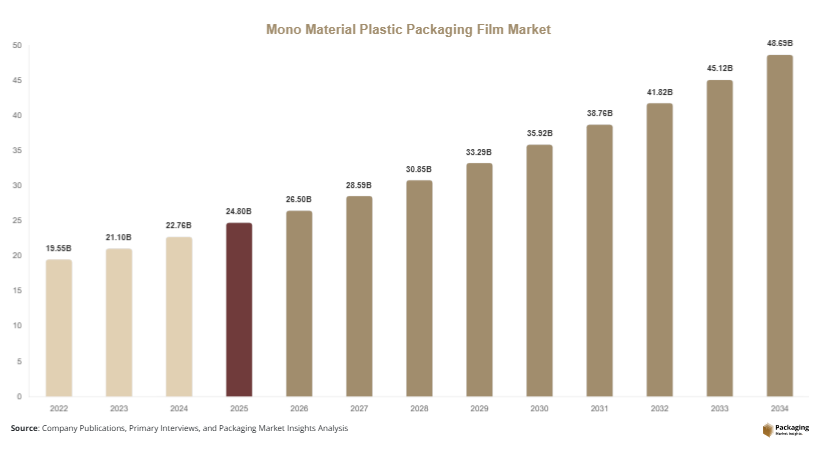
The mono material plastic packaging film market is witnessing consistent growth as industries transition toward recyclable and sustainable packaging solutions. The market size was estimated at USD 24.8 billion in 2025 and is projected to reach USD 26.5 billion in 2026. Over the forecast period, the market is expected to grow to approximately USD 49.2 billion by 2034, registering a CAGR of 7.9% from 2025 to 2034.
Mono material plastic packaging films are produced using a single type of polymer, such as polyethylene (PE) or polypropylene (PP), enabling easier recycling compared to multi-layer films. These materials are increasingly preferred as regulatory bodies and brands aim to improve recyclability and reduce environmental impact. The growing emphasis on circular economy practices is pushing manufacturers to redesign packaging structures using mono materials while maintaining performance standards.
Key Highlights:
- Market size reached USD 24.8 billion in 2025
- Expected to grow at a CAGR of 7.9% (2025–2034)
- Forecasted to reach USD 49.2 billion by 2034
- Increasing focus on recyclable packaging solutions
- Rising adoption in food and beverage applications
Explore more data points, trends and opportunities Download Free Sample Report
Market Trends
Transition from Multi-Layer to Mono Material Structures
A significant trend in the mono material plastic packaging film market is the transition from complex multi-layer films to mono material structures. Multi-layer packaging often combines different polymers to achieve desired barrier properties, but it poses challenges for recycling. Mono material films address this issue by using a single polymer type, making them easier to process in existing recycling systems. Manufacturers are investing in research to enhance the performance of mono materials, including barrier coatings and advanced processing techniques. This trend is gaining traction in industries such as food packaging, where sustainability requirements are increasing. As technology continues to evolve, mono material films are expected to replace traditional multi-layer solutions in various applications.
Development of High-Performance Barrier Films
Another important trend is the development of high-performance mono material films with improved barrier properties. Traditionally, mono material films lacked the necessary resistance to moisture, oxygen, and light. However, advancements in coatings and additives are enabling these films to achieve comparable performance to multi-layer structures. This innovation is expanding the application scope of mono material films, particularly in food and pharmaceutical packaging. Companies are focusing on developing solutions that combine sustainability with functionality. This trend is expected to drive market growth as manufacturers seek to meet both regulatory requirements and consumer expectations.
Market Drivers
Stringent Environmental Regulations
Stringent environmental regulations are a key driver of the mono material plastic packaging film market. Governments around the world are implementing policies aimed at reducing plastic waste and promoting recyclable packaging solutions. These regulations are encouraging manufacturers to adopt mono material films as they offer better recyclability compared to multi-layer packaging. Compliance with these regulations is becoming essential for companies operating in various industries. As a result, there is a growing demand for packaging solutions that align with sustainability goals. This driver is expected to continue influencing market growth over the forecast period.
Increasing Demand for Sustainable Packaging
The rising demand for sustainable packaging is another major driver of the market. Consumers are becoming more aware of environmental issues and are actively seeking products with eco-friendly packaging. Brands are responding to this demand by adopting mono material films that can be easily recycled. This shift is particularly evident in the food and beverage industry, where packaging plays a critical role in product differentiation. The growing emphasis on sustainability is driving innovation in packaging materials and design. As consumer preferences continue to evolve, the demand for mono material plastic packaging films is expected to increase.
Market Restraint
Performance Limitations Compared to Multi-Layer Films
One of the primary restraints in the mono material plastic packaging film market is the performance limitations compared to traditional multi-layer films. Multi-layer packaging offers superior barrier properties by combining different materials, which can be difficult to replicate with a single polymer. While advancements in coatings and additives have improved the performance of mono material films, they may still fall short in certain high-performance applications.
This limitation has a direct impact on industries such as pharmaceuticals and high-moisture food products, where stringent packaging requirements must be met. For example, certain perishable food items require packaging that provides extended shelf life and protection against environmental factors. In such cases, multi-layer films may still be preferred. This restraint can slow down the adoption of mono material films, particularly in applications where performance is critical. Addressing this challenge requires continued innovation and investment in material science to enhance the capabilities of mono material packaging solutions.
Market Opportunities
Growth in Circular Economy Initiatives
The increasing focus on circular economy initiatives presents significant opportunities for the mono material plastic packaging film market. Companies are adopting strategies that prioritize recycling and resource efficiency. Mono material films align well with these initiatives, as they can be easily recycled and reused. Governments and organizations are promoting circular economy practices through policies and incentives, encouraging the adoption of sustainable packaging solutions. This opportunity is driving innovation in packaging design and materials. As circular economy initiatives gain momentum, the demand for mono material films is expected to increase.
Expansion in Emerging Markets
The expansion of emerging markets offers another key opportunity for the market. Countries in Asia Pacific, Latin America, and Africa are experiencing rapid industrialization and urbanization. This growth is driving demand for packaged goods and, consequently, packaging materials. As awareness of sustainability increases in these regions, there is a growing demand for eco-friendly packaging solutions. Manufacturers can capitalize on this opportunity by introducing cost-effective mono material films tailored to local market needs. The expansion of retail and e-commerce sectors in emerging markets is further supporting this growth.
Report Scope
| Report Metric | Details |
|---|---|
| Market Size in 2025 | USD 24.8 Billion |
| Market Size in 2026 | USD 26.5 Billion |
| Market Size in 2034 | USD 49.2 Billion |
| CAGR | 7.9% (2026-2034) |
| Base Year for Estimation | 2025 |
| Historical Data | 2022-2024 |
| Forecast Period | 2026-2034 |
| Report Coverage | Revenue Forecast, Competitive Landscape, Supply Chain Disruption, Growth Factors, Environment & Regulatory Landscape and Trends |
| Geographies Covered | North America, Europe, APAC, Middle East and Africa, LATAM |
| Countries Covered | U.S., Canada, U.K., Germany, France, Spain, Italy, Russia, Nordic, Benelux, Rest of Europe, China, South Korea, Japan, India, Australia, Singapore, Taiwan, South East Asia, Rest of Asia-Pacific, UAE, Turky, Saudi Arabia, South Africa, Egypt, Nigeria, Rest of MEA, Brazil, Mexico, Argentina, Chile, Colombia, Rest of LATAM |
Explore more data points, trends and opportunities Download Free Sample Report
Segmental Analysis
By Type
The polyethylene (PE) segment dominated the mono material plastic packaging film market in 2024, accounting for approximately 44% of the total share. PE-based films are widely used due to their flexibility, durability, and cost-effectiveness. These films are suitable for a variety of applications, including food packaging and industrial uses. The ability to recycle PE films within existing infrastructure is a key factor supporting their dominance. Manufacturers are focusing on improving the performance of PE films through advanced processing techniques and additives. The growing demand for sustainable packaging solutions is further driving the adoption of PE-based mono material films.
The polypropylene (PP) segment is expected to be the fastest-growing, with a CAGR of 8.3% during the forecast period. PP films offer higher temperature resistance and improved clarity compared to PE films. This makes them suitable for applications such as ready-to-eat meals and microwaveable packaging. The increasing demand for high-performance packaging solutions is driving the growth of this segment. Advances in material technology are enabling the development of recyclable PP films with enhanced properties.
By Application
The food and beverage segment held the largest share in 2024, accounting for approximately 51% of the market. Mono material films are widely used in this sector due to their ability to preserve product freshness and extend shelf life. The growing demand for packaged food products is driving the adoption of sustainable packaging solutions. Companies are focusing on developing mono material films that meet the stringent requirements of food packaging. The increasing emphasis on reducing food waste is also supporting the growth of this segment.
The pharmaceutical segment is projected to grow at the fastest CAGR of 8.1% during the forecast period. The need for safe and reliable packaging solutions in the pharmaceutical industry is driving this growth. Mono material films are being developed to meet regulatory requirements while offering improved recyclability. The increasing demand for sustainable packaging in healthcare is further supporting the growth of this segment.
By End-Use
The food processing companies segment dominated the market in 2024, accounting for approximately 47% of the total share. These companies rely on flexible packaging solutions to ensure product safety and extend shelf life. The adoption of mono material films is driven by the need to comply with sustainability regulations and meet consumer expectations. Food processing companies are investing in innovative packaging technologies to reduce environmental impact while maintaining product quality.
The e-commerce and retail segment is expected to grow at the fastest CAGR of 8.5%. The rapid growth of online shopping is driving demand for lightweight and durable packaging solutions. Mono material films offer advantages such as reduced material usage and improved recyclability. Companies are focusing on developing packaging solutions that align with sustainability goals while meeting the requirements of e-commerce logistics.
Mono Material Plastic Packaging Film Market Segmentations
Type
- Polyethylene (PE) Films
- Polypropylene (PP) Films
- Others
Application
- Food & Beverage
- Pharmaceutical
- Personal Care
- Industrial
End-Use
- Food Processing Companies
- E-commerce & Retail
- Pharmaceutical Companies
Regional Analysis
North America
North America accounted for approximately 26% of the mono material plastic packaging film market share in 2025 and is expected to grow at a CAGR of 7.2% during the forecast period. The region’s growth is driven by increasing regulatory pressure and strong demand for sustainable packaging solutions. Companies are actively adopting mono material films to comply with environmental standards and meet consumer expectations.
The United States dominates the regional market due to its advanced packaging industry and high level of consumer awareness. A key growth factor is the adoption of recyclable packaging in the food and beverage sector, supported by corporate sustainability initiatives and government policies.
Europe
Europe held around 25% of the market share in 2025 and is projected to grow at a CAGR of 7.5%. The region is known for its strict environmental regulations and commitment to sustainability. Policies aimed at reducing plastic waste are driving the adoption of mono material packaging solutions.
Germany is the leading country in the region, supported by its strong manufacturing base and focus on innovation. A unique growth factor is the implementation of recycling targets, which are encouraging companies to adopt mono material films.
Asia Pacific
Asia Pacific dominated the market with a share of 33% in 2025 and is expected to grow at the fastest CAGR of 8.6% during the forecast period. The region’s growth is driven by rapid industrialization and increasing demand for packaged goods.
China is the dominant country in the region, supported by its large-scale manufacturing capabilities. A key growth factor is the expansion of e-commerce, which is driving demand for lightweight and recyclable packaging solutions.
Middle East & Africa
The Middle East & Africa region accounted for about 7% of the market share in 2025 and is projected to grow at a CAGR of 6.3%. The market is supported by increasing awareness of sustainability and growing investments in packaging infrastructure.
The United Arab Emirates leads the regional market, with a key growth factor being the development of sustainable retail initiatives. These initiatives are encouraging the adoption of eco-friendly packaging solutions.
Latin America
Latin America held approximately 9% of the market share in 2025 and is expected to grow at a CAGR of 6.8%. The region is witnessing increasing demand for sustainable packaging solutions in the consumer goods sector.
Brazil is the dominant country in the region, supported by its expanding manufacturing sector. A unique growth factor is the growing focus on reducing plastic waste through government initiatives and public awareness campaigns.
Competitive Landscape
The mono material plastic packaging film market is highly competitive, with several global players focusing on innovation and sustainability. Companies are investing in research and development to enhance the performance of mono material films and expand their product portfolios. Strategic collaborations and partnerships are also common, enabling companies to strengthen their market presence.
Amcor plc is a leading player in the market, known for its focus on sustainable packaging solutions. The company has introduced a range of mono material films designed to improve recyclability. A recent development includes the launch of advanced PE-based films for food packaging applications, aimed at reducing environmental impact.
Other key players such as Berry Global Inc., Mondi Group, Sealed Air Corporation, and Uflex Ltd. are also actively investing in sustainable packaging technologies. These companies are focusing on capacity expansion and product innovation to maintain a competitive edge.
Key Players List
- Amcor plc
- Berry Global Inc.
- Mondi Group
- Sealed Air Corporation
- Uflex Ltd.
- Huhtamaki Oyj
- Sonoco Products Company
- Constantia Flexibles Group GmbH
- Coveris Holdings S.A.
- ProAmpac LLC
- Winpak Ltd.
- Clondalkin Group
- Glenroy, Inc.
- Novolex Holdings, LLC
- Sigma Plastics Group