Molded Pulp Packaging Market Size and Growth
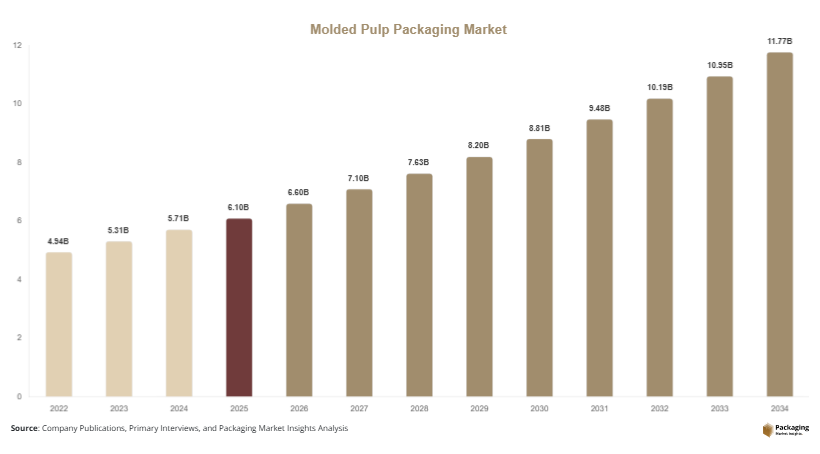
The global molded pulp packaging market size was valued at USD 6.1 billion in 2025 and is estimated to reach USD 6.6 billion in 2026. The market is projected to expand to USD 11.8 billion by 2034, registering a compound annual growth rate (CAGR) of 7.5% during the forecast period from 2025 to 2034. Growth is supported by increasing sustainability regulations, rapid expansion in e-commerce shipments, and rising demand from the food service industry. Businesses are focusing on environmentally responsible packaging solutions to meet both regulatory and consumer expectations.
The molded pulp packaging market is gaining strong momentum as industries shift toward sustainable and recyclable packaging solutions. Molded pulp packaging is produced from recycled paper, cardboard, and natural fibers. It is widely used to protect fragile products during transportation and storage. The material offers structural strength while remaining biodegradable and recyclable. These characteristics have positioned molded pulp packaging as a preferred alternative to plastic packaging in many industries.
Key Highlights
- The Molded Pulp Packaging Market was valued at USD 6.1 billion in 2025 and is expected to grow to USD 6.6 billion in 2026, reflecting steady industry expansion.
- The market is projected to reach USD 11.8 billion by 2034, registering a CAGR of 7.5% from 2025 to 2034.
- Growth is primarily driven by sustainability regulations, rapid e-commerce expansion, and increasing demand from the food service packaging industry.
Explore more data points, trends and opportunities Download Free Sample Report
Market Trends
Increasing Adoption of Sustainable Packaging Solutions
A major trend shaping the molded pulp packaging market is the rising demand for environmentally responsible packaging materials. Businesses are under pressure from regulators, investors, and consumers to reduce plastic waste. Molded pulp packaging provides a practical solution because it is produced using recycled paper fibers and can be composted after use. Companies across industries are integrating molded pulp solutions to align with corporate sustainability targets and reduce environmental impact.
Retailers and consumer goods companies are also redesigning product packaging to eliminate single-use plastics. Electronics manufacturers, cosmetic brands, and household appliance producers increasingly use molded pulp trays and inserts for protective packaging. The ability to produce customized shapes that securely hold products has increased adoption in premium packaging applications. As sustainability continues to influence purchasing decisions, the transition toward molded pulp packaging is expected to accelerate.
Technological Advancements in Molded Fiber Manufacturing
Technological innovation in molded fiber production is another trend influencing the market. Earlier molded pulp packaging products were mostly limited to simple shapes such as egg cartons and trays. However, new manufacturing techniques have significantly improved product quality, surface smoothness, and design flexibility. Modern thermoformed fiber processes allow manufacturers to produce high-precision packaging components with improved aesthetics and durability.
These advancements are enabling molded pulp packaging to compete with plastic packaging in applications that require better product presentation. Companies are investing in automated forming equipment and advanced drying systems to improve production efficiency and scalability. The integration of digital design tools also allows manufacturers to develop customized packaging solutions tailored to specific product dimensions. As technology continues to evolve, molded pulp packaging is expected to penetrate new industries and applications.
Market Drivers
Expansion of the Global E-Commerce Industry
The rapid growth of the global e-commerce sector is a key driver of the molded pulp packaging market . Online retail requires reliable protective packaging that prevents product damage during transportation. Molded pulp packaging offers cushioning properties that absorb shock and protect fragile items such as electronics, glassware, and household appliances. As online shopping volumes increase, demand for sustainable protective packaging solutions continues to rise.
E-commerce companies are also focusing on reducing packaging waste and improving recyclability. Molded pulp packaging aligns well with these objectives because it is made from recycled paper materials and can be easily recycled again after use. In addition, molded pulp packaging is lightweight, which helps reduce shipping costs and carbon emissions during transportation. The combination of protective performance, sustainability, and cost efficiency makes molded pulp packaging an attractive solution for e-commerce logistics.
Increasing Government Regulations on Plastic Packaging
Government regulations targeting plastic waste are significantly influencing packaging materials used by manufacturers and retailers. Many countries have introduced policies that restrict single-use plastics and encourage the use of biodegradable alternatives. These regulatory measures are driving companies to explore sustainable packaging materials such as molded pulp.
The food service sector is particularly affected by these regulations. Restaurants, cafes, and takeaway businesses are transitioning toward molded pulp containers, trays, and drink carriers as replacements for plastic packaging. In addition, environmental policies supporting recycling and circular economy practices are encouraging the use of recycled materials in packaging production. As governments continue implementing stricter environmental regulations, molded pulp packaging adoption is expected to increase across multiple industries.
Market Restraint
High Production Costs Compared to Conventional Plastic Packaging
Despite its environmental advantages, the molded pulp packaging market faces challenges related to production costs. Manufacturing molded pulp packaging requires specialized machinery, fiber processing equipment, and drying systems. These processes can increase operational costs compared to traditional plastic packaging production. Plastic packaging, particularly when produced in large volumes, often remains less expensive due to established manufacturing infrastructure and lower raw material costs.
This cost difference can limit adoption among price-sensitive industries. Small manufacturers and retailers may hesitate to transition fully to molded pulp packaging because it can increase overall packaging expenses. Additionally, production efficiency varies depending on fiber quality and moisture control during manufacturing. In some cases, inconsistencies in product quality or longer drying times can affect production speed.
Another challenge involves the availability and price fluctuations of recycled paper fibers used as raw materials. When recycled fiber supply becomes limited, production costs can increase further. For example, packaging manufacturers in developing markets sometimes face supply constraints that raise input costs and reduce competitiveness compared to plastic alternatives.
However, many industry participants are addressing this restraint by investing in automation and process optimization technologies. Improved production efficiency and large-scale manufacturing facilities are gradually reducing costs. As sustainable packaging demand increases and production technology improves, the cost gap between molded pulp and plastic packaging is expected to narrow over time.
Market Opportunities
Rising Demand from the Food and Beverage Industry
The food and beverage industry presents significant growth opportunities for the molded pulp packaging market . Restaurants, quick-service outlets, and food delivery platforms require packaging solutions that are both functional and environmentally friendly. Molded pulp containers, trays, bowls, and clamshell packaging are increasingly used to package takeaway meals, fruits, and beverages.
Consumers are becoming more aware of packaging waste generated by food service businesses. This awareness is encouraging restaurants and food delivery companies to adopt biodegradable packaging materials. Molded pulp packaging meets these expectations by providing strength, insulation, and compostability. In addition, it can withstand moderate heat and moisture, making it suitable for food packaging applications. As food delivery and takeaway services continue to grow globally, the demand for molded pulp packaging is expected to increase significantly.
Expansion into Consumer Electronics Packaging
Another promising opportunity lies in the consumer electronics sector. Electronics products such as smartphones, laptops, and home appliances require protective packaging to prevent damage during transportation. Traditionally, many electronics manufacturers used plastic foam inserts. However, environmental concerns and corporate sustainability goals are driving companies to replace plastic foam with molded pulp packaging.
Molded pulp inserts can be designed to securely hold electronic components while providing cushioning against shocks and vibrations. The ability to customize shapes according to product dimensions makes molded pulp packaging highly suitable for electronics packaging. Furthermore, large electronics manufacturers are actively reducing plastic content in their packaging designs. As the consumer electronics market continues to expand globally, molded pulp packaging manufacturers are likely to benefit from increasing demand.
Report Scope
| Report Metric | Details |
|---|---|
| Market Size in 2025 | USD 6.1 Billion |
| Market Size in 2026 | USD 6.6 Billion |
| Market Size in 2034 | USD 11.8 Billion |
| CAGR | 7.5% (2026-2034) |
| Base Year for Estimation | 2025 |
| Historical Data | 2022-2024 |
| Forecast Period | 2026-2034 |
| Report Coverage | Revenue Forecast, Competitive Landscape, Supply Chain Disruption, Growth Factors, Environment & Regulatory Landscape and Trends |
| Geographies Covered | North America, Europe, APAC, Middle East and Africa, LATAM |
| Countries Covered | U.S., Canada, U.K., Germany, France, Spain, Italy, Russia, Nordic, Benelux, Rest of Europe, China, South Korea, Japan, India, Australia, Singapore, Taiwan, South East Asia, Rest of Asia-Pacific, UAE, Turky, Saudi Arabia, South Africa, Egypt, Nigeria, Rest of MEA, Brazil, Mexico, Argentina, Chile, Colombia, Rest of LATAM |
Explore more data points, trends and opportunities Download Free Sample Report
Segmental Analysis
By Type
The transfer molded pulp segment dominated the molded pulp packaging market and accounted for approximately 48% of the total market share in 2024. Transfer molded pulp products are widely used in packaging applications such as egg trays, fruit trays, and drink carriers. These products are produced using recycled paper fibers and are known for their cost efficiency and high production volume capability. Manufacturers favor this production method because it allows large-scale manufacturing while maintaining consistent product quality. The demand for transfer molded pulp packaging continues to increase due to its widespread use in food packaging and agricultural product transportation.
The thermoformed fiber segment is expected to be the fastest-growing type with an estimated CAGR of 9.1% during the forecast period. Thermoformed fiber packaging offers smoother surfaces, higher structural strength, and better visual appearance compared to traditional molded pulp products. These characteristics make it suitable for premium packaging applications such as electronics packaging and luxury consumer goods. The growing demand for high-quality sustainable packaging solutions is encouraging manufacturers to adopt thermoformed fiber technologies.
By Application
The food packaging segment accounted for the largest share of approximately 44% in 2024. Molded pulp packaging is widely used for eggs, fruits, beverages, and takeaway food containers. Food packaging companies prefer molded pulp products because they are biodegradable, recyclable, and capable of protecting fragile items during transportation. The material also provides insulation and structural support for food containers. As the global food service industry expands, molded pulp packaging demand in this segment continues to grow.
The electronics packaging segment is projected to be the fastest-growing application, with a CAGR of 8.9% during the forecast period. Electronics manufacturers are increasingly replacing plastic foam inserts with molded pulp packaging to reduce environmental impact. Molded pulp inserts can be precisely designed to hold electronic devices securely during shipping. The growing consumer electronics market and rising sustainability commitments among technology companies are key growth drivers for this segment.
By End-Use Industry
The food and beverage industry dominated the market with a market share of around 46% in 2024. Restaurants, food delivery platforms, and grocery retailers use molded pulp packaging for eggs, fruits, beverages, and takeaway meals. The material offers structural strength and insulation properties that help maintain food quality during transportation. Additionally, its biodegradable nature aligns with sustainability goals of food service companies.
The consumer electronics industry is expected to grow at the fastest rate, registering a CAGR of approximately 9.3% through 2034. Electronics manufacturers are focusing on reducing plastic packaging waste and improving recyclability. Molded pulp packaging provides a protective and sustainable alternative for packaging devices such as laptops, tablets, and smartphones. Increasing global demand for electronic devices is expected to support the growth of this segment.
Molded Pulp Packaging Market Segmentations
Type
- Transfer Molded Pulp
- Thermoformed Fiber
- Thick Wall Molded Pulp
- Processed Molded Pulp
Application
- Food Packaging
- Electronics Packaging
- Healthcare Packaging
- Industrial Packaging
End-Use Industry
- Food & Beverage
- Consumer Electronics
- Healthcare
- Personal Care & Cosmetics
- Industrial Goods
Regional Analysis
North America
North America accounted for approximately 28% of the global molded pulp packaging market share in 2025. The region is expected to grow at a CAGR of around 6.8% during the forecast period. Growth is supported by increasing adoption of sustainable packaging materials across retail, electronics, and food service industries. Companies operating in the United States and Canada are prioritizing recyclable packaging solutions to comply with environmental regulations and corporate sustainability commitments.
The United States dominates the regional market due to strong e-commerce activity and advanced packaging manufacturing infrastructure. A major growth factor in the country is the rising demand for sustainable protective packaging used in online retail shipments. Large retailers and logistics companies are replacing plastic cushioning materials with molded pulp inserts to reduce packaging waste.
Europe
Europe held nearly 26% of the global market share in 2025 and is projected to expand at a CAGR of 7.2% through 2034. The region benefits from strict environmental regulations targeting plastic waste and promoting recyclable materials. European consumers also show high awareness of sustainability issues, which encourages companies to adopt biodegradable packaging solutions such as molded pulp packaging.
Germany leads the European market due to its strong manufacturing sector and advanced recycling infrastructure. A key growth factor in the country is the presence of well-established recycling systems that provide a stable supply of recycled fiber materials used in molded pulp production. This infrastructure supports sustainable packaging initiatives across industries.
Asia Pacific
Asia Pacific represented the largest regional share at approximately 32% in 2025 and is forecast to grow at a CAGR of 8.6% during the forecast period. Rapid industrialization, expanding e-commerce platforms, and increasing consumer demand for packaged goods are contributing to market expansion across the region. Many packaging manufacturers are investing in new molded pulp production facilities to meet rising demand.
China dominates the Asia Pacific market due to its large manufacturing base and strong export industry. A key growth factor in the country is the rapid growth of online retail shipments, which require protective packaging materials. Chinese manufacturers are increasingly producing molded pulp packaging to support e-commerce logistics and export packaging requirements.
Middle East & Africa
The Middle East & Africa accounted for around 7% of the global market share in 2025 and is expected to grow at a CAGR of 6.3% during the forecast period. The market in this region is still developing, but increasing environmental awareness and packaging waste concerns are encouraging adoption of sustainable materials. Governments are gradually introducing policies to reduce plastic waste.
United Arab Emirates is a leading market in the region due to its growing retail and hospitality sectors. A unique growth factor is the rapid expansion of food delivery and takeaway services, particularly in major urban centers. Restaurants and food service providers are adopting molded pulp packaging to meet sustainability expectations.
Latin America
Latin America held approximately 7% of the global molded pulp packaging market share in 2025 and is projected to grow at a CAGR of 6.9% during the forecast period. Increasing consumer demand for environmentally responsible packaging and expanding agricultural exports are supporting regional growth. Molded pulp packaging is commonly used to protect fruits and vegetables during transportation.
Brazil dominates the regional market due to its large agricultural industry and growing packaging sector. A major growth factor is the increasing use of molded pulp trays and containers for fruit packaging and export logistics. These packaging products provide cushioning protection while remaining recyclable.
Competitive Landscape
The molded pulp packaging market is moderately fragmented, with several regional and international manufacturers competing through product innovation, capacity expansion, and sustainability initiatives. Companies are investing in advanced molded fiber manufacturing technologies to improve product quality and production efficiency. Strategic partnerships with consumer goods companies and electronics manufacturers are also common as businesses seek to expand their market presence.
One of the leading companies in the market is Huhtamaki, which has a strong global presence in sustainable food packaging solutions. The company focuses on developing molded fiber packaging products that reduce plastic usage while maintaining high performance standards. In recent years, Huhtamaki has invested in expanding molded fiber production facilities to meet rising demand from the food service sector.
Other major companies are focusing on innovation in thermoformed fiber technologies to produce premium molded pulp packaging solutions. These companies are developing customized packaging designs for electronics, cosmetics, and consumer goods industries. Competition in the market is expected to intensify as sustainability regulations continue to influence packaging choices worldwide.
Key Players List
- Huhtamaki
- Brødrene Hartmann A/S
- UFP Technologies
- Pactiv Evergreen
- Henry Molded Products
- Eco-Products Inc.
- EnviroPAK Corporation
- Keiding Inc.
- Sabert Corporation
- Genpak LLC
- FiberCel Packaging LLC
- Pacific Pulp Molding LLC
- Protopak Engineering Corporation
- Celluloses de la Loire
- Green Packaging Asia