Molded Fiber Packaging Market Size and Growth
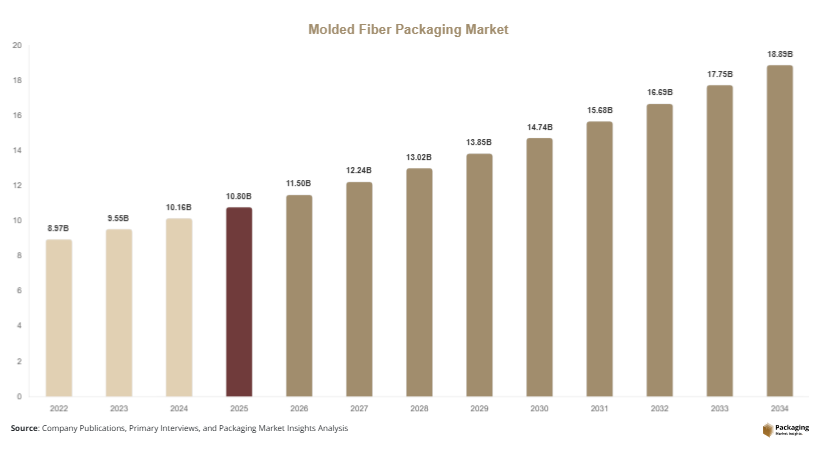
In 2025, the global molded fiber packaging market size is estimated at approximately USD 10.8 billion, and it is projected to reach around USD 11.5 billion in 2026. The market is expected to expand significantly, reaching nearly USD 18.9 billion by 2034, growing at a CAGR of 6.4% during 2025–2034.
Molded fiber packaging, also known as pulp packaging, is manufactured from recycled paper, cardboard, and natural fibers. It is widely used in food service, electronics, healthcare, and consumer goods industries due to its lightweight structure, cushioning properties, and environmental benefits. The growing emphasis on reducing plastic waste is one of the primary factors driving market growth.
Key Highlights:
- Market size is projected to reach USD 18.9 billion by 2034, reflecting steady expansion across global markets. This growth is driven by increasing demand for sustainable and eco-friendly packaging solutions.
- The market is expected to grow at a CAGR of 6.4% during 2025–2034, supported by strong regulatory initiatives. Rising consumer awareness regarding environmental impact is further accelerating market adoption.
- Rising demand for biodegradable and recyclable packaging is a major factor driving market growth. Industries are shifting toward environmentally responsible materials to meet sustainability goals.
- Strong growth in food service and e-commerce industries is significantly boosting demand for molded fiber packaging. Increasing online deliveries and takeaway consumption are supporting this trend.
- Advancements in molded fiber technology are improving product strength, durability, and versatility. These innovations are expanding applications across food, electronics, and industrial packaging sectors.
Explore more data points, trends and opportunities Download Free Sample Report
Market Trends
Increasing Adoption of Sustainable and Biodegradable Packaging
A major trend in the molded fiber packaging market is the growing adoption of environmentally friendly packaging materials. Consumers and businesses are becoming more aware of the environmental impact of plastic waste, leading to increased demand for biodegradable alternatives. Molded fiber packaging, made from recycled materials, offers a sustainable solution that aligns with global environmental goals. Companies are actively replacing plastic packaging with molded fiber products to meet regulatory requirements and enhance brand image. This trend is particularly strong in the food service and retail sectors, where sustainability is a key purchasing factor.
Technological Advancements in Molded Fiber Production
Another significant trend is the advancement in molded fiber manufacturing technologies. Innovations such as improved molding techniques, automation, and enhanced drying processes are enabling the production of high-quality packaging with better strength and precision. These advancements are expanding the use of molded fiber packaging in industries such as electronics and healthcare, where product protection is critical. Additionally, the development of water-resistant and grease-resistant coatings is enhancing the functionality of molded fiber products. These improvements are making molded fiber packaging more competitive with traditional plastic and foam packaging solutions.
Market Drivers
Growing Demand for Eco-Friendly Packaging Solutions
The increasing demand for eco-friendly packaging solutions is a major driver of the molded fiber packaging market. Governments and regulatory authorities are implementing strict policies to reduce plastic usage, encouraging businesses to adopt sustainable alternatives. Molded fiber packaging is biodegradable, recyclable, and made from renewable resources, making it an attractive option for companies seeking to reduce their environmental footprint. The rising awareness among consumers regarding sustainability is also influencing purchasing decisions, further driving market growth.
Expansion of Food Service and E-Commerce Industries
The rapid growth of the food service and e-commerce industries is another key driver. The increasing popularity of online food delivery and takeaway services is driving demand for disposable packaging solutions. Molded fiber packaging is widely used for food containers, trays, and clamshells due to its cost-effectiveness and environmental benefits. Additionally, the growth of e-commerce is increasing the need for protective packaging for shipping products. Molded fiber packaging provides cushioning and protection, making it suitable for transporting fragile items.
Market Restraint
Limited Water Resistance and Performance Constraints
A significant restraint in the molded fiber packaging market is the limited water resistance and performance limitations of molded fiber products compared to plastic alternatives. While molded fiber packaging offers environmental benefits, it may not provide the same level of moisture resistance and durability as plastic or foam packaging. This can limit its use in certain applications, particularly in industries that require high-performance packaging solutions. For example, exposure to moisture can weaken the structural integrity of molded fiber packaging, affecting product protection. Manufacturers are working to address these challenges through coatings and material innovations, but these solutions can increase production costs. As a result, performance limitations may restrict market growth in some segments.
Market Opportunities
Development of Advanced Coated Molded Fiber Products
The development of advanced coated molded fiber products presents a significant opportunity for market growth. Manufacturers are focusing on enhancing the functionality of molded fiber packaging by introducing coatings that improve water resistance, grease resistance, and durability. These innovations are expanding the use of molded fiber packaging in applications such as food service and healthcare. The ability to provide sustainable packaging with improved performance characteristics is expected to drive adoption across various industries.
Increasing Demand in Emerging Markets
Emerging markets offer substantial growth opportunities for the molded fiber packaging market. Rapid urbanization, population growth, and increasing disposable income are driving demand for packaged goods in regions such as Asia Pacific and Latin America. The growing awareness of environmental issues is also encouraging the adoption of sustainable packaging solutions. Companies can capitalize on these opportunities by offering cost-effective and eco-friendly molded fiber products tailored to local market needs.
Report Scope
| Report Metric | Details |
|---|---|
| Market Size in 2025 | USD 10.8 Billion |
| Market Size in 2026 | USD 11.5 Billion |
| Market Size in 2034 | USD 18.9 Billion |
| CAGR | 6.4% (2026-2034) |
| Base Year for Estimation | 2025 |
| Historical Data | 2022-2024 |
| Forecast Period | 2026-2034 |
| Report Coverage | Revenue Forecast, Competitive Landscape, Supply Chain Disruption, Growth Factors, Environment & Regulatory Landscape and Trends |
| Geographies Covered | North America, Europe, APAC, Middle East and Africa, LATAM |
| Countries Covered | U.S., Canada, U.K., Germany, France, Spain, Italy, Russia, Nordic, Benelux, Rest of Europe, China, South Korea, Japan, India, Australia, Singapore, Taiwan, South East Asia, Rest of Asia-Pacific, UAE, Turky, Saudi Arabia, South Africa, Egypt, Nigeria, Rest of MEA, Brazil, Mexico, Argentina, Chile, Colombia, Rest of LATAM |
Explore more data points, trends and opportunities Download Free Sample Report
Segmental Analysis
By Type
Transfer molded products dominated the market in 2024, accounting for approximately 45% of the total share. These products are widely used due to their smooth surface finish and precise shape, making them suitable for applications such as food packaging and consumer goods. The demand is driven by their ability to provide better aesthetics and functionality compared to other molded fiber types.
Thermoformed fiber products are expected to be the fastest-growing segment, with a CAGR of 6.8% during the forecast period. This growth is driven by increasing demand for high-quality and durable packaging solutions. Thermoformed products offer improved strength and precision, making them suitable for electronics and premium packaging applications.
By Application
Food packaging dominated the market in 2024, accounting for approximately 55% of the market share. Molded fiber packaging is widely used for trays, containers, and clamshells in the food industry due to its eco-friendly nature and cost efficiency. The growing demand for takeaway and ready-to-eat food is driving this segment.
Electronics packaging is expected to be the fastest-growing segment, with a CAGR of 6.7% during the forecast period. The growth is driven by increasing demand for protective packaging solutions in the electronics industry. Molded fiber packaging provides cushioning and shock absorption, making it suitable for transporting fragile products.
By End-Use
Food service industry dominated the market in 2024, holding approximately 60% of the total share. The need for disposable and sustainable packaging solutions is driving this segment. Molded fiber packaging is widely used in restaurants, cafes, and takeaway services due to its environmental benefits.
Healthcare industry is expected to be the fastest-growing segment, with a CAGR of 6.5% during the forecast period. The growth is driven by increasing demand for sterile and biodegradable packaging solutions. Molded fiber packaging is used for medical trays and protective packaging, supporting market expansion.
Molded Fiber Packaging Market Segmentations
Type
- Transfer Molded
- Thermoformed Fiber
- Processed Pulp
Application
- Food Packaging
- Electronics Packaging
- Healthcare Packaging
- Others
End-Use
- Food Service
- Healthcare
- Consumer Goods
Regional Analysis
North America
North America accounted for approximately 26% of the global market share in 2025, driven by strong demand for sustainable packaging solutions across food service and retail industries. The region is projected to grow at a CAGR of 5.8% during the forecast period, supported by regulatory initiatives aimed at reducing plastic waste and increasing adoption of eco-friendly materials. The presence of established packaging manufacturers and advanced recycling infrastructure is further contributing to market growth.
The United States dominates the regional market due to its large food service industry and high consumer awareness regarding sustainability. A unique growth factor is the increasing adoption of molded fiber packaging in quick-service restaurants and takeaway services. Companies are replacing plastic containers with biodegradable alternatives to meet environmental regulations and consumer expectations.
Europe
Europe held around 24% of the market share in 2025 and is expected to grow at a CAGR of 6.0% during the forecast period. The region’s growth is driven by stringent environmental regulations and strong emphasis on sustainability. Governments across Europe are implementing policies to reduce plastic usage, encouraging the adoption of molded fiber packaging solutions.
Germany is a key market, supported by its strong manufacturing base and focus on environmental sustainability. A unique growth factor is the increasing demand for recyclable packaging in the retail and food industries. Companies are investing in innovative packaging solutions to meet regulatory requirements and consumer preferences, supporting market growth.
Asia Pacific
Asia Pacific accounted for approximately 32% of the global market share in 2025, making it the largest regional market. The region is projected to grow at a CAGR of 7.0%, driven by rapid urbanization, population growth, and increasing demand for packaged goods. Expanding e-commerce and food delivery services are further supporting market growth.
China dominates the market due to its large manufacturing base and growing packaging industry. A unique growth factor is the increasing government initiatives to reduce plastic waste and promote sustainable packaging solutions. The adoption of molded fiber packaging is increasing across various industries, supporting market expansion.
Middle East & Africa
The Middle East & Africa region held about 8% of the market share in 2025 and is expected to grow at a CAGR of 5.9% during the forecast period. The market is expanding due to increasing demand for sustainable packaging solutions and growing awareness of environmental issues. The development of retail infrastructure is also contributing to market growth.
Saudi Arabia is a key market, supported by investments in packaging and food processing industries. A unique growth factor is the increasing demand for biodegradable packaging in the food service sector. Companies are adopting molded fiber packaging to reduce environmental impact and meet regulatory requirements.
Latin America
Latin America accounted for around 10% of the global market share in 2025 and is projected to grow at a CAGR of 6.2% during the forecast period. The region is experiencing steady growth due to increasing consumption of packaged goods and rising environmental awareness. The expansion of retail and e-commerce sectors is supporting market growth.
Brazil dominates the regional market, driven by its large consumer base and growing packaging industry. A unique growth factor is the demand for cost-effective and sustainable packaging solutions. Molded fiber packaging offers an affordable alternative to plastic packaging, making it widely adopted in the region.
Competitive Landscape
The molded fiber packaging market is moderately fragmented, with several global and regional players competing based on product innovation and sustainability. Companies are focusing on developing eco-friendly packaging solutions to meet regulatory requirements and consumer demand. Strategic partnerships and expansions are common strategies adopted by market players.
Huhtamaki Oyj is a leading player in the market, known for its sustainable packaging solutions. The company has recently expanded its molded fiber production capacity to meet increasing demand. Other key players are investing in research and development to introduce advanced products with improved performance characteristics.
Key Players List
- Huhtamaki Oyj
- UFP Technologies, Inc.
- Brødrene Hartmann A/S
- Sonoco Products Company
- Pactiv Evergreen Inc.
- Genpak LLC
- Eco-Products Inc.
- Henry Molded Products Inc.
- Pro-Pac Packaging Limited
- PrimeWare by PrimeLink Solutions
- FiberCel Packaging LLC
- Sabert Corporation
- OrCon Industries Corporation
- Keiding, Inc.
- EnviroPAK Corporation