Molded Fiber Coatings Market Size
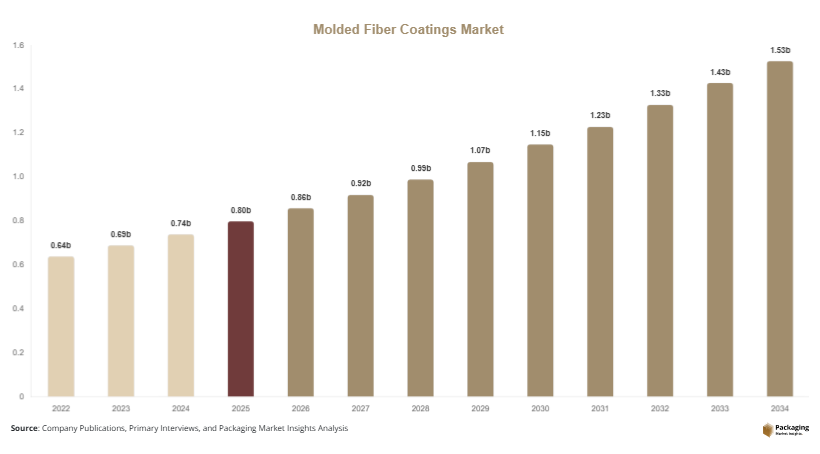
Molded Fiber Coatings market size is projected at USD 0.86 billion in 2026 and is expected to hit USD 1.54 billion by 2034 with a CAGR of 7.5%. The report provides detailed quantitative assessment across historical data from 2022–2024, the base year 2025, and the forecast period 2026–2034. It evaluates industry segmentation, pricing trends, production volumes exceeding 9.8 billion coated molded fiber units annually, raw material availability, and competitive positioning across global manufacturers to support strategic business decisions.
The molded fiber coatings market comprises specialty coating technologies applied to molded pulp products to enhance moisture resistance, grease resistance, oxygen barriers, printability, and durability while maintaining recyclability and compostability. Global production surpassed 8.9 million metric tons of molded fiber products in 2025, with coated variants accounting for approximately 39% of total output. Food packaging represented nearly 52% of coated molded fiber consumption, while healthcare and electronics together contributed over 31%. Adoption continues to increase as regulatory initiatives promote fiber-based alternatives to conventional plastics, strengthening the molded fiber coatings market.
Explore more data points, trends and opportunities Download Free Sample Report
Molded Fiber Coatings Market Trends
Increasing Adoption of Sustainable Barrier Technologies
Manufacturers are rapidly replacing fluorochemical and plastic laminations with bio-based barrier technologies capable of achieving grease resistance levels above KIT 10, moisture transmission reductions exceeding 40%, and oxygen barrier improvements of nearly 35%. More than 2.8 billion coated molded fiber trays and containers entered commercial production during 2025 as investments in sustainable packaging technologies accelerated across foodservice and retail sectors, reinforcing the molded fiber coatings market.
Growing automation and precision coating systems are enabling production speeds exceeding 350 units per minute while reducing coating consumption by approximately 18% per unit. Digital inspection systems now achieve defect detection accuracy above 97%, improving product consistency and lowering manufacturing waste by nearly 15%. Rising adoption throughout food delivery, ready-to-eat meals, and premium consumer packaging continues supporting the molded fiber coatings market.
Molded Fiber Coatings Market Drivers
Growing Regulatory Preference for Plastic-Free Packaging
Government restrictions targeting single-use plastics across more than 70 countries have accelerated investment in fiber-based packaging solutions. Food manufacturers increased procurement of coated molded fiber packaging by nearly 21% during 2025, while sustainable packaging investments exceeded USD 5 billion globally. Improved coating technologies delivering water resistance above 24 hours and oil resistance beyond 95% continue driving adoption throughout multiple industries, strengthening the molded fiber coatings market.
Molded Fiber Coatings Market Restraints
High Cost of Advanced Coating Materials
Bio-based polymers, specialty binders, and functional additives remain significantly more expensive than conventional synthetic coatings. Premium coating formulations can increase packaging production costs by 18–32%, while equipment upgrades often require investments exceeding USD 3 million per manufacturing line. Limited availability of specialty raw materials and fluctuating cellulose prices continue restricting broader commercialization within the molded fiber coatings market.
Molded Fiber Coatings Market Opportunities
Expansion of High-Performance Compostable Packaging
Demand for premium compostable foodservice packaging is expanding rapidly as quick-service restaurants and retail chains increase sustainable procurement targets. Compostable coated molded fiber production is projected to exceed 13 billion units annually before 2034, while bio-based coating penetration is expected to surpass 55% of newly installed production capacity. Investments in nanocellulose and aqueous barrier technologies continue creating new opportunities across the molded fiber coatings market.
Challenges in Molded Fiber Coatings Market
Maintaining Barrier Performance While Preserving Recyclability
Manufacturers continue balancing high-performance moisture protection with recyclability and compostability requirements. Multi-layer coating systems often increase processing complexity by 20%, while maintaining coating adhesion above 98% without affecting fiber recovery remains technically demanding. Certification requirements across multiple international standards also increase product development timelines throughout the molded fiber coatings market.
Report Scope
| Report Metric | Details |
|---|---|
| Market Size in 2025 | USD 0.80 billion |
| Market Size in 2026 | USD 0.86 billion |
| Market Size in 2034 | USD 1.54 billion |
| CAGR | 7.5% (2026-2034) |
| Base Year for Estimation | 2025 |
| Historical Data | 2022-2024 |
| Forecast Period | 2026-2034 |
| Report Coverage | Revenue Forecast, Competitive Landscape, Supply Chain Disruption, Growth Factors, Environment & Regulatory Landscape and Trends |
| Geographies Covered | North America, Europe, APAC, Middle East and Africa, LATAM |
| Countries Covered | U.S., Canada, U.K., Germany, France, Spain, Italy, Russia, Nordic, Benelux, Rest of Europe, China, South Korea, Japan, India, Australia, Singapore, Taiwan, South East Asia, Rest of Asia-Pacific, UAE, Turky, Saudi Arabia, South Africa, Egypt, Nigeria, Rest of MEA, Brazil, Mexico, Argentina, Chile, Colombia, Rest of LATAM |
Explore more data points, trends and opportunities Download Free Sample Report
Molded Fiber Coatings Market Segmentation
Coating technology segmentation demonstrates that water-based solutions account for nearly 47% of total consumption, while food packaging contributes approximately 52% of global demand. Growing investments in sustainable coatings continue expanding commercial production across all major application segments.
By Type
Water-based Coatings
Water-based coatings dominate with nearly 47% market share due to low VOC emissions, rapid drying performance, and compatibility with large-scale molded fiber production. Annual production exceeds 4.5 billion coated units, providing strong grease and moisture protection while supporting industrial compostability standards.
Bio-based Coatings
Bio-based coatings represent approximately 29% of industry demand. These coatings utilize renewable feedstocks including starches, proteins, and plant-derived polymers, achieving renewable content above 85% while supporting food-contact compliance. Production capacity continues expanding across North America and Europe.
Barrier Coatings
Barrier coatings account for roughly 24% of the market. These advanced formulations improve oxygen, vapor, and oil resistance for demanding packaging applications. Performance levels exceeding 95% grease resistance and moisture barrier improvements above 40% have increased adoption in premium packaging.
By Application
Food Packaging
Food packaging remains the leading application with approximately 52% market share. More than 5 billion coated molded fiber containers are produced annually for ready meals, fresh produce, bakery products, and takeaway packaging. High grease resistance, microwave compatibility, and compostability continue driving adoption.
Consumer Electronics Packaging
Consumer electronics packaging contributes nearly 26% of global demand. Protective molded fiber inserts coated for moisture resistance safeguard products during transportation, with annual production exceeding 1.8 billion packaging components and increasing utilization across smartphones, laptops, and household electronics.
Healthcare Packaging
Healthcare packaging accounts for roughly 22% of total consumption. Sterile trays, pharmaceutical transport packaging, and disposable medical products increasingly utilize coated molded fiber solutions because of improved hygiene performance, structural integrity, and sustainable disposal characteristics.
Molded Fiber Coatings Market Segmentations
Coating Type
- Water-based Coatings
- Bio-based Coatings
- Barrier Coatings
Application
- Food Packaging
- Consumer Electronics Packaging
- Healthcare Packaging
Molded Fiber Coatings Regional Outlook
North America
North America contributes approximately 34% of global demand, supported by strong foodservice packaging regulations and investments in sustainable manufacturing. The United States accounts for nearly 82% of regional production, while Canada continues expanding compostable packaging capacity. Annual coated molded fiber production exceeds 2.9 billion units.
Europe
Europe represents nearly 30% of the market due to stringent environmental legislation and circular economy initiatives. Germany, France, Italy, and the United Kingdom collectively generate more than 70% of regional output. Bio-based coatings account for over 48% of newly commissioned production lines.
Asia-Pacific
Asia-Pacific holds approximately 28% market share and records the fastest manufacturing expansion. China contributes nearly 46% of regional production, followed by Japan, India, and South Korea. Annual production exceeds 3.1 billion coated molded fiber products, supported by growing food delivery and consumer electronics industries.
Latin America, Middle East & Africa
These regions collectively account for approximately 8% of global demand. Brazil, Mexico, the UAE, Saudi Arabia, and South Africa continue investing in sustainable packaging infrastructure. Production volumes are increasing by nearly 9% annually, particularly across food exports and consumer goods packaging.
Top players in Molded Fiber Coatings Market
- Huhtamaki Oyj
- Hartmann Packaging
- Brødrene Hartmann A/S
- Pactiv Evergreen Inc.
- UFP Technologies Inc.
- CKF Inc.
- EnviroPAK Corporation
- Genpak LLC
- Keiding Inc.
- Henry Molded Products Inc.
- FiberCel Packaging LLC
- Sabert Corporation
Huhtamaki Oyj
-
Estimated global market presence of 12–14%.
-
Strong leadership in sustainable food packaging and coated molded fiber innovations.
-
Manufacturing facilities across Europe, Asia-Pacific, and North America support annual production exceeding 1 billion fiber packaging units. Continuous investments in water-based barrier technologies and recyclable coating platforms strengthen its competitive position while expanding premium foodservice applications.
Hartmann Packaging
-
Estimated market presence of 9–11% globally.
-
Leading supplier of molded fiber packaging for food, eggs, and industrial applications.
-
Focuses on lightweight fiber solutions with advanced moisture-resistant coatings capable of meeting stringent environmental requirements. Continuous automation investments, high-capacity manufacturing facilities, and sustainable material development enable strong regional expansion throughout Europe and North America.