Mobile Phone Packaging Market Size and Growth
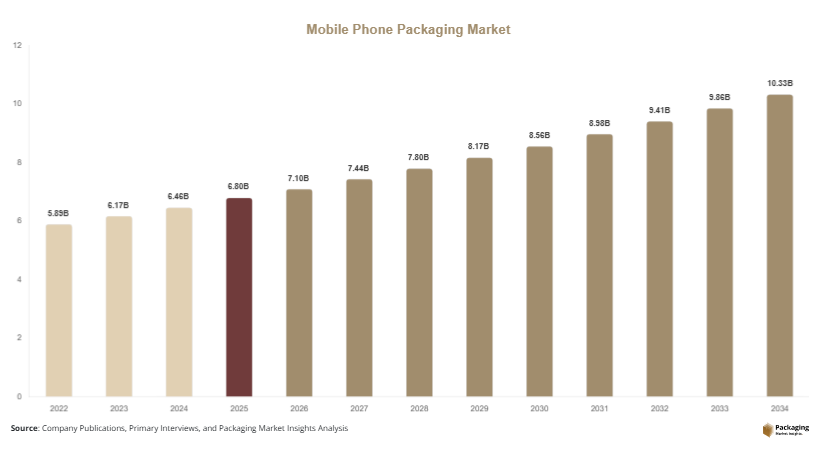
The global mobile phone packaging market is projected to grow from USD 6.8 billion in 2025 to USD 10.4 billion by 2034, registering a CAGR of 4.8% during 2025–2034. In 2026, the market size is estimated at USD 7.1 billion, driven by rising smartphone shipments and increasing demand for sustainable packaging solutions.
Several key growth factors are shaping the market. First, the rapid expansion of the global smartphone industry, especially in Asia Pacific and emerging economies, is increasing demand for standardized packaging solutions. Second, the growth of online smartphone sales has significantly increased the need for durable, shock-resistant packaging to prevent damage during transportation. Third, increasing environmental regulations are pushing manufacturers toward recyclable and biodegradable packaging materials.
Key Highlights
- Asia Pacific dominated the market with a 37.4% share in 2025.
- Latin America is projected to grow at the fastest CAGR of 6.2%.
- Paper-based packaging led the material segment with a 54.6% share.
- Premium retail packaging dominated with a 48.3% share.
- Smartphone OEMs accounted for 62.1% of demand, while e-commerce packaging is growing steadily.
- The US remained the dominant country with a market size of USD 11.2 billion in 2025 and USD 11.9 billion in 2026.
Explore more data points, trends and opportunities Download Free Sample Report
Market Trends
Shift Toward Eco-Friendly and Plastic-Free Packaging
A major trend in the mobile phone packaging market is the transition toward eco-friendly, plastic-free packaging solutions. Smartphone manufacturers are actively replacing plastic trays and foam inserts with molded fiber and recycled paper materials. For example, several global smartphone brands have redesigned their packaging to eliminate plastic entirely, replacing it with pulp-based inserts and soy-based inks. This shift is driven by increasing environmental regulations and consumer demand for sustainable products. In Europe, regulatory pressure is particularly strong, pushing OEMs to redesign packaging to meet recycling standards. In the future, circular packaging systems and fully biodegradable packaging designs are expected to become standard across the industry.
Premiumization and Experience-Driven Packaging Design
Another key trend is the increasing focus on premium packaging and enhanced unboxing experiences. Smartphone brands are investing in minimalist design, magnetic closures, textured finishes, and layered packaging structures to improve customer perception. For instance, flagship smartphone models from leading brands use multi-layered rigid boxes with custom inserts to create a premium feel. This trend is especially strong in high-end smartphone segments where packaging plays a role in brand positioning. In the future, integration of smart packaging features such as QR codes, AR-enabled manuals, and digital authentication systems is expected to further enhance user engagement.
Market Drivers
Growth in Global Smartphone Shipments
The expansion of global smartphone shipments is a major driver of the mobile phone packaging market. Increasing demand for affordable smartphones in emerging markets such as India, Indonesia, and Brazil is significantly boosting packaging volumes. For example, India’s smartphone market has seen rapid growth in mid-range and budget devices, leading to higher demand for standardized corrugated and rigid packaging solutions. As smartphone penetration continues to rise globally, packaging demand is expected to grow in parallel.
Expansion of E-Commerce Distribution Channels
The rise of e-commerce platforms for smartphone sales is another key driver. Online sales require highly durable and protective packaging to prevent damage during shipping. For instance, global e-commerce giants and direct-to-consumer smartphone brands rely on reinforced corrugated packaging with shock-absorbing inserts. This shift has increased demand for tamper-proof and impact-resistant packaging solutions. As online retail continues to expand, packaging requirements will become more stringent, supporting market growth.
Market Restraint
A major restraint in the mobile phone packaging market is the rising cost pressure associated with sustainable packaging materials. Eco-friendly materials such as molded fiber, recycled paperboard, and biodegradable coatings are more expensive than conventional plastic-based packaging. This increases production costs for manufacturers, especially for mid-range and budget smartphone segments where cost optimization is critical.
Additionally, supply chain limitations in sustainable material sourcing can create production delays. For example, manufacturers in developing regions often face challenges in securing consistent quality recycled materials. This restricts large-scale adoption of fully sustainable packaging solutions.
Market Opportunities
Expansion of Sustainable Packaging Innovation
The shift toward sustainability presents a major opportunity for the mobile phone packaging market. Companies are investing in biodegradable materials, compostable packaging, and plastic-free designs. For example, smartphone manufacturers are developing fully recyclable packaging systems that eliminate synthetic components. This trend aligns with global ESG goals and regulatory requirements. In the future, innovations in bio-based coatings and reusable packaging systems are expected to create new growth avenues.
Integration of Smart Packaging Technologies
Smart packaging represents another major opportunity. QR codes, NFC tags, and augmented reality features are being integrated into mobile phone packaging to enhance user experience and authentication. For instance, some smartphone brands now include QR-enabled manuals and digital warranty registration systems inside packaging. This improves customer engagement and reduces paper usage. In the future, blockchain-based authentication and smart tracking systems are expected to become widely adopted in premium smartphone packaging.
Report Scope
| Report Metric | Details |
|---|---|
| Market Size in 2025 | USD 6.8 Billion |
| Market Size in 2026 | USD 7.1 Billion |
| Market Size in 2034 | USD 10.4 Billion |
| CAGR | 4.8% (2026-2034) |
| Base Year for Estimation | 2025 |
| Historical Data | 2022-2024 |
| Forecast Period | 2026-2034 |
| Report Coverage | Revenue Forecast, Competitive Landscape, Supply Chain Disruption, Growth Factors, Environment & Regulatory Landscape and Trends |
| Geographies Covered | North America, Europe, APAC, Middle East and Africa, LATAM |
| Countries Covered | U.S., Canada, U.K., Germany, France, Spain, Italy, Russia, Nordic, Benelux, Rest of Europe, China, South Korea, Japan, India, Australia, Singapore, Taiwan, South East Asia, Rest of Asia-Pacific, UAE, Turky, Saudi Arabia, South Africa, Egypt, Nigeria, Rest of MEA, Brazil, Mexico, Argentina, Chile, Colombia, Rest of LATAM |
Explore more data points, trends and opportunities Download Free Sample Report
Segmental Analysis
Type
The rigid box packaging segment dominated with a 2024 market share of 52.8%, driven by its strong protective capability and premium branding use. Rigid boxes are widely used for flagship smartphones due to their durability and aesthetic appeal. For example, leading smartphone brands use high-quality rigid boxes with magnetic closures and layered inserts to enhance customer experience. These boxes also provide strong protection during global shipping and retail handling, making them the preferred choice for premium devices.
Corrugated packaging is also widely used but mainly in mid-range and budget smartphone categories due to cost efficiency. However, its structural limitations reduce use in premium segments.
The fastest-growing segment is molded fiber packaging, with a CAGR of 6.7%, driven by sustainability trends and regulatory pressure to eliminate plastic. Companies are increasingly adopting molded pulp inserts as replacements for foam and plastic trays. Future growth will be supported by innovation in biodegradable coatings and lightweight fiber structures.
Material
Paperboard packaging dominated with a 2024 share of 54.6%, due to its recyclability, cost efficiency, and branding flexibility. It is widely used across all smartphone categories, especially for retail packaging.
Plastic materials are declining due to environmental concerns but still used in protective inserts for low-cost devices.
The fastest-growing segment is molded fiber materials, driven by sustainability mandates and consumer preference for eco-friendly packaging. CAGR stands at 6.7%, supported by innovation in bio-based fibers and recyclable packaging systems.
End-Use
Smartphone OEMs dominated with a 2024 share of 62.1%, driven by direct packaging of devices at manufacturing stage. OEMs control packaging design, material selection, and branding strategy.
E-commerce platforms represent a growing segment due to increasing online smartphone purchases.
The fastest-growing segment is e-commerce distribution packaging, driven by rising online sales and demand for secure shipping solutions. CAGR stands at 5.9%, supported by expansion of digital retail ecosystems.
Mobile Phone Packaging Market Segmentations
By Type
- Rigid Box Packaging
- Corrugated Packaging
- Molded Fiber Packaging
By Material
- Paperboard
- Plastic
- Molded Fiber
By End-User
- Smartphone OEMs
- E-commerce Platforms
- Retail Distribution
Regional Analysis
North America
North America accounted for approximately 25.8% share of the mobile phone packaging market in 2025, with a projected CAGR of 4.3% through 2034. The region benefits from strong smartphone adoption, high disposable income, and advanced retail infrastructure. The United States dominates the regional market due to high demand for premium smartphones and strong presence of global OEMs. Packaging demand is driven by both retail and e-commerce channels, where protective and branded packaging plays a critical role.
A key growth factor is the expansion of direct-to-consumer smartphone sales. For example, major smartphone brands in the U.S. are increasingly shipping devices directly to customers, requiring highly durable and tamper-proof packaging. Canada also contributes to demand with strong retail electronics distribution networks. Sustainability initiatives are influencing packaging design, with companies shifting toward recyclable materials and reduced plastic usage.
The United States leads the region due to its strong technology ecosystem and high smartphone replacement rate. A unique growth driver is the integration of premium unboxing experiences in flagship smartphone launches. For instance, leading smartphone brands design multi-layer packaging with precision-cut inserts and minimalistic aesthetics to enhance brand perception. This focus on customer experience is significantly influencing packaging innovation in North America.
Europe
Europe held around 23.4% market share in 2025, growing at a CAGR of 4.1%. The region is heavily influenced by environmental regulations and strong sustainability commitments. Countries such as Germany, France, and the UK dominate due to high smartphone penetration and strong regulatory frameworks promoting eco-friendly packaging.
A key growth factor is strict EU packaging waste regulations, which require manufacturers to reduce plastic usage and increase recyclability. For example, smartphone OEMs in Europe are redesigning packaging to eliminate plastic trays and use molded fiber alternatives. Retailers are also demanding sustainable packaging compliance.
Germany dominates the region due to its strong manufacturing and electronics distribution ecosystem. A unique growth driver is the adoption of fully recyclable packaging standards in electronics retail chains. For example, German electronics retailers are implementing packaging return and recycling programs, encouraging circular economy practices.
Asia Pacific
Asia Pacific dominated with a 37.4% share in 2025, and is projected to grow at a CAGR of 5.4%. The region benefits from massive smartphone manufacturing bases, rising consumer demand, and strong export-oriented production. China, India, South Korea, and Vietnam are key contributors.
A major growth factor is large-scale smartphone production and exports. For example, China manufactures a significant share of global smartphones, requiring standardized packaging solutions for global distribution. India is emerging as a fast-growing smartphone consumption market.
China dominates the region due to its massive electronics manufacturing ecosystem. A key growth driver is the expansion of export-driven smartphone manufacturing facilities requiring high-volume packaging solutions. For instance, Chinese OEM suppliers are investing in automated packaging lines to meet global demand efficiently.
Middle East & Africa
Middle East & Africa accounted for 7.1% share in 2025, with a CAGR of 4.6%. Growth is driven by increasing smartphone penetration, expanding retail infrastructure, and rising youth population. UAE, Saudi Arabia, and South Africa are key markets.
A key growth factor is increasing smartphone imports and retail expansion. For example, rising e-commerce penetration in the UAE is increasing demand for protective packaging solutions. Tourism-driven retail sales also contribute to packaging demand.
The UAE dominates the region due to its strong retail and logistics infrastructure. A unique driver is the growth of premium smartphone sales in urban centers, requiring high-end packaging solutions.
Latin America
Latin America held around 6.3% share in 2025, and is projected to grow at the fastest CAGR of 6.2%. Brazil and Mexico dominate due to expanding smartphone adoption and retail distribution networks.
A key growth factor is rising smartphone affordability and penetration in mid-income populations. For example, Brazil’s growing smartphone user base is increasing demand for packaged devices in retail and e-commerce channels.
Brazil dominates the region due to its large consumer electronics market. A unique driver is expansion of online smartphone sales platforms requiring secure and durable packaging solutions.
Competitive Landscape
The mobile phone packaging market is moderately consolidated, with key players focusing on sustainability, automation, and premium packaging innovation. Major companies include DS Smith, Smurfit Kappa, WestRock, Amcor, and International Paper. Among these, Smurfit Kappa leads due to its global corrugated packaging network and strong focus on sustainable packaging innovation.
Companies are investing in recyclable materials, smart packaging technologies, and automated production systems. Strategic collaborations with smartphone OEMs are increasing to develop customized packaging solutions aligned with brand identity and sustainability goals.
Key Players List
- DS Smith
- Smurfit Kappa Group
- WestRock Company
- International Paper
- Amcor plc
- Mondi Group
- Stora Enso
- Sonoco Products Company
- Huhtamaki
- Uflex Ltd.
- Shandong Lianchuang Packaging
- Oji Holdings Corporation
- Mayr-Melnhof Karton AG
- Packaging Corporation of America
- Georgia-Pacific LLC