Milk Packaging Market Size and Growth
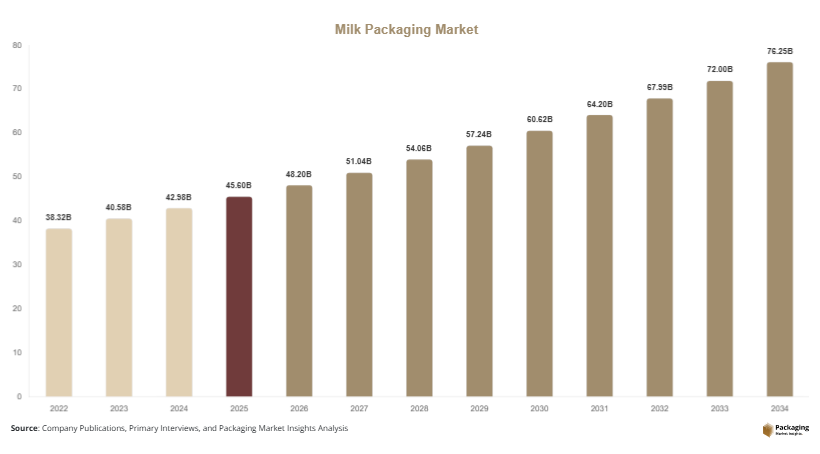
The Milk Packaging Market plays a critical role in the global dairy value chain by ensuring product safety, shelf life, and efficient distribution. Packaging solutions for milk include bottles, cartons, pouches, and other flexible or rigid formats that protect dairy products from contamination and environmental exposure. The global milk packaging market size is estimated to reach USD 45.6 billion in 2025, increasing to USD 48.2 billion in 2026. The market is projected to expand steadily and reach approximately USD 76.5 billion by 2034, registering a compound annual growth rate (CAGR) of 5.9% from 2025 to 2034.
Growing global milk consumption remains a primary factor supporting market growth. Rising population levels, urbanization, and increasing demand for packaged dairy products are encouraging dairy producers to adopt modern packaging solutions. Packaged milk ensures improved hygiene and longer shelf life, which is particularly important in urban retail environments and modern trade channels.
Key Highlights
- The milk packaging market is projected to grow from USD 45.6 billion in 2025 to USD 76.5 billion by 2034, registering a CAGR of 5.9% during 2025–2034.
- Market growth is supported by rising global demand for packaged dairy products and expanding modern retail and dairy distribution networks.
- Increasing adoption of sustainable and recyclable packaging materials is further driving innovation and growth in the market.
Explore more data points, trends and opportunities Download Free Sample Report
Market Trends
Increasing Adoption of Sustainable Packaging Materials
Sustainability has become one of the most significant trends influencing the milk packaging market. Governments, consumers, and environmental organizations are encouraging the reduction of plastic waste and carbon emissions associated with packaging materials. As a result, dairy companies and packaging manufacturers are investing in eco-friendly solutions such as recyclable paper cartons, bio-based plastics, and lightweight packaging formats.
Many packaging producers are redesigning traditional milk containers to use less raw material while maintaining durability and barrier protection. Paperboard cartons with plant-based coatings are gaining popularity because they offer strong sustainability credentials while preserving milk quality. In addition, several companies are incorporating recycled content in plastic bottles and pouches. These developments are helping brands meet environmental regulations and respond to changing consumer preferences.
Growing Demand for Aseptic and Extended Shelf-Life Packaging
Another important trend in the milk packaging market is the rising demand for aseptic packaging technologies that extend milk shelf life. Aseptic packaging allows milk to remain fresh for longer periods without refrigeration by combining sterilized packaging materials with ultra-heat-treated milk processing. This approach reduces spoilage and improves distribution efficiency.
The trend is particularly visible in regions where cold chain infrastructure is limited. Dairy producers are adopting aseptic cartons and multilayer packaging materials that protect milk from oxygen, moisture, and light exposure. Extended shelf-life packaging supports long-distance transportation and export opportunities for dairy brands. As global trade in dairy products expands, the demand for advanced packaging solutions that maintain product stability during transit continues to increase.
Market Drivers
Rising Global Milk Consumption and Urbanization
One of the major drivers supporting the milk packaging market is the steady increase in global milk consumption. Population growth, changing dietary habits, and rising disposable incomes are encouraging greater consumption of dairy products in many regions. Urban consumers often prefer packaged milk because it offers convenience, safety, and longer storage life compared with loose milk.
Urbanization has also led to a shift toward organized retail channels such as supermarkets and convenience stores. These outlets require standardized packaging formats that can be easily transported, displayed, and stored. As urban populations expand, dairy producers are increasingly adopting modern packaging technologies to meet the growing demand for packaged milk products.
Expansion of Dairy Processing and Cold Chain Infrastructure
The rapid expansion of dairy processing facilities and cold chain logistics networks is another important driver of the milk packaging market. Governments and private investors are supporting the development of dairy infrastructure to improve milk collection, processing, and distribution efficiency.
Modern dairy plants rely heavily on automated packaging equipment to maintain hygiene standards and production efficiency. Improved cold storage and refrigerated transportation systems also encourage the distribution of packaged milk over longer distances. These infrastructure developments increase the demand for high-quality packaging materials that can maintain milk freshness during storage and transportation.
Market Restraints
Volatility in Raw Material Prices
Fluctuations in the prices of packaging raw materials present a significant restraint for the milk packaging market. Many packaging solutions rely on materials such as polyethylene, polypropylene, aluminum foil, and paperboard. These materials are influenced by global commodity markets, energy prices, and supply chain disruptions.
When raw material prices rise sharply, packaging manufacturers face increased production costs. These cost pressures often pass through the supply chain, affecting dairy processors and ultimately consumers. Smaller dairy producers may struggle to absorb these additional costs, which can limit adoption of advanced packaging technologies.
The impact is particularly visible in emerging economies where price sensitivity is high. For example, sudden increases in plastic resin costs may discourage dairy companies from switching to higher-quality packaging formats. Instead, they may continue using low-cost alternatives that offer limited protection. This dynamic can slow the adoption of innovative and sustainable packaging solutions, thereby restraining overall market growth.
Market Opportunities
Growth of Plant-Based and Alternative Milk Products
The rapid expansion of plant-based dairy alternatives presents a promising opportunity for the milk packaging market. Products such as almond milk, soy milk, oat milk, and coconut milk require specialized packaging solutions similar to traditional dairy milk. These beverages often use aseptic cartons and innovative bottle designs to maintain product freshness and appeal to environmentally conscious consumers.
As demand for plant-based beverages grows globally, packaging manufacturers have the opportunity to develop customized solutions tailored to these products. Lightweight cartons, recyclable bottles, and resealable packaging formats are becoming popular in this segment. Packaging companies that invest in sustainable and functional designs can benefit from the rapid expansion of the alternative dairy beverage market.
Technological Advancements in Smart Packaging
Smart packaging technologies represent another significant opportunity for the milk packaging market. These technologies include features such as freshness indicators, QR codes, and digital traceability systems. Smart labels allow consumers to access product information, verify authenticity, and track supply chain data.
For dairy companies, smart packaging can improve product safety and enhance consumer trust. Temperature-sensitive indicators can alert retailers and consumers if milk has been exposed to unsuitable storage conditions. As food safety regulations become more stringent and digital supply chain solutions expand, the adoption of intelligent packaging technologies is expected to grow significantly.
Report Scope
| Report Metric | Details |
|---|---|
| Market Size in 2025 | USD 45.6 Billion |
| Market Size in 2026 | USD 48.2 Billion |
| Market Size in 2034 | USD 76.5 Billion |
| CAGR | 5.9% (2026-2034) |
| Base Year for Estimation | 2025 |
| Historical Data | 2022-2024 |
| Forecast Period | 2026-2034 |
| Report Coverage | Revenue Forecast, Competitive Landscape, Supply Chain Disruption, Growth Factors, Environment & Regulatory Landscape and Trends |
| Geographies Covered | North America, Europe, APAC, Middle East and Africa, LATAM |
| Countries Covered | U.S., Canada, U.K., Germany, France, Spain, Italy, Russia, Nordic, Benelux, Rest of Europe, China, South Korea, Japan, India, Australia, Singapore, Taiwan, South East Asia, Rest of Asia-Pacific, UAE, Turky, Saudi Arabia, South Africa, Egypt, Nigeria, Rest of MEA, Brazil, Mexico, Argentina, Chile, Colombia, Rest of LATAM |
Explore more data points, trends and opportunities Download Free Sample Report
Segmental Analysis
Packaging Type
The bottles segment dominated the milk packaging market in 2024, accounting for approximately 38% of the total market share. Plastic bottles are widely used due to their durability, transparency, and convenience for consumers. They allow easy storage and pouring while protecting milk from contamination. Bottles are commonly used in refrigerated milk distribution systems and are compatible with automated filling lines used by large dairy processing facilities.
Bottles also provide opportunities for branding and product differentiation. Dairy companies often use custom bottle designs and labeling to attract consumers in retail stores. The popularity of high-density polyethylene bottles further supports the segment’s growth because the material provides strong barrier properties and recyclability. As consumer demand for packaged milk continues to rise globally, bottle packaging remains a preferred choice for many dairy brands.
The cartons segment is expected to be the fastest-growing subsegment, projected to expand at a CAGR of 6.7% through 2034. Carton packaging is gaining popularity because it provides extended shelf life and strong sustainability benefits. Aseptic cartons allow milk to be stored for longer periods without refrigeration, which improves distribution efficiency.
Another growth factor for carton packaging is its environmental advantage. Paperboard-based cartons are lightweight and often produced from renewable materials. Many dairy companies are adopting carton packaging to meet sustainability goals and comply with environmental regulations. The ability to store milk safely during long-distance transportation further increases the adoption of cartons in global markets.
Material Type
The plastic segment held the largest share of the milk packaging market in 2024, representing approximately 46% of total revenue. Plastic materials such as polyethylene and polypropylene are widely used because they offer durability, flexibility, and cost efficiency. Plastic packaging is suitable for various formats including bottles, pouches, and caps, making it a versatile solution for dairy producers.
Plastic materials also provide strong resistance to moisture and contamination, which helps maintain milk freshness. Their compatibility with automated packaging systems further supports their widespread use in large-scale dairy processing facilities. In addition, plastic packaging can be easily molded into different shapes and sizes, allowing brands to create convenient and user-friendly designs for consumers.
The paperboard segment is expected to be the fastest-growing material category, projected to expand at a CAGR of 6.9% during the forecast period. Increasing environmental awareness and regulatory pressure to reduce plastic waste are encouraging dairy companies to adopt paper-based packaging solutions.
Paperboard cartons provide excellent barrier protection when combined with thin polymer or aluminum layers. They are also lightweight and easy to transport, which helps reduce overall logistics costs. As governments introduce stricter recycling policies and sustainability targets, the demand for paperboard packaging in the milk industry is expected to increase significantly.
End-Use Industry
The dairy processing companies segment dominated the milk packaging market in 2024, accounting for around 62% of the total market share. Large dairy processors rely heavily on advanced packaging technologies to maintain product quality and comply with food safety standards. These companies operate large-scale packaging facilities capable of processing thousands of liters of milk per hour.
Packaging solutions used by dairy processors include automated bottle filling lines, aseptic carton systems, and flexible pouch packaging. These technologies help maintain hygiene and efficiency in milk production. Dairy processors also invest in packaging innovations to improve product shelf life and reduce waste. As global milk production increases, the demand for reliable packaging systems in dairy processing facilities continues to grow.
The retail and private label segment is expected to be the fastest-growing end-use category, projected to grow at a CAGR of 6.4% through 2034. Supermarkets and retail chains are increasingly introducing their own private label dairy products. These retailers require cost-effective packaging solutions that maintain product quality while supporting brand identity.
Private label milk products often use standardized packaging formats that reduce manufacturing costs and simplify supply chain operations. Retailers also focus on packaging designs that enhance shelf visibility and consumer convenience. The growing popularity of private label dairy products in supermarkets is expected to create additional demand for innovative and affordable milk packaging solutions.
Milk Packaging Market Segmentations
Packaging Type
- Bottles
- Cartons
- Pouches
- Cans
- Others
Material Type
- Plastic
- Paperboard
- Glass
- Metal
End-Use Industry
- Dairy Processing Companies
- Retail & Private Label
- Food Service Sector
Regional Analysis
North America
North America accounted for approximately 24% of the global milk packaging market share in 2025. The region is expected to grow at a CAGR of around 4.8% through 2034. Demand for packaged milk remains stable due to well-established dairy industries and high consumer awareness of food safety standards. The presence of advanced packaging technologies and strong distribution networks supports the steady adoption of innovative packaging materials.
The United States dominates the regional market due to its large dairy production capacity and developed retail infrastructure. A key growth factor is the increasing adoption of sustainable packaging solutions. Dairy producers are investing in recyclable plastic bottles and paper-based cartons to meet environmental targets and consumer expectations regarding sustainable packaging.
Europe
Europe held nearly 22% of the global milk packaging market share in 2025 and is expected to grow at a CAGR of 4.6% during the forecast period. The region benefits from strong dairy consumption patterns and advanced food safety regulations. European packaging manufacturers are actively developing recyclable materials and lightweight packaging formats to comply with environmental policies.
Germany represents one of the dominant markets in the region due to its strong dairy processing industry and technological capabilities. A major growth factor in Germany is the emphasis on circular economy practices. Packaging companies are introducing fully recyclable cartons and plastic bottles with higher recycled content to meet sustainability regulations.
Asia Pacific
Asia Pacific accounted for approximately 31% of the global milk packaging market share in 2025, making it the largest regional market. The region is projected to grow at a CAGR of around 7.2% through 2034, driven by population growth and rising dairy consumption. Rapid urbanization and expanding retail networks are encouraging dairy producers to adopt packaged milk products.
China dominates the regional market due to its large consumer base and increasing demand for packaged dairy products. A key growth factor is the expansion of domestic dairy processing facilities. The government and private sector are investing in modern dairy infrastructure, which is increasing the demand for advanced packaging solutions.
Middle East & Africa
The Middle East & Africa region accounted for about 11% of the milk packaging market share in 2025 and is expected to grow at a CAGR of 6.1% during the forecast period. Demand for packaged milk is increasing due to rising urban populations and improvements in food distribution systems. Packaging solutions that extend shelf life are particularly important in this region.
Saudi Arabia is a dominant market due to its strong dairy industry and high consumption of packaged milk products. A key growth factor is the increasing demand for long-life milk products. Aseptic cartons are widely used in the region because they allow milk to be stored without refrigeration for extended periods.
Latin America
Latin America held approximately 12% of the global milk packaging market share in 2025 and is expected to grow at a CAGR of 5.4% through 2034. The region has a well-established dairy industry, and packaged milk products are widely consumed. Rising investments in dairy processing and packaging technologies support market development.
Brazil leads the regional market due to its large dairy production capacity and expanding food retail sector. One of the main growth factors in Brazil is the increasing demand for convenient packaging formats such as flexible pouches and resealable bottles, which offer affordability and ease of use for consumers.
Competitive Landscape
The milk packaging market is moderately competitive, with several global and regional packaging companies operating across different product categories. Leading companies focus on product innovation, sustainable materials, and strategic partnerships with dairy processors to strengthen their market presence.
One of the leading players in the market is Tetra Pak, which specializes in aseptic carton packaging solutions widely used by dairy producers worldwide. The company continues to invest in research and development to improve packaging sustainability and efficiency. For example, the company recently introduced carton packaging with higher renewable material content to reduce environmental impact.
Other major companies in the market include Amcor, Berry Global, SIG Group, and Elopak. These companies offer a wide range of packaging solutions such as plastic bottles, flexible pouches, and carton systems. Market participants are focusing on technological innovation and expansion into emerging markets to capture new growth opportunities.
Strategic collaborations between packaging manufacturers and dairy companies are also increasing. These partnerships allow companies to develop customized packaging solutions that meet specific dairy processing requirements and sustainability goals.
Key Players List
- Tetra Pak
- Amcor Plc
- Berry Global Inc.
- SIG Group AG
- Elopak AS
- Mondi Group
- DS Smith Plc
- Sealed Air Corporation
- Smurfit Kappa Group
- Huhtamaki Oyj
- International Paper Company
- WestRock Company
- Crown Holdings Inc.
- Graham Packaging Company
- Reynolds Group Holdings