Microwave Ready Packaging Market Size and Growth
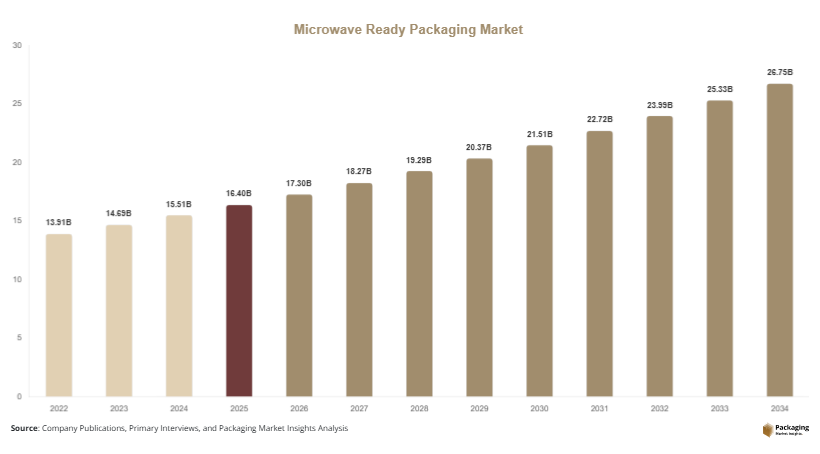
In 2025, the global microwave ready packaging market size is estimated at USD 16.4 billion, and it is projected to reach approximately USD 17.3 billion in 2026. The market is expected to expand to USD 26.8 billion by 2034, growing at a CAGR of 5.6% from 2025 to 2034. Microwave ready packaging includes trays, bowls, pouches, and containers designed to withstand microwave heating while maintaining food quality and safety.
One of the primary growth factors is the increasing demand for convenience food products. Rapid urbanization, changing lifestyles, and busy work schedules are encouraging consumers to opt for ready meals that can be quickly heated in microwaves. Microwave-ready packaging plays a critical role in supporting this trend by offering safe and efficient heating solutions. Another important growth factor is the expansion of the food service and retail sectors. Supermarkets, hypermarkets, and online grocery platforms are offering a wide range of ready-to-eat and ready-to-cook meals, boosting demand for microwave-compatible packaging.
Key Highlights:
- Market size is projected to reach USD 26.8 billion by 2034, reflecting steady growth across global food packaging industries. Increasing consumption of ready meals is supporting long-term expansion.
- The market is expected to grow at a CAGR of 5.6% during 2025–2034, indicating stable demand over the forecast period. Continuous innovations in packaging materials are contributing to this growth.
- There is a rising demand for convenient and ready-to-eat food products, driven by busy lifestyles and urbanization. Consumers prefer quick meal solutions that require minimal preparation time.
- Strong growth is observed in retail, food service, and frozen food segments, where microwave-ready packaging is widely used. Expansion of supermarkets and online food delivery is further supporting demand.
- Advancements in heat-resistant and sustainable packaging materials are improving product safety and performance. These innovations also support environmental goals by promoting recyclable and eco-friendly solutions.
Explore more data points, trends and opportunities Download Free Sample Report
Market Trends
Increasing Adoption of Sustainable Microwave-Safe Packaging Materials
A key trend in the microwave ready packaging market is the increasing adoption of sustainable and environmentally friendly materials. Manufacturers are focusing on developing packaging solutions that are both microwave-safe and recyclable. Traditional plastic packaging is being replaced with paper-based and bio-based materials that reduce environmental impact. Innovations in coatings and barrier technologies are enabling these materials to withstand microwave heating without compromising performance. This trend is driven by consumer demand for eco-friendly packaging and regulatory pressure to reduce plastic waste, encouraging companies to invest in sustainable solutions.
Growth of Smart and Functional Packaging Designs
Another important trend is the growth of smart and functional packaging designs. Microwave-ready packaging is being enhanced with features such as steam vents, self-venting lids, and temperature indicators to improve user convenience and safety. These innovations ensure even heating and prevent overcooking or spillage. Additionally, packaging designs are becoming more user-friendly, with easy-open and resealable features. The integration of smart packaging technologies is also gaining traction, providing consumers with information about cooking times and product freshness. These advancements are improving the overall consumer experience and driving market growth.
Market Drivers
Rising Demand for Ready-to-Eat and Convenience Foods
The increasing demand for ready-to-eat and convenience foods is a major driver of the microwave ready packaging market. Consumers are seeking quick meal solutions that fit into their busy lifestyles. Microwave-ready packaging enables easy heating and consumption, making it an essential component of convenience foods. The growth of urban populations and dual-income households is further supporting this trend. Additionally, the expansion of food delivery and online grocery services is increasing the demand for packaging solutions that can maintain food quality during storage and heating.
Expansion of Frozen and Chilled Food Segments
The expansion of frozen and chilled food segments is another key driver of market growth. These products require packaging that can withstand temperature variations and microwave heating. Microwave-ready packaging provides the necessary durability and performance, ensuring product safety and quality. The increasing popularity of frozen meals, particularly in developed regions, is driving demand. Moreover, advancements in freezing technologies and cold chain logistics are supporting the growth of this segment, further boosting the market.
Market Restraint
Environmental Concerns and Recycling Challenges
One of the primary restraints in the microwave ready packaging market is the environmental impact associated with certain packaging materials. Many microwave-ready packaging solutions use plastics and multilayer materials that can be difficult to recycle. This poses challenges in regions with strict environmental regulations and limited recycling infrastructure. For example, single-use plastic trays and containers may contribute to waste accumulation if not properly managed. These concerns are prompting governments and consumers to push for more sustainable alternatives. However, developing eco-friendly materials that maintain heat resistance and safety can be complex and costly. This creates a barrier for manufacturers and may slow market growth.
Market Opportunities
Development of Eco-Friendly and Recyclable Packaging Solutions
The development of eco-friendly and recyclable packaging solutions presents a significant opportunity for the microwave ready packaging market. Manufacturers are investing in innovative materials such as biodegradable plastics, paper-based trays, and compostable films. These solutions aim to reduce environmental impact while maintaining performance. As sustainability becomes a priority, companies that offer environmentally friendly packaging are likely to gain a competitive advantage. This trend is expected to drive market growth and open new avenues for innovation.
Growth in Emerging Markets and Urbanization
Emerging markets and urbanization offer another major opportunity for the market. Rapid economic development, increasing disposable income, and changing consumer preferences are driving demand for convenience foods in regions such as Asia Pacific and Latin America. The expansion of retail infrastructure and e-commerce platforms is further supporting market growth. Microwave-ready packaging is well-suited for these markets due to its convenience and efficiency. Companies can capitalize on these opportunities by expanding their presence and offering cost-effective solutions tailored to local needs.
Report Scope
| Report Metric | Details |
|---|---|
| Market Size in 2025 | USD 16.4 Billion |
| Market Size in 2026 | USD 17.3 Billion |
| Market Size in 2034 | USD 26.8 Billion |
| CAGR | 5.6% (2026-2034) |
| Base Year for Estimation | 2025 |
| Historical Data | 2022-2024 |
| Forecast Period | 2026-2034 |
| Report Coverage | Revenue Forecast, Competitive Landscape, Supply Chain Disruption, Growth Factors, Environment & Regulatory Landscape and Trends |
| Geographies Covered | North America, Europe, APAC, Middle East and Africa, LATAM |
| Countries Covered | U.S., Canada, U.K., Germany, France, Spain, Italy, Russia, Nordic, Benelux, Rest of Europe, China, South Korea, Japan, India, Australia, Singapore, Taiwan, South East Asia, Rest of Asia-Pacific, UAE, Turky, Saudi Arabia, South Africa, Egypt, Nigeria, Rest of MEA, Brazil, Mexico, Argentina, Chile, Colombia, Rest of LATAM |
Explore more data points, trends and opportunities Download Free Sample Report
Segmental Analysis
By Type
Trays dominated the market in 2024, accounting for approximately 48% of the total share. These are widely used for ready meals due to their durability and ability to withstand microwave heating. The increasing demand for packaged meals is driving this segment.
Pouches are expected to be the fastest-growing segment, with a CAGR of 5.9% during the forecast period. Their lightweight nature and convenience are driving adoption in various applications.
By Application
Ready-to-eat meals dominated the market in 2024, accounting for approximately 55% of the market share. The growing popularity of convenience foods is driving this segment.
Frozen foods are expected to be the fastest-growing segment, with a CAGR of 5.8% during the forecast period. The expansion of cold chain infrastructure is supporting growth.
By End-Use
Food industry dominated the market in 2024, holding approximately 70% of the total share. The need for efficient packaging solutions is driving this segment.
Retail and e-commerce are expected to be the fastest-growing segments, with a CAGR of 5.7% during the forecast period. The growth of online grocery platforms is supporting demand.
Microwave Ready Packaging Market Segmentations
Product Type
- Trays
- Pouches
Application
- Ready-to-Eat Meals
- Frozen Foods
End-Use
- Food Industry
- Retail & E-Commerce
Regional Analysis
North America
North America accounted for approximately 26% of the global market share in 2025, driven by strong demand for convenience foods and advanced packaging solutions. The region is projected to grow at a CAGR of 5.4% during the forecast period, supported by technological advancements and high consumer adoption of microwave-ready meals. The presence of established food processing companies further contributes to market growth.
The United States dominates the regional market due to its large consumer base and well-developed retail infrastructure. A unique growth factor is the increasing demand for frozen and ready-to-eat meals, which require microwave-compatible packaging.
Europe
Europe held around 24% of the market share in 2025 and is expected to grow at a CAGR of 5.5%. The region’s growth is driven by strong regulatory support for sustainable packaging and increasing demand for convenience foods. The adoption of eco-friendly materials is also gaining momentum.
Germany is a key market in Europe, supported by its advanced manufacturing sector. A unique growth factor is the emphasis on reducing food waste, which is driving the use of efficient packaging solutions.
Asia Pacific
Asia Pacific accounted for approximately 30% of the global market share in 2025, making it the largest regional market. The region is projected to grow at a CAGR of 6.2%, driven by rapid urbanization and changing lifestyles.
China dominates the market in this region due to its large population and expanding food industry. A unique growth factor is the growth of the middle-class population, increasing demand for convenient meal options.
Middle East & Africa
The Middle East & Africa region held about 8% of the market share in 2025 and is expected to grow at a CAGR of 5.1%. The market is gradually expanding as demand for packaged foods increases.
Saudi Arabia is a key market in this region, supported by investments in retail and food sectors. A unique growth factor is the rising demand for ready-to-eat meals in urban areas.
Latin America
Latin America accounted for around 12% of the global market share in 2025 and is projected to grow at a CAGR of 5.6%. The region is experiencing steady growth due to increasing consumption of packaged foods.
Brazil dominates the regional market, driven by its strong food processing industry. A unique growth factor is the growing demand for frozen and convenience foods.
Competitive Landscape
The microwave ready packaging market is moderately competitive, with key players focusing on innovation and sustainability. Companies are investing in research and development to improve product performance and meet consumer demands.
Amcor Plc is a leading player, known for its advanced packaging solutions. The company recently introduced recyclable microwave-safe packaging materials, strengthening its market position.
Key Players List
- Amcor Plc
- Berry Global Inc.
- Sealed Air Corporation
- Mondi Group
- Huhtamaki Oyj
- Sonoco Products Company
- Coveris Holdings S.A.
- Constantia Flexibles
- Uflex Ltd.
- Winpak Ltd.
- ProAmpac LLC
- Graphic Packaging Holding Company
- Sabert Corporation
- Genpak LLC
- Anchor Packaging Inc.