Microwave Packaging Market Size and Growth
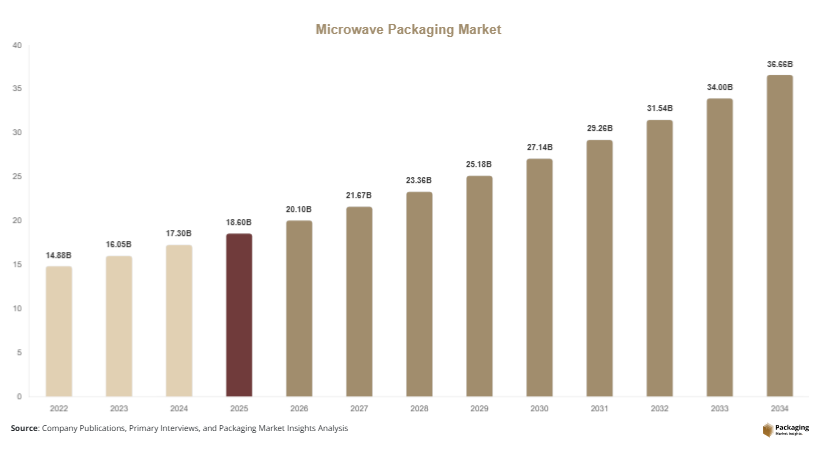
The Microwave Packaging Market size was estimated at USD 18.6 billion in 2025 and is projected to reach approximately USD 20.1 billion in 2026, reflecting consistent short-term growth. Over the forecast period, the market is expected to reach USD 36.8 billion by 2034, growing at a compound annual growth rate (CAGR) of 7.8% from 2025 to 2034. This growth trajectory highlights the increasing relevance of microwave-compatible packaging across both developed and emerging economies.
One of the primary growth factors is the rapid expansion of the ready-to-eat (RTE) and frozen food sectors. As urban populations grow and working professionals seek time-saving meal options, microwave packaging solutions have become essential for maintaining product quality and convenience. Additionally, advancements in material science—such as heat-resistant polymers, susceptor films, and recyclable paper-based solutions—are improving the performance and sustainability of microwave packaging formats.
Key Highlights:
- The market size reached USD 18.6 billion in 2025 and is projected to reach USD 36.8 billion by 2034. This reflects steady expansion driven by increasing demand across food packaging applications.
- The market is expected to grow at a CAGR of 7.8% from 2025 to 2034. Consistent growth is supported by evolving consumer preferences and packaging innovations.
- Rising demand for convenience and ready-to-eat meals is a major growth driver. Busy lifestyles and urbanization are increasing reliance on quick and easy food solutions.
- Increasing adoption of sustainable and recyclable packaging materials is shaping the market. Regulatory pressure and environmental awareness are encouraging eco-friendly innovations.
- Technological advancements in heat-resistant and smart packaging solutions are enhancing product performance. These innovations improve heating efficiency, food quality, and overall consumer experience.
Explore more data points, trends and opportunities Download Free Sample Report
Market Trends
Increasing Adoption of Sustainable Microwave Packaging Solutions
Sustainability has emerged as a major trend influencing the microwave packaging market. Manufacturers are focusing on reducing plastic usage and introducing environmentally friendly materials such as molded fiber, paperboard, and bio-based polymers. This shift is driven by stringent regulations and changing consumer preferences toward eco-conscious products. Companies are investing in recyclable and compostable packaging formats that maintain heat resistance and structural integrity during microwave use. Additionally, innovations such as water-based coatings and plant-derived films are gaining popularity as alternatives to traditional plastic layers. These developments not only reduce environmental impact but also enhance brand value and compliance with global sustainability standards.
Integration of Advanced Functional and Smart Packaging Technologies
Another significant trend is the integration of advanced functional features into microwave packaging. Technologies such as susceptor films, steam-release valves, and dual-ovenable trays are improving cooking efficiency and food quality. Smart packaging solutions that enable uniform heating, crisping, and moisture control are becoming increasingly popular in the ready-meal segment. These innovations enhance the consumer experience by delivering restaurant-quality results at home. Additionally, manufacturers are exploring the use of intelligent indicators that signal optimal heating conditions, further improving usability. This trend is particularly prominent in developed markets where consumers demand high-performance packaging solutions.
Market Drivers
Rising Demand for Convenience and Ready-to-Eat Food Products
The growing demand for convenience foods is a major driver of the microwave packaging market. Urbanization, busy lifestyles, and increased workforce participation have led to a surge in consumption of ready-to-eat and frozen meals. Microwave packaging provides a quick and efficient solution for heating these products, making it an essential component of modern food consumption patterns. The expansion of retail chains and online grocery platforms has further amplified this demand. Consumers are increasingly prioritizing ease of use, minimal preparation time, and consistent food quality, all of which are supported by advanced microwave packaging solutions.
Growth of Food Delivery and E-commerce Platforms
The rapid growth of food delivery services and e-commerce platforms is significantly contributing to market expansion. Microwave packaging ensures that food can be safely reheated without compromising taste or texture, making it ideal for delivered meals. Restaurants and cloud kitchens are adopting microwave-safe containers to enhance customer satisfaction. Additionally, the rise of meal kit services and subscription-based food models is driving demand for packaging that supports both storage and reheating. This trend is particularly strong in urban regions where digital food ordering is becoming the norm.
Market Restraint
Environmental Concerns and Regulatory Challenges
Despite its growth, the microwave packaging market faces significant challenges related to environmental concerns and regulatory pressures. Traditional microwave packaging often relies on plastic materials that are difficult to recycle, leading to increased scrutiny from governments and environmental organizations. Regulations restricting single-use plastics are forcing manufacturers to redesign packaging solutions, which can increase production costs and complexity. Additionally, the development of sustainable alternatives that meet performance requirements—such as heat resistance and durability—remains a technical challenge. For example, certain biodegradable materials may not withstand high temperatures or prolonged microwave use, limiting their applicability. These constraints can slow down adoption rates and create barriers for smaller manufacturers with limited resources.
Market Opportunities
Development of Eco-Friendly and Compostable Packaging Materials
The shift toward sustainability presents significant opportunities for innovation in microwave packaging. Companies are investing in the development of compostable and biodegradable materials that can replace conventional plastics. Advances in material science are enabling the creation of packaging solutions that offer both environmental benefits and functional performance. For instance, molded fiber trays and plant-based films are gaining traction as viable alternatives. These innovations align with regulatory requirements and consumer expectations, creating new growth avenues for market players. Additionally, partnerships between packaging companies and food manufacturers are accelerating the adoption of sustainable solutions.
Expansion in Emerging Markets and Changing Consumption Patterns
Emerging markets offer substantial growth potential for the microwave packaging market. Rapid urbanization, rising disposable incomes, and changing dietary habits are driving demand for convenience foods in regions such as Asia Pacific and Latin America. As microwave oven penetration increases, the need for compatible packaging solutions is expected to grow. Local manufacturers are also entering the market, offering cost-effective products tailored to regional preferences. Furthermore, the expansion of modern retail infrastructure and online food delivery platforms is creating new opportunities for market expansion. These factors collectively contribute to the growing adoption of microwave packaging in developing economies.
Report Scope
| Report Metric | Details |
|---|---|
| Market Size in 2025 | USD 18.6 Billion |
| Market Size in 2026 | USD 20.1 Billion |
| Market Size in 2034 | USD 36.8 Billion |
| CAGR | 7.8% (2026-2034) |
| Base Year for Estimation | 2025 |
| Historical Data | 2022-2024 |
| Forecast Period | 2026-2034 |
| Report Coverage | Revenue Forecast, Competitive Landscape, Supply Chain Disruption, Growth Factors, Environment & Regulatory Landscape and Trends |
| Geographies Covered | North America, Europe, APAC, Middle East and Africa, LATAM |
| Countries Covered | U.S., Canada, U.K., Germany, France, Spain, Italy, Russia, Nordic, Benelux, Rest of Europe, China, South Korea, Japan, India, Australia, Singapore, Taiwan, South East Asia, Rest of Asia-Pacific, UAE, Turky, Saudi Arabia, South Africa, Egypt, Nigeria, Rest of MEA, Brazil, Mexico, Argentina, Chile, Colombia, Rest of LATAM |
Explore more data points, trends and opportunities Download Free Sample Report
Segmental Analysis
By Material Type
Plastic-based microwave packaging dominated the market in 2024, accounting for approximately 48% of the total share. Materials such as polypropylene (PP) and polyethylene terephthalate (PET) are widely used due to their heat resistance, durability, and cost-effectiveness. These materials are particularly suitable for ready-to-eat meals and frozen foods, where maintaining structural integrity during heating is essential. The widespread availability and established manufacturing processes of plastic materials further contribute to their dominance in the market.
Paper-based packaging is the fastest-growing subsegment, with a projected CAGR of 8.6% during the forecast period. This growth is driven by increasing environmental concerns and regulatory restrictions on plastic usage. Paperboard trays, molded fiber containers, and coated paper products are gaining popularity as sustainable alternatives. Innovations in barrier coatings and heat-resistant treatments are enhancing the performance of paper-based packaging, making it suitable for microwave applications.
By Packaging Type
Trays and containers held the largest market share in 2024, accounting for approximately 52% of the total market. These packaging formats are widely used in ready-to-eat meals, frozen foods, and foodservice applications. Their ability to provide structural support, ease of handling, and compatibility with microwave heating makes them a preferred choice for manufacturers and consumers. Additionally, the availability of various sizes and designs allows for customization based on product requirements.
Susceptor packaging is the fastest-growing segment, with a CAGR of 9.1%. This packaging type uses metallized films to enhance heating efficiency and provide crisping effects. It is commonly used in products such as pizzas, snacks, and bakery items. The increasing demand for high-quality microwaveable food products is driving the adoption of susceptor packaging. Manufacturers are also investing in advanced designs to improve performance and reduce material usage.
By Application
The ready-to-eat meals segment dominated the market in 2024, accounting for approximately 46% of the total share. The growing demand for convenience foods and the expansion of retail and food delivery services are key factors driving this segment. Microwave packaging plays a crucial role in ensuring food safety, quality, and ease of preparation, making it an essential component of this application.
The frozen food segment is the fastest-growing, with a CAGR of 8.9%. The increasing popularity of frozen meals, particularly among working professionals and urban consumers, is driving demand for microwave packaging. Advances in packaging technology are improving the shelf life and quality of frozen products, further supporting market growth. Additionally, the expansion of cold chain infrastructure is facilitating the distribution of frozen foods.
Microwave Packaging Market Segmentations
By Material Type
- Plastic
- Paper & Paperboard
- Others
By Packaging Type
- Trays & Containers
- Bags & Pouches
- Susceptor Packaging
By Application
- Ready-to-Eat Meals
- Frozen Foods
- Snacks
- Others
Regional Analysis
North America
North America held a significant share of the microwave packaging market in 2025, accounting for approximately 32% of global revenue. The region is expected to grow at a CAGR of 6.9% during the forecast period. High consumer demand for ready-to-eat meals and advanced packaging technologies are key factors driving growth. The presence of established food processing industries and strong retail networks further supports market expansion.
The United States dominates the regional market due to its high consumption of frozen and packaged foods. A unique growth factor is the widespread adoption of smart packaging technologies that enhance heating efficiency and food quality. Additionally, the growing focus on sustainability is encouraging the use of recyclable microwave packaging solutions.
Europe
Europe accounted for around 26% of the global market share in 2025 and is projected to grow at a CAGR of 6.5%. Stringent environmental regulations and increasing demand for eco-friendly packaging are key factors influencing market growth. The region is witnessing a shift toward paper-based and biodegradable packaging solutions.
Germany leads the European market due to its strong manufacturing base and focus on sustainability. A unique growth factor is the implementation of strict recycling regulations, which are driving innovation in eco-friendly microwave packaging materials. This regulatory environment is encouraging companies to invest in sustainable solutions.
Asia Pacific
Asia Pacific is the fastest-growing region, with a market share of approximately 24% in 2025 and a projected CAGR of 9.2%. Rapid urbanization, population growth, and increasing disposable incomes are driving demand for convenience foods. The expansion of modern retail and food delivery services further supports market growth.
China dominates the region due to its large consumer base and growing food processing industry. A unique growth factor is the increasing adoption of microwave ovens in urban households, which is driving demand for compatible packaging solutions. Additionally, government initiatives supporting food safety are contributing to market expansion.
Middle East & Africa
The Middle East & Africa region accounted for around 9% of the global market share in 2025 and is expected to grow at a CAGR of 7.1%. The growing demand for packaged and convenience foods is a key driver of market growth. The expansion of retail infrastructure is also supporting the adoption of microwave packaging.
Saudi Arabia leads the regional market due to its increasing urban population and changing consumption patterns. A unique growth factor is the rising demand for imported ready-to-eat meals, which require microwave-compatible packaging. This trend is driving the adoption of advanced packaging solutions.
Latin America
Latin America held approximately 9% of the market share in 2025 and is projected to grow at a CAGR of 7.4%. The region is experiencing steady growth due to increasing urbanization and changing dietary habits. The expansion of food delivery services is also contributing to market demand.
Brazil dominates the regional market due to its large population and growing food industry. A unique growth factor is the increasing penetration of modern retail chains, which are promoting the sale of packaged and microwaveable food products. This is driving demand for innovative packaging solutions.
Competitive Landscape
The microwave packaging market is characterized by the presence of several global and regional players competing on the basis of product innovation, sustainability, and cost efficiency. Leading companies are focusing on developing eco-friendly packaging solutions and enhancing product performance through advanced materials and technologies.
Amcor Plc is a leading player in the market, known for its extensive portfolio of sustainable packaging solutions. The company has recently introduced recyclable microwave packaging materials, strengthening its position in the market. Other key players are also investing in research and development to introduce innovative products and expand their market presence. Strategic partnerships, mergers, and acquisitions are common strategies used by companies to enhance their capabilities and gain a competitive edge.
Key Players List
- Amcor Plc
- Sealed Air Corporation
- Berry Global Inc.
- Sonoco Products Company
- Huhtamaki Oyj
- WestRock Company
- Graphic Packaging International
- Coveris Holdings S.A.
- Constantia Flexibles
- ProAmpac LLC
- Mondi Group
- DS Smith Plc
- Pactiv Evergreen Inc.
- Winpak Ltd.
- Genpak LLC