Micro Packaging Market Size and Growth
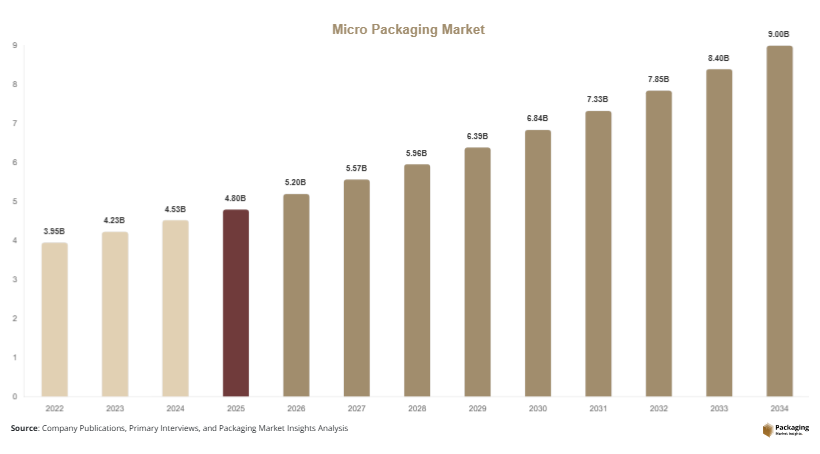
The global micro packaging market was valued at approximately USD 4.8 billion in 2025 and is projected to reach USD 5.2 billion in 2026. The market is expected to grow at a CAGR of 7.1% from 2025 to 2034, reaching nearly USD 9.6 billion by the end of the forecast period. Increasing demand for compact packaging solutions across pharmaceutical, electronics, food, healthcare, and cosmetic industries is driving strong market expansion worldwide. Micro packaging technologies are becoming increasingly important for protecting small and sensitive products while improving storage efficiency, portability, and shelf-life performance.
Micro packaging refers to highly compact, lightweight, and precision-engineered packaging formats used for miniature products, single-dose applications, microelectronic components, medical devices, and specialty consumer products. The market is witnessing strong adoption due to rapid growth in miniaturized electronics, personalized healthcare products, and single-use packaging applications. Manufacturers are increasingly investing in advanced barrier materials, micro blister packs, flexible pouches, micro tubes, and precision dispensing systems to meet evolving packaging requirements.
Key Highlights
- Asia Pacific dominated the market with a 41.2% share in 2025.
- Latin America is projected to grow at the fastest CAGR of 7.6%.
- Blister micro packaging led the type segment with a 33.5% share.
- Plastic materials dominated with a 54.7% share.
- Pharmaceutical applications led the segment with 38.9% share.
- The US remained the dominant country with a market size of USD 1.1 billion in 2025 and USD 1.2 billion in 2026.
Explore more data points, trends and opportunities Download Free Sample Report
Market Trends
Rising Adoption of Sustainable and Biodegradable Micro Packaging
Sustainability has become a major trend shaping the micro packaging market as industries face increasing pressure to reduce plastic waste and improve packaging recyclability. Packaging manufacturers are increasingly developing biodegradable micro pouches, recyclable blister packs, and lightweight flexible packaging solutions designed for pharmaceutical, food, and cosmetic applications. Companies are investing in bio-based polymers and compostable films that provide barrier protection while reducing environmental impact.
For example, pharmaceutical companies are exploring paper-based blister packaging and biodegradable single-dose sachets to comply with sustainability regulations. Food manufacturers are also adopting recyclable portion-control packaging for condiments, nutritional supplements, and snack products. This trend is expected to accelerate further as governments strengthen regulations related to single-use plastics and waste management. Over the long term, sustainable material innovation is likely to reshape procurement strategies across the healthcare and consumer goods industries.
Increasing Integration of Smart Packaging Technologies
Smart packaging technologies are becoming increasingly common in the micro packaging market as manufacturers seek to improve traceability, product safety, and customer engagement. Smart labels, QR codes, NFC-enabled packaging, and freshness indicators are being integrated into micro packaging formats used in pharmaceuticals, healthcare products, and premium electronics.
For instance, pharmaceutical companies are using connected micro blister packs to monitor medication adherence and improve patient safety. Electronics manufacturers are integrating anti-counterfeit tracking systems into packaging for semiconductor components and wearable devices. Food companies are also adopting freshness indicators and temperature-sensitive packaging for specialty products and nutritional supplements. Future developments in printed electronics and low-cost sensor technologies are expected to expand smart micro packaging applications across multiple industries.
Market Drivers
Growth in Pharmaceutical and Personalized Healthcare Applications
The rapid expansion of pharmaceutical manufacturing and personalized healthcare solutions is a major driver supporting the micro packaging market. Pharmaceutical companies require compact, sterile, and tamper-resistant packaging systems for unit-dose medicines, injectable drugs, diagnostic kits, and portable medical devices. Micro packaging solutions improve dosage control, reduce contamination risks, and support patient convenience.
The increasing prevalence of chronic diseases and growing demand for home healthcare products are further accelerating demand for advanced pharmaceutical packaging. Countries such as the United States, Germany, India, and China are witnessing rising pharmaceutical exports and higher healthcare packaging investments. For example, pharmaceutical manufacturers are increasingly using micro blister packs and sterile micro pouches for high-value biologics and specialty drugs. This growing healthcare demand is expected to create long-term opportunities for precision-engineered micro packaging technologies.
Expansion of Miniaturized Consumer Electronics
The rising production of miniaturized electronic devices is another major factor driving the micro packaging market. Smartphones, wearable devices, sensors, semiconductors, and IoT components require highly protective packaging systems that prevent moisture exposure, static discharge, and mechanical damage during storage and transportation.
Electronics manufacturers are increasingly adopting anti-static micro trays, vacuum-sealed pouches, and precision component packaging solutions to protect sensitive devices. The expansion of electric vehicles, smart medical devices, and connected consumer electronics is also increasing demand for advanced micro packaging systems. Countries such as China, South Korea, Japan, and Taiwan continue to invest heavily in semiconductor manufacturing, which is supporting packaging innovation and increasing demand for precision packaging materials.
Market Restraint
High Production Costs and Complex Manufacturing Requirements
High production costs and complex manufacturing processes remain significant restraints affecting the micro packaging market. Micro packaging solutions often require precision engineering, specialized machinery, advanced barrier materials, and cleanroom manufacturing environments. These requirements increase operational costs for packaging manufacturers, particularly small and medium-sized companies.
Pharmaceutical and electronics applications demand strict quality control standards and contamination prevention systems, which further increase production complexity. In addition, advanced micro packaging formats such as smart blister packs and connected packaging systems require investments in digital printing, sensors, and authentication technologies.
For example, manufacturers producing sterile pharmaceutical micro packaging may need to invest heavily in automated filling systems and high-performance barrier films to meet regulatory standards. Rising raw material prices for specialty polymers and advanced films also create cost pressures across the industry. These factors can limit market penetration in price-sensitive developing regions where manufacturers often prioritize low-cost conventional packaging solutions.
Market Opportunities
Expansion of Smart Healthcare Packaging Solutions
The growing adoption of connected healthcare technologies presents strong opportunities for the micro packaging market. Pharmaceutical and healthcare companies are increasingly investing in smart micro packaging systems capable of monitoring dosage usage, tracking temperature exposure, and improving medication adherence.
Smart blister packaging integrated with digital reminders and patient monitoring systems is becoming increasingly important for chronic disease management. Healthcare providers are also adopting connected packaging solutions for injectable medicines and diagnostic products to improve supply chain traceability and patient safety. Future advancements in printed electronics and flexible sensors are expected to create new growth opportunities for intelligent healthcare packaging applications.
Increasing Demand for Single-Serve and Portable Food Packaging
The rising demand for convenient and portable food products is creating significant opportunities for micro packaging manufacturers. Consumers are increasingly purchasing single-serve snacks, nutritional supplements, sauces, dairy products, and ready-to-consume beverages that require compact and lightweight packaging.
Food manufacturers are adopting micro sachets, mini pouches, and precision dispensing systems to improve convenience and reduce food waste. Urbanization, changing lifestyles, and growth in e-commerce grocery delivery are supporting demand for portion-controlled packaging solutions across emerging economies. Future opportunities are expected to emerge from sustainable single-serve packaging innovations and smart food packaging systems capable of monitoring freshness and product quality.
Report Scope
| Report Metric | Details |
|---|---|
| Market Size in 2025 | USD 4.8 Billion |
| Market Size in 2026 | USD 5.2 Billion |
| Market Size in 2034 | USD 9.6 Billion |
| CAGR | 7.1% (2026-2034) |
| Base Year for Estimation | 2025 |
| Historical Data | 2022-2024 |
| Forecast Period | 2026-2034 |
| Report Coverage | Revenue Forecast, Competitive Landscape, Supply Chain Disruption, Growth Factors, Environment & Regulatory Landscape and Trends |
| Geographies Covered | North America, Europe, APAC, Middle East and Africa, LATAM |
| Countries Covered | U.S., Canada, U.K., Germany, France, Spain, Italy, Russia, Nordic, Benelux, Rest of Europe, China, South Korea, Japan, India, Australia, Singapore, Taiwan, South East Asia, Rest of Asia-Pacific, UAE, Turky, Saudi Arabia, South Africa, Egypt, Nigeria, Rest of MEA, Brazil, Mexico, Argentina, Chile, Colombia, Rest of LATAM |
Explore more data points, trends and opportunities Download Free Sample Report
Segmental Analysis
By Type
Blister micro packaging dominated the micro packaging market with approximately 33.5% of the global market share in 2024. Blister packaging is widely used across pharmaceutical, healthcare, electronics, and consumer product applications because it provides strong barrier protection, tamper evidence, and product visibility. Pharmaceutical companies extensively use blister micro packaging for tablets, capsules, diagnostic products, and unit-dose medicines. The format supports precise dosage control while protecting products from moisture and contamination. Electronics manufacturers are also using miniature blister packaging for batteries, sensors, connectors, and semiconductor components. Packaging suppliers are increasingly investing in high-barrier films and recyclable blister packaging technologies to improve sustainability performance. The growing demand for portable healthcare products and compact electronics continues to strengthen demand for blister micro packaging solutions worldwide.
Smart micro packaging is projected to register the fastest CAGR of 8.1% during the forecast period due to increasing demand for connected packaging and digital traceability systems. Smart packaging technologies integrated with QR codes, NFC chips, and freshness indicators are becoming increasingly popular across pharmaceutical and electronics applications. Healthcare companies are using connected blister packs to monitor medication adherence and improve patient outcomes. Electronics manufacturers are also adopting smart packaging with anti-counterfeit tracking capabilities to protect high-value semiconductor products. Future growth is expected to be driven by advancements in printed electronics, flexible sensors, and low-cost digital labeling technologies. Packaging manufacturers are investing heavily in intelligent packaging systems capable of supporting data-driven supply chain management and customer engagement.
By Material
Plastic materials dominated the micro packaging market with a 54.7% share in 2024 because of their flexibility, lightweight structure, and cost efficiency. Plastic-based micro packaging solutions are widely used across pharmaceutical, food, electronics, and cosmetic applications because they provide excellent barrier protection and compatibility with automated manufacturing systems. Polyethylene, polypropylene, and polyethylene terephthalate are commonly used materials due to their durability and moisture resistance. Pharmaceutical companies rely heavily on plastic blister films, micro pouches, and sterile packaging systems for medicines and healthcare products. Electronics manufacturers also prefer plastic anti-static packaging for semiconductor components and microchips. Packaging companies continue investing in lightweight plastic materials and multilayer films designed to improve performance while reducing transportation costs and material usage.
Biodegradable materials are expected to witness the fastest CAGR of 8.4% through 2034 due to increasing sustainability regulations and rising environmental awareness. Packaging manufacturers are increasingly developing bio-based films, compostable pouches, and recyclable micro packaging materials for pharmaceutical and food applications. Food companies are adopting biodegradable portion-control packaging to reduce plastic waste and improve sustainability performance. Pharmaceutical manufacturers are also exploring paper-based blister packaging and compostable sachets to meet environmental targets. Future growth is likely to be supported by advancements in plant-based polymers and improvements in biodegradable barrier materials capable of protecting sensitive products while reducing environmental impact.
By End-Use
Pharmaceutical applications accounted for nearly 38.9% of the global micro packaging market in 2024, making it the dominant end-use segment. The pharmaceutical industry requires highly protective and contamination-resistant packaging solutions for tablets, capsules, injectable medicines, diagnostic kits, and specialty healthcare products. Micro packaging supports precise dosage control, portability, and product traceability while improving patient convenience. The growing prevalence of chronic diseases and increasing demand for personalized medicines are significantly contributing to segment growth. Pharmaceutical manufacturers are investing in sterile micro pouches, connected blister packs, and tamper-evident packaging systems to improve patient safety and regulatory compliance. Rising pharmaceutical exports from India, China, Germany, and the United States are also increasing global demand for precision healthcare packaging solutions.
Electronics packaging is projected to register the fastest CAGR of 7.9% during the forecast period because of increasing production of miniaturized electronic devices and semiconductor components. Micro packaging solutions are essential for protecting microchips, sensors, connectors, and wearable electronics from static discharge, dust, and moisture exposure. Consumer electronics manufacturers are increasingly adopting vacuum-sealed pouches, anti-static trays, and precision protective films to improve product safety during transportation. The rapid expansion of electric vehicles, smart medical devices, and IoT technologies is expected to create additional growth opportunities for advanced electronics micro packaging solutions. Packaging companies are also developing lightweight recyclable materials specifically designed for semiconductor and electronics applications.
Micro Packaging Market Segmentations
By Type
- Blister Micro Packaging
- Micro Pouches
- Micro Tubes
- Smart Micro Packaging
- Vacuum Micro Packaging
By Material
- Plastic
- Paper & Paperboard
- Metal Foils
- Biodegradable Materials
- Glass
By End-User
- Pharmaceutical
- Electronics
- Food & Beverage
- Personal Care & Cosmetics
- Healthcare Devices
Regional Analysis
North America
North America accounted for approximately 24.6% of the global micro packaging market in 2025 and is projected to expand at a CAGR of 6.8% through 2034. The region benefits from advanced pharmaceutical manufacturing, strong consumer electronics production, and increasing demand for precision healthcare packaging. Micro packaging is widely used across pharmaceuticals, diagnostic kits, wearable devices, and specialty food applications. Growing investments in healthcare technology and smart packaging solutions are further supporting market development. Companies in the region are increasingly adopting sustainable packaging materials and automated production systems to improve operational efficiency and regulatory compliance.
The United States remains the dominant country within the North American market due to its strong pharmaceutical sector and advanced electronics industry. One unique growth driver in the region is the rapid expansion of personalized medicine and home healthcare products. Pharmaceutical manufacturers are increasingly using unit-dose micro packaging formats to improve dosage accuracy and patient safety. Several healthcare packaging companies are also investing in connected packaging systems with digital monitoring capabilities for chronic disease management and specialty medicines.
Europe
Europe represented nearly 22.1% of the global micro packaging market in 2025 and is expected to register a CAGR of 6.9% during the forecast period. The region is strongly influenced by strict packaging sustainability regulations, advanced healthcare systems, and growing demand for recyclable packaging materials. Pharmaceutical companies are increasingly adopting biodegradable micro blister packs and lightweight flexible packaging to meet environmental targets.
Germany remains the leading country in the European market due to its strong pharmaceutical manufacturing base and advanced industrial packaging technologies. One important growth driver in the region is the increasing adoption of smart pharmaceutical packaging solutions. European healthcare providers are using connected blister packs and traceable medicine packaging systems to improve medication compliance and reduce counterfeit drug risks. The region is also witnessing rising demand for micro packaging in luxury cosmetics and premium food products.
Asia Pacific
Asia Pacific dominated the global micro packaging market with a 41.2% share in 2025 and is anticipated to grow at a CAGR of 7.4% through 2034. Rapid industrialization, expanding pharmaceutical production, and strong electronics manufacturing activities are supporting regional market growth. Countries such as China, Japan, South Korea, Taiwan, and India are major manufacturing hubs for semiconductors, consumer electronics, and pharmaceutical products requiring precision packaging solutions.
China remains the dominant country in the regional market because of its extensive electronics manufacturing sector and growing pharmaceutical exports. One unique growth driver is the rapid expansion of semiconductor packaging and microelectronic component manufacturing. Packaging suppliers are investing in anti-static materials, vacuum-sealed pouches, and precision protective packaging systems for microchips and sensors. India is also emerging as a high-growth market due to increasing healthcare investments and expanding pharmaceutical production facilities.
Middle East & Africa
The Middle East & Africa accounted for approximately 5.8% of the global micro packaging market in 2025 and is expected to grow at a CAGR of 6.7% during the forecast period. Rising healthcare infrastructure investments, increasing food imports, and growing pharmaceutical demand are supporting market development across the region. Micro packaging is increasingly used for medical supplies, nutritional products, and specialty food packaging applications.
Saudi Arabia remains the dominant country in the regional market due to rising healthcare expenditure and increasing pharmaceutical manufacturing investments. One major growth driver is the expansion of temperature-sensitive healthcare logistics and diagnostic product distribution. Pharmaceutical suppliers are increasingly adopting sterile micro packaging solutions for injectable medicines and laboratory products. The region is also witnessing growing demand for portable food packaging because of rising urbanization and tourism activities.
Latin America
Latin America held nearly 6.3% of the global micro packaging market in 2025 and is projected to register the fastest CAGR of 7.6% through 2034. Expanding pharmaceutical production, increasing processed food demand, and rising consumer electronics imports are supporting regional market expansion. Food and healthcare companies are increasingly adopting compact packaging solutions to improve transportation efficiency and product shelf life.
Brazil remains the dominant country within the Latin American market due to its strong food processing industry and growing healthcare packaging sector. One unique growth driver is the increasing demand for affordable single-dose pharmaceutical packaging and nutritional supplements. Manufacturers are investing in flexible micro pouches and unit-dose packaging systems to improve accessibility and reduce product waste. Mexico is also witnessing increased demand for micro packaging solutions due to rising exports of medical devices and packaged food products.
Competitive Landscape
The micro packaging market is moderately fragmented, with global packaging companies focusing on advanced materials, precision manufacturing technologies, and sustainable packaging innovations to strengthen market competitiveness. Companies are increasingly investing in smart packaging systems, biodegradable films, and high-barrier flexible materials designed for healthcare, electronics, and food applications.
Amcor plc remains one of the leading companies in the market due to its extensive flexible packaging portfolio and strong global manufacturing presence. The company has expanded its recyclable micro packaging solutions and increased investments in pharmaceutical and healthcare packaging technologies.
Sealed Air Corporation, Berry Global, Sonoco Products Company, and Constantia Flexibles are also major participants in the market. These companies are focusing on lightweight materials, smart packaging integration, and regional production expansion to improve market position. Strategic partnerships with pharmaceutical companies and electronics manufacturers are becoming increasingly common as packaging suppliers seek long-term contracts for specialized applications.
Regional companies in Asia Pacific are rapidly expanding manufacturing capabilities to support semiconductor production and pharmaceutical exports. Packaging firms are also investing in digital printing technologies and intelligent packaging systems capable of supporting product authentication and supply chain visibility.
Key Players List
- Amcor plc
- Berry Global Inc.
- Sealed Air Corporation
- Sonoco Products Company
- Constantia Flexibles
- WestRock Company
- Huhtamaki Oyj
- AptarGroup Inc.
- Mondi Group
- UFlex Ltd.
- ProAmpac LLC
- Winpak Ltd.
- Clondalkin Group
- Tekni-Plex Inc.
- Coveris Holdings S.A.
- Schott AG