Micro Flute Paper Market Size and Growth
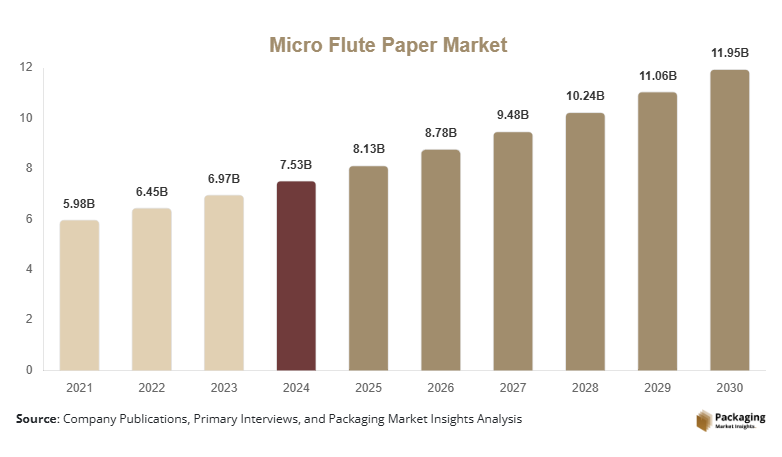
The global micro flute paper market size was valued at USD 7.53 billion in 2024 and is projected to grow from USD 8.13 billion in 2025 to reach approximately USD 11.95 billion by 2030, expanding at a CAGR of 8% during the forecast period (2025–2030). The micro flute paper market growth is primarily driven by the rising demand for lightweight, recyclable, and high-printability packaging solutions across retail, food & beverage, and e-commerce industries. Increasing emphasis on sustainability, coupled with the rapid expansion of organized retail and direct-to-consumer distribution models, continues to strengthen global adoption of micro flute-based packaging formats.
Micro flute paper has evolved from a protective packaging substrate into a value-added material offering superior structural performance, enhanced visual appeal, and reduced material usage. Its ability to replace traditional folding cartons and solid boards without compromising strength has made it an attractive option for brand owners seeking cost efficiency and environmental compliance. Advancements in flute engineering, recycled fiber processing, and printing compatibility are further accelerating market penetration across both developed and emerging economies.
Key Market Insights
- Micro flute paper is increasingly replacing conventional folding cartons and solid boards due to its superior strength-to-weight ratio and sustainability advantages.
- Recycled micro flute paper dominates material consumption as brands prioritize carbon footprint reduction and circular packaging solutions.
- Asia-Pacific leads global production and consumption, supported by strong manufacturing infrastructure and export-oriented packaging industries.
- E-commerce and shelf-ready packaging are the fastest-growing application segments, driven by retail automation and last-mile delivery demand.
- Offset and digital printing compatibility is enhancing the role of micro flute paper in premium and promotional packaging.
- Continuous investments in high-speed corrugators and digital printing lines are improving product quality and capacity utilization globally.
Explore more data points, trends and opportunities Download Free Sample Report
Latest Market Trend
Sustainability-Driven Packaging Adoption Gaining Momentum
Sustainability has become the most influential trend shaping the micro flute paper market. Governments, retailers, and multinational brands are actively transitioning away from plastic-based and multi-material packaging toward recyclable paper-based alternatives. Micro flute paper aligns strongly with these objectives by offering reduced fiber usage, high recycled content compatibility, and improved lifecycle performance. Manufacturers are increasingly developing recycled and semi-chemical micro flute grades that meet both performance and regulatory standards. In addition, water-based coatings and mono-material laminations are expanding micro flute paper’s application into moisture-sensitive and food-contact packaging, significantly broadening its addressable market.
The micro flute paper market is also benefiting from rising demand for shelf-ready and visually appealing packaging formats. Brands are prioritizing packaging that enhances shelf presence while maintaining logistical efficiency, pushing converters to adopt finer flute profiles such as E-flute and F-flute. These trends are supported by advancements in offset and digital printing technologies, enabling high-resolution graphics and shorter production runs.
Market Drivers
Shift Toward Sustainable Packaging Solutions
Regulatory frameworks restricting single-use plastics and encouraging recyclable paper-based materials have significantly increased the adoption of micro flute paper across multiple industries. Compared to traditional solid board, micro flute paper offers comparable strength with lower material consumption, directly supporting sustainability targets.
Rapid Expansion of Organized Retail and Branded FMCG Products
Shelf-ready packaging and point-of-sale displays increasingly rely on micro flute paper due to its superior print quality and structural integrity. Retailers favor packaging that reduces replenishment time while maintaining aesthetic appeal, which has boosted demand for E-flute and F-flute paperboards globally.
Market Restraints
Volatility in Raw Material Prices
Particularly, recovered paper and virgin pulp directly impact production costs and profit margins. Sudden fluctuations can limit pricing flexibility for manufacturers operating under long-term supply contracts. Additionally, capital-intensive machinery requirements for micro flute conversion and high-precision flute formation pose barriers for small and mid-sized entrants, slowing capacity expansion in certain regions.
Market Opportunities
Premium Retail and Shelf-Ready Packaging
As retailers increasingly demand packaging that enhances shelf visibility while remaining lightweight and recyclable, micro flute paper offers an optimal balance. Brands in food, cosmetics, and electronics are shifting from rigid cartons and plastic clamshells to printed micro flute formats, opening new revenue streams for manufacturers capable of delivering high-quality print surfaces and customized flute structures.
E-commerce and direct-to-consumer (DTC) Growth
Particularly in Asia-Pacific, Latin America, and the Middle East. Micro flute paper’s superior compression strength and cushioning properties make it ideal for last-mile delivery packaging. As cross-border e-commerce volumes rise, demand for standardized yet lightweight protective packaging solutions is expected to accelerate. New entrants can capitalize on this trend by offering e-commerce-optimized micro flute grades with improved damage resistance and lower shipping weight.
Report Scope
| Report Metric | Details |
|---|---|
| Market Size in 2024 | USD 7.53 Billion |
| Market Size in 2025 | USD 8.13 Billion |
| Market Size in 2030 | USD 11.95 Billion |
| CAGR | 8% (2025-2030) |
| Base Year for Estimation | 2024 |
| Historical Data | 2021-2023 |
| Forecast Period | 2025-2030 |
| Report Coverage | Revenue Forecast, Competitive Landscape, Supply Chain Disruption, Growth Factors, Environment & Regulatory Landscape and Trends |
| Geographies Covered | North America, Europe, APAC, Middle East and Africa, LATAM |
| Countries Covered | U.S., Canada, U.K., Germany, France, Spain, Italy, Russia, Nordic, Benelux, Rest of Europe, China, South Korea, Japan, India, Australia, Singapore, Taiwan, South East Asia, Rest of Asia-Pacific, UAE, Turky, Saudi Arabia, South Africa, Egypt, Nigeria, Rest of MEA, Brazil, Mexico, Argentina, Chile, Colombia, Rest of LATAM |
Explore more data points, trends and opportunities Download Free Sample Report
Segmental Analysis
By Application
The Food and Beverage Packaging subsegment accounted for the largest share of the micro flute paper market by application in 2024, representing approximately 34% of total demand. This dominance is primarily driven by the rapid growth of packaged food, ready-to-eat meals, and beverage multipacks, which require lightweight yet durable secondary packaging. Micro flute paper is widely used for folding cartons, shelf-ready trays, and promotional packs in food retail due to its high compression strength, excellent printability, and compliance with sustainability requirements. Increasing adoption of recyclable and plastic-free packaging formats by global food brands has further reinforced the leadership of this subsegment.
The Pharmaceutical Packaging subsegment is projected to be the fastest-growing application segment, registering a CAGR of approximately 7.8% from 2025 to 2033. Growth is driven by the expanding pharmaceutical manufacturing base, increasing use of secondary packaging for medicines, and rising regulatory emphasis on traceability and product protection. Micro flute paper is increasingly preferred for pharma cartons due to its rigidity, stacking performance, and compatibility with high-quality printing for regulatory information and branding.
By Substrate
The Recycled Paper subsegment held the dominant share of the micro flute paper market by substrate in 2024, accounting for nearly 44% of total consumption. This leadership is attributed to strong sustainability mandates, cost advantages, and growing corporate commitments toward circular economy practices. Recycled micro flute paper provides sufficient strength and print performance for most retail and e-commerce applications, making it a preferred choice among brand owners and converters.
The Kraft Paper subsegment is expected to witness the fastest growth, expanding at a CAGR of 7.2% during the forecast period. Demand is driven by applications requiring higher burst strength, moisture resistance, and premium appearance, particularly in electronics, cosmetics, and export packaging. Increasing preference for virgin fiber in high-value packaging applications continues to support this growth trajectory.
By Flute Size
The E Flute (0.020 inch) subsegment accounted for the largest share of the global micro flute paper market by flute size in 2024, representing approximately 38% of total market value. E flute’s optimal balance of thickness, strength, and surface smoothness makes it ideal for folding cartons and shelf-ready packaging. Its superior print quality compared to coarser flutes has driven widespread adoption in branded consumer goods packaging.
The F Flute (0.014 inch) subsegment is projected to be the fastest-growing, registering a CAGR of 8.1% from 2025 to 2033. This growth is supported by increasing demand for ultra-thin, premium packaging with excellent graphic quality, particularly in cosmetics, pharmaceuticals, and high-end retail applications. F flute’s ability to replace solid board while reducing material usage positions it strongly in sustainability-driven packaging strategies.
By Coating
The Uncoated micro flute paper subsegment held the largest share of the market by coating type in 2024, accounting for approximately 46% of total demand. This dominance is driven by its cost-effectiveness, recyclability, and widespread use in industrial, food, and e-commerce packaging, where moisture resistance requirements are minimal. Uncoated boards also support high recyclability rates, aligning well with environmental regulations.
The Coated micro flute paper subsegment is expected to grow at the fastest CAGR of 7.6% during the forecast period. Growth is driven by rising demand for enhanced print aesthetics, moisture resistance, and grease barriers in food, pharmaceutical, and personal care packaging. Advances in water-based and eco-friendly coatings are further expanding the use of coated micro flute paper without compromising recyclability.
Micro Flute Paper Market Segmentations
By Application
- Food and Beverage Packaging
- Pharmaceutical Packaging
- Cosmetics and Personal Care Packaging
- Industrial Packaging
By Substrate
- Kraft Paper
- Semi-Chemical Paper
- Recycled Paper
By Flute Size
- F Flute (0.014 inch)
- N Flute (0.018 inch)
- E Flute (0.020 inch)
- K Flute (0.024 inch)
By Coating
- Uncoated
- Coated
- Laminated
Regional Analysis
North America
North America remains a major demand center for micro flute paper, supported by strong retail infrastructure, high e-commerce penetration, and widespread adoption of shelf-ready packaging. The United States dominates regional consumption, driven by demand from food, consumer electronics, and personal care packaging. Sustainability regulations and retailer-led packaging optimization initiatives are accelerating the shift toward lightweight corrugated solutions. North American demand is also characterized by high adoption of offset-printable micro flute boards for premium branding applications.
Europe
Europe represents a mature yet steadily expanding market, underpinned by stringent environmental regulations and advanced recycling systems. Countries such as Germany, the United Kingdom, France, and Italy are key contributors, with recycled micro flute paper accounting for a substantial share of regional demand. European brand owners are highly receptive to eco-certified packaging, driving innovation in recycled fiber quality and barrier coatings. Growth is further supported by strong demand from food & beverage, pharmaceutical, secondary packaging, and retail display applications.
Asia-Pacific
Asia-Pacific is the largest and fastest-growing region in the global micro flute paper market, accounting for approximately 39% of global demand in 2024. China leads regional consumption and production due to its extensive packaging manufacturing base and export-driven industries. India is the fastest-growing country, supported by the rapid expansion of organized retail, e-commerce, and FMCG sectors. Japan and South Korea contribute steady demand, particularly for high-quality printed packaging used in electronics and premium consumer goods. Rising investments in modern corrugation facilities and recycling infrastructure are further strengthening regional supply capabilities.
Latin America
Latin America is an emerging market for micro flute paper, led by Brazil and Mexico. Growth is driven by increasing penetration of organized retail, expanding food processing industries, and gradual adoption of sustainable packaging standards. While the market remains relatively small, improving economic stability and foreign investments in packaging manufacturing are creating long-term growth opportunities.
Middle East & Africa
The Middle East & Africa region is witnessing gradual growth, supported by expanding retail sectors and rising demand for packaged food products. The UAE and Saudi Arabia are key demand centers, driven by imports and premium retail packaging requirements. In Africa, South Africa leads regional consumption, supported by local corrugated packaging production and growing retail activity. Increasing urbanization and government initiatives to diversify economies are expected to support future demand.
Competitive Landscape
The micro flute paper market is moderately consolidated, with the top five manufacturers collectively accounting for approximately 42% of the global market share. Large integrated paper and packaging companies benefit from economies of scale, diversified product portfolios, and strong relationships with global brand owners. Competition is driven by pricing efficiency, recycled fiber sourcing, printing quality, and sustainability certifications. While large players dominate high-volume contracts, regional manufacturers remain competitive in customized and niche applications.
Key Players in the Micro Flute Paper Market
- Smurfit Kappa Group
- DS Smith
- Mondi Group
- International Paper
- WestRock
- Stora Enso
- Oji Holdings
- Nine Dragons Paper
- Nippon Paper Industries
- Sappi Limited
- Klabin
- Packaging Corporation of America
- Lee & Man Paper
- Rengo Co., Ltd.
- Billerud