Metallized Film Market Size and Growth
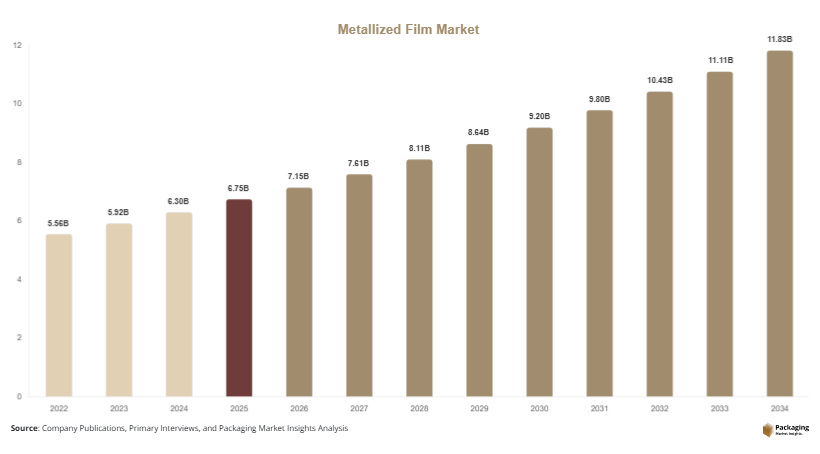
In 2025, the global metallized film market size is estimated at USD 6.75 billion, and it is projected to reach approximately USD 7.15 billion in 2026. The market is expected to grow to USD 11.85 billion by 2034, expanding at a CAGR of 6.5% from 2025 to 2034. Metallized films, typically made by depositing a thin layer of metal such as aluminum onto plastic substrates, offer excellent barrier properties against moisture, oxygen, and light, making them widely used in flexible packaging.
One of the primary growth factors driving the market is the rising demand for extended shelf-life packaging solutions. Food manufacturers increasingly rely on metallized films to preserve product freshness and reduce spoilage. This is particularly relevant in packaged snacks, confectionery, and ready-to-eat meals, where barrier performance is critical. Another key growth factor is the rapid expansion of the flexible packaging industry. Metallized films provide a lightweight, cost-effective alternative to traditional aluminum foil, reducing transportation costs while maintaining protective properties.
Key Highlights:
- Market size is projected to reach USD 11.85 billion by 2034, reflecting steady expansion across packaging and industrial applications. Increasing demand from multiple end-use industries is supporting long-term growth.
- The market is expected to grow at a CAGR of 6.5% during 2025–2034, indicating consistent demand over the forecast period. Continuous innovation in materials and processing technologies is contributing to this growth.
- There is a rising demand for high-barrier flexible packaging solutions, especially in food and consumer goods sectors. These films help extend shelf life and protect products from moisture, oxygen, and light.
- Strong growth is observed in food, electronics, and insulation applications, where metallized films are widely used. Their durability, conductivity, and protective properties make them suitable for diverse uses.
- Advancements in metallization and coating technologies are enhancing product performance and efficiency. These innovations are improving barrier properties, durability, and application versatility across industries.
Explore more data points, trends and opportunities Download Free Sample Report
Market Trends
Growing Adoption of Sustainable and Lightweight Packaging Materials
A major trend in the metallized film market is the increasing adoption of sustainable and lightweight packaging materials. Manufacturers are shifting toward metallized films as a replacement for aluminum foil due to their reduced material usage and improved recyclability. These films provide similar barrier properties while using significantly less metal, making them more environmentally efficient. The trend is particularly strong in the food and beverage sector, where companies are focusing on reducing packaging waste. Additionally, consumer awareness about sustainability is encouraging brands to adopt eco-friendly packaging solutions, further driving demand for metallized films.
Technological Advancements in High-Barrier and Specialty Films
Another key trend shaping the market is the advancement in high-barrier and specialty metallized films. Innovations in vacuum deposition and coating technologies are enabling the production of films with enhanced barrier performance, durability, and optical properties. These advanced films are being used in applications such as pharmaceutical packaging, electronics, and insulation. The development of multi-layer and functional films is expanding the scope of metallized films beyond traditional packaging applications. As industries demand higher performance and customization, the adoption of advanced metallized films is expected to increase.
Market Drivers
Increasing Demand from Food and Beverage Packaging Industry
The food and beverage industry is a major driver of the metallized film market. The need for packaging materials that can extend shelf life and maintain product quality is driving demand for metallized films. These films provide excellent barrier properties, protecting products from moisture, oxygen, and light. The increasing consumption of packaged foods, snacks, and ready-to-eat meals is further boosting demand. Additionally, the growth of e-commerce and retail distribution channels is increasing the need for durable and lightweight packaging solutions, supporting market expansion.
Expansion of Flexible Packaging Industry
The expansion of the flexible packaging industry is another key driver of market growth. Flexible packaging offers several advantages, including reduced material usage, lower transportation costs, and improved convenience. Metallized films play a crucial role in flexible packaging due to their barrier properties and versatility. The increasing adoption of flexible packaging across various industries, including food, pharmaceuticals, and consumer goods, is driving demand for metallized films. Additionally, advancements in packaging technologies are further supporting the growth of this segment.
Market Restraint
Challenges in Recycling and Environmental Concerns
One of the primary restraints in the metallized film market is the challenge associated with recycling these materials. Metallized films consist of multiple layers, including plastic substrates and a thin metal coating, which makes separation and recycling difficult. This complexity can limit their adoption in regions with strict recycling regulations or limited waste management infrastructure. For example, in certain markets, the inability to efficiently recycle metallized films may lead to increased landfill waste, raising environmental concerns. Additionally, regulatory pressure to improve recyclability and reduce plastic waste is pushing manufacturers to develop alternative solutions. These challenges highlight the need for innovation in recyclable metallized film technologies to ensure sustainable growth.
Market Opportunities
Development of Recyclable and Bio-Based Metallized Films
The development of recyclable and bio-based metallized films presents significant opportunities for market growth. Manufacturers are focusing on creating films that can be easily recycled or composted without compromising performance. Innovations in material science are enabling the use of bio-based polymers and environmentally friendly coatings, reducing the environmental impact of metallized films. These advancements are expected to drive adoption, particularly in regions with strict environmental regulations. As sustainability becomes a key focus area, companies investing in eco-friendly solutions are likely to gain a competitive advantage.
Increasing Demand in Emerging Markets
Emerging markets offer substantial growth opportunities for the metallized film market. Rapid urbanization, increasing disposable income, and changing consumer preferences are driving demand for packaged goods in regions such as Asia Pacific and Latin America. The expansion of retail and e-commerce sectors is further supporting market growth. Additionally, the growing food processing industry in these regions is increasing the demand for high-barrier packaging materials. Companies can capitalize on these opportunities by expanding their presence and offering cost-effective solutions tailored to local markets.
Report Scope
| Report Metric | Details |
|---|---|
| Market Size in 2025 | USD 6.75 Billion |
| Market Size in 2026 | USD 7.15 Billion |
| Market Size in 2034 | USD 11.85 Billion |
| CAGR | 6.5% (2026-2034) |
| Base Year for Estimation | 2025 |
| Historical Data | 2022-2024 |
| Forecast Period | 2026-2034 |
| Report Coverage | Revenue Forecast, Competitive Landscape, Supply Chain Disruption, Growth Factors, Environment & Regulatory Landscape and Trends |
| Geographies Covered | North America, Europe, APAC, Middle East and Africa, LATAM |
| Countries Covered | U.S., Canada, U.K., Germany, France, Spain, Italy, Russia, Nordic, Benelux, Rest of Europe, China, South Korea, Japan, India, Australia, Singapore, Taiwan, South East Asia, Rest of Asia-Pacific, UAE, Turky, Saudi Arabia, South Africa, Egypt, Nigeria, Rest of MEA, Brazil, Mexico, Argentina, Chile, Colombia, Rest of LATAM |
Explore more data points, trends and opportunities Download Free Sample Report
Segmental Analysis
By Type
Metallized BOPP films dominated the market in 2024, accounting for approximately 52% of the total share. These films are widely used due to their excellent barrier properties, clarity, and cost-effectiveness. They are commonly used in food packaging applications, including snacks and confectionery. The increasing demand for flexible packaging is driving the growth of this segment.
Metallized PET films are expected to be the fastest-growing segment, with a CAGR of 6.9% during the forecast period. These films offer superior strength, thermal stability, and barrier properties, making them suitable for high-performance applications. The growth of this segment is driven by increasing demand in electronics and industrial applications.
By Application
Packaging dominated the market in 2024, accounting for approximately 65% of the market share. Metallized films are widely used in packaging due to their ability to protect products from moisture and oxygen. The increasing demand for packaged food and beverages is driving the growth of this segment.
Decorative applications are expected to be the fastest-growing segment, with a CAGR of 6.7% during the forecast period. The growth is driven by increasing use of metallized films in labeling, gift wrapping, and decorative laminates. The demand for visually appealing packaging is further supporting this segment.
By End-Use
Food and beverage industry dominated the market in 2024, holding approximately 60% of the total share. The use of metallized films in food packaging is increasing due to their barrier properties and ability to extend shelf life. The growing consumption of packaged foods is driving this segment.
Electronics industry is expected to be the fastest-growing segment, with a CAGR of 6.8% during the forecast period. The growth is driven by increasing use of metallized films in capacitors and insulation materials. The expansion of the electronics industry is supporting demand.
Metallized Film Market Segmentations
Type
- Metallized BOPP Films
- Metallized PET Films
Application
- Packaging
- Decorative
End-Use
- Food & Beverage
- Electronics
Regional Analysis
North America
North America accounted for approximately 23% of the global market share in 2025, driven by strong demand from the food and packaging industries. The region is projected to grow at a CAGR of 6.2% during the forecast period, supported by increasing adoption of flexible packaging solutions and advanced materials. The presence of established packaging companies and technological advancements further contribute to market growth.
The United States dominates the regional market due to its large consumer base and well-developed packaging industry. A unique growth factor is the increasing demand for convenient and ready-to-eat food products, which require high-performance packaging solutions.
Europe
Europe held around 25% of the market share in 2025 and is expected to grow at a CAGR of 6.3%. The region’s growth is driven by strict environmental regulations and a strong focus on sustainable packaging. The adoption of recyclable materials is increasing across various industries.
Germany is a key market in Europe, supported by its strong manufacturing sector. A unique growth factor is the increasing demand for eco-friendly packaging solutions, which is driving the adoption of metallized films.
Asia Pacific
Asia Pacific accounted for approximately 34% of the global market share in 2025, making it the largest regional market. The region is projected to grow at a CAGR of 7.1%, driven by rapid industrialization and increasing consumption of packaged goods.
China dominates the market in this region due to its large manufacturing base and growing food processing industry. A unique growth factor is the expansion of the middle-class population, which is driving demand for packaged food products.
Middle East & Africa
The Middle East & Africa region held about 8% of the market share in 2025 and is expected to grow at a CAGR of 5.8%. The market is gradually expanding as demand for packaged goods increases and infrastructure develops.
Saudi Arabia is a key market in this region, supported by investments in the food and retail sectors. A unique growth factor is the increasing demand for packaged food products in urban areas.
Latin America
Latin America accounted for around 10% of the global market share in 2025 and is projected to grow at a CAGR of 6.0%. The region is experiencing steady growth due to increasing consumption of packaged goods and expanding retail networks.
Brazil dominates the regional market, driven by its strong food processing industry. A unique growth factor is the growing demand for snack foods and beverages, which is supporting the adoption of metallized films.
Competitive Landscape
The metallized film market is moderately competitive, with several global players focusing on innovation, product development, and strategic expansion. Companies are investing in advanced manufacturing technologies to improve product performance and meet evolving customer demands. Strategic partnerships and mergers are also common, enabling companies to strengthen their market presence.
Toray Industries is a leading player in the market, known for its advanced film technologies and global presence. The company recently introduced new high-barrier metallized films designed for food packaging applications. Other key players are also focusing on developing sustainable and recyclable solutions, contributing to market growth.
Key Players List
- Toray Industries, Inc.
- Mitsubishi Chemical Group
- Cosmo Films Ltd.
- Jindal Poly Films Ltd.
- Uflex Ltd.
- Polyplex Corporation Ltd.
- Taghleef Industries
- SRF Limited
- Dunmore Corporation
- Celplast Metallized Products Ltd.
- Treofan Group
- Innovia Films Ltd.
- FlexFilms
- Klöckner Pentaplast
- Berry Global Inc.