Metalized Biaxially Oriented Polypropylene Films Market Size and Growth
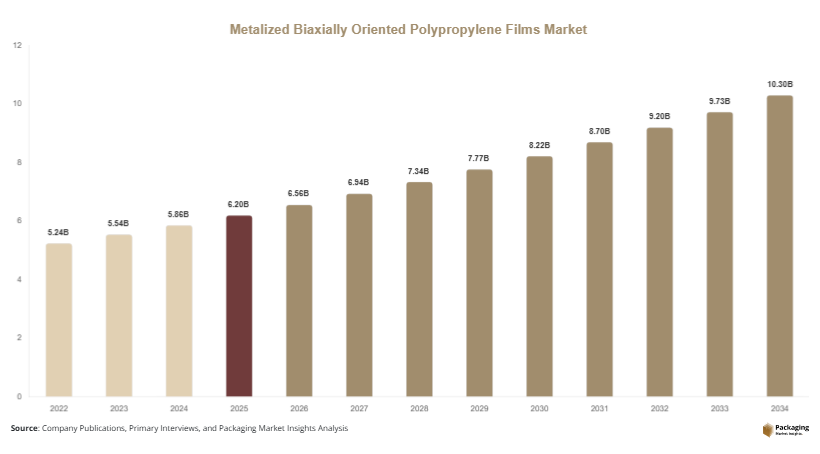
The global Metalized Biaxially Oriented Polypropylene (BOPP) Films Market is projected to exhibit substantial growth over the forecast period, with the market size estimated at USD 6.2 billion in 2025 and anticipated to reach USD 10.1 billion by 2034, registering a CAGR of 5.8% between 2025 and 2034. The increasing demand for sustainable and high-performance packaging materials in the food and beverage, pharmaceutical, and personal care industries is a significant driver of market expansion. These films are valued for their superior barrier properties, tensile strength, and lightweight nature, making them suitable for applications requiring enhanced shelf life and aesthetic appeal.
Additionally, the surge in e-commerce and retail sectors globally has prompted manufacturers to adopt innovative packaging solutions that offer durability, flexibility, and consumer appeal. The integration of advanced metallization techniques has also improved the films' functionality, including moisture and oxygen barrier capabilities, which are essential in preventing spoilage and maintaining product integrity. Furthermore, the rising preference for flexible packaging over traditional rigid options is expected to drive adoption across emerging economies, particularly in Asia Pacific and Latin America, where urbanization and disposable income are increasing rapidly.
Key Highlights:
- The global metalized biaxially oriented polypropylene films market is projected to reach USD 10.1 billion by 2034, reflecting steady growth over the forecast period. This growth is supported by rising demand across multiple end-use industries.
- A CAGR of 5.8% is anticipated from 2025 to 2034, indicating consistent year-on-year market expansion driven by technological advancements and evolving packaging trends.
- There is increasing demand for these films in the food & beverage, pharmaceutical, and personal care sectors, owing to their superior barrier properties and durability. These industries rely on metalized BOPP films to maintain product quality and extend shelf life.
- Growing adoption of flexible packaging solutions, particularly in e-commerce and retail sectors, is fueling market expansion. Businesses are leveraging lightweight, protective films to enhance shipping efficiency and consumer convenience.
- The market is witnessing a rising focus on sustainable and recyclable films, as manufacturers respond to environmental regulations and consumer preference for eco-friendly packaging. This trend is driving innovation in biodegradable and recyclable BOPP films.
Explore more data points, trends and opportunities Download Free Sample Report
Market Trend
Shift Towards Sustainable Packaging Solutions
A significant trend shaping the metalized biaxially oriented polypropylene films market is the increased adoption of environmentally friendly and recyclable materials. Manufacturers are transitioning from conventional plastic films to eco-friendly alternatives that reduce environmental impact while retaining the superior barrier properties of metalized films. For instance, recyclable metalized BOPP films are increasingly being used in snack food packaging, confectioneries, and personal care product wraps. This shift is not only driven by consumer awareness but also by stringent government regulations on single-use plastics. Sustainable packaging adoption is expected to increase the market’s appeal in developed regions such as North America and Europe, where regulatory frameworks and consumer preference for environmentally responsible products are highly influential. Companies investing in R&D for sustainable BOPP films gain a competitive edge in this evolving market.
Integration of Advanced Printing and Customization Technologies
Another notable trend is the growing utilization of high-quality printing technologies to enhance the visual appeal and brand recognition of packaged products. Metalized BOPP films are increasingly being customized with multi-color, high-resolution printing, holographic effects, and laminates to attract consumer attention on retail shelves. This trend is particularly evident in the confectionery, snack food, and luxury goods segments, where product differentiation is essential. Advanced printing capabilities allow manufacturers to offer premium packaging solutions that combine aesthetics with functionality, thereby increasing product value and shelf impact. The trend towards personalized and brand-specific packaging is expected to continue over the forecast period, reinforcing the market’s expansion potential.
Market Drivers
Rising Demand for Flexible Packaging
The rising global demand for flexible packaging solutions is a key driver of the Metalized BOPP Films Market. Flexible packaging offers benefits such as reduced material usage, lightweight structure, and enhanced consumer convenience, making it ideal for food, beverages, and pharmaceutical products. Metalized BOPP films are particularly suitable due to their excellent barrier properties against moisture, oxygen, and UV light, which preserve product quality and extend shelf life. The surge in packaged food consumption, coupled with urbanization and changing consumer lifestyles, has further propelled the adoption of flexible packaging. Manufacturers are increasingly leveraging BOPP films to design innovative packaging formats such as pouches, sachets, and wrap-around packs that are lightweight, durable, and visually appealing, thereby driving market growth.
Technological Advancements in Film Manufacturing
Technological innovations in film extrusion, metallization, and coating processes are fueling growth in the market. Enhanced production techniques allow manufacturers to produce films with improved mechanical strength, barrier efficiency, and heat sealability, meeting the evolving requirements of diverse end-use industries. For example, advancements in plasma and vacuum metallization processes have enabled the production of films with uniform coating and high gloss, improving both performance and aesthetics. Moreover, automated production lines and quality control measures ensure consistent film properties and scalability for large-scale packaging operations. Continuous innovation ensures that metalized BOPP films remain relevant for industries seeking premium packaging solutions with both functional and visual benefits.
Market Restraint
High Production Costs and Raw Material Price Volatility
A notable restraint limiting the growth of the metalized biaxially oriented polypropylene films market is the high cost of production and volatility in raw material prices. Polypropylene, aluminum, and other base materials used in metallized films are subject to fluctuations due to global supply-demand dynamics and crude oil price variations. This impacts profit margins and may lead manufacturers to pass costs onto end-users, potentially reducing demand in price-sensitive markets. The metallization process itself is energy-intensive, further adding to operational expenses. For example, small and mid-sized packaging manufacturers may face challenges in maintaining cost-effectiveness while delivering high-quality films, potentially slowing adoption in emerging regions. Despite strong market demand, these economic constraints can affect investment in new production lines and R&D initiatives, presenting a barrier to rapid market expansion.
Market Opportunities
Expansion in Emerging Economies
Emerging economies in Asia Pacific and Latin America present significant opportunities for market growth. Increasing disposable income, urbanization, and modern retail penetration in countries like India, Brazil, and Mexico are driving demand for packaged food, beverages, and consumer goods. Metalized BOPP films offer a cost-effective solution for extending product shelf life and improving packaging aesthetics, aligning with consumer expectations. Companies that strategically establish production facilities or partnerships in these regions can capitalize on the growing packaging demand. Furthermore, government initiatives supporting manufacturing infrastructure and sustainable packaging adoption enhance the market potential in these geographies, offering long-term growth opportunities.
Adoption in Pharmaceutical and Healthcare Packaging
The pharmaceutical and healthcare industries are increasingly adopting metalized BOPP films due to their superior barrier and protective properties. These films prevent contamination, moisture ingress, and UV degradation, making them suitable for medical devices, drug vials, blister packs, and diagnostic kits. With rising global healthcare expenditure and stricter regulations on product integrity, there is substantial potential for BOPP films in this sector. Innovations such as tamper-evident and child-resistant packaging further augment opportunities. Companies focusing on the healthcare segment can leverage these films to offer value-added solutions, tapping into a niche yet rapidly expanding market segment.
Report Scope
| Report Metric | Details |
|---|---|
| Market Size in 2025 | USD 6.2 Billion |
| Market Size in 2026 | USD 6.56 Billion |
| Market Size in 2034 | USD 10.1 Billion |
| CAGR | 5.8% (2026-2034) |
| Base Year for Estimation | 2025 |
| Historical Data | 2022-2024 |
| Forecast Period | 2026-2034 |
| Report Coverage | Revenue Forecast, Competitive Landscape, Supply Chain Disruption, Growth Factors, Environment & Regulatory Landscape and Trends |
| Geographies Covered | North America, Europe, APAC, Middle East and Africa, LATAM |
| Countries Covered | U.S., Canada, U.K., Germany, France, Spain, Italy, Russia, Nordic, Benelux, Rest of Europe, China, South Korea, Japan, India, Australia, Singapore, Taiwan, South East Asia, Rest of Asia-Pacific, UAE, Turky, Saudi Arabia, South Africa, Egypt, Nigeria, Rest of MEA, Brazil, Mexico, Argentina, Chile, Colombia, Rest of LATAM |
Explore more data points, trends and opportunities Download Free Sample Report
Segmental Analysis
Type Segment
The metalized BOPP films market by type is primarily segmented into thermal, solvent-based, and water-based metallized films. Thermal metallized films dominate the market, accounting for approximately 45% of the market share in 2024 due to their high barrier properties, gloss, and cost-effectiveness. Thermal metallization allows uniform coating and enhanced adhesion, which is crucial for food and snack packaging. The films are widely adopted in confectionery, bakery, and snack industries, supporting both functional and aesthetic packaging requirements. High demand for premium packaging with extended shelf life further drives the dominance of thermal metallized films.
Solvent-based metallized films represent the fastest-growing subsegment, with a CAGR of 6.8% from 2025–2034. Growth is fueled by increasing demand for films with superior barrier properties in pharmaceutical, cosmetic, and luxury packaging applications. These films are preferred for products that require high moisture and oxygen resistance. Technological advancements in coating processes are making solvent-based metallized films more environmentally friendly and economically viable, further encouraging their adoption across multiple end-use industries.
Application Segment
By application, the market is divided into food & beverages, pharmaceuticals, and personal care. Food & beverages dominate the application segment, holding nearly 50% of the market share in 2024. The extensive use of metalized BOPP films in snacks, confectioneries, frozen foods, and beverage packaging is driven by their ability to maintain product freshness and enhance visual appeal. The rising e-commerce sector and retail expansion also contribute to increased film usage in protective packaging for transport and storage.
Pharmaceutical applications are the fastest-growing segment, projected to expand at a CAGR of 7.0% between 2025–2034. Factors driving this growth include stringent regulatory requirements for tamper-evident and protective packaging, combined with increasing demand for blister packs and medical device wraps. Metalized films provide essential barrier properties against moisture, UV light, and contamination, ensuring product integrity. The development of child-resistant and sustainable packaging solutions further supports market growth within the pharmaceutical sector.
End-Use Segment
The end-use segment encompasses FMCG, industrial, and healthcare sectors. FMCG dominates the market with a share of 55% in 2024, driven by extensive use in food, beverages, and personal care products. Metalized BOPP films provide FMCG manufacturers with customizable, visually appealing, and protective packaging solutions, which enhance brand differentiation and consumer appeal. Retailers’ emphasis on shelf-ready packaging also contributes to higher adoption in the FMCG segment.
Healthcare applications are emerging as the fastest-growing subsegment with a projected CAGR of 7.2% from 2025–2034. Growth is fueled by increasing demand for sterile packaging, diagnostic kits, and pharmaceutical wraps. Metalized BOPP films ensure the safe transport and storage of sensitive medical products, providing moisture, oxygen, and UV protection. Additionally, the rising need for tamper-evident and child-resistant packaging in healthcare further drives the adoption of high-performance films in this sector.
Metalized Biaxially Oriented Polypropylene Films Market Segmentations
By Type
- Thermal Metallized BOPP Films
- Solvent-Based Metallized BOPP Films
- Water-Based Metallized BOPP Films
By Application
- Food & Beverages
- Pharmaceuticals
- Personal Care
By End-Use
- FMCG
- Industrial
- Healthcare
Regional Analysis
North America
North America held approximately 28% of the global Metalized BOPP Films Market share in 2025, with the region expected to grow at a CAGR of 4.8% during the forecast period. The market growth is primarily driven by high consumer demand for packaged food products and stringent regulations promoting food safety and quality. The presence of a robust manufacturing base and technological advancements in film production further support market expansion. Companies in the region are increasingly adopting sustainable and high-performance films to meet regulatory requirements and consumer expectations, contributing to steady growth.
The United States dominates the North American market, accounting for the majority share due to its well-established food and beverage industry and strong retail network. One unique growth factor is the rapid adoption of e-commerce-driven packaging, requiring films that are lightweight yet protective during transportation. Additionally, awareness of eco-friendly packaging solutions is higher compared to other countries in the region, encouraging manufacturers to invest in recyclable metalized BOPP films, thereby fostering innovation and market penetration.
Europe
Europe accounted for roughly 26% of the global market in 2025, projected to grow at a CAGR of 5.2% by 2034. High consumer preference for premium and sustainable packaging in countries like Germany, France, and the UK is driving demand. The presence of major BOPP film manufacturers and stringent environmental regulations promoting recyclable and biodegradable materials further stimulate market growth. European consumers increasingly prioritize packaging aesthetics and functionality, prompting manufacturers to develop innovative and customized solutions to maintain competitiveness.
Germany is the dominant country in Europe, benefiting from strong industrial infrastructure and technological expertise in packaging. One unique growth factor is the widespread adoption of sustainable packaging policies among retailers, mandating the use of recyclable metalized films. This trend encourages continuous investment in eco-friendly film production and innovation, positioning Germany as a key growth hub within the European market.
Asia Pacific
Asia Pacific held the largest share of the Metalized BOPP Films Market in 2025 at approximately 32%, with a forecasted CAGR of 6.4% during 2025–2034. The rapid expansion is driven by increasing urbanization, rising disposable incomes, and growing packaged food consumption in countries like China, India, and Japan. The region also benefits from low manufacturing costs and a growing number of BOPP film production facilities catering to domestic and export demand.
China leads the Asia Pacific market, with one unique growth factor being the government’s push for modern retail expansion and e-commerce growth. Increased consumer demand for packaged products with enhanced shelf life is driving investments in high-quality metalized films. Additionally, domestic companies are focusing on research and development to produce films that are both sustainable and high-performing, further bolstering market growth.
Middle East & Africa
The Middle East & Africa contributed around 8% to the global market in 2025, projected to expand at a CAGR of 5.5% by 2034. Growth is largely driven by increasing urbanization, expanding retail infrastructure, and rising disposable incomes in countries like the UAE, Saudi Arabia, and South Africa. The region is witnessing rising demand for packaged food, personal care products, and pharmaceuticals, all of which rely on high-performance BOPP films.
The UAE dominates the regional market due to its status as a trade hub and robust retail sector. A unique growth factor is the region’s increasing reliance on imported raw materials and technologically advanced packaging solutions to meet international quality standards. This has created opportunities for global manufacturers to establish a presence and supply high-quality metalized BOPP films, thereby expanding market reach and distribution networks.
Latin America
Latin America accounted for nearly 6% of the market share in 2025, with a projected CAGR of 6.0% over the forecast period. Market expansion is driven by the growing packaged food and beverage industry, increased consumer awareness, and rising demand for visually appealing and protective packaging. Countries such as Brazil and Mexico are experiencing steady urbanization and modern retail growth, creating a favorable environment for the adoption of metalized films.
Brazil is the dominant country in Latin America, with one unique growth factor being the rising trend of packaged convenience foods and snacks. Increased investments in the retail and FMCG sectors are driving the adoption of high-performance BOPP films that ensure product safety and shelf-life extension. Moreover, collaborations between local distributors and international manufacturers facilitate wider availability and adoption of premium metalized films, further boosting market growth in the region.
Competitive Landscape
The metalized biaxially oriented polypropylene films market is moderately consolidated, with top players including Mondi Group, Amcor plc, Jindal Poly Films, Uflex Ltd., and Cosmo Films Ltd. dominating the global landscape. Mondi Group is recognized as a market leader, recently launching a range of recyclable metalized BOPP films for the food and pharmaceutical sectors, highlighting its focus on sustainability and innovation. Other major players are investing in R&D and expanding production capacities in emerging markets to meet rising demand. Strategic collaborations, joint ventures, and product innovations are common practices among these companies to strengthen market presence and deliver high-performance solutions. The competitive landscape is further characterized by technological advancements, product customization, and sustainability initiatives, enabling companies to gain a competitive edge.
Key Players List
- Mondi Group
- Amcor plc
- Jindal Poly Films
- Uflex Ltd.
- Cosmo Films Ltd.
- Toray Industries, Inc.
- Mitsubishi Polyester Film, Inc.
- Huhtamaki Oyj
- Profol GmbH
- Innovia Films Ltd.
- Garware Polyester Ltd.
- AEP Industries, Inc.
- Treofan Group
- Shanghai Petrochemical Company
- Flex Films Ltd.