Metalized Barrier Films Market Size and Growth
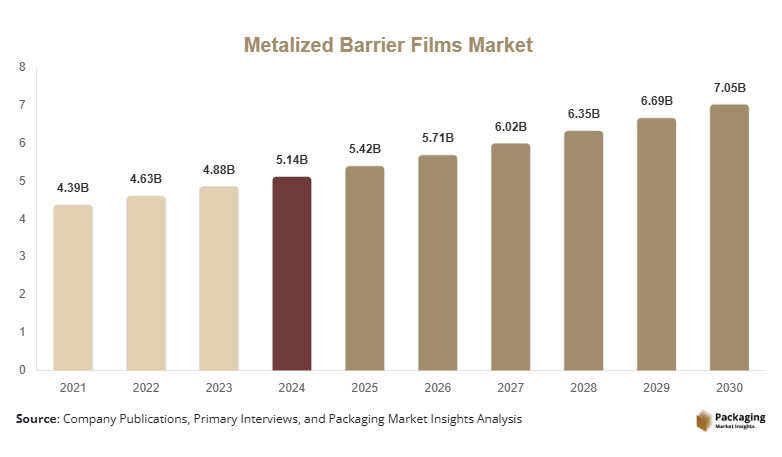
The global metalized barrier films market size was valued at USD 5.14 billion in 2024 and is projected to grow from USD 5.42 billion in 2025 to reach approximately USD 7.05 billion by 2030, expanding at a CAGR of 5.4% during the forecast period (2025–2030). The metalized barrier films market growth is primarily driven by the rising demand for high-performance flexible packaging, increasing adoption of lightweight and cost-efficient alternatives to aluminum foil laminates, and growing focus on shelf-life extension across food, pharmaceutical, and personal care industries.
Metalized barrier films offer enhanced protection against oxygen, moisture, light, and aroma while using minimal metal content, making them an attractive solution for sustainability-driven packaging transitions. Continuous advancements in vacuum metallization and oxide coating technologies have further strengthened the market’s role across both mass-volume and premium packaging applications.
Key Market Insights
- Metalized barrier films are increasingly replacing traditional aluminum foil laminates due to their lightweight structure, improved cost efficiency, and compatibility with recyclable packaging formats.
- Food and beverage packaging remains the dominant application, accounting for the majority of global demand, particularly for snacks, confectionery, dairy, and pet food products.
- Asia-Pacific leads global consumption, supported by rapid growth in packaged food manufacturing, export-oriented production, and expanding middle-class consumption in China and India.
- Pharmaceutical and healthcare applications represent the fastest-growing segment, driven by rising demand for moisture- and oxygen-sensitive drug packaging.
- Technological advancements such as aluminum oxide (AlOx) and silicon oxide (SiOx) coatings are enabling penetration into high-value and transparent packaging applications.
- Sustainability regulations and brand-owner commitments toward mono-material and recyclable packaging are reshaping product innovation strategies across the market.
Explore more data points, trends and opportunities Download Free Sample Report
Latest Market Trends
Shift Toward Sustainable and Recyclable Packaging Solutions
The metalized barrier films market is witnessing a strong shift toward sustainable packaging formats as brand owners seek to reduce environmental impact while maintaining performance. Manufacturers are increasingly developing recyclable metalized BOPP and PET films that offer comparable barrier properties to aluminum foil laminates but with significantly lower material usage. Downgauging, mono-material structures, and compatibility with existing recycling streams are becoming key product development priorities. This trend is particularly strong in Europe and North America, where regulatory pressure and consumer awareness around packaging waste continue to intensify.
Growing Adoption in High-Barrier Food Packaging Applications
Food packaging remains the backbone of the metalized barrier films market, with rising demand for extended shelf-life solutions in snacks, bakery products, frozen foods, and pet food. Metalized films are being widely adopted due to their ability to preserve freshness, aroma, and texture while enabling flexible packaging formats such as pouches and sachets. The growth of private-label brands and export-oriented food processing is further accelerating adoption, particularly in the Asia-Pacific.
Market Drivers
Rising Demand for Flexible Packaging Across Food and Beverage Applications
Metalized films extend shelf life, preserve flavor, and protect against environmental exposure while enabling lightweight packaging formats. As global consumption of packaged snacks, frozen foods, and pet food continues to rise, demand for cost-efficient barrier materials has increased substantially.
Sustainability-led Shift Away from Aluminum Foil Laminates
Metalized films use significantly less aluminum, reducing material costs and environmental impact. With regulators and consumers increasingly scrutinizing packaging waste, metalized barrier films are emerging as a preferred alternative due to their recyclability potential and lower carbon footprint.
Market Restraints
Volatility in Raw Material Prices
Particularly, polymer resins and aluminum. Fluctuations in crude oil prices and metal supply chains directly impact production costs, squeezing margins for manufacturers operating in highly competitive pricing environments.
Technical Limitations Related to Recyclability and Coating Adhesion
Especially in high-barrier applications. While metalized films are more sustainable than foil laminates, recycling infrastructure varies significantly by region. Ensuring consistent barrier performance without compromising recyclability remains a technical challenge that requires ongoing R&D investment.
Market Opportunities
Transition Toward Recyclable and Mono-Material Packaging Solutions
Brand owners and FMCG companies are actively replacing multi-layer aluminum foil laminates with metalized BOPP and PET films that offer comparable barrier properties while remaining compatible with existing recycling streams. This shift creates strong opportunities for manufacturers investing in advanced coating technologies such as AlOx and plasma-enhanced deposition.
Rapid Expansion of Packaged Food and Ready-To-Eat Meals in Emerging Economies
Particularly across India, Southeast Asia, and Africa. Rising urbanization, higher disposable incomes, and changing consumer lifestyles are driving demand for extended shelf-life packaging. Metalized films provide an ideal solution for snack foods, confectionery, dairy, and pet food, enabling manufacturers to tap into high-volume, cost-sensitive markets without sacrificing performance.
Report Scope
| Report Metric | Details |
|---|---|
| Market Size in 2024 | USD 5.14 Billion |
| Market Size in 2025 | USD 5.42 Billion |
| Market Size in 2030 | USD 7.05 Billion |
| CAGR | 5.4% (2025-2030) |
| Base Year for Estimation | 2024 |
| Historical Data | 2021-2023 |
| Forecast Period | 2025-2030 |
| Report Coverage | Revenue Forecast, Competitive Landscape, Supply Chain Disruption, Growth Factors, Environment & Regulatory Landscape and Trends |
| Geographies Covered | North America, Europe, APAC, Middle East and Africa, LATAM |
| Countries Covered | U.S., Canada, U.K., Germany, France, Spain, Italy, Russia, Nordic, Benelux, Rest of Europe, China, South Korea, Japan, India, Australia, Singapore, Taiwan, South East Asia, Rest of Asia-Pacific, UAE, Turky, Saudi Arabia, South Africa, Egypt, Nigeria, Rest of MEA, Brazil, Mexico, Argentina, Chile, Colombia, Rest of LATAM |
Explore more data points, trends and opportunities Download Free Sample Report
Segmental Analysis
By Material Type
The aluminum foil subsegment accounted for a significant share of the metalized barrier films market by material type in 2024. This dominance was primarily driven by its superior barrier properties against oxygen, moisture, and light, making it a preferred choice for high-protection food and pharmaceutical packaging applications. Aluminum foil-based structures are widely used in applications requiring extended shelf life and high product integrity, particularly in ready-to-eat foods, dairy products, and pharmaceutical blister packaging.
The polyester films subsegment, including PET-based metalized films, represented a substantial portion of the market due to their excellent mechanical strength, thermal stability, and printability. These films are extensively used in premium food packaging and personal care products where durability and visual appeal are critical.
The polypropylene films subsegment, particularly metalized BOPP, is projected to witness the fastest growth over the forecast period. This growth is attributed to its cost-effectiveness, lightweight structure, and increasing adoption as a sustainable alternative to aluminum foil laminates in snack and confectionery packaging.
The BOPET films subsegment continues to gain traction in high-barrier and specialty packaging applications. Its superior dimensional stability and high gloss finish make it suitable for advanced laminated structures, especially in pharmaceutical and electronics packaging.
By Application
The food packaging subsegment dominated the metalized barrier films market by application in 2024. This leadership was driven by the high demand for flexible packaging solutions that extend shelf life, preserve flavor, and protect food products from environmental factors. Metalized films are extensively used in packaging snacks, bakery products, frozen foods, and pet food due to their excellent barrier performance and lightweight nature.
The pharmaceutical packaging subsegment is anticipated to register the fastest growth rate during the forecast period. This rapid expansion is fueled by the rising production of moisture- and oxygen-sensitive drugs, increased demand for blister packaging, and stringent regulatory requirements for pharmaceutical safety and product integrity.
The consumer goods packaging subsegment holds a notable share, supported by increasing demand for attractive, durable, and protective packaging for personal care, household, and hygiene products. Metalized films enhance visual appeal while providing functional protection.
The agricultural films subsegment is witnessing steady growth, driven by the use of barrier films in seed packaging, fertilizer packaging, and crop protection materials where moisture resistance and durability are essential.
By Thickness
The below 20 microns thickness subsegment accounted for the largest share of the market in 2024. This dominance is attributed to the growing preference for lightweight and downgauged packaging materials that reduce material consumption while maintaining adequate barrier properties. These films are widely used in high-volume food packaging applications.
The 20–40 microns subsegment represents a significant portion of the market, offering a balance between strength, barrier performance, and cost. These films are commonly used in pharmaceutical and consumer goods packaging where enhanced durability is required.
The above 40 microns subsegment is expected to grow steadily, driven by demand from industrial, bulk, and specialty packaging applications that require higher mechanical strength and puncture resistance.
By End User Industry
The food and beverage industry accounted for the dominant share of the metalized barrier films market by end user in 2024. This was due to the extensive use of metalized films in packaging snacks, confectionery, dairy products, and ready-to-eat meals, supported by rising global consumption of packaged foods.
The pharmaceuticals subsegment is projected to be the fastest-growing end user, driven by increasing demand for high-barrier packaging solutions for tablets, capsules, and blister packs. Growth in biopharmaceuticals and stricter packaging regulations are further accelerating adoption.
The personal care industry holds a considerable share, supported by rising demand for premium and visually appealing packaging for cosmetics, skincare, and hygiene products. Metalized films enhance shelf appeal while providing moisture and oxygen protection.
The electronics subsegment is experiencing gradual growth, driven by the need for moisture- and static-resistant packaging for sensitive electronic components. Advancements in high-barrier and anti-static metalized films are expanding their application in this industry.
Metalized Barrier Films Market Segmentations
By Material Type
- Aluminum Foil
- Polyester Films
- Polypropylene Films
- BOPET Films
Application
- Food Packaging
- Pharmaceutical Packaging
- Consumer Goods Packaging
- Agricultural Films
Thickness
- Below 20 microns
- 20-40 microns
- Above 40 microns
End User Industry
- Food & Beverage
- Pharmaceuticals
- Personal Care
- Electronics
Regional Analysis
North America
North America represents a mature but steadily growing market for metalized barrier films, driven primarily by the United States and Canada. High consumption of packaged and convenience foods, along with strong pharmaceutical manufacturing activity, supports consistent demand. The region shows a strong preference for high-barrier and premium metalized films, particularly in healthcare and specialty food packaging. Sustainability initiatives and recycling regulations are influencing material selection, encouraging the shift away from aluminum foil-based laminates.
Europe
Europe is one of the most innovation-driven regions in the metalized barrier films market, led by Germany, France, Italy, and the United Kingdom. The region benefits from strong regulatory support for circular economy practices and sustainable packaging. European converters and brand owners are early adopters of AlOx and SiOx-coated films, particularly for pharmaceutical and high-end food packaging. Demand is also supported by the region’s strong export base for processed foods and personal care products.
Asia-Pacific
Asia-Pacific dominates the global metalized barrier films market, accounting for the largest share of consumption. China, India, Japan, and South Korea are the key demand centers, supported by large-scale flexible packaging production, growing domestic consumption, and strong export activity. China leads in volume demand due to its massive food processing and packaging industry, while India is the fastest-growing market, driven by rapid urbanization and rising packaged food consumption. Increasing investments in packaging infrastructure and manufacturing capacity continue to strengthen the region’s market position.
Latin America
Latin America represents a developing market for metalized barrier films, with Brazil and Mexico leading regional demand. Growth is supported by expanding packaged food industries and increasing adoption of flexible packaging formats. While price sensitivity remains high, demand for cost-efficient metalized films is gradually increasing, particularly in snack food and confectionery packaging.
Middle East & Africa
The Middle East & Africa region is witnessing moderate but accelerating growth, driven by rising food imports, expanding pharmaceutical manufacturing, and growing demand for packaged consumer goods. Countries such as Saudi Arabia, the UAE, and South Africa are key markets, supported by improving packaging infrastructure and export-oriented food processing. Intra-regional trade and increasing focus on shelf-life extension in hot climates further support demand for metalized barrier films.
Competitive Landscape
The metalized barrier films market is moderately consolidated, with the top five players accounting for approximately 46% of global market share. Leading manufacturers benefit from large-scale production capabilities, advanced metallization technologies, and long-term supply relationships with major brand owners and packaging converters. While global players dominate high-volume and premium segments, regional manufacturers remain competitive in cost-sensitive markets, particularly in Asia-Pacific and Latin America.
Key Players in the Metalized Barrier Films Market
- Toray Industries
- Jindal Poly Films
- Uflex Limited
- Mitsubishi Chemical Group
- Cosmo Films
- Taghleef Industries
- Treofan Group
- Polyplex Corporation
- Ester Industries
- SRF Limited
- Innovia Films
- Flex Films
- Dunmore Corporation
- Amcor
- Klöckner Pentaplast