Medication Dispensing And Packaging Systems Market Size and Growth
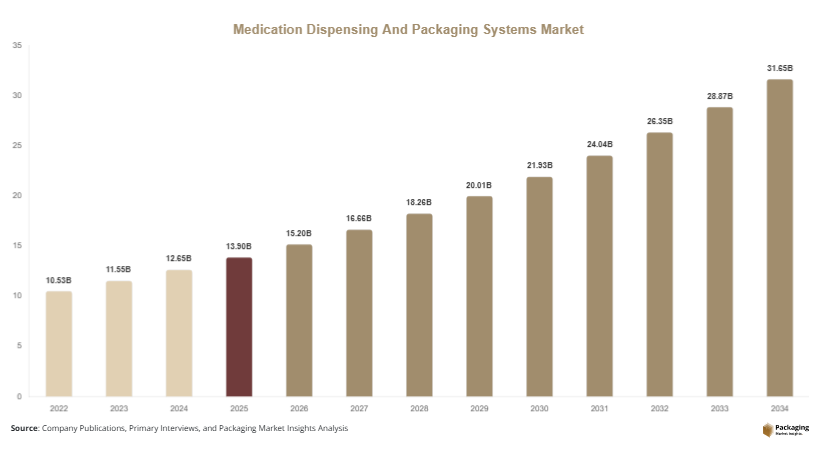
The global medication dispensing and packaging systems market size reached USD 13.9 billion in 2025 and is projected to grow to USD 15.2 billion in 2026. With the rising adoption of automation and digital healthcare infrastructure, the market is forecast to reach USD 34.7 billion by 2034, registering a CAGR of 9.6% during the forecast period (2025–2034). The medication dispensing and packaging systems market is experiencing steady expansion driven by the increasing need for accurate, safe, and efficient medication management across healthcare settings. These systems play a critical role in minimizing medication errors, improving patient adherence, and streamlining pharmacy operations.
One of the major growth factors for the medication dispensing and packaging systems market is the increasing prevalence of chronic diseases, which has led to a rise in long-term medication usage. Patients with conditions such as diabetes, cardiovascular disorders, and neurological diseases require consistent medication schedules, creating demand for automated dispensing systems that ensure accuracy and compliance.
Key Highlights:
- Market size reached USD 13.9 billion in 2025 and is projected to grow significantly, reaching USD 34.7 billion by 2034. This reflects strong expansion driven by increasing healthcare automation and packaging innovation.
- The market is expected to register a CAGR of 9.6% during the forecast period from 2025 to 2034. This steady growth rate indicates rising adoption across hospitals, pharmacies, and long-term care facilities.
- Increasing adoption of automated medication management systems is improving operational efficiency and reducing human errors. These systems are becoming essential in modern healthcare infrastructure for accurate dispensing and tracking.
- Rising demand for patient safety and medication adherence solutions is further accelerating market growth. Advanced packaging and dispensing technologies help ensure correct dosage, timely intake, and improved patient outcomes.
Explore more data points, trends and opportunities Download Free Sample Report
Market Trends
Integration of Digital Health Technologies with Dispensing Systems
The integration of digital health technologies is emerging as a key trend in the medication dispensing and packaging systems market. Healthcare providers are increasingly adopting systems that connect with electronic health records and pharmacy management platforms. These integrated solutions allow real-time monitoring of medication dispensing, improve prescription accuracy, and enable better patient tracking. Advanced systems also support remote monitoring, allowing healthcare professionals to oversee medication adherence in home care settings. This trend is enhancing operational efficiency and supporting the shift toward data-driven healthcare systems.
Increasing Adoption of Unit-Dose and Multi-Dose Packaging Systems
The adoption of unit-dose and multi-dose packaging systems is gaining traction due to their role in reducing medication errors and improving patient compliance. Unit-dose packaging ensures that each dose is accurately measured and labeled, reducing the risk of incorrect administration. Multi-dose systems are particularly beneficial for patients managing multiple medications, as they organize doses by time and date. These systems are widely used in hospitals, long-term care facilities, and retail pharmacies, supporting consistent medication delivery and improving patient outcomes.
Market Drivers
Rising Focus on Reducing Medication Errors
Reducing medication errors is a major driver for the medication dispensing and packaging systems market. Medication errors can lead to serious health complications and increased healthcare costs. Automated dispensing and packaging systems help minimize human errors by ensuring accurate dosing, labeling, and tracking. Healthcare providers are increasingly adopting these systems to improve patient safety and comply with regulatory standards. The use of barcode scanning and automated verification processes further enhances accuracy, driving market growth.
Growing Demand for Pharmacy Automation
The growing demand for pharmacy automation is another key driver of the market. Pharmacies are under pressure to handle increasing prescription volumes while maintaining accuracy and efficiency. Automated dispensing systems streamline workflows, reduce manual labor, and improve inventory management. This is particularly important in large hospitals and retail pharmacy chains, where efficiency is critical. The adoption of automation is also helping pharmacies address workforce shortages and improve service quality.
Market Restraint
High Initial Investment and Maintenance Costs
High initial investment and maintenance costs represent a significant restraint for the medication dispensing and packaging systems market. Implementing automated dispensing and packaging systems requires substantial capital expenditure, including the cost of equipment, installation, and staff training. Smaller healthcare facilities and independent pharmacies may find it challenging to afford these investments, limiting market adoption.
In addition to upfront costs, ongoing maintenance and software upgrades add to the financial burden. For example, automated dispensing cabinets require regular calibration and servicing to ensure accuracy. Integration with existing healthcare IT systems can also be complex and costly. These factors can slow down adoption, particularly in developing regions where budget constraints are more pronounced.
Market Opportunities
Expansion of Home Healthcare and Remote Medication Management
The expansion of home healthcare services presents a significant opportunity for the medication dispensing and packaging systems market. As healthcare systems shift toward patient-centric care, there is increasing demand for solutions that support medication management at home. Automated dispensing devices and smart packaging systems enable patients to manage their medications independently while allowing caregivers to monitor adherence remotely. This trend is expected to drive innovation and create new growth opportunities.
Increasing Adoption in Emerging Markets
Emerging markets offer substantial growth opportunities due to improving healthcare infrastructure and rising awareness of medication safety. Countries in Asia Pacific, Latin America, and the Middle East are investing in modern healthcare technologies, including automated dispensing systems. As pharmaceutical consumption increases in these regions, the demand for efficient medication management solutions is expected to grow. Companies can capitalize on this opportunity by offering cost-effective and scalable solutions tailored to local needs.
Report Scope
| Report Metric | Details |
|---|---|
| Market Size in 2025 | USD 13.9 Billion |
| Market Size in 2026 | USD 15.2 Billion |
| Market Size in 2034 | USD 34.7 Billion |
| CAGR | 9.6% (2026-2034) |
| Base Year for Estimation | 2025 |
| Historical Data | 2022-2024 |
| Forecast Period | 2026-2034 |
| Report Coverage | Revenue Forecast, Competitive Landscape, Supply Chain Disruption, Growth Factors, Environment & Regulatory Landscape and Trends |
| Geographies Covered | North America, Europe, APAC, Middle East and Africa, LATAM |
| Countries Covered | U.S., Canada, U.K., Germany, France, Spain, Italy, Russia, Nordic, Benelux, Rest of Europe, China, South Korea, Japan, India, Australia, Singapore, Taiwan, South East Asia, Rest of Asia-Pacific, UAE, Turky, Saudi Arabia, South Africa, Egypt, Nigeria, Rest of MEA, Brazil, Mexico, Argentina, Chile, Colombia, Rest of LATAM |
Explore more data points, trends and opportunities Download Free Sample Report
Segmental Analysis
By Product Type
Automated dispensing systems dominated the medication dispensing and packaging systems market in 2024, accounting for approximately 58% of the total market share. These systems are widely used in hospitals and pharmacies to ensure accurate medication dispensing and reduce human error. The growing adoption of automation in healthcare settings is driving the demand for these systems. Features such as barcode scanning, inventory tracking, and integration with healthcare IT systems are enhancing their functionality and supporting market growth.
Medication packaging systems are expected to be the fastest-growing segment, with a CAGR of 10.2% during the forecast period. This growth is driven by increasing demand for unit-dose and multi-dose packaging solutions that improve patient adherence and safety. Packaging systems are also being integrated with smart technologies, enabling real-time monitoring and data collection. These advancements are supporting the expansion of this segment.
By Mode of Operation
Centralized dispensing systems held the largest market share in 2024, accounting for approximately 52% of the total revenue. These systems are commonly used in large hospitals and healthcare facilities where centralized control of medication distribution is required. Centralized systems improve inventory management and reduce medication errors by standardizing processes.
Decentralized dispensing systems are expected to grow at the fastest rate, with a CAGR of 10.5% during the forecast period. These systems are installed closer to patient care areas, such as hospital wards, allowing faster access to medications. The increasing focus on improving workflow efficiency and patient care is driving the adoption of decentralized systems.
By End-Use
Hospitals dominated the market in 2024, accounting for approximately 62% of the total share. Hospitals require efficient medication management systems to handle large volumes of prescriptions and ensure patient safety. The adoption of automated dispensing and packaging systems helps reduce errors and improve operational efficiency.
Retail pharmacies are expected to be the fastest-growing segment, with a CAGR of 10.3% during the forecast period. The expansion of pharmacy chains and increasing prescription volumes are driving demand for automated solutions. Retail pharmacies are adopting these systems to improve customer service and streamline operations.
Medication Dispensing And Packaging Systems Market Segmentations
By Product Type
- Automated Dispensing Systems
- Medication Packaging Systems
By Mode of Operation
- Centralized Systems
- Decentralized Systems
By End-Use
- Hospitals
- Retail Pharmacies
- Others
Regional Analysis
North America
North America accounted for approximately 38% of the medication dispensing and packaging systems market share in 2025 and is expected to grow at a CAGR of 9.1% during the forecast period. The region benefits from advanced healthcare infrastructure and high adoption of automation technologies in pharmacies and hospitals. Strong regulatory frameworks also support the use of advanced medication management systems.
The United States dominates the regional market due to its large healthcare sector and high healthcare spending. A unique growth factor is the widespread adoption of electronic health records, which enables seamless integration with automated dispensing systems and enhances operational efficiency.
Europe
Europe held a market share of approximately 27% in 2025 and is projected to grow at a CAGR of 9.3% during the forecast period. The region’s growth is driven by increasing focus on patient safety and regulatory compliance. Healthcare systems across Europe are adopting automated dispensing solutions to improve medication accuracy and efficiency.
Germany is the leading country in the European market due to its strong healthcare infrastructure. A unique growth factor is the emphasis on reducing hospital readmissions through improved medication adherence, driving demand for advanced packaging systems.
Asia Pacific
Asia Pacific accounted for around 22% of the global market share in 2025 and is expected to register the highest CAGR of 10.4% during the forecast period. The region’s growth is driven by increasing healthcare investments and rising pharmaceutical consumption. Governments are focusing on modernizing healthcare infrastructure.
China is the dominant country in the Asia Pacific market due to its large population and expanding healthcare sector. A unique growth factor is the rapid adoption of automation technologies in hospital pharmacies, supporting market growth.
Middle East & Africa
The Middle East & Africa region held a market share of approximately 7% in 2025 and is expected to grow at a CAGR of 8.6% during the forecast period. The market is driven by improving healthcare infrastructure and increasing demand for medication management solutions.
The United Arab Emirates is a key market in the region, supported by investments in healthcare technology. A unique growth factor is the development of smart hospitals, which are adopting automated dispensing systems to improve efficiency.
Latin America
Latin America accounted for around 6% of the global market share in 2025 and is projected to grow at a CAGR of 8.9% during the forecast period. The region’s growth is supported by increasing healthcare access and pharmaceutical demand.
Brazil is the dominant country in the Latin American market due to its large population. A unique growth factor is the expansion of retail pharmacy chains, driving demand for automated dispensing and packaging systems.
Competitive Landscape
The medication dispensing and packaging systems market is characterized by strong competition, with key players focusing on innovation and technological advancements. Companies are investing in research and development to introduce advanced systems that integrate with digital healthcare platforms. Strategic partnerships and acquisitions are common as players aim to expand their market presence.
BD (Becton, Dickinson and Company) is a leading player in the market, known for its comprehensive range of medication management solutions. The company recently introduced advanced automated dispensing systems with enhanced data analytics capabilities. Other major players are also focusing on expanding their product portfolios and improving system efficiency.
Key Players List
- Becton, Dickinson and Company
- Omnicell, Inc.
- Swisslog Healthcare
- Baxter International Inc.
- Capsa Healthcare
- ARxIUM
- Talyst LLC
- ScriptPro LLC
- Parata Systems
- Accu-Chart Plus Healthcare Systems
- JVM Co., Ltd.
- TCGRx
- Yuyama Co., Ltd.
- Kirby Lester LLC
- RxSafe LLC