Medical Specialty Bag Market Size
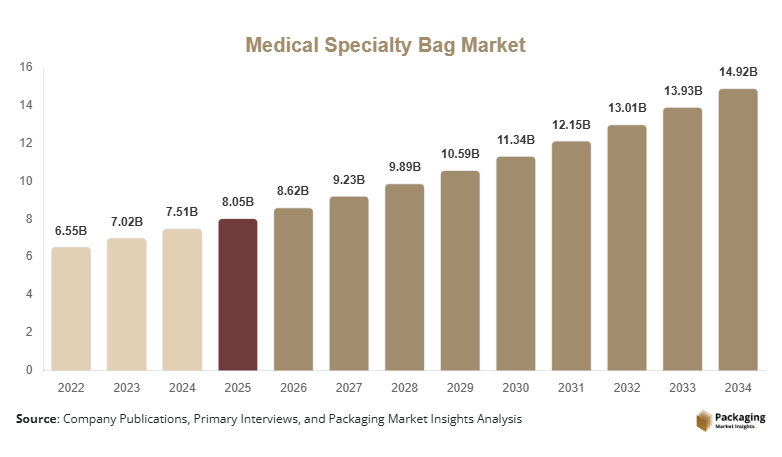
The medical specialty bag market size is projected at USD 8.62 billion in 2026 and is expected to hit USD 14.96 billion by 2034 with a CAGR of 7.1%.
The report provides an in-depth assessment of industry performance through comprehensive evaluation of product categories, end-user demand, manufacturing capacity, regulatory developments, technological advancements, and competitive landscape. It delivers detailed quantitative analysis to support strategic investment and expansion decisions across the global healthcare packaging industry.
Medical specialty bags are sterile medical-grade polymer bags designed for blood collection, intravenous fluid administration, ostomy care, enteral nutrition, urine collection, and other critical healthcare applications. Global production exceeded 14.8 billion units in 2025, while hospital procurement represented nearly 61% of total demand. Blood bags accounted for approximately 38% of total production, IV fluid bags contributed 34%, and home healthcare utilization increased to 19%, reinforcing the medical specialty bag market.
Explore more data points, trends and opportunities Download Free Sample Report
Medical Specialty Bag Market Trends
Rising Adoption of High-Performance Sterile Medical Packaging
Healthcare providers continue investing in advanced sterile packaging products featuring multilayer polymer films, DEHP-free materials, and improved barrier performance. More than 8.6 billion medical specialty bags incorporated advanced polymer technologies during 2025, while automated production capacity expanded by 15% globally. Smart manufacturing and enhanced quality assurance systems continue supporting the medical specialty bag market.
Growing emphasis on infection prevention and patient safety has accelerated demand for disposable medical bags. Approximately 68% of newly procured hospital fluid management systems utilized single-use sterile bags, while production of IV fluid bags exceeded 5.1 billion units globally. Healthcare infrastructure expansion and increasing surgical procedures continue supporting the medical specialty bag market.
Medical Specialty Bag Market Drivers
Increasing Healthcare Expenditure and Surgical Procedures
Growing healthcare investments and rising hospitalization rates continue driving demand for sterile medical bags. Global surgical procedures exceeded 330 million annually, while blood collection activities surpassed 128 million donations. Hospital procurement increased by 11% during 2025, and IV therapy utilization expanded significantly, accelerating the medical specialty bag market.
Medical Specialty Bag Market Restraints
Stringent Regulatory Compliance and Raw Material Costs
Medical specialty bag manufacturers must comply with rigorous regulatory standards governing sterility, biocompatibility, and product safety. Regulatory validation accounts for nearly 9% of production costs, while medical-grade polymer prices fluctuated between 10% and 16% during 2025. Compliance expenses and certification timelines continue restraining the medical specialty bag market.
Medical Specialty Bag Market Opportunities
Expansion of Home Healthcare Services
Growing adoption of home-based treatment and aging populations create significant opportunities for portable sterile medical bags. Home healthcare utilization increased by 14% during 2025, while wearable infusion therapies expanded by 12% globally. Demand for lightweight, patient-friendly medical bags is expected to support the medical specialty bag market.
Challenges in Medical Specialty Bag Market
Supply Chain Stability for Medical-Grade Polymers
Consistent availability of high-quality PVC, EVA, and multilayer medical polymers remains challenging. Raw material lead times increased by 17%, while transportation costs rose by approximately 8% during recent procurement cycles. Manufacturers continue diversifying sourcing strategies to maintain uninterrupted production across the medical specialty bag market.
Report Scope
| Report Metric | Details |
|---|---|
| Market Size in 2025 | USD 8.05 Billion |
| Market Size in 2026 | USD 8.62 Billion |
| Market Size in 2034 | USD 14.96 Billion |
| CAGR | 7.1% (2026-2034) |
| Base Year for Estimation | 2025 |
| Historical Data | 2022-2024 |
| Forecast Period | 2026-2034 |
| Report Coverage | Revenue Forecast, Competitive Landscape, Supply Chain Disruption, Growth Factors, Environment & Regulatory Landscape and Trends |
| Geographies Covered | North America, Europe, APAC, Middle East and Africa, LATAM |
| Countries Covered | U.S., Canada, U.K., Germany, France, Spain, Italy, Russia, Nordic, Benelux, Rest of Europe, China, South Korea, Japan, India, Australia, Singapore, Taiwan, South East Asia, Rest of Asia-Pacific, UAE, Turkey, Saudi Arabia, South Africa, Egypt, Nigeria, Rest of MEA, Brazil, Mexico, Argentina, Chile, Colombia, Rest of LATAM |
Explore more data points, trends and opportunities Download Free Sample Report
Medical Specialty Bag Market Segmentation
The market is segmented according to product type and end user. Blood bags account for approximately 38% of total demand, while hospitals contribute nearly 61% of overall consumption owing to increasing patient admissions, blood transfusions, and intravenous therapy procedures.
By Product Type
Blood bags account for approximately 38% of global demand. Annual production exceeded 5.6 billion units during 2025 with single, double, triple, and quadruple bag configurations widely utilized by blood banks and hospitals. High-strength medical-grade PVC materials and sterile tubing systems ensure safe blood collection and storage.
IV fluid bags represent nearly 34% of market demand. Production surpassed 5.1 billion units, supporting hydration therapy, medication delivery, and nutritional infusion. These bags feature multilayer polymer construction, excellent transparency, and high seal integrity suitable for critical healthcare environments.
Ostomy bags contribute approximately 28% of total demand. Annual production exceeded 4.1 billion units, incorporating skin-friendly adhesives, odor barriers, and leak-resistant multilayer films. Increasing colorectal surgeries and chronic disease management continue driving product adoption.
By End User
Hospitals dominate with approximately 61% market share. More than 9 billion medical specialty bags were consumed during 2025 across emergency care, surgery, critical care, and inpatient treatment. Continuous patient admissions and advanced healthcare infrastructure remain primary demand drivers.
Ambulatory surgical centers account for approximately 23% of total demand. Medical specialty bag consumption exceeded 3.4 billion units, supported by increasing outpatient procedures, minimally invasive surgeries, and same-day treatment facilities requiring sterile disposable products.
Home healthcare represents nearly 16% of market consumption. Annual utilization exceeded 2.3 billion units, driven by chronic disease management, home infusion therapies, and elderly patient care. Portable, lightweight, and user-friendly medical bags continue expanding across residential healthcare settings.
Medical Specialty Bag Market Segmentations
Product Type
- Blood Bags
- IV Fluid Bags
- Ostomy Bags
End User
- Hospitals
- Ambulatory Surgical Centers
- Home Healthcare
Medical Specialty Bag Regional Outlook
North America
North America accounts for approximately 34% of global demand. The United States contributes nearly 84% of regional production and consumption owing to advanced healthcare infrastructure, high hospitalization rates, and strong medical device manufacturing. Annual production exceeded 4.8 billion units.
Europe
Europe represents approximately 28% of the global market. Germany, France, Italy, and the United Kingdom collectively account for over 73% of regional production. Sterile medical packaging adoption surpassed 69%, supported by stringent healthcare quality standards and increasing surgical volumes.
Asia-Pacific
Asia-Pacific contributes approximately 30% of global demand and remains the fastest-growing regional market. China, Japan, India, and South Korea account for more than 78% of regional production. Annual manufacturing exceeded 4.3 billion units, supported by expanding healthcare infrastructure and rising patient populations.
Latin America
Latin America represents nearly 5% of worldwide demand. Brazil and Mexico remain the leading regional markets with hospitals accounting for approximately 64% of medical specialty bag consumption. Healthcare investments continue supporting production expansion.
Middle East & Africa
The Middle East & Africa contributes approximately 3% of global demand. Saudi Arabia, the UAE, and South Africa continue investing in hospital modernization and healthcare accessibility. Regional medical specialty bag consumption increased by 10% during 2025.
Top Players In The Medical Specialty Bag Market
- Baxter International Inc.
- Fresenius Kabi AG,
- B. Braun SE,
- Terumo Corporation
- ICU Medical, Inc.
- Macopharma,
- Haemonetics Corporation,
- JMS Co., Ltd.,
- Polymedicure Ltd.,
- Kawasumi Laboratories, Inc.
- Nipro Corporation
- Renolit SE
- West Pharmaceutical Services, Inc.
- Angiplast Pvt. Ltd.
- Wipak Group
Baxter International Inc. Estimated market share: 14–16% Global leader in IV therapy and medical fluid delivery solutions. Extensive manufacturing footprint across North America, Europe, and Asia. Strong portfolio of sterile IV fluid bags, infusion systems, and healthcare packaging solutions supported by continuous investments in medical-grade polymer technologies, automated manufacturing, and global hospital supply networks. Fresenius Kabi AG Estimated market share: 10–12% Leading supplier of infusion therapy and clinical nutrition products. Strong presence across hospital and home healthcare markets. Continuous investment in sterile medical packaging technologies, environmentally responsible manufacturing processes, and advanced IV fluid systems supports sustained competitiveness in the global medical specialty bag industry.