Medical Fluids Packaging Solutions Market Size and Growth
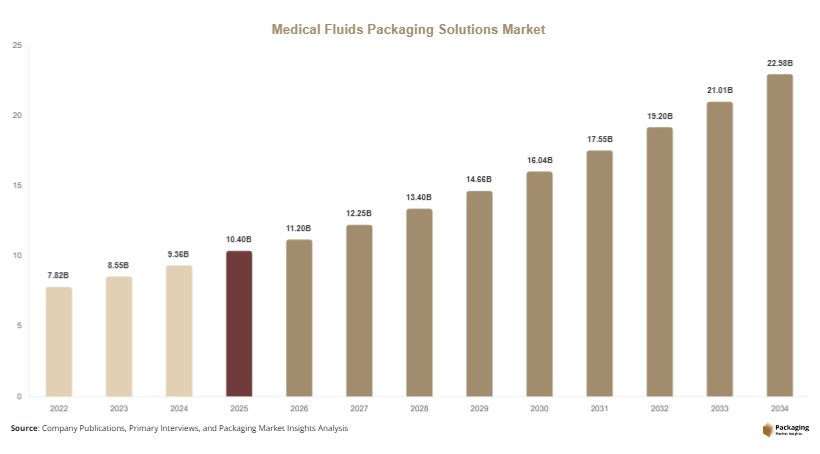
In 2025, the global medical fluids packaging solutions market size is estimated at USD 10.4 billion, which is expected to reach USD 11.2 billion in 2026. By 2034, the market is projected to reach approximately USD 22.8 billion, growing at a CAGR of 9.4% (2025–2034). The medical fluids packaging solutions market is witnessing steady expansion due to rising global demand for safe, sterile, and efficient packaging systems for intravenous (IV) fluids, saline solutions, dialysis fluids, blood products, and nutraceutical liquids used in healthcare applications. These packaging solutions play a critical role in maintaining sterility, preventing contamination, and ensuring compatibility with sensitive medical formulations.
Growth in the market is primarily driven by increasing hospitalization rates, rising demand for intravenous therapies, and expansion of home healthcare services. The growing prevalence of chronic diseases such as diabetes, cancer, and kidney disorders is also contributing significantly to the consumption of medical fluids, thereby increasing demand for advanced packaging solutions. Additionally, global vaccination programs and emergency healthcare responses have further strengthened the need for reliable sterile fluid packaging systems.
Key Highlights
- Market size (2025): The Medical Fluids Packaging Solutions Market is valued at USD 10.4 Billion in 2025, supported by strong demand from hospitals, clinics, and home healthcare sectors. Growth is driven by rising intravenous therapy usage, increasing chronic disease burden, and expanding healthcare infrastructure across developed and emerging economies.
- Market size (2026): The market is projected to reach USD 11.2 Billion in 2026, reflecting steady expansion in sterile medical packaging adoption. Increased utilization of prefilled containers and advanced fluid delivery systems in hospital environments is further supporting year-on-year market growth.
- Forecast value (2034): By 2034, the market is expected to reach USD 22.8 Billion, driven by continuous expansion of healthcare services, rising demand for biologics and infusion therapies, and growing shift toward efficient and sustainable medical packaging solutions globally.
- CAGR (2025–2034): The market is projected to grow at a CAGR of 9.4% during 2025–2034, supported by strong demand from hospitals, clinics, and home healthcare sectors, along with increasing adoption of non-PVC and eco-friendly medical fluid packaging systems.
- Strong demand from hospitals, clinics, and home healthcare sectors: Demand continues to rise due to increasing patient admissions, expansion of outpatient care, and growing preference for home-based treatment solutions requiring safe, sterile, and easy-to-use medical fluid packaging formats.
- Rising adoption of non-PVC and eco-friendly medical fluid packaging: Healthcare providers and manufacturers are increasingly shifting toward sustainable, non-PVC materials to reduce chemical risks, improve patient safety, and comply with stringent environmental and medical packaging regulations globally.
Explore more data points, trends and opportunities Download Free Sample Report
Market Trends
Shift Toward Non-PVC and Eco-Friendly Medical Fluid Packaging
The medical fluids packaging industry is experiencing a strong shift toward non-PVC and environmentally sustainable packaging materials. Traditional PVC-based containers are gradually being replaced due to concerns related to chemical leaching and environmental impact. Manufacturers are increasingly adopting polyolefin-based multilayer films and polypropylene containers that offer improved safety and recyclability. This transition is particularly strong in Europe and North America, where environmental regulations and healthcare safety standards are strict. Hospitals and healthcare providers are also favoring eco-friendly packaging systems to reduce medical waste and improve sustainability performance. Additionally, pharmaceutical companies are investing in R&D to develop bio-compatible materials that ensure both patient safety and regulatory compliance.
Growth of Ready-to-Use and Prefilled Medical Fluid Systems
Another major trend shaping the market is the increasing adoption of ready-to-use and prefilled medical fluid packaging systems. These systems reduce preparation time in hospitals, minimize contamination risks, and improve dosing accuracy. Prefilled IV bags, saline solutions, and dialysis fluids are gaining traction due to their convenience and efficiency in critical care environments. This trend is especially strong in emergency care units and ambulatory surgical centers where time-sensitive treatment is essential. The integration of automated filling and sterilization technologies is further enhancing production efficiency, making prefilled systems more cost-effective and scalable across global healthcare facilities.
Market Drivers
Rising Global Burden of Chronic and Acute Diseases
The increasing prevalence of chronic diseases such as diabetes, cancer, and kidney failure is a major driver of the medical fluids packaging solutions market. These conditions often require long-term intravenous therapies, dialysis treatments, and fluid-based drug administration, which significantly increases demand for sterile medical fluid packaging. Aging populations in developed regions further contribute to higher hospitalization rates and fluid therapy consumption. Additionally, the rise in surgical procedures globally is boosting demand for IV fluids and sterile medical solutions. As healthcare systems expand their capacity, the need for safe and efficient packaging solutions continues to grow across hospitals and clinics.
Expansion of Hospital Infrastructure and Home Healthcare Services
The rapid expansion of healthcare infrastructure worldwide is another key driver supporting market growth. New hospitals, specialty clinics, and diagnostic centers are increasing the consumption of medical fluids, requiring advanced packaging systems that ensure sterility and ease of use. In parallel, the growing adoption of home healthcare services is boosting demand for compact, easy-to-handle, and prefilled medical fluid packaging solutions. Patients receiving long-term care at home require safe and convenient packaging formats that reduce the risk of contamination while ensuring accurate dosage delivery. This dual expansion across institutional and home care segments is significantly strengthening market demand.
Market Restraint
High Cost of Advanced Packaging Materials and Sterilization Requirements
A major restraint in the medical fluids packaging solutions market is the high cost associated with advanced packaging materials and stringent sterilization requirements. Non-PVC materials, multilayer films, and specialized medical-grade plastics are significantly more expensive than conventional packaging materials. Additionally, the production of sterile medical fluid packaging requires advanced manufacturing infrastructure, cleanroom environments, and strict quality control systems, which increase operational costs.
For example, small and mid-sized healthcare packaging manufacturers often face challenges in adopting advanced sterile packaging technologies due to high capital investment requirements. Regulatory compliance across different regions also adds complexity, as packaging must meet varying international standards for safety and sterility. These cost-related challenges can limit adoption in price-sensitive markets, particularly in developing economies where healthcare budgets are constrained.
Market Opportunities
Growth in Biopharmaceuticals and Injectable Drug Delivery
The rapid expansion of the biopharmaceutical industry presents a major opportunity for the medical fluids packaging solutions market. Biologics, biosimilars, and injectable therapies require highly sterile and chemically stable packaging systems to maintain product integrity. Medical fluid packaging solutions such as IV bags and infusion containers are increasingly being used for drug delivery applications in oncology, immunotherapy, and critical care treatments. As biologic drug pipelines expand globally, demand for advanced packaging solutions capable of ensuring stability and safety is expected to rise significantly.
Technological Advancements in Smart and Connected Packaging
The integration of smart technologies into medical fluid packaging is creating new growth opportunities. Smart labels, RFID tracking, and temperature monitoring sensors are being incorporated into packaging systems to ensure real-time monitoring of storage and transportation conditions. This is particularly important for temperature-sensitive fluids and biologics that require strict cold-chain management. These innovations improve patient safety, enhance supply chain visibility, and reduce wastage due to improper storage conditions. The increasing adoption of digital healthcare systems is expected to accelerate the use of connected packaging solutions across hospitals and pharmaceutical logistics networks.
Report Scope
| Report Metric | Details |
|---|---|
| Market Size in 2025 | USD 10.4 Billion |
| Market Size in 2026 | USD 11.2 Billion |
| Market Size in 2034 | USD 22.8 Billion |
| CAGR | 9.4% (2026-2034) |
| Base Year for Estimation | 2025 |
| Historical Data | 2022-2024 |
| Forecast Period | 2026-2034 |
| Report Coverage | Revenue Forecast, Competitive Landscape, Supply Chain Disruption, Growth Factors, Environment & Regulatory Landscape and Trends |
| Geographies Covered | North America, Europe, APAC, Middle East and Africa, LATAM |
| Countries Covered | U.S., Canada, U.K., Germany, France, Spain, Italy, Russia, Nordic, Benelux, Rest of Europe, China, South Korea, Japan, India, Australia, Singapore, Taiwan, South East Asia, Rest of Asia-Pacific, UAE, Turky, Saudi Arabia, South Africa, Egypt, Nigeria, Rest of MEA, Brazil, Mexico, Argentina, Chile, Colombia, Rest of LATAM |
Explore more data points, trends and opportunities Download Free Sample Report
Segmental Analysis
By Material Type
PVC-based medical fluid packaging solutions held the dominant share of approximately 40% in 2024, driven by their low cost, flexibility, and widespread use in intravenous (IV) fluid packaging. These materials have traditionally been used in hospital settings due to their durability and ease of manufacturing. However, concerns related to chemical leaching and environmental impact are gradually limiting long-term dominance in some developed markets.
Non-PVC polyolefin-based packaging materials are expected to grow at a CAGR of 10.5% (2025–2034), driven by increasing demand for safer, more biocompatible, and environmentally sustainable alternatives. These materials offer improved chemical stability, reduced risk of contamination, and better compatibility with biologics and sensitive medical formulations, making them highly suitable for modern healthcare applications.
By Product Type
IV bags dominated the market with approximately 46% share in 2024, due to their extensive use in hospitals, emergency care, and surgical procedures. They are essential for fluid replacement therapies, drug delivery, and electrolyte balance management. Their high adoption is supported by increasing hospitalization rates and rising demand for injectable treatments globally.
Prefilled containers are projected to grow at a CAGR of 10.7% (2025–2034), driven by increasing preference for ready-to-use medical solutions that reduce preparation time and minimize contamination risks. These systems are gaining traction in both hospital and home healthcare settings due to their convenience, accuracy, and improved patient safety.
By End-Use Industry
Hospitals accounted for approximately 52% share in 2024, making them the largest end-use segment due to high consumption of IV fluids, infusion solutions, and emergency care products. Hospitals rely heavily on sterile, high-volume medical fluid packaging systems for critical patient care operations.
Home healthcare is expected to grow at the fastest CAGR of 11.0% (2025–2034), driven by increasing demand for outpatient care, chronic disease management at home, and cost-effective healthcare delivery models. The shift toward home-based infusion therapies is significantly increasing demand for user-friendly and prefilled medical fluid packaging solutions.
Medical Fluids Packaging Solutions Market Segmentations
By Material Type
- PVC-Based Packaging
- Non-PVC Polyolefin Packaging
- Polypropylene Containers
By Product Type
- IV Bags
- Prefilled Syringes
- Infusion Bottles
By End-Use Industry
- Hospitals
- Clinics
- Home Healthcare
- Pharmaceutical Companies
Regional Analysis
North America
North America accounted for approximately 32% share of the medical fluids packaging solutions market in 2025, with a projected CAGR of 9.2% (2025–2034). The region leads due to advanced healthcare infrastructure, high adoption of intravenous therapies, and strong presence of global pharmaceutical and medical packaging companies. Rising demand for sterile packaging systems in hospitals, emergency care, and home healthcare services is further strengthening market expansion.
The United States dominates the regional market due to high healthcare expenditure and widespread use of IV therapies and infusion-based treatments. A key growth factor is the rapid expansion of home healthcare and outpatient infusion services, which is increasing demand for safe, prefilled, and easy-to-handle medical fluid packaging solutions.
Europe
Europe held around 26% share in 2025, with a projected CAGR of 9.1% (2025–2034). Growth is driven by strict healthcare regulations, strong emphasis on patient safety, and increasing adoption of sustainable and non-PVC packaging materials across medical applications. The region also benefits from advanced pharmaceutical manufacturing and strong hospital infrastructure.
Germany leads the European market due to its strong medical device and pharmaceutical packaging industry. A key growth factor is the enforcement of EU sustainability and healthcare safety regulations, which is accelerating the shift toward eco-friendly and high-performance medical fluid packaging systems.
Asia Pacific
Asia Pacific accounted for approximately 27% share in 2025, and is expected to grow at the fastest CAGR of 10.3% (2025–2034). Growth is driven by expanding healthcare infrastructure, rising patient population, and increasing government investment in public health systems. The region is also witnessing rapid growth in pharmaceutical manufacturing and hospital expansion.
China dominates the regional market due to its large healthcare system and strong domestic production of medical supplies. A key growth factor is the rising demand for affordable healthcare solutions, which is driving adoption of cost-effective medical fluid packaging systems across public and private hospitals.
Middle East & Africa
The Middle East & Africa region held approximately 7% share in 2025, with a projected CAGR of 8.8% (2025–2034). Market growth is supported by increasing healthcare investments, modernization of hospital infrastructure, and rising demand for imported medical products. Governments are also focusing on improving access to quality healthcare services.
Saudi Arabia leads the regional market due to ongoing healthcare transformation initiatives under national development programs. A key growth factor is the expansion of advanced hospital networks and specialized medical centers, increasing demand for sterile and reliable medical fluid packaging solutions.
Latin America
Latin America accounted for approximately 8% share in 2025, with a projected CAGR of 9.0% (2025–2034). Growth is driven by increasing healthcare access, rising hospitalization rates, and expansion of pharmaceutical distribution networks. The region is also witnessing gradual modernization of medical packaging systems.
Brazil dominates the regional market due to its strong public healthcare system and large hospital network. A key growth factor is increasing government investment in healthcare infrastructure, which is improving access to intravenous therapies and sterile medical fluid packaging solutions.
Competitive Landscape
The market is moderately consolidated with key players focusing on sterile packaging innovation, material advancement, and sustainability. Major companies include Baxter International Inc., B. Braun Melsungen AG, Fresenius Kabi, Amcor plc, and Gerresheimer AG.
Baxter International is a leading player due to its strong IV fluid packaging portfolio. Recent development includes expansion of eco-friendly IV bag production lines to support sustainable healthcare initiatives.
Key Players List
- Baxter International Inc.
- B. Braun Melsungen AG
- Fresenius Kabi
- Amcor plc
- Gerresheimer AG
- West Pharmaceutical Services
- Schott AG
- Berry Global Inc.
- AptarGroup Inc.
- Huhtamaki Oyj
- Nipro Corporation
- Terumo Corporation
- Saint-Gobain
- SKC Co. Ltd.
- Clariant AG