Material Neutral Packaging Market Size and Growth
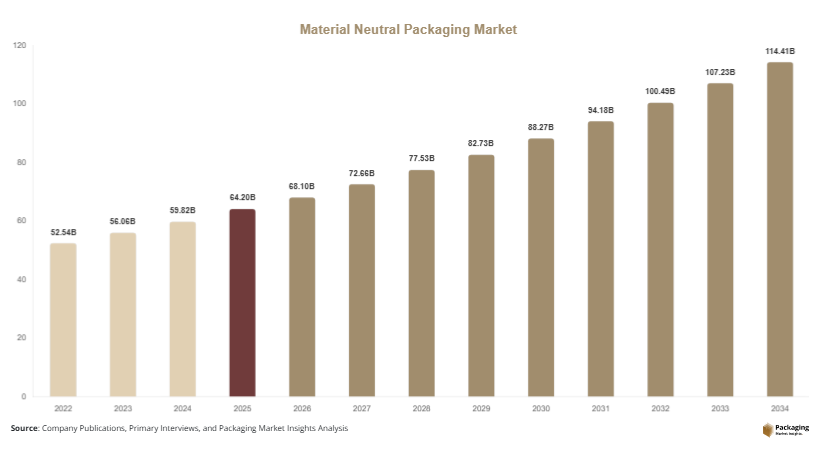
The global material neutral packaging market size was valued at USD 64.2 billion in 2025 and is estimated to reach USD 68.1 billion in 2026. The market is projected to expand significantly and reach approximately USD 118.7 billion by 2034, growing at a CAGR of 6.7% from 2025 to 2034. The growth reflects increasing adoption of hybrid packaging formats and demand for optimized packaging performance.
Several growth factors are shaping the market trajectory. First, rising sustainability concerns are encouraging companies to adopt packaging strategies that reduce environmental impact regardless of material type. Second, regulatory frameworks are pushing manufacturers toward recyclable, reusable, and lightweight packaging formats. Third, advancements in material science are enabling the development of multi-material solutions that improve barrier properties, durability, and shelf life.
Key Highlights:
- The market is projected to reach USD 118.7 billion by 2034, reflecting steady expansion driven by increasing adoption across multiple industries. This growth highlights the rising importance of flexible and performance-based packaging solutions.
- The market is expected to grow at a CAGR of 6.7% from 2025 to 2034, indicating consistent and stable development. This growth is supported by evolving regulatory frameworks and industry demand.
- Increasing focus on sustainability and material optimization is a key factor driving market growth. Companies are prioritizing eco-friendly materials and efficient packaging designs to reduce environmental impact.
- Rising demand from e-commerce, healthcare, and food industries is contributing significantly to market expansion. These sectors require durable, cost-effective, and adaptable packaging solutions.
- Technological advancements in hybrid and multi-material packaging are enhancing product performance. Innovations are improving barrier properties, durability, and overall efficiency of packaging solutions.
Explore more data points, trends and opportunities Download Free Sample Report
Market Trends
Shift Toward Hybrid and Multi-Material Packaging Solutions
A key trend in the material neutral packaging market is the increasing adoption of hybrid packaging solutions that combine multiple materials to enhance performance. Manufacturers are blending paper, plastic, and metal components to achieve improved barrier properties, durability, and flexibility. This approach allows companies to maintain product integrity while reducing material usage and cost. Hybrid packaging is particularly popular in food and beverage applications where moisture resistance and shelf-life extension are critical. The trend is also supported by advancements in adhesive technologies and lamination processes, which enable seamless integration of different materials. As a result, companies are focusing on material efficiency rather than material exclusivity.
Integration of Sustainable and Recyclable Design Principles
Another notable trend is the integration of sustainability into packaging design through material-neutral strategies. Companies are adopting recyclable, biodegradable, and reusable materials without restricting themselves to a single category. This trend is driven by consumer awareness and regulatory pressure to reduce environmental impact. Brands are redesigning packaging structures to minimize waste while maintaining performance. For instance, lightweight packaging solutions are gaining traction as they reduce transportation emissions. Additionally, the use of mono-material alternatives within multi-layer structures is increasing to improve recyclability. This trend is expected to reshape packaging innovation across industries.
Market Drivers
Growing Demand for Sustainable Packaging Solutions
Sustainability is a major driver of the material neutral packaging market. Companies are under increasing pressure to reduce their environmental footprint and comply with regulations aimed at minimizing packaging waste. Material-neutral strategies allow businesses to select environmentally friendly materials without compromising functionality. This flexibility supports the adoption of recyclable and biodegradable materials while maintaining product safety and quality. Additionally, consumer demand for eco-friendly packaging is influencing brand decisions, particularly in the food and beverage sector. Companies are leveraging material-neutral approaches to meet sustainability goals and improve brand image, which is driving market growth.
Expansion of E-commerce and Logistics Sectors
The rapid expansion of e-commerce and global logistics is another key driver. Packaging requirements in these sectors are complex, requiring durability, cost efficiency, and lightweight properties. Material-neutral packaging enables companies to optimize packaging design based on specific shipping and handling needs. This approach reduces damage during transit and lowers transportation costs. Furthermore, the rise of direct-to-consumer delivery models has increased demand for packaging that enhances customer experience while ensuring product protection. As a result, companies are investing in flexible packaging solutions that can adapt to diverse requirements.
Market Restraint
Complexity in Recycling Multi-Material Packaging
One of the major challenges in the material neutral packaging market is the complexity associated with recycling multi-material packaging. While combining materials improves performance, it often creates difficulties in separation and recycling processes. Many recycling systems are designed to handle single-material packaging, making it challenging to process hybrid structures. This limitation can reduce the environmental benefits of material-neutral packaging and create regulatory hurdles. For example, multi-layer packaging used in food applications often requires specialized recycling facilities, which are not widely available. As a result, companies must balance performance benefits with recyclability concerns, which can increase costs and limit adoption in certain regions.
Market Opportunities
Advancements in Material Science and Innovation
Advancements in material science present significant opportunities for the material neutral packaging market. Innovations in biodegradable polymers, recyclable composites, and smart materials are enabling the development of packaging solutions that meet both performance and sustainability requirements. These advancements allow manufacturers to create packaging that is lightweight, durable, and environmentally friendly. Additionally, research into mono-material alternatives for multi-layer packaging is improving recyclability. Companies that invest in material innovation can gain a competitive advantage by offering solutions that align with regulatory and consumer expectations.
Growth in Emerging Markets
Emerging markets offer substantial growth opportunities for material-neutral packaging solutions. Rapid urbanization, rising disposable incomes, and expanding retail sectors are driving demand for packaged goods in regions such as Asia Pacific and Latin America. These markets require cost-effective and adaptable packaging solutions, making material-neutral approaches highly relevant. Additionally, governments in these regions are implementing policies to promote sustainable packaging, creating favorable conditions for market growth. Companies that expand their presence in emerging markets can benefit from increasing demand and evolving regulatory frameworks.
Report Scope
| Report Metric | Details |
|---|---|
| Market Size in 2025 | USD 64.2 Billion |
| Market Size in 2026 | USD 68.1 Billion |
| Market Size in 2034 | USD 118.7 Billion |
| CAGR | 6.7% (2026-2034) |
| Base Year for Estimation | 2025 |
| Historical Data | 2022-2024 |
| Forecast Period | 2026-2034 |
| Report Coverage | Revenue Forecast, Competitive Landscape, Supply Chain Disruption, Growth Factors, Environment & Regulatory Landscape and Trends |
| Geographies Covered | North America, Europe, APAC, Middle East and Africa, LATAM |
| Countries Covered | U.S., Canada, U.K., Germany, France, Spain, Italy, Russia, Nordic, Benelux, Rest of Europe, China, South Korea, Japan, India, Australia, Singapore, Taiwan, South East Asia, Rest of Asia-Pacific, UAE, Turky, Saudi Arabia, South Africa, Egypt, Nigeria, Rest of MEA, Brazil, Mexico, Argentina, Chile, Colombia, Rest of LATAM |
Explore more data points, trends and opportunities Download Free Sample Report
Segmental Analysis
By Type
Flexible packaging emerged as the dominant segment in 2024, accounting for approximately 48% of the market share. This dominance is attributed to its lightweight nature, cost efficiency, and versatility. Flexible packaging solutions are widely used in food, beverage, and healthcare applications due to their ability to extend shelf life and reduce material usage. The material-neutral approach allows manufacturers to combine different materials to enhance performance. Additionally, flexible packaging supports innovative designs and customization, making it a preferred choice for various industries.
Rigid packaging is expected to be the fastest-growing segment, with a CAGR of 7.2% during the forecast period. The growth is driven by increasing demand for durable and protective packaging solutions. Rigid packaging is widely used in industries such as pharmaceuticals and electronics, where product safety is critical. The adoption of sustainable materials and recyclable designs is further supporting segment growth.
By Application
The food and beverage segment dominated the market in 2024, accounting for around 52% of the share. This dominance is driven by the high demand for packaging that ensures product safety, freshness, and compliance with regulations. Material-neutral packaging allows manufacturers to select materials that provide optimal barrier properties while maintaining sustainability. The increasing consumption of packaged and ready-to-eat foods is further driving demand in this segment.
The healthcare segment is expected to grow at the fastest CAGR of 7.8%. The growth is driven by the need for secure and hygienic packaging solutions. Material-neutral approaches enable the use of specialized materials that meet stringent regulatory requirements. Additionally, the rising demand for pharmaceutical products is supporting segment growth.
By End-Use Industry
The retail and e-commerce segment dominated the market in 2024, accounting for approximately 45% of the share. The growth is driven by increasing online shopping and demand for efficient packaging solutions. Material-neutral packaging helps companies optimize packaging design to reduce costs and improve product protection. The ability to use different materials based on specific requirements is a key advantage.
The industrial segment is expected to grow at a CAGR of 6.9%. The growth is driven by increasing demand for durable packaging solutions in manufacturing and logistics. Material-neutral approaches enable companies to select materials that provide strength and cost efficiency. This flexibility is supporting segment growth.
Material Neutral Packaging Market Segmentations
By Type
- Flexible Packaging
- Rigid Packaging
- Hybrid Packaging
By Application
- Food & Beverage
- Healthcare
- Personal Care
- Industrial
By End-User Industry
- Retail & E-commerce
- Manufacturing
- Logistics
- Pharmaceuticals
Regional Analysis
North America
North America accounted for approximately 32% of the global material neutral packaging market share in 2025 and is expected to grow at a CAGR of 6.2% during the forecast period. The region’s growth is driven by strong demand from the food, beverage, and healthcare sectors. Regulatory initiatives promoting sustainable packaging and recycling are encouraging companies to adopt material-neutral strategies. Additionally, technological advancements in packaging design are supporting market expansion.
The United States dominates the North American market due to its advanced manufacturing capabilities and strong presence of key industry players. A unique growth factor in this region is the increasing adoption of smart packaging technologies, which enhance product traceability and consumer engagement. Companies are integrating digital features such as QR codes and RFID tags into packaging solutions.
Europe
Europe held a market share of around 28% in 2025 and is projected to grow at a CAGR of 6.5%. The region is characterized by stringent environmental regulations and a strong focus on sustainability. Governments are implementing policies to reduce plastic waste and promote recyclable packaging, which is driving the adoption of material-neutral solutions. The presence of established packaging manufacturers further supports market growth.
Germany leads the European market due to its strong industrial base and commitment to sustainability. A unique growth factor is the emphasis on circular economy practices, which encourage the reuse and recycling of materials. Companies are investing in innovative packaging solutions that align with these principles.
Asia Pacific
Asia Pacific accounted for approximately 25% of the market share in 2025 and is expected to grow at the fastest CAGR of 7.5%. Rapid industrialization, urbanization, and increasing consumption of packaged goods are driving market growth. The region’s diverse consumer base creates demand for flexible and cost-effective packaging solutions.
China dominates the Asia Pacific market due to its large manufacturing sector and growing e-commerce industry. A unique growth factor is the expansion of online retail platforms, which require efficient and durable packaging solutions. This trend is boosting the adoption of material-neutral packaging.
Middle East & Africa
The Middle East & Africa region held a market share of around 8% in 2025 and is projected to grow at a CAGR of 5.8%. The market is driven by increasing demand for packaged food and beverages, as well as growth in the retail sector. Governments are also focusing on improving waste management systems.
The United Arab Emirates is a key market in this region. A unique growth factor is the rising adoption of sustainable packaging in the hospitality and tourism sectors. Companies are focusing on eco-friendly solutions to align with sustainability goals.
Latin America
Latin America accounted for approximately 7% of the market share in 2025 and is expected to grow at a CAGR of 6.0%. The region’s growth is driven by expanding food and beverage industries and increasing urbanization. Packaging demand is rising as consumer lifestyles change.
Brazil leads the Latin American market due to its large consumer base. A unique growth factor is the growing awareness of environmental issues, which is encouraging companies to adopt sustainable packaging solutions. This trend is supporting market growth.
Competitive Landscape
The material neutral packaging market is moderately fragmented, with several global and regional players competing on innovation, sustainability, and cost efficiency. Key companies are focusing on developing advanced packaging solutions that align with regulatory requirements and consumer preferences. Strategic partnerships, mergers, and acquisitions are common in this market as companies aim to expand their product portfolios and geographic presence.
Amcor plc is a leading player in the market, known for its focus on sustainable packaging solutions. The company has recently invested in developing recyclable and lightweight packaging materials. Other major players are also investing in research and development to enhance product performance and sustainability.
Key Players List
- Amcor plc
- Berry Global Inc.
- Sealed Air Corporation
- Mondi Group
- Smurfit Kappa Group
- DS Smith plc
- Sonoco Products Company
- Huhtamaki Oyj
- WestRock Company
- Uflex Ltd.
- Constantia Flexibles
- Coveris Holdings S.A.
- ProAmpac LLC
- AptarGroup, Inc.
- Tetra Pak International S.A.