Luxury Spirit Packaging Market Size and Growth
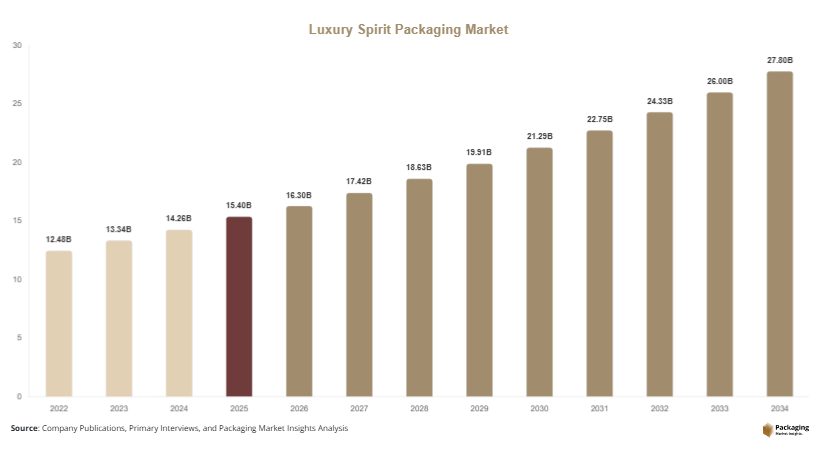
The global luxury spirit packaging market was valued at approximately USD 15.4 billion in 2025 and is expected to reach USD 16.3 billion in 2026. By 2034, the market is projected to attain a value of nearly USD 27.8 billion, registering a CAGR of 6.9% during 2025–2034. Luxury spirit packaging includes premium bottles, decorative labels, closures, rigid boxes, and customized packaging solutions used for whiskey, vodka, rum, gin, tequila, cognac, and other premium alcoholic beverages. The luxury spirit packaging market is experiencing consistent growth due to rising premium alcohol consumption, increasing demand for visually distinctive packaging, and expanding luxury gifting culture across global markets.
One of the primary growth factors driving the market is the increasing consumer preference for premium and ultra-premium alcoholic beverages. Consumers are willing to spend more on high-end spirits with attractive packaging that reflects exclusivity and craftsmanship. Another significant factor is the rapid growth of luxury gifting and festive consumption trends. Premium spirits are increasingly being purchased as gifts during holidays, weddings, and corporate events, increasing demand for elegant packaging solutions. Luxury packaging also plays a crucial role in enhancing brand identity and product differentiation in highly competitive alcoholic beverage markets.
Key Highlights
- Europe dominated the market with a 34.6% share in 2025.
- Asia Pacific is projected to grow at the fastest CAGR of 7.4%.
- Glass bottles led the packaging type segment with a 46.9% share.
- Premium whiskey packaging dominated the application segment with a 38.2% share.
- Rigid box packaging led the secondary packaging segment with a 33.7% share.
- The US remained the dominant country with a market size of USD 3.1 billion in 2025 and USD 3.3 billion in 2026.
Explore more data points, trends and opportunities Download Free Sample Report
Market Trends
Increasing Adoption of Sustainable Luxury Packaging
Sustainability is becoming a major trend in the luxury spirit packaging market as premium alcohol brands seek to reduce environmental impact while maintaining premium aesthetics. Manufacturers are increasingly introducing recyclable glass bottles, biodegradable labels, and reusable rigid boxes to align with changing consumer expectations. Luxury spirit companies are also reducing packaging weight to improve transportation efficiency and lower carbon emissions. Sustainable closures made from natural cork and recycled aluminum are gaining popularity across whiskey and wine spirit categories. Consumers are increasingly associating sustainable packaging with brand responsibility and product authenticity. This trend is encouraging packaging companies to invest in eco-friendly decorative technologies and renewable raw materials.
Rising Demand for Personalized and Collector Packaging
Luxury spirit brands are increasingly focusing on personalized and limited-edition packaging to strengthen customer engagement and brand exclusivity. Customized engraving, embossed labels, artistic bottle shapes, and seasonal collector editions are becoming common across premium whiskey, vodka, and tequila products. Consumers are seeking unique packaging experiences that reflect luxury and craftsmanship. Brands are also collaborating with artists and designers to create visually distinctive packaging for special launches and gifting occasions. Digital printing technologies are allowing companies to produce small-batch customized packaging with greater flexibility. This trend is expected to continue as premium alcohol consumers increasingly value exclusivity and product storytelling.
Market Drivers
Rising Consumption of Premium and Ultra-Premium Spirits
The increasing global demand for premium and ultra-premium alcoholic beverages is a major driver supporting the growth of the luxury spirit packaging market. Consumers are shifting toward high-quality spirits with unique flavors, aged formulations, and sophisticated presentation. Luxury packaging enhances perceived product value and influences purchasing decisions, especially in retail environments and gifting applications. Premium whiskey, cognac, tequila, and gin brands are investing heavily in decorative bottles, embossed labels, and premium secondary packaging to differentiate themselves in competitive markets. The expansion of luxury hospitality and nightlife industries is also contributing to higher consumption of premium spirits worldwide.
Expansion of Global Travel Retail and Duty-Free Channels
The growth of international travel retail and duty-free shopping is another key driver for the luxury spirit packaging market. Airports and luxury retail stores often feature premium alcoholic beverages packaged in visually attractive and exclusive formats. Spirit manufacturers are launching travel-exclusive editions and limited-edition packaging designs to attract international consumers. Premium packaging helps brands improve shelf visibility and enhance customer engagement in high-traffic retail environments. The expansion of tourism and global travel activities is increasing demand for compact, durable, and premium-looking packaging solutions suitable for international transportation and gifting purposes.
Market Restraint
High Production Costs and Stringent Alcohol Packaging Regulations
One of the major restraints affecting the luxury spirit packaging market is the high production cost associated with premium materials and decorative technologies. Luxury packaging often involves custom-designed glass bottles, metallic finishes, embossing, engraving, and rigid box structures, which significantly increase manufacturing expenses. Small and medium-sized spirit brands may face financial challenges in adopting advanced luxury packaging solutions because of higher initial investments and operational costs. In addition, strict regulations regarding alcohol labeling, packaging safety, and environmental compliance can create additional complexities for manufacturers. For example, several European countries are implementing tighter sustainability regulations requiring recyclable materials and waste reduction in alcoholic beverage packaging. Compliance with these standards can increase development costs and production timelines. Fluctuations in raw material prices, especially premium glass and aluminum, also affect profitability across the supply chain. These factors may limit the adoption of high-end packaging solutions among smaller spirit producers and emerging market participants.
Market Opportunities
Growth of Premium Gifting and Corporate Packaging
The increasing popularity of premium spirits as gifts presents a significant opportunity for the luxury spirit packaging market. Consumers are purchasing luxury whiskey, cognac, vodka, and tequila products for festive occasions, weddings, anniversaries, and corporate gifting programs. This trend is encouraging spirit brands to invest in decorative gift boxes, premium closures, and personalized packaging formats. Luxury packaging enhances the emotional value of gifting products and strengthens brand recognition. Seasonal limited-edition packaging and customized corporate branding solutions are also becoming increasingly popular. As luxury gifting culture expands globally, packaging manufacturers are expected to benefit from growing demand for visually attractive and premium-quality packaging solutions.
Expansion of E-commerce Sales for Premium Spirits
The rapid growth of e-commerce platforms for alcoholic beverages is creating new opportunities in the luxury spirit packaging market. Online spirit retailers require packaging solutions that combine product protection with premium visual appeal. Packaging manufacturers are developing durable glass protection systems, shock-resistant inserts, and aesthetically designed shipping boxes suitable for direct-to-consumer delivery. Digital printing technologies are enabling brands to create personalized online-exclusive packaging designs that improve customer engagement. As regulations around online alcohol sales become more supportive in several countries, demand for secure and visually appealing luxury spirit packaging solutions is expected to rise steadily.
Report Scope
| Report Metric | Details |
|---|---|
| Market Size in 2025 | USD 15.4 Billion |
| Market Size in 2026 | USD 16.3 Billion |
| Market Size in 2034 | USD 27.8 Billion |
| CAGR | 6.9% (2026-2034) |
| Base Year for Estimation | 2025 |
| Historical Data | 2022-2024 |
| Forecast Period | 2026-2034 |
| Report Coverage | Revenue Forecast, Competitive Landscape, Supply Chain Disruption, Growth Factors, Environment & Regulatory Landscape and Trends |
| Geographies Covered | North America, Europe, APAC, Middle East and Africa, LATAM |
| Countries Covered | U.S., Canada, U.K., Germany, France, Spain, Italy, Russia, Nordic, Benelux, Rest of Europe, China, South Korea, Japan, India, Australia, Singapore, Taiwan, South East Asia, Rest of Asia-Pacific, UAE, Turky, Saudi Arabia, South Africa, Egypt, Nigeria, Rest of MEA, Brazil, Mexico, Argentina, Chile, Colombia, Rest of LATAM |
Explore more data points, trends and opportunities Download Free Sample Report
Segmental Analysis
By Packaging Type
Glass bottles dominated the luxury spirit packaging market in 2024, accounting for approximately 46.9% of the total market share. Premium spirit brands widely prefer glass bottles because they provide a luxurious appearance, excellent transparency, and strong product preservation properties. Decorative glass bottles with embossing, unique shapes, and premium closures help improve shelf appeal and enhance consumer perception of quality. Glass packaging is especially popular in whiskey, vodka, cognac, and tequila applications where product presentation significantly influences purchasing decisions. Manufacturers are also developing lightweight premium glass bottles to reduce transportation costs while maintaining visual appeal and durability.
Sustainable packaging materials are projected to be the fastest-growing subsegment, registering a CAGR of 7.6% during the forecast period. Growing environmental awareness and stricter packaging regulations are encouraging spirit manufacturers to adopt recyclable paperboard, biodegradable labels, and lightweight packaging materials. Luxury alcohol brands are increasingly promoting sustainability as part of their brand identity. Packaging companies are introducing eco-friendly decorative technologies and renewable raw materials to support this transition. Improvements in sustainable barrier coatings and premium recycled glass production are also contributing to segment growth across global markets.
By Application
Premium whiskey packaging dominated the luxury spirit packaging market in 2024 with a share of approximately 38.2%. Whiskey brands invest heavily in premium bottles, decorative labels, and collector-edition boxes to strengthen product differentiation and consumer loyalty. Limited-edition whiskey releases often feature customized packaging elements such as embossed logos, metallic foils, and handcrafted closures. Rising global demand for aged and craft whiskey products is supporting continued investment in premium packaging formats. Retailers and duty-free stores also prioritize visually attractive whiskey packaging to improve shelf visibility and encourage impulse purchases among consumers.
Tequila packaging is expected to be the fastest-growing application segment, expanding at a CAGR of 7.5% during the forecast period. The increasing global popularity of premium tequila and mezcal products is driving demand for artistic bottle designs and luxury secondary packaging. Spirit brands are using handcrafted glass bottles, ceramic containers, and culturally inspired decorative elements to enhance product authenticity and premium appeal. Younger consumers are increasingly purchasing premium tequila products for social and gifting occasions, creating additional opportunities for packaging innovation. Growth in premium cocktail culture is also supporting segment expansion worldwide.
By Secondary Packaging
Rigid box packaging accounted for the largest market share in 2024 at approximately 33.7%. Luxury spirit brands widely use rigid boxes because they provide strong product protection and premium visual presentation. These boxes are commonly used for premium whiskey, cognac, and gift packaging applications. Decorative rigid boxes with magnetic closures, textured finishes, and metallic embellishments help improve customer perception and support premium brand positioning. Luxury retailers and gifting channels increasingly prefer rigid packaging solutions because they enhance the unboxing experience and improve product differentiation in competitive markets.
Personalized packaging is projected to be the fastest-growing subsegment, with a forecast CAGR of 7.8% during 2025–2034. Consumers are increasingly seeking customized packaging experiences for gifting, celebrations, and collector purchases. Spirit brands are using digital printing and laser engraving technologies to create personalized labels, names, and artwork on bottles and secondary packaging. Personalized packaging strengthens customer engagement and encourages repeat purchases. The growing popularity of online luxury spirit sales is also supporting demand for customized packaging formats tailored to direct-to-consumer gifting applications.
Luxury Spirit Packaging Market Segmentations
By Packaging Type
- Glass Bottles
- Metal Packaging
- Sustainable Packaging Materials
- Decorative Labels & Closures
By Application
- Whiskey Packaging
- Vodka Packaging
- Tequila Packaging
- Cognac & Rum Packaging
By Secondary Packaging
- Rigid Boxes
- Gift Packaging
- Personalized Packaging
- Collector Edition Packaging
Regional Analysis
North America
North America accounted for approximately 28.3% of the global luxury spirit packaging market share in 2025 and is projected to grow at a CAGR of 6.2% during the forecast period. The region benefits from high consumption of premium whiskey, vodka, and tequila products. Strong demand for luxury gifting and collector-edition spirits is encouraging packaging innovation across the United States and Canada. Packaging manufacturers are increasingly focusing on sustainable decorative materials and customized bottle designs to meet evolving consumer preferences.
The United States dominates the North American luxury spirit packaging market because of its large premium alcohol industry and strong retail distribution network. One unique growth factor is the increasing popularity of craft distilleries producing limited-edition spirits with artistic packaging designs. These producers are investing in premium labels, embossed bottles, and collectible packaging formats to strengthen brand positioning.
Europe
Europe held nearly 34.6% of the global luxury spirit packaging market share in 2025 and is expected to grow at a CAGR of 6.4% through 2034. The region has a long-established premium spirits industry supported by strong demand for whiskey, cognac, vodka, and gin products. Luxury spirit brands in Europe are increasingly adopting sustainable materials and premium decorative technologies to enhance brand value. The region also benefits from strong tourism and duty-free retail markets supporting premium alcohol sales.
France remains the dominant country in the European luxury spirit packaging market because of its globally recognized cognac and premium liquor industry. A unique growth factor is the strong heritage branding associated with French luxury spirits, which encourages investments in artistic bottle designs and handcrafted packaging materials. Luxury packaging plays a critical role in maintaining product authenticity and premium positioning.
Asia Pacific
Asia Pacific represented approximately 24.8% of the luxury spirit packaging market share in 2025 and is projected to grow at the fastest CAGR of 7.4% during the forecast period. Rising disposable incomes, expanding urban populations, and increasing premium alcohol consumption are major factors driving regional growth. Consumers across China, Japan, South Korea, and India are increasingly purchasing premium imported spirits packaged in visually distinctive formats. E-commerce expansion is also contributing to higher demand for protective and aesthetically appealing packaging solutions.
China dominates the Asia Pacific market due to its rapidly growing premium liquor consumer base and expanding luxury retail industry. One unique growth factor is the increasing popularity of premium gifting culture during festivals and business events. This trend is encouraging spirit brands to launch decorative limited-edition packaging designs tailored to local consumer preferences.
Middle East & Africa
The Middle East & Africa luxury spirit packaging market accounted for around 4.7% of the global market share in 2025 and is expected to grow at a CAGR of 5.8% during the forecast period. Growth in the region is supported by expanding tourism activities, luxury hospitality industries, and duty-free retail operations. Premium alcoholic beverages are increasingly being sold through international hotels, airports, and luxury retail stores. Packaging manufacturers are focusing on compact and visually appealing packaging formats suitable for travel retail applications.
The United Arab Emirates dominates the regional market because of its strong tourism sector and expanding luxury retail environment. One unique growth factor is the increasing demand for premium spirits among international travelers purchasing products through duty-free channels. Luxury packaging plays an important role in attracting consumers in high-traffic retail locations.
Latin America
Latin America accounted for approximately 7.6% of the global luxury spirit packaging market share in 2025 and is projected to grow at a CAGR of 6.9% during the forecast period. Rising premiumization trends and increasing consumption of imported alcoholic beverages are supporting market growth across the region. Packaging manufacturers are introducing decorative bottle designs and premium labeling solutions to improve shelf visibility and brand differentiation.
Brazil remains the dominant country in the Latin American luxury spirit packaging market due to its large consumer base and expanding premium beverage industry. One unique growth factor is the growing popularity of premium rum and craft spirits packaged in customized glass bottles and decorative boxes. This trend is encouraging local and international brands to invest in premium packaging innovations.
Competitive Landscape
The luxury spirit packaging market is moderately competitive, with major packaging manufacturers focusing on decorative innovation, sustainability, and premium material development. Companies are investing in advanced glass molding technologies, digital printing systems, and eco-friendly packaging materials to strengthen their market positions. Strategic partnerships with premium alcohol brands and luxury retailers remain common across the industry. Manufacturers are also expanding production capabilities for customized packaging solutions and limited-edition product launches.
Saverglass is one of the leading companies in the luxury spirit packaging market due to its strong expertise in premium glass bottle manufacturing and decorative technologies. In 2024, the company introduced a lightweight luxury glass bottle collection designed to reduce carbon emissions while maintaining premium aesthetics. Other major companies operating in the market include Berlin Packaging, Verallia, O-I Glass Inc., and Amcor plc. These companies continue to focus on sustainable packaging innovations, premium branding solutions, and advanced decorative finishes to meet evolving market demand.
Key Players List
- Saverglass
- Berlin Packaging
- Verallia
- O-I Glass Inc.
- Amcor plc
- Ardagh Group
- Estal Packaging
- Stoelzle Glass Group
- Vidrala S.A.
- Piramal Glass
- Saxco International
- Owens-Illinois Inc.
- DS Smith plc
- Crown Holdings Inc.
- James Cropper plc