Luxury Rigid Box Market Size and Growth
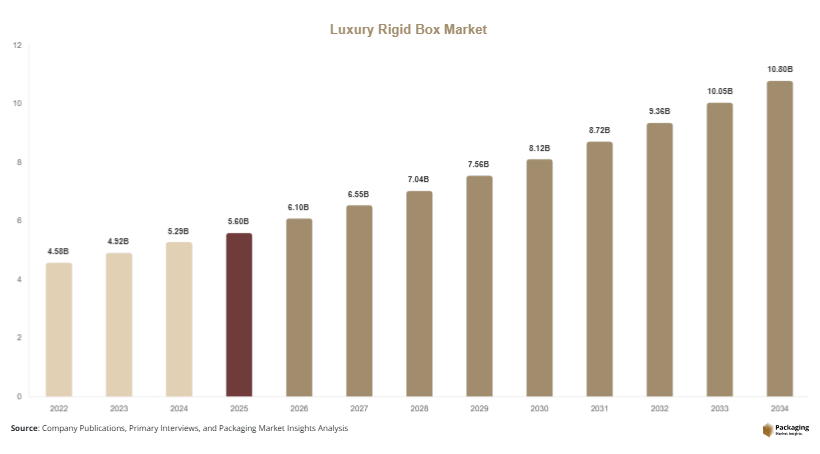
The global luxury rigid box market size was valued at approximately USD 5.6 billion in 2025 and is estimated to reach USD 6.1 billion in 2026. According to industry projections, the market is expected to expand to USD 10.8 billion by 2034, registering a compound annual growth rate (CAGR) of around 7.4% from 2025 to 2034. Increasing consumer demand for premium products and luxury branding strategies continues to shape the market landscape. Companies across sectors are investing heavily in packaging innovation to create memorable unboxing experiences and reinforce brand identity.
The luxury rigid box market has witnessed consistent expansion over the past decade as premium packaging becomes a central component of brand differentiation across luxury goods industries. Luxury rigid boxes are widely used in packaging for jewelry, cosmetics, watches, electronics, and premium confectionery products. These boxes are known for their durability, structured design, and high-end aesthetic appeal, making them an important packaging solution for brands seeking to deliver enhanced customer experiences and perceived product value.
Key Highlights
- Global market projected to reach USD 10.8 billion by 2034
- CAGR of 7.4% during 2025–2034
- Rising demand from luxury cosmetics and jewelry sectors
- Growing adoption of sustainable rigid packaging materials
- Increasing influence of premium branding strategies in packaging design
Explore more data points, trends and opportunities Download Free Sample Report
Market Trends
Growing Adoption of Sustainable Luxury Packaging
Sustainability has become an important trend in the luxury rigid box market , as premium brands increasingly align packaging strategies with environmental goals. Luxury product manufacturers are transitioning from plastic packaging to rigid paperboard structures made from recycled materials. Packaging suppliers are developing rigid boxes using FSC-certified boards, biodegradable adhesives, and water-based inks to reduce environmental impact.
Brands are also redesigning packaging structures to reduce material consumption while maintaining luxury aesthetics. Magnetic closures, reusable boxes, and minimalistic structural designs are gaining popularity because they combine premium presentation with reduced environmental footprint. As consumers become more environmentally aware, brands view sustainable luxury packaging as a strategic differentiator. This trend is expected to accelerate innovation across packaging production technologies.
Expansion of Customized and Personalized Packaging
Customization is another key trend shaping the luxury rigid box market . Premium brands are increasingly adopting personalized packaging designs to enhance brand storytelling and customer engagement. Rigid boxes now feature advanced design elements such as digital printing, textured finishes, metallic foiling, and structural inserts tailored to specific products.
The rise of limited-edition collections and exclusive product launches has encouraged brands to use customized rigid boxes that reflect unique brand narratives. Digital printing technologies have enabled packaging manufacturers to produce smaller batches of highly personalized packaging designs efficiently. This flexibility supports marketing campaigns, seasonal product launches, and luxury gift packaging strategies. As luxury brands continue to focus on differentiated consumer experiences, customization is expected to remain a central trend influencing market growth.
Market Drivers
Growth of the Global Luxury Goods Industry
The steady expansion of the luxury goods sector is a primary driver of the luxury rigid box market . Luxury brands across categories such as jewelry, watches, fragrances, cosmetics, and premium electronics rely heavily on rigid packaging to reinforce product value and brand positioning. High-quality rigid boxes create a premium perception that enhances the overall consumer experience.
Consumers purchasing luxury products often expect sophisticated packaging that reflects exclusivity. As luxury brands compete for customer loyalty, packaging has become an important branding tool. Rigid boxes allow brands to incorporate distinctive design elements such as embossing, ribbon closures, magnetic lids, and high-end printing finishes. The continuous growth of luxury product sales globally therefore directly supports increased demand for rigid packaging solutions.
Rapid Growth of E-Commerce for Premium Products
The rise of e-commerce platforms has significantly influenced the luxury rigid box market growth. Luxury brands are increasingly selling products through online channels, which has increased the need for packaging that provides both visual appeal and structural protection during transportation.
Rigid boxes offer superior durability compared to folding cartons, making them suitable for shipping high-value items such as watches, perfumes, and electronics. Additionally, the unboxing experience has become an important aspect of online retail marketing. Premium rigid packaging helps brands deliver memorable unboxing moments that strengthen customer relationships and encourage repeat purchases. As online sales of luxury goods continue to expand globally, rigid packaging demand is expected to increase accordingly.
Market Restraint
High Production Costs of Luxury Rigid Packaging
One of the main restraints affecting the luxury rigid box market is the relatively high cost associated with rigid box manufacturing. Compared with folding cartons and flexible packaging solutions, rigid boxes require thicker paperboard materials, additional lamination processes, and complex assembly procedures. These factors significantly increase production costs.
Manufacturers often incorporate premium design elements such as magnetic closures, velvet linings, foil stamping, and custom inserts, which further raise production expenses. Small and medium-sized brands may find it challenging to justify the higher cost of luxury rigid boxes, especially when packaging budgets are limited. This can restrict adoption in price-sensitive product categories.
Another factor contributing to higher costs is the labor-intensive nature of rigid box manufacturing. Many rigid boxes require manual assembly processes, particularly for premium finishes and complex structural designs. This increases operational costs and limits production scalability.
For example, emerging cosmetic brands entering the premium segment often choose simplified packaging structures instead of fully rigid boxes to control expenses. As a result, the higher cost structure of rigid packaging may slow adoption among smaller companies. Packaging manufacturers are addressing this challenge by investing in automation technologies and optimized manufacturing processes to reduce costs and improve efficiency.
Market Opportunities
Rising Demand from Luxury Cosmetics and Beauty Products
The cosmetics and beauty sector presents significant growth opportunities for the luxury rigid box market . Premium skincare and fragrance brands are increasingly adopting rigid packaging to create strong shelf appeal and reinforce product exclusivity. Luxury rigid boxes allow cosmetic brands to incorporate decorative finishes, molded inserts, and innovative opening mechanisms that enhance product presentation.
The growth of premium skincare products and luxury fragrance lines has increased the need for sophisticated packaging solutions. Consumers often associate rigid packaging with product quality and brand prestige. As beauty brands continue launching high-end product lines and limited-edition collections, rigid packaging solutions are expected to gain wider adoption.
Increasing Use of Luxury Packaging in Consumer Electronics
Consumer electronics manufacturers are increasingly using rigid packaging to enhance product presentation and protection. High-value electronics such as smartphones, headphones, and wearable devices require packaging that provides structural strength while reflecting brand identity.
Rigid boxes offer superior cushioning and design flexibility, making them suitable for packaging premium electronics products. Many brands use magnetic rigid boxes or drawer-style structures to create elegant product presentations during unboxing. As electronics companies continue emphasizing design and customer experience, the use of rigid packaging is likely to expand. This trend is expected to generate new revenue opportunities for packaging manufacturers operating in the luxury rigid box segment.
Report Scope
| Report Metric | Details |
|---|---|
| Market Size in 2025 | USD 5.6 Billion |
| Market Size in 2026 | USD 6.1 Billion |
| Market Size in 2034 | USD 10.8 Billion |
| CAGR | 7.4% (2026-2034) |
| Base Year for Estimation | 2025 |
| Historical Data | 2022-2024 |
| Forecast Period | 2026-2034 |
| Report Coverage | Revenue Forecast, Competitive Landscape, Supply Chain Disruption, Growth Factors, Environment & Regulatory Landscape and Trends |
| Geographies Covered | North America, Europe, APAC, Middle East and Africa, LATAM |
| Countries Covered | U.S., Canada, U.K., Germany, France, Spain, Italy, Russia, Nordic, Benelux, Rest of Europe, China, South Korea, Japan, India, Australia, Singapore, Taiwan, South East Asia, Rest of Asia-Pacific, UAE, Turky, Saudi Arabia, South Africa, Egypt, Nigeria, Rest of MEA, Brazil, Mexico, Argentina, Chile, Colombia, Rest of LATAM |
Explore more data points, trends and opportunities Download Free Sample Report
Segmental Analysis
By Type
The magnetic closure rigid boxes segment held the dominant position in the luxury rigid box market , accounting for approximately 34% of the market share in 2024. Magnetic closure boxes are widely used in luxury packaging because they combine structural durability with elegant opening mechanisms. These boxes are commonly used for packaging jewelry, watches, electronics, and premium cosmetics products. The magnetic closure design provides both convenience and a sophisticated unboxing experience, making it attractive for luxury brands aiming to strengthen product presentation. Additionally, magnetic rigid boxes offer strong structural integrity, ensuring product safety during storage and transportation. Their premium appearance and versatility have contributed to widespread adoption across multiple luxury product categories.
The drawer rigid box segment is expected to witness the fastest growth during the forecast period, with an estimated CAGR of around 8.1%. Drawer boxes are gaining popularity because they provide a distinctive sliding mechanism that enhances product presentation. Luxury brands often incorporate foam inserts, fabric linings, and custom compartments within drawer boxes to securely hold delicate items such as jewelry or electronic accessories. Another growth factor supporting this segment is the rising demand for gift packaging in premium product launches. Drawer-style rigid boxes provide a memorable unboxing experience while maintaining high structural durability, making them an attractive choice for luxury product manufacturers.
By Material
The paperboard segment dominated the luxury rigid box market in 2024, capturing approximately 62% of the total market share. Paperboard is widely used in rigid box manufacturing because it provides structural strength while allowing flexible design customization. Manufacturers can easily apply decorative finishes such as lamination, embossing, and foil stamping on paperboard surfaces. This versatility enables brands to create visually distinctive packaging designs that align with luxury brand identities. In addition, paperboard is considered an environmentally favorable material compared to plastic alternatives. The increasing focus on sustainable packaging solutions has further strengthened the demand for paperboard-based rigid boxes across luxury goods industries.
The fabric-wrapped rigid box segment is expected to grow at the fastest rate, registering a CAGR of around 8.4% during the forecast period. Fabric-wrapped boxes are commonly used for high-value luxury products such as premium jewelry, luxury watches, and collectible items. The use of fabrics such as velvet, silk, or linen enhances the tactile experience of packaging while creating an elegant appearance. One important growth factor for this segment is the increasing demand for luxury gifting packaging. Many brands use fabric-wrapped rigid boxes for limited-edition collections and special promotional packaging. This trend is expected to drive continued adoption in the coming years.
By End-Use Industry
The cosmetics and personal care segment accounted for the largest share of the luxury rigid box market in 2024, representing nearly 36% of the global market. Premium skincare, fragrances, and beauty products often rely on rigid packaging to convey product quality and exclusivity. Luxury cosmetic brands invest heavily in packaging design to create strong shelf appeal and differentiate products in competitive retail environments. Rigid boxes allow manufacturers to incorporate custom inserts, decorative printing, and innovative opening mechanisms. These features enhance product presentation and protect delicate cosmetic items such as glass perfume bottles during transportation and storage.
The consumer electronics segment is expected to register the fastest growth, expanding at a CAGR of approximately 8.6% through 2034. Premium electronics brands increasingly use rigid packaging to deliver sophisticated unboxing experiences and ensure product protection. High-value devices such as smartphones, smartwatches, and wireless headphones require packaging that combines structural durability with refined design aesthetics. Another factor driving growth is the importance of packaging in brand perception within the electronics industry. Many technology companies view rigid packaging as an extension of product design, which encourages adoption of innovative rigid box formats.
Luxury Rigid Box Market Segmentations
Type
- Magnetic Closure Boxes
- Drawer Rigid Boxes
- Hinged Lid Boxes
- Two-Piece Rigid Boxes
Material
- Paperboard
- Fabric Wrapped
- Leather Wrapped
- Specialty Materials
End-Use Industry
- Cosmetics & Personal Care
- Jewelry & Watches
- Consumer Electronics
- Premium Confectionery
- Luxury Gift Packaging
Regional Analysis
North America
North America accounted for approximately 28% of the global luxury rigid box market share in 2025. The region is projected to expand at a CAGR of around 6.9% through 2034, supported by strong demand for premium packaging across cosmetics, jewelry, and consumer electronics industries. Luxury brands in the region increasingly use rigid packaging to strengthen brand perception and deliver enhanced unboxing experiences. In addition, the rapid growth of online retail channels for premium products has accelerated demand for durable packaging solutions that ensure product protection.
The United States dominates the regional market due to the presence of a well-established luxury goods industry and advanced packaging infrastructure. A key growth factor in the country is the increasing use of premium packaging for subscription-based luxury product services. Many brands are offering curated monthly product boxes, which require durable and visually appealing rigid packaging. This shift toward experiential marketing strategies continues to support demand for luxury rigid boxes.
Europe
Europe represented nearly 26% of the luxury rigid box market share in 2025 and is expected to register a CAGR of approximately 7.1% during the forecast period. The region has a long tradition of luxury goods manufacturing, particularly in cosmetics, perfumes, fashion accessories, and premium confectionery. Luxury rigid boxes are widely used by European brands to maintain high product presentation standards and reinforce heritage branding.
France remains the dominant market in Europe due to its strong luxury cosmetics and fragrance industries. One important growth factor in the country is the emphasis on sustainable packaging solutions. Luxury brands based in France are increasingly adopting recyclable rigid boxes and eco-friendly materials to align with environmental regulations and consumer expectations. This focus on sustainable premium packaging is contributing to steady regional market growth.
Asia Pacific
Asia Pacific held the largest share of around 31% in the luxury rigid box market in 2025 and is forecast to grow at a CAGR of 8.2% through 2034. Rapid urbanization, rising disposable incomes, and increasing demand for luxury goods are key factors driving market expansion in the region. Luxury packaging demand has increased significantly as premium brands expand their presence in emerging Asian markets.
China leads the Asia Pacific market due to its rapidly expanding luxury consumer base. One unique growth factor in the country is the strong influence of digital retail platforms on luxury product sales. Online luxury purchases in China often emphasize packaging aesthetics and unboxing experiences, encouraging brands to invest in premium rigid packaging designs. This trend is expected to continue supporting regional market growth.
Middle East & Africa
The Middle East & Africa accounted for roughly 8% of the global luxury rigid box market share in 2025 and is projected to grow at a CAGR of around 6.5% during the forecast period. Demand for luxury rigid packaging in the region is supported by high spending on premium perfumes, jewelry, and gift items. Luxury rigid boxes are widely used in these product categories to deliver elegant presentation and protection.
The United Arab Emirates represents the leading market in the region. One major growth factor is the strong culture of luxury gifting, particularly during festive seasons and special events. Premium packaging plays an essential role in gift presentation, encouraging brands to invest in decorative rigid box designs. As the luxury retail sector continues to expand across the region, packaging demand is expected to increase.
Latin America
Latin America accounted for approximately 7% of the luxury rigid box market share in 2025 and is anticipated to grow at a CAGR of about 6.8% through 2034. The regional market is gradually expanding as premium consumer goods industries develop in major economies. Luxury rigid packaging demand is particularly strong in cosmetics, gourmet food products, and premium alcoholic beverages.
Brazil dominates the Latin American market due to its growing beauty and cosmetics sector. One unique growth factor in the country is the increasing popularity of luxury gift packaging for seasonal retail promotions. Many cosmetic brands launch special edition gift sets that require premium rigid packaging. This marketing strategy has encouraged packaging manufacturers to develop visually appealing rigid box solutions tailored for retail gifting campaigns.
Competitive Landscape
The luxury rigid box market is moderately fragmented, with several global and regional packaging manufacturers competing through design innovation, material development, and strategic partnerships with luxury brands. Companies are focusing on advanced printing technologies, automated production processes, and sustainable materials to strengthen their market positions.
DS Smith Plc is considered one of the leading companies in the market due to its strong global presence and extensive packaging design capabilities. The company has been expanding its portfolio of sustainable rigid packaging solutions to meet increasing demand from luxury brands seeking environmentally responsible packaging options.
Other major companies in the market include International Paper Company, Smurfit Kappa Group, PakFactory, and Holmen AB. These companies are investing in research and development to introduce innovative packaging formats and premium finishing techniques. Strategic collaborations with luxury cosmetics and electronics brands are also helping manufacturers expand their market reach and strengthen competitive positioning.
Key Players List
- DS Smith Plc
- International Paper Company
- Smurfit Kappa Group
- PakFactory
- Holmen AB
- Elegant Packaging
- Sunrise Packaging
- Design Packaging Group
- Robinson Plc
- Burt Rigid Box Inc.
- Bigso Box of Sweden
- GPA Global
- Madovar Packaging
- Shenzhen Yuto Packaging
- WestRock Company