Luxury Gift Packaging Market Size and Growth
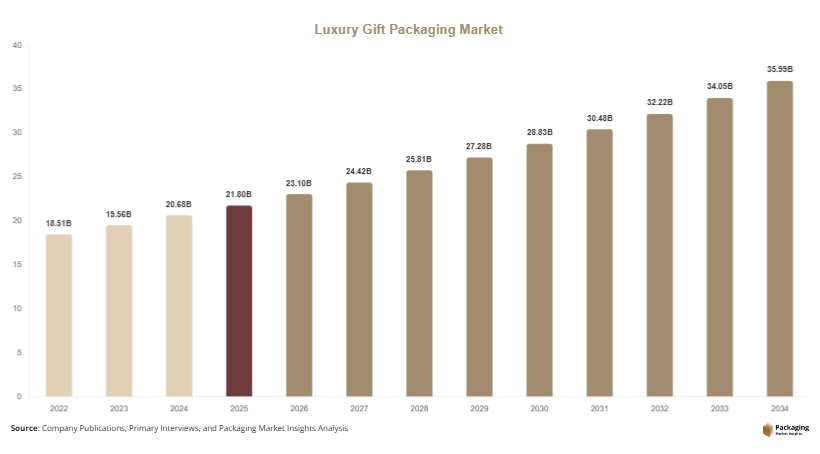
The global luxury gift packaging market size is estimated at USD 21.8 billion in 2025, while the market is projected to reach USD 23.1 billion in 2026. By 2034, the market is forecasted to attain USD 37.9 billion, expanding at a CAGR of 5.7% during 2025–2034. The global luxury gift packaging market is witnessing consistent expansion due to rising consumer spending on premium products, growing demand for personalized gifting solutions, and increasing adoption of sustainable high-end packaging materials. Luxury gift packaging includes decorative rigid boxes, premium paper bags, magnetic closure boxes, specialty wraps, ribbons, and customized packaging accessories designed to improve brand perception and customer experience. These packaging solutions are widely used across cosmetics, jewelry, fashion accessories, gourmet foods, wines, chocolates, perfumes, and premium consumer goods industries.
One of the primary growth factors driving the market is the increasing consumer preference for premium gifting experiences. Luxury brands are investing heavily in attractive and customized packaging designs to strengthen product differentiation and improve customer engagement. The expansion of online luxury retail platforms is also contributing to market growth, as premium packaging plays a critical role in delivering an enhanced unboxing experience for consumers purchasing products online. In addition, the rising popularity of festive gifting, corporate gifting, and personalized gifting solutions is supporting strong demand for decorative luxury packaging products.
Key Highlights
- Europe dominated the market with a 34.6% share in 2025.
- Asia Pacific is projected to grow at the fastest CAGR of 6.5%.
- Rigid boxes led the packaging type segment with a 38.2% share%.
- Cosmetics and fragrances applications dominated the market with a 31.7% share.
- Luxury retail brands led the end-use segment with 35.4% share.
- The US remained the dominant country with a market size of USD 4.8 billion in 2025 and USD 5.1 billion in 2026.
Explore more data points, trends and opportunities Download Free Sample Report
Market Trends
Rising Adoption of Sustainable Luxury Packaging Materials
Luxury brands are increasingly integrating sustainable materials into gift packaging designs to align with changing consumer preferences and environmental commitments. Recyclable rigid paperboard, biodegradable wraps, reusable fabric bags, and FSC-certified paper products are becoming common in premium packaging applications. Consumers are placing greater importance on environmentally responsible luxury products, encouraging companies to reduce plastic usage and improve packaging recyclability. High-end brands are also introducing reusable packaging formats that can be repurposed for storage or decorative use. This trend is encouraging packaging manufacturers to develop innovative eco-friendly materials that maintain premium aesthetics while improving sustainability performance across global luxury packaging industries.
Increasing Demand for Personalized and Premium Unboxing Experiences
Personalization and premium unboxing experiences are becoming important trends shaping the luxury gift packaging market. Brands are increasingly using customized packaging designs, embossing, foil stamping, magnetic closures, and digitally printed graphics to create distinctive consumer experiences. E-commerce luxury retailers are focusing heavily on premium packaging presentation to improve customer satisfaction and strengthen brand identity. Consumers purchasing premium cosmetics, jewelry, gourmet foods, and fashion accessories expect visually appealing packaging that reflects product quality and exclusivity. Technological advancements in digital printing and smart packaging integration are enabling manufacturers to provide customized short-run packaging solutions tailored to seasonal gifting and premium retail campaigns.
Market Drivers
Growth of the Global Luxury Goods Industry
The expansion of the global luxury goods industry is one of the major drivers supporting the luxury gift packaging market. Rising disposable incomes, increasing urbanization, and growing demand for premium consumer products are contributing to higher sales of luxury cosmetics, fashion accessories, jewelry, gourmet foods, and fragrances. Luxury brands rely heavily on visually attractive packaging to improve customer engagement and reinforce premium brand positioning. Gift packaging plays a significant role in product presentation, especially during seasonal promotions, corporate gifting campaigns, and festive sales events. As luxury retail industries continue expanding globally, demand for premium packaging solutions is expected to rise steadily.
Expansion of E-Commerce Luxury Retail Platforms
The rapid growth of online luxury retail platforms is significantly contributing to demand for premium gift packaging solutions. Consumers increasingly purchase luxury products through digital platforms and expect attractive packaging that enhances the overall shopping experience. E-commerce retailers are investing in rigid boxes, decorative inserts, magnetic closures, and customized packaging designs to improve customer satisfaction and brand loyalty. Premium packaging also helps protect delicate luxury products during transportation and reduces product damage risks. The continued growth of cross-border luxury e-commerce and premium subscription services is expected to support long-term market expansion.
Market Restraint
High Production Costs and Volatility in Premium Raw Materials
One of the major restraints affecting the luxury gift packaging market is the high production cost associated with premium materials and decorative finishing processes. Luxury packaging products often require rigid paperboard, specialty fabrics, metallic foils, textured papers, magnetic closures, and advanced printing technologies, all of which increase manufacturing expenses. Fluctuations in raw material prices and energy costs can further impact profitability for packaging manufacturers. For example, rising prices of specialty paperboard and decorative foils may increase overall production costs for premium rigid box manufacturers. In addition, luxury packaging customization requires shorter production runs and complex designs, which may reduce operational efficiency and increase lead times. Smaller luxury brands may face challenges adopting premium packaging solutions because of budget limitations and supply chain constraints, limiting market penetration in certain regions.
Market Opportunities
Expansion of Sustainable Reusable Packaging Solutions
The growing demand for reusable and sustainable packaging formats presents a significant opportunity for luxury gift packaging manufacturers. Consumers increasingly value packaging that offers long-term utility and reduces environmental waste. Reusable rigid boxes, premium fabric bags, and decorative storage packaging are gaining popularity among luxury brands seeking to improve sustainability performance and customer engagement. Packaging manufacturers are introducing innovative recyclable materials and reusable designs that combine functionality with premium aesthetics. The shift toward circular economy practices is expected to create strong growth opportunities for eco-friendly luxury packaging products across cosmetics, jewelry, and fashion industries.
Rising Demand for Corporate and Seasonal Gifting Packaging
Corporate gifting and seasonal promotional campaigns are creating substantial growth opportunities in the luxury gift packaging market. Businesses increasingly use premium packaging solutions for executive gifts, festive hampers, product launches, and promotional campaigns to strengthen brand image and customer relationships. Luxury packaging suppliers are developing customized seasonal packaging collections featuring decorative finishes, limited-edition designs, and personalized branding elements. Rising demand for premium gifting during holidays, weddings, and special occasions is also contributing to market expansion. Companies investing in flexible and high-quality customization capabilities are expected to benefit significantly from this growing demand.
Report Scope
| Report Metric | Details |
|---|---|
| Market Size in 2025 | USD 21.8 Billion |
| Market Size in 2026 | USD 23.1 Billion |
| Market Size in 2034 | USD 37.9 Billion |
| CAGR | 5.7% (2026-2034) |
| Base Year for Estimation | 2025 |
| Historical Data | 2022-2024 |
| Forecast Period | 2026-2034 |
| Report Coverage | Revenue Forecast, Competitive Landscape, Supply Chain Disruption, Growth Factors, Environment & Regulatory Landscape and Trends |
| Geographies Covered | North America, Europe, APAC, Middle East and Africa, LATAM |
| Countries Covered | U.S., Canada, U.K., Germany, France, Spain, Italy, Russia, Nordic, Benelux, Rest of Europe, China, South Korea, Japan, India, Australia, Singapore, Taiwan, South East Asia, Rest of Asia-Pacific, UAE, Turky, Saudi Arabia, South Africa, Egypt, Nigeria, Rest of MEA, Brazil, Mexico, Argentina, Chile, Colombia, Rest of LATAM |
Explore more data points, trends and opportunities Download Free Sample Report
Segmental Analysis
By Packaging Type
Rigid boxes dominated the luxury gift packaging market in 2024 and accounted for approximately 38.2% of total market share. These packaging solutions are widely used for premium cosmetics, jewelry, watches, gourmet chocolates, and fashion accessories because of their durability and premium appearance. Rigid boxes provide excellent product protection while enhancing brand presentation through decorative finishes such as embossing, foil stamping, and textured coatings. Luxury brands increasingly prefer rigid packaging formats because they improve unboxing experiences and strengthen customer perception of product value. Growing demand for premium retail presentation and luxury gifting continues to support segment growth globally.
Sustainable paper packaging is expected to be the fastest-growing subsegment, registering a CAGR of 6.9% during the forecast period. Brands are increasingly adopting recyclable paperboard, biodegradable decorative materials, and reusable packaging formats to meet sustainability goals and changing consumer expectations. Sustainable luxury packaging solutions are becoming particularly popular in cosmetics, fashion, and gourmet food industries where environmentally responsible branding is gaining importance. Manufacturers are also developing advanced paper materials with improved strength and decorative capabilities to maintain premium aesthetics while reducing environmental impact.
By Application
Cosmetics and fragrances applications held the dominant position in the market in 2024 with a share of approximately 31.7%. Luxury perfumes, skincare products, and beauty gift sets rely heavily on decorative packaging to attract consumers and improve brand identity. Premium boxes, customized inserts, ribbons, and magnetic closures are widely used across luxury cosmetics packaging applications. Seasonal gift collections and limited-edition packaging campaigns further contribute to strong demand within this segment. Rising global demand for premium beauty and skincare products is expected to continue supporting market expansion.
Premium food and confectionery packaging is projected to witness the fastest CAGR of 6.4% during the forecast period. Gourmet chocolates, premium tea collections, wine gift sets, and artisanal confectionery products increasingly use decorative luxury packaging to improve customer engagement and gifting appeal. Consumers purchasing premium food products often prioritize packaging presentation, especially during festive seasons and special occasions. Manufacturers are developing customized food-grade luxury packaging solutions featuring sustainable materials, premium textures, and personalized branding elements to meet growing market demand.
By End-Use
Luxury retail brands dominated the market in 2024 and accounted for approximately 35.4% of total market revenue. Fashion houses, jewelry brands, cosmetics companies, and premium lifestyle retailers rely heavily on luxury packaging to strengthen brand image and improve customer experiences. Decorative rigid boxes, premium shopping bags, and customized packaging accessories are widely used across luxury retail applications. The increasing focus on premium in-store presentation and branded packaging experiences continues to support segment growth globally. Retailers are also integrating sustainable materials and digital printing technologies to improve packaging personalization.
E-commerce luxury packaging is expected to record the fastest CAGR of 6.8% during the forecast period. Online luxury retailers require visually appealing and protective packaging solutions that maintain product quality during transportation while delivering premium unboxing experiences. Magnetic closure boxes, decorative tissue wraps, and branded packaging inserts are becoming increasingly common across luxury e-commerce platforms. Rising online sales of premium cosmetics, jewelry, and fashion accessories are significantly increasing demand for customized luxury packaging solutions optimized for e-commerce logistics and customer engagement.
Luxury Gift Packaging Market Segmentations
By Packaging Type
- Rigid Boxes
- Paper Bags
- Folding Cartons
- Sustainable Paper Packaging
- Decorative Accessories
By Application
- Cosmetics & Fragrances
- Jewelry & Watches
- Premium Food & Confectionery
- Fashion Accessories
- Wines & Spirits
By End-User
- Luxury Retail Brands
- E-Commerce Luxury Packaging
- Corporate Gifting
- Hospitality Industry
- Premium Consumer Goods
Regional Analysis
North America
North America accounted for approximately 27.1% of the global luxury gift packaging market share in 2025 and is projected to grow at a CAGR of 5.4% during the forecast period. The region benefits from strong luxury retail industries, high consumer spending on premium products, and growing e-commerce penetration. Luxury cosmetics, gourmet foods, and premium fashion brands are increasingly investing in customized packaging solutions to improve customer engagement and strengthen brand value.
The United States dominates the North American market due to its large luxury consumer base and established premium retail sector. A unique growth factor is the rising demand for personalized gifting and premium subscription boxes. Luxury brands are increasingly using digitally printed rigid packaging and customized decorative designs to enhance customer experiences and improve online product presentation.
Europe
Europe held nearly 34.6% of the global luxury gift packaging market share in 2025 and is expected to register a CAGR of 5.2% through 2034. The region benefits from its strong luxury fashion, cosmetics, and fragrance industries, particularly in countries such as France, Italy, and the United Kingdom. European consumers place high importance on packaging aesthetics, sustainability, and premium presentation, encouraging manufacturers to invest in innovative packaging materials and decorative technologies.
France remains the dominant country in the European market because of its globally recognized luxury fashion and cosmetics industries. A unique growth factor is the country’s emphasis on artisanal packaging craftsmanship and premium branding. French luxury brands continue investing in elegant packaging formats featuring embossed finishes, textured materials, and sustainable decorative elements to strengthen brand exclusivity.
Asia Pacific
Asia Pacific represented approximately 24.9% of the global market share in 2025 and is projected to grow at the fastest CAGR of 6.5% during the forecast period. Rising disposable incomes, rapid urbanization, and growing luxury retail industries are driving strong demand for premium gift packaging across the region. Expanding e-commerce platforms and rising consumer interest in premium cosmetics, jewelry, and fashion products are also contributing to market growth.
China dominates the Asia Pacific market because of its rapidly growing luxury consumer base and strong manufacturing capabilities. One unique growth factor is the increasing popularity of premium gifting culture during festivals and corporate events. Luxury brands in China are increasingly adopting decorative rigid boxes, customized paper bags, and sustainable premium packaging formats to attract affluent consumers.
Middle East & Africa
The Middle East & Africa region accounted for approximately 5.2% of the global luxury gift packaging market share in 2025 and is forecast to grow at a CAGR of 5.1%. Growing luxury retail infrastructure, rising tourism activity, and increasing demand for premium cosmetics and perfumes are supporting market expansion across the region. High-end shopping malls and luxury boutiques are increasingly using decorative packaging solutions to improve customer experiences and brand perception.
The United Arab Emirates dominates the regional market because of its strong luxury retail and tourism sectors. A unique growth factor is the growing demand for luxury gifting during cultural festivals and high-profile events. Premium retailers are increasingly investing in customized packaging with decorative finishes and personalized branding elements to attract affluent consumers and international tourists.
Latin America
Latin America accounted for nearly 8.2% of the global market share in 2025 and is projected to grow at a CAGR of 5.8% during the forecast period. The market is benefiting from rising consumer interest in premium cosmetics, gourmet foods, and fashion accessories. Luxury retail brands are expanding across major urban centers, creating demand for visually appealing and sustainable gift packaging solutions.
Brazil leads the Latin American market because of its expanding beauty and personal care industries. A unique growth factor is the increasing popularity of premium festive gifting and customized packaging for special occasions. Luxury brands are introducing decorative packaging collections tailored for seasonal campaigns and high-end retail promotions to strengthen customer engagement.
Competitive Landscape
The global luxury gift packaging market is moderately fragmented, with leading companies focusing on premium packaging innovation, sustainable materials, and customized decorative solutions. Market participants are investing in advanced digital printing, embossing technologies, and recyclable materials to strengthen competitiveness and address changing consumer preferences. Strategic collaborations with luxury brands and premium retailers are also supporting market expansion.
WestRock Company remains one of the leading companies in the luxury gift packaging market because of its broad portfolio of rigid packaging and decorative packaging solutions. In 2024, the company introduced sustainable premium packaging formats designed for luxury cosmetics and gourmet confectionery brands. Other major companies operating in the market include DS Smith Plc, International Paper Company, GPA Global, and HH Deluxe Packaging. These firms continue investing in recyclable luxury packaging materials, premium decorative finishes, and customized packaging technologies to support evolving industry requirements.
Key Players List
- WestRock Company
- DS Smith Plc
- International Paper Company
- GPA Global
- HH Deluxe Packaging
- PakFactory
- Burt Rigid Box Inc.
- Elegant Packaging
- Design Packaging Inc.
- Owens-Illinois Inc.
- Karl Knauer KG
- McLaren Packaging Ltd.
- Robinson Plc
- Stolzle Glass Group
- Sunrise Packaging Inc.