Laminated Tubes Market Size and Growth
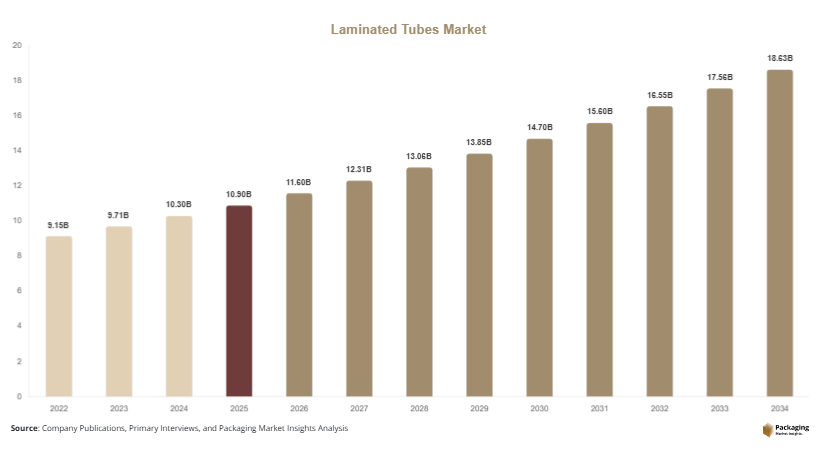
The laminated tubes market size was valued at USD 10.9 billion in 2025 and is projected to reach USD 11.6 billion in 2026. Over the forecast period from 2025 to 2034, the market is expected to grow at a CAGR of 6.1%, reaching approximately USD 19.8 billion by 2034. This growth trajectory reflects increasing consumption of packaged products and the growing importance of protective packaging solutions that maintain product integrity and shelf life. The laminated tubes market is witnessing consistent expansion driven by rising demand for flexible, durable, and visually appealing packaging across personal care, pharmaceutical, and food sectors.
A key growth factor for the laminated tubes market is the expanding personal care and cosmetics industry, where laminated tubes are widely used for packaging creams, gels, lotions, and toothpaste. These tubes offer excellent barrier properties, protecting contents from moisture, oxygen, and contamination. Another major factor is the increasing demand for convenient and portable packaging formats, as consumers prefer easy-to-use and travel-friendly products. Laminated tubes provide controlled dispensing and reduce product wastage, making them suitable for a wide range of applications.
Key Highlights
- Asia Pacific dominated the market with a 40.3% share in 2025, while Latin America is projected to grow at the fastest CAGR of 6.8%.
- Aluminum barrier laminated tubes led the type segment with a 36.7% share, while plastic barrier laminated tubes are expected to grow at a CAGR of 6.4%.
- Plastic-based laminates dominated with a 58.9% share, while paper-based laminates are forecasted to grow at a CAGR of 6.2%.
- Personal care applications led the segment with 49.6% share, while pharmaceutical applications are expected to grow at a CAGR of 6.5%.
- China remained the dominant country with a market size of USD 2.8 billion in 2025 and USD 3.1 billion in 2026.
Explore more data points, trends and opportunities Download Free Sample Report
Market Trends
Increasing focus on sustainable and recyclable laminate structures
The laminated tubes market is undergoing a transformation due to the growing emphasis on sustainability and environmental responsibility. Manufacturers are actively developing recyclable laminate structures that reduce the environmental impact of packaging waste. Innovations such as mono-material laminates and reduced plastic usage are gaining traction among brands aiming to meet sustainability targets. Consumers are also showing a preference for eco-friendly packaging, influencing purchasing decisions. Regulatory pressures in various regions are encouraging companies to adopt recyclable and biodegradable materials. This trend is expected to drive the adoption of sustainable laminated tubes across multiple industries.
Growing demand for high-barrier and multi-layer packaging solutions
Another prominent trend in the laminated tubes market is the increasing demand for high-barrier and multi-layer packaging solutions. These advanced laminates offer enhanced protection against moisture, oxygen, and light, ensuring product stability and extended shelf life. Industries such as pharmaceuticals and cosmetics are particularly benefiting from these features, as product quality is critical. Multi-layer laminated tubes also support complex formulations and sensitive ingredients. The ability to combine different materials into a single structure provides flexibility in design and performance, making them suitable for diverse applications. This trend is expected to continue as product formulations become more sophisticated.
Market Drivers
Expansion of personal care and cosmetics industry
The growth of the personal care and cosmetics industry is a significant driver of the laminated tubes market. Increasing consumer awareness regarding skincare and grooming is leading to higher demand for cosmetic products. Laminated tubes are widely used for packaging these products due to their convenience, hygiene, and aesthetic appeal. The rise of premium and niche brands is also driving demand for high-quality packaging solutions. As the beauty industry continues to expand globally, the need for laminated tubes is expected to increase steadily.
Rising demand for convenient and hygienic packaging formats
Convenience and hygiene are key factors influencing consumer preferences in packaging. Laminated tubes offer easy dispensing, portability, and protection from contamination, making them suitable for various applications. The increasing demand for travel-sized and single-use products is further supporting market growth. In addition, laminated tubes minimize product exposure to external elements, ensuring safety and quality. As consumers continue to prioritize convenience and hygiene, the demand for laminated tubes is expected to grow.
Market Restraint
Challenges associated with recycling multi-layer laminated materials
One of the main challenges in the laminated tubes market is the difficulty in recycling multi-layer laminated materials. These tubes are composed of multiple layers of different materials, which can be difficult to separate during the recycling process. This complexity can lead to increased waste and environmental concerns. For example, traditional laminated tubes used in toothpaste packaging often contain layers of plastic and aluminum, making recycling challenging. As sustainability regulations become stricter, manufacturers are under pressure to develop recyclable alternatives. However, transitioning to new materials can involve additional costs and technical challenges, which may restrain market growth.
Market Opportunities
Development of mono-material and recyclable laminated tubes
The development of mono-material laminated tubes presents a significant opportunity for the laminated tubes market. These tubes are designed using a single type of material, making them easier to recycle compared to traditional multi-layer structures. Manufacturers are investing in research and development to create solutions that maintain performance while improving recyclability. This innovation aligns with global sustainability goals and regulatory requirements. As demand for eco-friendly packaging increases, mono-material laminated tubes are expected to gain widespread adoption.
Growth in pharmaceutical and healthcare packaging applications
The pharmaceutical and healthcare sectors are emerging as key growth areas for the laminated tubes market. Laminated tubes are widely used for packaging ointments, creams, and topical medications due to their protective properties. The increasing demand for healthcare products, driven by aging populations and rising health awareness, is supporting market growth. Additionally, the need for safe and hygienic packaging solutions is driving the adoption of laminated tubes in this sector. This trend is expected to create new opportunities for market expansion.
Report Scope
| Report Metric | Details |
|---|---|
| Market Size in 2025 | USD 10.9 Billion |
| Market Size in 2026 | USD 11.6 Billion |
| Market Size in 2034 | USD 19.8 Billion |
| CAGR | 6.1% (2026-2034) |
| Base Year for Estimation | 2025 |
| Historical Data | 2022-2024 |
| Forecast Period | 2026-2034 |
| Report Coverage | Revenue Forecast, Competitive Landscape, Supply Chain Disruption, Growth Factors, Environment & Regulatory Landscape and Trends |
| Geographies Covered | North America, Europe, APAC, Middle East and Africa, LATAM |
| Countries Covered | U.S., Canada, U.K., Germany, France, Spain, Italy, Russia, Nordic, Benelux, Rest of Europe, China, South Korea, Japan, India, Australia, Singapore, Taiwan, South East Asia, Rest of Asia-Pacific, UAE, Turky, Saudi Arabia, South Africa, Egypt, Nigeria, Rest of MEA, Brazil, Mexico, Argentina, Chile, Colombia, Rest of LATAM |
Explore more data points, trends and opportunities Download Free Sample Report
Segmental Analysis
By Type
Aluminum barrier laminated tubes dominated the market in 2024, accounting for approximately 36.7% of the total share. These tubes offer excellent barrier properties, protecting products from moisture, light, and oxygen. They are widely used in pharmaceutical and cosmetic applications where product stability is critical. The demand for aluminum barrier laminated tubes is supported by their durability and performance.
Plastic barrier laminated tubes are expected to grow at the fastest CAGR of 6.4% during the forecast period. These tubes offer flexibility, lightweight properties, and cost efficiency. The increasing demand for convenient packaging solutions is driving the growth of this segment.
By Material
Plastic-based laminates accounted for the largest share of 58.9% in 2024, driven by their versatility and cost-effectiveness. These materials are widely used in the production of laminated tubes due to their durability and ease of manufacturing. The demand for plastic-based laminates is supported by their ability to provide effective barrier properties.
Paper-based laminates are expected to grow at a CAGR of 6.2% during the forecast period. This growth is driven by increasing demand for sustainable packaging solutions. Manufacturers are investing in eco-friendly materials to meet consumer preferences and regulatory requirements.
By Application
Personal care applications held the largest share of 49.6% in 2024, driven by the increasing demand for skincare and grooming products. Laminated tubes are widely used for packaging creams, lotions, and gels. The growth of the personal care industry is supporting the demand for laminated tubes.
Pharmaceutical applications are expected to grow at the fastest CAGR of 6.5% during the forecast period. This growth is driven by the increasing demand for healthcare products. Laminated tubes offer protection and hygiene, making them suitable for pharmaceutical applications.
Laminated Tubes Market Segmentations
By Product Type
- Aluminum Barrier Laminated Tubes
- Plastic Barrier Laminated Tubes
By Application
- Personal Care
- Pharmaceutical
- Food Products
- Industrial Products
By Material
- Plastic-Based Laminates
- Paper-Based Laminates
- Aluminum-Based Laminates
Regional Analysis
North America
North America accounted for 23.9% of the laminated tubes market share in 2025 and is projected to grow at a CAGR of 5.7% during the forecast period. The region benefits from a well-established personal care and pharmaceutical industry. Increasing demand for sustainable packaging solutions is encouraging manufacturers to adopt recyclable laminated tubes. The presence of major cosmetic brands is also supporting market growth.
The United States is the dominant country in North America, supported by its strong consumer base and advanced manufacturing capabilities. A key growth factor is the increasing demand for premium personal care products, which require high-quality packaging solutions. This trend is driving the adoption of laminated tubes in the region.
Europe
Europe held a market share of 22.1% in 2025 and is expected to grow at a CAGR of 5.5% through 2034. The region is characterized by strict environmental regulations and a strong focus on sustainability. Companies are adopting recyclable materials to comply with regulatory requirements. The demand for laminated tubes is also supported by the growth of the cosmetics industry.
Germany leads the European market due to its advanced manufacturing base. A unique growth factor is the increasing adoption of eco-friendly packaging solutions, which is driving demand for laminated tubes.
Asia Pacific
Asia Pacific dominated the laminated tubes market with a 40.3% share in 2025 and is projected to grow at a CAGR of 6.5%. The region benefits from rapid urbanization and increasing disposable incomes. The demand for personal care and healthcare products is driving the adoption of laminated tubes.
China is the leading country in the region, supported by its large manufacturing capacity. A key growth factor is the increasing demand for affordable and innovative packaging solutions, which is driving market growth.
Middle East & Africa
The Middle East & Africa accounted for 6.8% of the market share in 2025 and is expected to grow at a CAGR of 6.0%. The region is witnessing growth in the personal care and healthcare sectors. Increasing urbanization and changing lifestyles are supporting market demand.
The United Arab Emirates is a key market in the region, driven by its focus on premium products. A unique growth factor is the increasing demand for high-quality packaging solutions in the cosmetics sector.
Latin America
Latin America held a market share of 6.9% in 2025 and is projected to grow at the fastest CAGR of 6.8%. The region is experiencing growth in the cosmetics and healthcare industries. Increasing consumer awareness and demand for personal care products are driving market growth.
Brazil is the dominant country in Latin America, supported by its large consumer base. A key growth factor is the increasing demand for affordable packaging solutions, which is driving the adoption of laminated tubes.
Competitive Landscape
The laminated tubes market is characterized by the presence of several global and regional players focusing on innovation and sustainability. Companies are investing in research and development to improve packaging materials and designs. Essel Propack Limited is considered a leading player due to its strong product portfolio and global presence. The company has recently introduced recyclable laminated tube solutions to address sustainability concerns.
Other key players are focusing on strategic partnerships, product innovation, and capacity expansion to strengthen their market position. Companies are also adopting advanced manufacturing technologies to improve efficiency and reduce costs. The competitive landscape is expected to remain dynamic, with sustainability and innovation driving competition.
Key Players List
- Essel Propack Limited
- Amcor plc
- Albea Group
- Huhtamaki Oyj
- Berry Global Inc.
- Montebello Packaging
- CCL Industries Inc.
- Linhardt GmbH & Co. KG
- Tubex GmbH
- Hoffmann Neopac AG
- Sonoco Products Company
- Alltub Group
- IntraPac International Corporation
- Unette Corporation
- World Wide Packaging LLC