Laminated Can Packaging Market Size and Growth
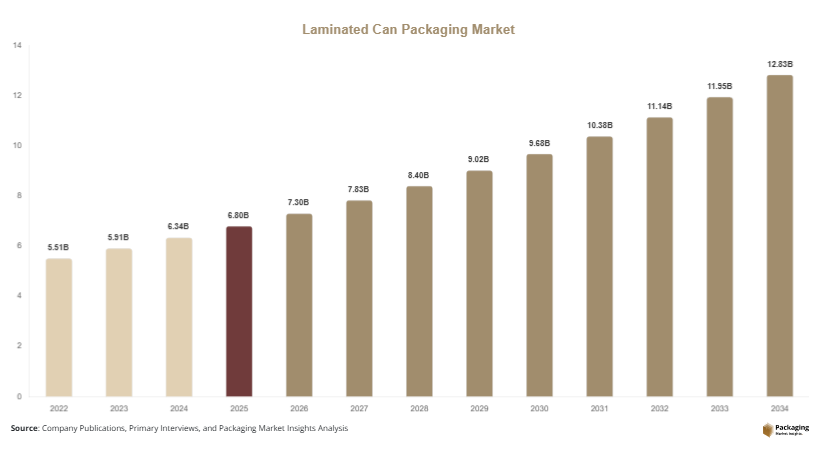
The laminated can packaging market size was valued at approximately USD 6.8 billion in 2025 and is projected to reach USD 7.3 billion in 2026, further expanding to around USD 12.9 billion by 2034, growing at a CAGR of 7.3% during 2025–2034. The laminated can packaging market is gaining traction as industries seek durable, lightweight, and visually appealing packaging solutions for a wide range of products. Laminated cans are typically constructed using multiple layers of materials such as paperboard, aluminum foil, and plastic films, providing enhanced barrier protection against moisture, oxygen, and contaminants.
A key growth factor in the laminated can packaging market is the increasing demand for convenient and shelf-stable packaging in the food and beverage sector. Products such as powdered drinks, snacks, dairy products, and ready-to-eat meals require packaging that ensures extended shelf life while maintaining product quality. Laminated cans provide superior barrier properties, making them suitable for such applications. The rise in urbanization and changing consumer lifestyles is further driving demand for packaged food products, supporting market growth.
Key Highlights:
- Asia Pacific dominated the market with a 39.2% share in 2025, while Latin America is projected to grow at the fastest CAGR of 7.6%.
- Composite laminated cans led the type segment with a 34.5% share, while eco-friendly laminated cans are expected to grow at a CAGR of 8.1%.
- Paper-based laminated packaging dominated with a 51.8% share, while biodegradable materials are forecasted to grow at a CAGR of 7.4%.
- Food & beverage applications led the segment with 46.7% share, while pharmaceutical packaging is expected to grow at a CAGR of 7.8%.
- China remained the dominant country with a market size of USD 1.5 billion in 2025 and USD 1.6 billion in 2026.
Explore more data points, trends and opportunities Download Free Sample Report
Market Trends
Rising Adoption of Sustainable Laminated Can Solutions
Sustainability is becoming a defining trend in the laminated can packaging market as companies respond to increasing environmental concerns and regulatory pressures. Manufacturers are focusing on reducing the environmental footprint of laminated cans by incorporating recyclable and biodegradable materials. Innovations in material science are enabling the development of laminated structures that maintain high barrier properties while being environmentally friendly. This shift is also supported by consumer preferences for sustainable products, which is influencing purchasing decisions. As brands seek to enhance their sustainability credentials, the adoption of eco-friendly laminated cans is expected to increase, driving market growth.
Increasing Demand for Premium and Customized Packaging
The demand for premium and customized packaging is growing in the laminated can packaging market, driven by the need for product differentiation. Laminated cans offer excellent design flexibility, allowing manufacturers to create unique packaging solutions that enhance brand identity. Advanced printing technologies enable high-quality graphics and intricate designs, making products more appealing to consumers. This trend is particularly evident in the food and beverage industry, where packaging plays a key role in influencing consumer perception. As competition intensifies, companies are investing in innovative packaging solutions to stand out in the market, contributing to overall growth.
Market Drivers
Growth in Packaged Food and Beverage Industry
The expansion of the packaged food and beverage industry is a major driver of the laminated can packaging market. Changing consumer lifestyles, urbanization, and increasing disposable incomes are driving demand for convenient and ready-to-eat food products. Laminated cans provide the necessary protection to maintain product freshness and quality over extended periods. The ability to preserve flavor and nutritional value makes them an attractive option for manufacturers. As the demand for packaged food continues to rise globally, the need for reliable packaging solutions is expected to drive market growth.
Advancements in Packaging Technology
Technological advancements in packaging are playing a significant role in the growth of the laminated can packaging market. Innovations in material composition and manufacturing processes are improving the performance and cost-effectiveness of laminated cans. Enhanced barrier properties, lightweight designs, and improved durability are making these packaging solutions more appealing to manufacturers. Additionally, automation in production processes is increasing efficiency and reducing costs. These advancements are enabling companies to meet evolving consumer demands and regulatory requirements, supporting market expansion.
Market Restraint
Complexity of Recycling Laminated Materials
One of the key restraints in the laminated can packaging market is the complexity associated with recycling laminated materials. Laminated cans are composed of multiple layers of different materials, which can be difficult to separate during the recycling process. This can limit their recyclability and pose environmental challenges. For example, the presence of plastic and aluminum layers in laminated cans can complicate recycling efforts, leading to increased waste. This issue is becoming more significant as governments and consumers place greater emphasis on sustainability. Companies are investing in research to develop recyclable laminated structures, but the complexity and cost of these solutions can hinder widespread adoption.
Market Opportunities
Expansion in Emerging Markets
Emerging markets offer significant growth opportunities for the laminated can packaging market. Rapid urbanization and industrialization in regions such as Asia Pacific, Latin America, and the Middle East are driving demand for packaged goods. As consumer purchasing power increases, there is a growing preference for convenient and high-quality packaging solutions. Laminated cans are well-suited to meet these requirements due to their durability and aesthetic appeal. Companies are expanding their presence in these regions to capitalize on growing demand, contributing to market growth.
Development of Innovative and Smart Packaging Solutions
The development of innovative and smart packaging solutions presents new opportunities in the laminated can packaging market. Technologies such as QR codes, NFC tags, and interactive packaging are being integrated into laminated cans to enhance consumer engagement and provide additional product information. These innovations are helping companies differentiate their products and improve customer experience. As digitalization continues to influence the packaging industry, the adoption of smart packaging solutions is expected to increase, creating new growth avenues for the market.
Report Scope
| Report Metric | Details |
|---|---|
| Market Size in 2025 | USD 6.8 Billion |
| Market Size in 2026 | USD 7.3 Billion |
| Market Size in 2034 | USD 12.9 Billion |
| CAGR | 7.3% (2026-2034) |
| Base Year for Estimation | 2025 |
| Historical Data | 2022-2024 |
| Forecast Period | 2026-2034 |
| Report Coverage | Revenue Forecast, Competitive Landscape, Supply Chain Disruption, Growth Factors, Environment & Regulatory Landscape and Trends |
| Geographies Covered | North America, Europe, APAC, Middle East and Africa, LATAM |
| Countries Covered | U.S., Canada, U.K., Germany, France, Spain, Italy, Russia, Nordic, Benelux, Rest of Europe, China, South Korea, Japan, India, Australia, Singapore, Taiwan, South East Asia, Rest of Asia-Pacific, UAE, Turky, Saudi Arabia, South Africa, Egypt, Nigeria, Rest of MEA, Brazil, Mexico, Argentina, Chile, Colombia, Rest of LATAM |
Explore more data points, trends and opportunities Download Free Sample Report
Segmental Analysis
By Type
Composite laminated cans dominated the laminated can packaging market in 2024, accounting for approximately 34.5% of the total market share. These cans are widely used due to their ability to provide excellent barrier protection and structural strength. They are suitable for a wide range of applications, including food, beverages, and pharmaceuticals. The increasing demand for durable and high-performance packaging solutions is driving the growth of this segment. Additionally, advancements in material technology are enhancing the properties of composite laminated cans, making them more efficient and cost-effective.
Eco-friendly laminated cans are expected to grow at the fastest CAGR of 8.1% during the forecast period. These cans are designed using sustainable materials that reduce environmental impact. The growing emphasis on sustainability is driving the adoption of eco-friendly packaging solutions. As regulatory requirements become more stringent, the demand for environmentally friendly laminated cans is expected to increase, supporting market growth.
By Material
Paper-based laminated packaging dominated the market in 2024 with a share of approximately 51.8%. Paper-based materials are widely used due to their recyclability and cost-effectiveness. They provide adequate protection for a variety of products while supporting sustainability initiatives. The increasing demand for eco-friendly packaging solutions is driving the growth of this segment. Additionally, advancements in coating technologies are improving the performance of paper-based laminated packaging.
Biodegradable materials are expected to grow at the fastest CAGR of 7.4% during the forecast period. These materials offer an environmentally friendly alternative to traditional packaging solutions. The growing awareness of environmental issues is driving the adoption of biodegradable packaging. As companies seek to reduce their environmental footprint, the demand for biodegradable laminated cans is expected to increase.
By End-Use
The food and beverage segment dominated the laminated can packaging market in 2024, accounting for approximately 46.7% of the total market share. The increasing demand for packaged food and beverages is driving the growth of this segment. Laminated cans provide the necessary protection to maintain product quality and extend shelf life. The growth of the food and beverage industry is expected to continue supporting this segment.
Pharmaceutical packaging is projected to grow at the fastest CAGR of 7.8% during the forecast period. The increasing demand for safe and reliable packaging solutions in the pharmaceutical industry is driving this growth. Laminated cans offer protection against moisture and contamination, making them suitable for pharmaceutical applications. As the healthcare industry continues to expand, the demand for laminated can packaging is expected to increase.
Laminated Can Packaging Market Segmentations
By Type
- Composite Laminated Cans
- Paper Laminated Cans
- Metal Laminated Cans
By Material
- Paper-Based
- Plastic-Based
- Biodegradable Materials
By End-Use
- Food & Beverage
- Pharmaceutical
- Personal Care
- Industrial
Regional Analysis
North America
North America accounted for approximately 28.7% of the laminated can packaging market share in 2025 and is projected to grow at a CAGR of 6.8% during the forecast period. The region benefits from a well-developed food and beverage industry and strong demand for innovative packaging solutions. The presence of established manufacturers and advanced infrastructure supports market growth.
The United States dominates the regional market due to its large consumer base and high demand for packaged goods. A unique growth factor is the increasing adoption of sustainable packaging solutions, which is driving innovation in laminated can design. This trend is expected to support market growth in the region.
Europe
Europe held a market share of around 25.3% in 2025 and is expected to grow at a CAGR of 6.7%. The region is characterized by strict environmental regulations and a strong focus on sustainability in packaging.
Germany leads the European market due to its advanced manufacturing capabilities and strong industrial base. A unique growth factor is the increasing demand for eco-friendly packaging solutions, which is driving the adoption of laminated cans. This is expected to boost market growth.
Asia Pacific
Asia Pacific dominated the market with a 39.2% share in 2025 and is projected to grow at the highest CAGR of 7.6%. The region is experiencing rapid urbanization and growth in the food and beverage industry.
China is the leading country in the region due to its large-scale manufacturing capabilities. A unique growth factor is the expansion of e-commerce, which is driving demand for durable and attractive packaging solutions. This trend is expected to continue during the forecast period.
Middle East & Africa
The Middle East & Africa region accounted for approximately 3.8% of the market share in 2025 and is projected to grow at a CAGR of 6.5%. The growth is supported by increasing investments in food processing and packaging industries.
Saudi Arabia is a key contributor to the regional market. A unique growth factor is the development of modern retail infrastructure, which is driving demand for packaged products. This is expected to support market growth.
Latin America
Latin America held a market share of around 3.0% in 2025 and is expected to grow at the fastest CAGR of 7.6%. The region is witnessing growth in the food and beverage sector and increasing consumer demand for packaged goods.
Brazil dominates the regional market due to its expanding food processing industry. A unique growth factor is the rising demand for convenient packaging solutions, which is driving the adoption of laminated cans. This is expected to support market growth.
Competitive Landscape
The laminated can packaging market is moderately competitive, with several global and regional players focusing on innovation and product development. Companies are investing in advanced technologies to enhance the performance and sustainability of laminated cans. Strategic partnerships and acquisitions are common as players seek to expand their market presence.
Sonoco Products Company is considered a leading player in the market due to its extensive product portfolio and strong global presence. The company recently introduced sustainable laminated can solutions, highlighting its commitment to environmental responsibility. Other players are also focusing on similar initiatives to remain competitive and meet evolving market demands.
Key Players List
- Sonoco Products Company
- Amcor plc
- Smurfit Kappa Group
- Mondi Group
- DS Smith Plc
- Ball Corporation
- Crown Holdings Inc.
- Greif Inc.
- WestRock Company
- Sealed Air Corporation
- Huhtamaki Oyj
- Can-Pack S.A.
- Ardagh Group
- Graphic Packaging International
- Uflex Ltd.