Labels, Tapes & Films Market Size and Growth
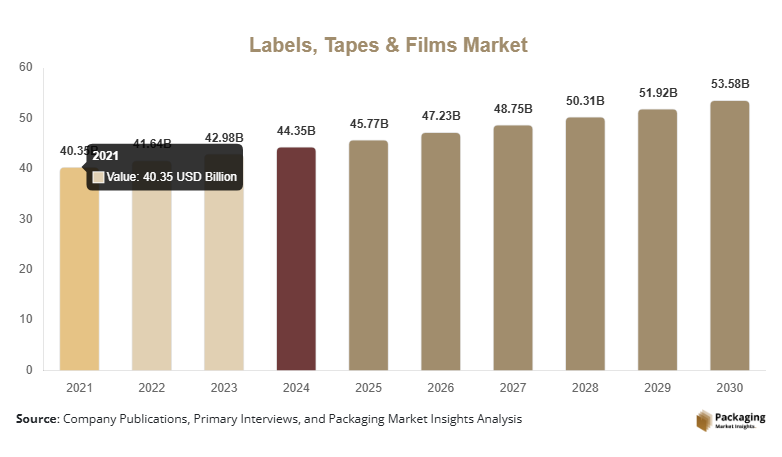
The global labels, tapes & films market size was valued at approximately USD 44.35 billion in 2024 and is projected to grow from around USD 45.77 billion in 2025 to reach nearly USD 221.0 billion by 2030, expanding at a CAGR of about 6.1% during the forecast period (2025–2030). The global market growth is primarily driven by rising demand for flexible and protective packaging, expansion of food & beverage and pharmaceutical industries, increasing e-commerce logistics activity, and rapid adoption of sustainable and high-performance packaging materials across global supply chains.
Key Market Insights
- Pressure-sensitive labels dominate the market, supported by ease of application, automation compatibility, and widespread adoption in food, beverage, pharmaceutical, and consumer goods packaging.
- Polypropylene- and polyethylene-based films and tapes account for the largest material share, owing to cost efficiency, durability, and recyclability advantages.
- Food & beverage remains the largest end-use industry, driven by packaged food consumption, branding requirements, and regulatory labeling mandates.
- Asia-Pacific leads global demand, supported by large-scale manufacturing, export-oriented packaging industries, and rapid urbanization in China and India.
- Sustainability-driven innovation is reshaping product portfolios, with increasing focus on mono-material films, linerless labels, and bio-based adhesives.
- Technological advancements, including digital printing, smart labels, RFID integration, and high-barrier multilayer films, are improving traceability, shelf-life, and operational efficiency.
Explore more data points, trends and opportunities Download Free Sample Report
Latest Market Trends
Sustainable and Recyclable Packaging Solutions Gaining Momentum
Manufacturers across the labels, tapes & films market are accelerating the shift toward sustainable packaging formats. Brand owners are increasingly demanding recyclable, compostable, and downgauged materials to comply with tightening environmental regulations and corporate ESG commitments. Mono-material films, paper-based labels, and linerless labeling solutions are gaining traction as they reduce waste generation and improve recyclability. Adhesive manufacturers are also investing in water-based and bio-derived formulations to minimize environmental impact while maintaining performance standards.
Market Drivers
Expansion of Food & Beverage Packaging
The global food and beverage industry accounts for nearly 35% of total labels, tapes, and films consumption in 2025. Growth in ready-to-eat meals, frozen foods, and beverage branding is driving demand for pressure-sensitive labels and high-barrier films.
E-commerce & Logistics Growth
The surge in global e-commerce shipments has significantly increased demand for carton sealing tapes, stretch films, and protective labeling. Automated warehouses and last-mile delivery networks favor lightweight, high-strength films compatible with robotic packaging lines.
Market Restraint
Volatility in Raw Material Prices
Fluctuating prices of petrochemical feedstocks such as polypropylene and polyethylene directly impact profit margins, particularly for mid-sized converters with limited hedging capabilities.
Market Opportunities
Sustainable & Circular Packaging Materials
One of the most significant growth opportunities lies in the transition toward recyclable, compostable, and mono-material solutions. Regulatory pressure in Europe, North America, and parts of Asia is compelling brand owners to replace PVC and multilayer laminates with recyclable PP, PE, and paper-based alternatives. Manufacturers offering downgauged films, linerless labels, and bio-based adhesives can unlock premium pricing while aligning with ESG mandates.
Smart Labels & Functional Films
Integration of QR codes, RFID, NFC, and tamper-evident technologies into labels and films presents a strong opportunity, particularly in pharmaceuticals, food traceability, and logistics. Smart labels enable supply chain transparency, anti-counterfeiting, and consumer engagement. Similarly, functional films offering oxygen, moisture, and UV barriers are seeing rising adoption in extended shelf-life applications.
Report Scope
| Report Metric | Details |
|---|---|
| Market Size in 2024 | USD 44.35 Billion |
| Market Size in 2025 | USD 45.77 Billion |
| Market Size in 2030 | USD 53.58 Billion |
| CAGR | 3.2% (2025-2030) |
| Base Year for Estimation | 2024 |
| Historical Data | 2021-2023 |
| Forecast Period | 2025-2030 |
| Report Coverage | Revenue Forecast, Competitive Landscape, Supply Chain Disruption, Growth Factors, Environment & Regulatory Landscape and Trends |
| Geographies Covered | North America, Europe, APAC, Middle East and Africa, LATAM |
| Countries Covered | U.S., Canada, U.K., Germany, France, Spain, Italy, Russia, Nordic, Benelux, Rest of Europe, China, South Korea, Japan, India, Australia, Singapore, Taiwan, South East Asia, Rest of Asia-Pacific, UAE, Turky, Saudi Arabia, South Africa, Egypt, Nigeria, Rest of MEA, Brazil, Mexico, Argentina, Chile, Colombia, Rest of LATAM |
Explore more data points, trends and opportunities Download Free Sample Report
Segmental Analysis
By Material Type
The plastic labels subsegment accounted for the largest share of the labels market in 2024, representing an estimated 42% of total demand. This dominance is primarily driven by the widespread use of plastic labels in food & beverage, personal care, and consumer products due to their durability, moisture resistance, and compatibility with high-speed automated labeling lines. Materials such as polypropylene (PP) and polyethylene (PE) are particularly favored for their cost efficiency and recyclability, making plastic labels the preferred choice for mass-market applications.
The synthetic labels subsegment is expected to witness the fastest growth during the forecast period, registering a projected CAGR of around 7.5% from 2025 to 2030. Growth is driven by increasing demand from pharmaceuticals, electronics, and industrial applications, where resistance to chemicals, abrasion, and extreme temperatures is critical. Synthetic labels, including polyester-based variants, offer superior performance in harsh environments, positioning them for accelerated adoption globally.
By Adhesive Type
The permanent adhesives subsegment held a dominant share of approximately 48% in 2024, supported by their extensive use in product identification, regulatory labeling, and long-term branding applications. Permanent adhesives are widely used in food packaging, pharmaceuticals, and industrial labeling, where label durability and tamper resistance are essential. Their strong bonding characteristics and reliability across varied surfaces have solidified their leading position.
The freezer adhesives subsegment is projected to grow at the fastest CAGR of nearly 8.0% between 2025 and 2030. This growth is fueled by the rapid expansion of frozen food, cold-chain logistics, and biopharmaceutical storage. Freezer adhesives are engineered to maintain adhesion at low and sub-zero temperatures, making them indispensable for refrigerated and frozen products, particularly in export-driven food and healthcare supply chains.
By Application
The food and beverage subsegment represented the largest application area, accounting for approximately 35% of the market share in 2024. This leadership is attributed to high consumption of packaged foods, beverages, and ready-to-eat products, all of which require extensive labeling for branding, nutritional information, and regulatory compliance. Increasing demand for premium packaging and shelf-life enhancement further supports growth in this segment.
The healthcare subsegment is anticipated to be the fastest-growing application, with a projected CAGR of about 7.8% from 2025 to 2030. Growth is driven by stringent pharmaceutical labeling regulations, rising drug production volumes, and increasing emphasis on traceability, serialization, and anti-counterfeiting measures. Labels used in healthcare must meet high standards of accuracy and durability, accelerating demand for advanced labeling solutions.
By Printing Technology
The flexographic printing subsegment dominated the market in 2024, accounting for nearly 40% of total printing technology adoption. Flexographic printing is widely used due to its cost-effectiveness for high-volume production, fast turnaround times, and compatibility with a wide range of substrates, including paper, films, and foils. Its extensive use in food, beverage, and consumer goods packaging has reinforced its market leadership.
The digital printing subsegment is expected to register the fastest growth, with a CAGR of approximately 9.0% during the forecast period. This rapid expansion is driven by rising demand for short-run customization, variable data printing, and faster time-to-market. Digital printing is increasingly preferred for premium labels, promotional packaging, and smart labeling applications, as it enables high-quality printing with minimal setup costs and reduced material waste.
Labels, Tapes & Films Market Segmentations
By Material Type
- Paper Labels
- Plastic Labels
- Synthetic Labels
- Foil Labels
Adhesive Type
- Permanent Adhesives
- Removable Adhesives
- Freezer Adhesives
- Heat Resistant Adhesives
Application
- Food and Beverage
- Healthcare
- Consumer Products
- Electronics
- Industrial
Printing Technology
- Flexographic Printing
- Digital Printing
- Lithographic Printing
- Gravure Printing
- Screen Printing
Regional Analysis
North America
North America remains one of the largest regional markets for labels, tapes & films, driven by strong demand from food & beverage, pharmaceuticals, and e-commerce packaging sectors. The United States accounts for the majority of regional consumption due to its large FMCG base, advanced logistics infrastructure, and high regulatory requirements for product labeling and traceability. Adoption of smart labels and high-performance industrial tapes is particularly strong, supported by automation in manufacturing and warehousing. Sustainability initiatives and investments in recyclable packaging solutions continue to shape purchasing decisions across the region.
Europe
Europe represents a mature yet innovation-driven market, led by Germany, France, the U.K., and Italy. European demand is strongly influenced by stringent packaging waste directives and circular economy policies, which are accelerating the adoption of recyclable films, paper-based labels, and low-impact adhesives. The region is also a leader in premium labeling solutions, including high-quality printed labels and specialty films for pharmaceuticals, cosmetics, and luxury consumer goods. Growth is further supported by export-oriented manufacturing and advanced printing technologies.
Asia-Pacific
Asia-Pacific is the largest and fastest-growing market for labels, tapes & films, accounting for nearly 38% of global demand. China leads regional consumption due to its massive manufacturing base and role as a global packaging exporter, while India is the fastest-growing country, driven by expanding food processing, pharmaceuticals, and e-commerce sectors. Japan and South Korea contribute steady demand for high-performance and specialty films used in electronics and automotive applications. Rising disposable incomes, urbanization, and government-led manufacturing initiatives are further accelerating regional growth.
Latin America
Latin America is witnessing steady growth, led by Brazil and Mexico. Expanding FMCG production, rising packaged food consumption, and improving retail infrastructure are supporting demand for labels and flexible packaging films. Industrial tapes are also gaining adoption in automotive assembly and construction applications. While sustainability adoption is at an early stage compared to Europe, regional players are gradually investing in recyclable materials to meet export standards.
Middle East & Africa
The Middle East & Africa market is supported by growing food imports, retail expansion, and pharmaceutical packaging demand. Gulf countries such as the UAE and Saudi Arabia are driving consumption of premium labels and films, supported by strong logistics networks and re-export activities. In Africa, South Africa leads demand, while other countries are gradually increasing usage as packaged goods penetration rises.
Competitive Landscape
The labels, tapes & films market is moderately fragmented, with the top five companies collectively accounting for approximately 38% of global market share. Large multinational players dominate high-volume and high-performance segments through scale, technology leadership, and long-term contracts with major brand owners. Mid-sized and regional manufacturers compete by offering customized solutions, cost advantages, and localized supply capabilities, particularly in emerging markets.
Key Players in the Labels, Tapes & Films Market
- Avery Dennison
- 3M Company
- CCL Industries
- Amcor Plc
- UPM Raflatac
- Berry Global
- Tesa SE
- LINTEC Corporation
- Sealed Air
- Intertape Polymer Group
- Fuji Seal International
- Huhtamaki
- Sika AG
- Nitto Denko Corporation
- Scapa Group