Label Converting Equipment Market Size and Growth
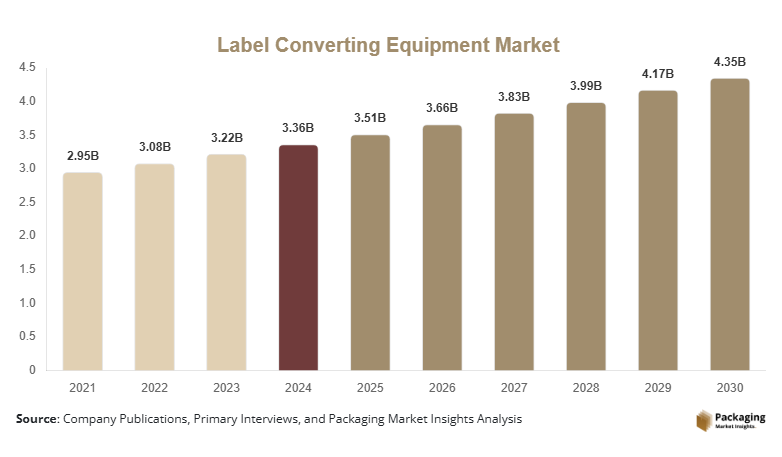
The label converting equipment market was valued at USD 3.36 billion in 2024 and is projected to reach USD 4.35 billion by 2030, expanding at a compound annual growth rate (CAGR) of 4.4% from 2025 to 2030. Label converting equipment includes machines used for cutting, printing, laminating, embossing, coating, and finishing label stock into ready-to-apply labels across diverse end-use industries.
A major global factor supporting market growth in 2024 was the continued expansion of consumer packaged goods (CPG) production, particularly in food, beverages, pharmaceuticals, and personal care. Brand owners increasingly prioritized high-quality labeling for regulatory compliance, shelf differentiation, and traceability, driving sustained demand for advanced converting lines. Additionally, rising SKU proliferation and shorter product life cycles accelerated the need for flexible, high-speed label converting equipment capable of handling multiple substrates and variable designs.
Key Highlights
- North America accounted for approximately 34.8% of global market share in 2024, while Asia Pacific is expected to record the fastest growth at a CAGR of 9.4% through 2030.
- Rotary die-cutting equipment led the type segment with a 29.6% share, while laser finishing systems are projected to grow at a CAGR of 11.2%.
- The United States dominated country-level demand with a market value of USD 1.42 billion in 2024, rising to USD 1.52 billion in 2025.
Explore more data points, trends and opportunities Download Free Sample Report
Latest Market Trends
Automation and Smart Converting Lines
Automation emerged as a defining trend in the label converting equipment market. Manufacturers increasingly adopted servo-controlled systems, inline quality inspection, and digital workflow integration to improve productivity and reduce manual intervention. Automated tension control, register accuracy, and waste monitoring allowed converters to meet tight delivery schedules while maintaining consistent quality across large and short production runs.
Compatibility with Sustainable Label Materials
The growing use of recyclable, linerless, and bio-based label materials significantly influenced equipment design. Equipment suppliers focused on enhancing compatibility with thinner facestocks, compostable adhesives, and specialty coatings. Converters sought machines capable of handling delicate materials without compromising speed or accuracy, making sustainability-ready equipment a key purchasing criterion.
Market Drivers
Rising Demand for Packaged Consumer Goods
The steady rise in packaged food, beverage, and household product consumption directly increased demand for high-volume label production. Label converting equipment played a critical role in ensuring visual consistency, branding compliance, and traceability across packaging formats. Increased private-label penetration also supported equipment investments by regional converters.
Growth of Pharmaceutical and Healthcare Labeling
Pharmaceutical manufacturing expansion drove demand for precision label converting equipment capable of producing regulatory-compliant labels with variable data, tamper evidence, and security features. Growth in clinical trials, OTC medicines, and medical devices reinforced equipment demand across developed and emerging markets.
Market Restraints
High Capital Investment and Maintenance Costs
High upfront capital expenditure remains a key restraint in the label converting equipment market. Advanced converting lines with automation, inspection, and digital integration require substantial investment, limiting adoption among small and mid-scale converters. Additionally, ongoing maintenance, skilled labor requirements, and spare part costs can impact total cost of ownership, particularly in price-sensitive regions.
Market Opportunities
Expansion in Emerging Packaging Markets
Rapid industrialization and consumer goods expansion in emerging economies present strong growth opportunities. Rising domestic brand manufacturing and export-oriented packaging facilities are expected to increase investments in modern label converting equipment.
Growth of Digital and Hybrid Converting Systems
The integration of digital printing with traditional converting processes offers new revenue opportunities. Hybrid systems enable short runs, personalization, and rapid design changes, making them attractive to converters serving niche and premium brands.
Report Scope
| Report Metric | Details |
|---|---|
| Market Size in 2024 | USD 3.36 Billion |
| Market Size in 2025 | USD 3.51 Billion |
| Market Size in 2030 | USD 4.35 Billion |
| CAGR | 4.4% (2025-2030) |
| Base Year for Estimation | 2024 |
| Historical Data | 2021-2023 |
| Forecast Period | 2025-2030 |
| Report Coverage | Revenue Forecast, Competitive Landscape, Supply Chain Disruption, Growth Factors, Environment & Regulatory Landscape and Trends |
| Geographies Covered | North America, Europe, APAC, Middle East and Africa, LATAM |
| Countries Covered | U.S., Canada, U.K., Germany, France, Spain, Italy, Russia, Nordic, Benelux, Rest of Europe, China, South Korea, Japan, India, Australia, Singapore, Taiwan, South East Asia, Rest of Asia-Pacific, UAE, Turky, Saudi Arabia, South Africa, Egypt, Nigeria, Rest of MEA, Brazil, Mexico, Argentina, Chile, Colombia, Rest of LATAM |
Explore more data points, trends and opportunities Download Free Sample Report
Segmental Analysis
By Equipment Type
The flexographic printers subsegment accounted for a dominant 31% share of the Label Converting Equipment Market by equipment type in 2024. This leadership was primarily driven by their widespread adoption in high-volume label production for food, beverage, and consumer goods packaging. Flexographic printers offer fast printing speeds, compatibility with a wide range of substrates, and cost efficiency for long production runs, making them a preferred choice for commercial label converters and large packaging manufacturers.
The digital printers subsegment is projected to be the fastest-growing, expanding at a CAGR of 10.6% from 2025 to 2033. This growth will be fueled by rising demand for short-run, variable data, and customized labels across pharmaceuticals, cosmetics, and premium consumer products. Digital printing enables rapid design changes, reduced setup time, and minimal material waste, positioning it as a critical growth engine within the label converting equipment market.
By Application
The food and beverage labels subsegment held a leading 38% share of the Label Converting Equipment Market by application in 2024. This dominance was attributed to the high consumption of packaged food and beverages globally, strict labeling regulations, and frequent product launches requiring consistent label supply. Label converting equipment used in this application supports high-speed output, color accuracy, and compliance with nutritional and safety labeling standards.
The pharmaceutical labels subsegment is expected to grow at the fastest rate, recording a CAGR of 9.3% during the forecast period. This accelerated growth will be driven by expanding pharmaceutical manufacturing, increasing regulatory scrutiny, and rising demand for track-and-trace, tamper-evident, and variable data labels. Precision, inspection accuracy, and serialization compatibility are key factors boosting equipment demand in this application.
By End Use Industry
The food and beverage industry accounted for approximately 36% of total market share by end use in 2024, making it the dominant industry segment. This significant share resulted from large-scale production volumes, strong brand competition, and continuous innovation in packaging formats. Label converting equipment plays a vital role in supporting shelf differentiation, compliance labeling, and supply chain efficiency across this industry.
The logistics industry is anticipated to emerge as the fastest-growing end-use segment, expanding at a CAGR of 8.8% from 2025 to 2033. This growth will be supported by the rapid expansion of e-commerce, warehousing, and global trade activities, which require high volumes of shipping, barcode, and tracking labels. Increasing automation in logistics operations further drives demand for efficient and durable label converting solutions.
Label Converting Equipment Market Segmentations
By Equipment Type
- Flexographic Printers
- Digital Printers
- Screen Printers
- Rotary Die Cutters
- Flatbed Die Cutters
Application
- Food and Beverage Labels
- Pharmaceutical Labels
- Cosmetic Labels
- Automotive Labels
- Logistics and Shipping Labels
End Use Industry
- Food and Beverage
- Pharmaceuticals
- Cosmetics
- Retail
- Logistics
Regional Analysis
North America
North America accounted for approximately 34.1% of global market share in 2025 and was characterized by early adoption of automated and digitally integrated converting lines. The regional market will grow at a CAGR of 6.8% from 2025 to 2033, supported by strong demand from packaged food, pharmaceuticals, and logistics labeling.
The United States dominated the region due to high label consumption per capita and stringent labeling regulations, which encouraged investments in precision converting technologies.
Europe
Europe held nearly 27.6% of market share in 2025 and maintained stable demand across food, beverage, and personal care packaging. The regional market will expand at a CAGR of 6.5% through 2033, supported by sustainability-driven equipment upgrades.
Germany led regional growth due to its strong machinery manufacturing base and high adoption of advanced converting technologies across industrial labeling applications.
Asia Pacific
Asia Pacific represented about 24.8% of global demand in 2025 and will register the fastest CAGR of 9.1% during the forecast period. Rapid urbanization, rising packaged food consumption, and expanding pharmaceutical manufacturing supported equipment investments.
China emerged as the dominant country, driven by large-scale label production capacity, export-oriented manufacturing, and increasing automation adoption among domestic converters.
Middle East & Africa
The Middle East & Africa region accounted for approximately 6.9% of market share in 2025 and will grow at a CAGR of 7.2% through 2033. Growth was supported by expanding food processing and pharmaceutical packaging infrastructure.
Saudi Arabia led regional demand due to investments in domestic manufacturing and regulatory focus on product labeling and traceability.
Latin America
Latin America captured nearly 6.6% of global demand in 2025 and will expand at a CAGR of 7.4% over the forecast period. Growth was driven by rising consumer goods manufacturing and export packaging.
Brazil dominated the region, supported by strong food and beverage production and increasing adoption of mid-range automated converting equipment.
Competitive Landscape
The label converting equipment market is moderately fragmented, with global and regional manufacturers competing on technology, customization, and after-sales support. Market leaders focus on automation, modular designs, and compatibility with sustainable materials.
Bobst Group SA remains a leading player, supported by its broad product portfolio and recent launch of high-speed, servo-driven converting platforms designed for flexible packaging and label applications. Other key players continue to expand regional footprints and enhance digital integration capabilities.
Top Key Players in Label Converting Equipment Market
- Bobst Group SA
- Mark Andy Inc.
- Nilpeter A/S
- MPS Systems B.V.
- Gallus Group
- OMET Srl
- Koenig & Bauer
- Prati Srl
- Webtech International
- Rotatek
- Edale Ltd.
- Dantex Group
- Lombardi Converting Machinery
- Martin Automatic Inc.
- Delta ModTech