Kraftliner Market Size and Growth
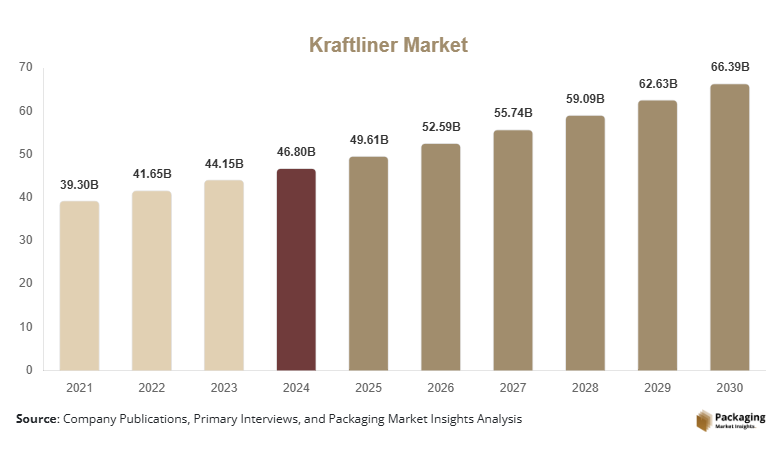
The global kraftliner market size was valued at approximately USD 46.8 billion in 2024 and is projected to grow from around USD 49.61 billion in 2025 to reach nearly USD 66.39 billion by 2030, expanding at a CAGR of about 6% during the forecast period (2025–2030). Kraftliner, a key paperboard grade produced primarily from virgin wood fibers, is widely used as an outer layer in corrugated packaging due to its high strength, durability, and printability. The market’s growth trajectory reflects the increasing demand for reliable packaging solutions across logistics, e-commerce, and industrial goods sectors.
One major global factor supporting the market growth was the expansion of organized retail and cross-border trade in 2024, which increased demand for secondary and tertiary packaging. As supply chains became more complex, brand owners and logistics providers relied heavily on corrugated boxes with kraftliner facings to ensure product protection, stackability, and cost efficiency during transportation. Additionally, the gradual shift away from plastic-based packaging materials reinforced kraftliner adoption as a fiber-based alternative.
The global market analysis indicates stable capacity additions by integrated paper manufacturers and moderate price fluctuations influenced by wood pulp availability. Producers increasingly optimized fiber usage and machine efficiency to maintain margins while meeting rising volume demand.
Key Highlights
- Asia Pacific accounted for approximately 42.5% of the global market share in 2025, while the region is expected to remain the fastest-growing with a forecast CAGR of 6.8%.
- By type, unbleached kraftliner dominated with a 68.0% share in 2024, while bleached kraftliner is expected to grow fastest at a CAGR of 6.5%.
- By application, corrugated boxes led the market, whereas retail-ready packaging is projected to expand at the highest CAGR of 7.1%.
- China dominated the market, valued at USD 12.4 billion in 2024 and an estimated USD 13.2 billion in 2025.
Explore more data points, trends and opportunities Download Free Sample Report
Latest Market Trends
Rising Preference for High-Strength Lightweight Kraftliner
Manufacturers increasingly focused on producing high-strength yet lightweight kraftliner grades to reduce overall packaging weight without compromising performance. This trend gained traction as logistics providers aimed to lower transportation costs and improve pallet efficiency. Lightweight kraftliner also enabled corrugated box producers to meet strength requirements using less material, aligning with cost-optimization strategies across the value chain. Advances in fiber refining and paper machine technologies supported this trend by improving tensile strength and burst resistance.
Increased Use of Kraftliner in Brand-Centric Packaging
Another notable trend in the Kraftliner Market was the rising use of kraftliner in brand-oriented packaging applications. Improved surface smoothness and printability allowed brand owners to use kraftliner as a visual communication medium. This trend was particularly visible in consumer electronics, processed foods, and personal care products, where outer packaging increasingly carried branding, handling instructions, and regulatory information. As a result, demand for premium kraftliner grades with consistent quality increased steadily.
Market Drivers
Expansion of E-Commerce and Logistics Networks
The rapid expansion of e-commerce platforms significantly drove the Kraftliner Market. Online retail operations relied heavily on corrugated packaging to protect goods during last-mile delivery. Kraftliner’s strength properties made it suitable for stacked storage, long-distance shipping, and automated handling systems. As parcel volumes increased, corrugated box producers scaled up kraftliner consumption to meet consistent demand from fulfillment centers and logistics hubs.
Growing Industrial and Manufacturing Output
Rising industrial output across automotive components, electrical equipment, and machinery sectors also supported kraftliner demand. These industries required heavy-duty corrugated packaging for safe transport of parts and semi-finished goods. Kraftliner’s resistance to compression and tearing made it an essential material for industrial packaging, especially in export-oriented manufacturing economies.
Market Restraints
Volatility in Virgin Fiber and Wood Pulp Prices
A major restraint affecting the Kraftliner Market was volatility in virgin fiber and wood pulp prices. Kraftliner production depends largely on high-quality virgin fibers, which are influenced by forestry regulations, energy costs, and climatic conditions. Price fluctuations increased input cost uncertainty for manufacturers and often resulted in delayed procurement decisions by corrugated box producers. Smaller kraftliner mills faced margin pressure during periods of elevated pulp prices, limiting their ability to expand capacity or invest in product upgrades.
Market Opportunities
Capacity Expansion in Emerging Economies
Emerging economies in Asia and Latin America present significant growth opportunities for the Kraftliner Market. Increasing domestic manufacturing, infrastructure development, and consumer goods production are expected to drive local demand for corrugated packaging. Investments in new kraftliner machines and mill modernization in these regions could enable producers to serve both domestic and export markets more efficiently.
Development of Specialty Kraftliner Grades
The development of specialty kraftliner grades designed for moisture resistance, enhanced stiffness, or superior printability offers another opportunity. These grades are expected to gain adoption in food packaging, pharmaceutical logistics, and export packaging applications, where performance requirements are more stringent.
Report Scope
| Report Metric | Details |
|---|---|
| Market Size in 2024 | USD 46.8 Billion |
| Market Size in 2025 | USD 49.61 Billion |
| Market Size in 2030 | USD 66.39 Billion |
| CAGR | 6% (2025-2030) |
| Base Year for Estimation | 2024 |
| Historical Data | 2021-2023 |
| Forecast Period | 2025-2030 |
| Report Coverage | Revenue Forecast, Competitive Landscape, Supply Chain Disruption, Growth Factors, Environment & Regulatory Landscape and Trends |
| Geographies Covered | North America, Europe, APAC, Middle East and Africa, LATAM |
| Countries Covered | U.S., Canada, U.K., Germany, France, Spain, Italy, Russia, Nordic, Benelux, Rest of Europe, China, South Korea, Japan, India, Australia, Singapore, Taiwan, South East Asia, Rest of Asia-Pacific, UAE, Turky, Saudi Arabia, South Africa, Egypt, Nigeria, Rest of MEA, Brazil, Mexico, Argentina, Chile, Colombia, Rest of LATAM |
Explore more data points, trends and opportunities Download Free Sample Report
Segmental Analysis
By Type
Unbleached kraftliner dominated the Kraftliner Market by type and accounted for 68.0% of the total market share in 2024. This dominance was attributed to its superior strength properties, cost efficiency, and widespread use in heavy-duty corrugated packaging. Unbleached kraftliner was extensively used in industrial, logistics, and bulk transport applications where appearance was secondary to performance.
Bleached kraftliner is expected to be the fastest-growing subsegment, expanding at a projected CAGR of 6.5% from 2025 to 2030. Growth will be driven by rising demand for visually appealing outer liners in retail and consumer goods packaging. Improved print quality and brand presentation requirements are expected to support adoption.
By Application
Corrugated boxes represented the largest application segment, accounting for 74.0% of the Kraftliner Market share in 2024. This dominance resulted from the extensive use of corrugated boxes across e-commerce, industrial shipping, and food distribution. Kraftliner’s role as an outer liner ensured box integrity and stacking strength.
Retail-ready packaging is expected to grow at the highest CAGR of 7.1% during the forecast period. Growth will be supported by the increasing need for shelf-ready and display packaging solutions that combine protection with branding visibility.
By End-Use Industry
The food and beverage industry was the dominant end-use segment, holding 36.5% of the market share in 2024. Kraftliner-based packaging was widely used for transporting processed foods, beverages, and agricultural produce due to its durability and compatibility with corrugated formats.
The consumer electronics end-use segment is projected to be the fastest-growing, with a CAGR of 6.9%. Growth will be driven by increased electronics manufacturing and export activity requiring high-strength protective packaging.
By Distribution Channel
Direct sales to corrugated box manufacturers dominated the market, accounting for 61.0% of total kraftliner sales in 2024. Long-term supply agreements and integrated production models supported this channel’s dominance.
Distributor-based sales are expected to grow faster at a CAGR of 6.2%, driven by demand from small and mid-sized packaging converters seeking flexible procurement options.
Kraftliner Market Segmentations
By Type
- Unbleached Kraftliner
- Bleached Kraftliner
By Application
- Corrugated Boxes
- Retail-Ready Packaging
- Industrial Packaging
By End-Use Industry
- Food & Beverage
- Consumer Electronics
- Industrial Goods
- Pharmaceuticals
By Distribution Channel
- Direct Sales
- Distributors
Regional Analysis
North America
North America accounted for 21.0% of the Kraftliner Market share in 2025 and was expected to grow at a forecast CAGR of 4.8% from 2025 to 2033. The region’s growth outlook was shaped by steady demand from e-commerce fulfillment, industrial packaging, and food distribution sectors. Established recycling and corrugated manufacturing infrastructure supported consistent kraftliner consumption.
The United States dominated the regional market, supported by high corrugated box production capacity and strong domestic logistics networks. Growth was driven by demand for durable packaging for long-haul transportation and automated warehousing systems.
Europe
Europe held approximately 19.5% of the Kraftliner Market share in 2025 and is projected to expand at a CAGR of 4.5% through 2033. Demand was influenced by manufacturing activity, export-oriented packaging, and cross-border trade within the region. European kraftliner producers focused on optimizing energy efficiency and fiber utilization.
Germany led the European market, supported by its strong industrial base and advanced packaging standards. Demand was driven by machinery exports and automotive component shipments requiring high-strength corrugated packaging.
Asia Pacific
Asia Pacific represented the largest regional market with a 42.5% share in 2025 and is expected to grow at the fastest CAGR of 6.8% between 2025 and 2033. Rapid industrialization, expanding retail networks, and rising export volumes supported kraftliner demand across the region. Capacity additions by integrated pulp and paper manufacturers further strengthened supply.
China dominated the Asia Pacific Kraftliner Market, driven by large-scale corrugated box production serving electronics, consumer goods, and manufacturing exports. Government investments in logistics infrastructure and industrial parks supported sustained growth.
Middle East & Africa
The Middle East & Africa accounted for 9.0% of the Kraftliner Market share in 2025 and is forecast to grow at a CAGR of 5.2% through 2033. Growth was supported by expanding trade activity, infrastructure projects, and food distribution networks. Demand remained concentrated in urban centers and export-oriented industries.
Saudi Arabia emerged as the dominant country, supported by industrial diversification initiatives and growing demand for packaging in construction materials and processed food sectors.
Latin America
Latin America captured 8.0% of the Kraftliner Market share in 2025 and is expected to grow at a CAGR of 5.5% during the forecast period. Increasing agricultural exports and regional manufacturing activity supported demand for corrugated packaging.
Brazil led the regional market, driven by strong demand from agribusiness exports and domestic consumer goods manufacturing requiring robust secondary packaging solutions.
Competitive Landscape
The Kraftliner Market was moderately consolidated, with a mix of global integrated paper producers and regional manufacturers. Leading players focused on capacity optimization, product quality consistency, and cost efficiency.
International Paper Company emerged as a market leader, supported by its extensive kraftliner production capacity and integrated supply chain. In 2024, the company announced machine upgrades aimed at improving strength-to-weight ratios in its kraftliner grades.
Other major players maintained competitive positions through regional expansion, operational efficiency improvements, and long-term supply contracts with corrugated box producers.
Key Players List
- International Paper Company
- WestRock Company
- Smurfit Kappa Group
- Mondi Group
- Stora Enso Oyj
- Nippon Paper Industries Co., Ltd.
- Oji Holdings Corporation
- Sappi Limited
- Svenska Cellulosa Aktiebolaget (SCA)
- Klabin S.A.
- Packaging Corporation of America
- Nine Dragons Paper Holdings
- Lee & Man Paper Manufacturing
- Billerud AB
- DS Smith Plc