IoT Enabled Packaging Market Size and Growth
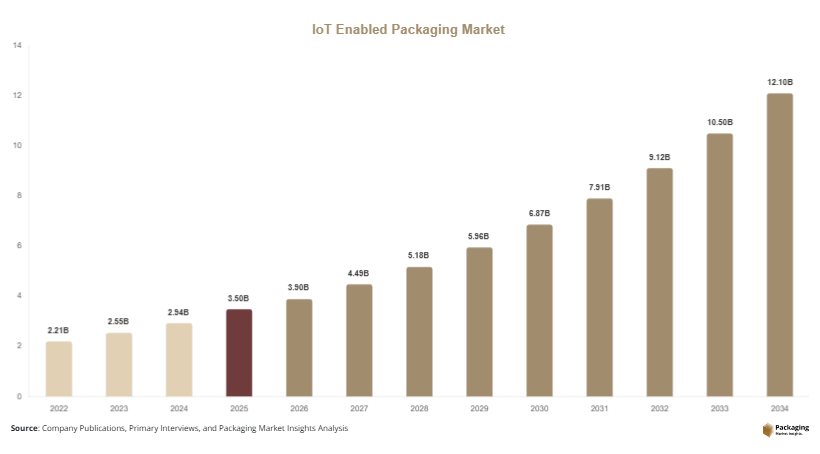
The global IoT enabled packaging market reached an estimated USD 3.5 billion in 2025 and is projected to expand to USD 3.9 billion in 2026. Analysts forecast a CAGR of 15.2% from 2025 to 2034, with the market expected to reach approximately USD 12.8 billion by 2034. The adoption of IoT-enabled packaging is being fueled by increasing awareness of product safety, the need for operational efficiency, and growing consumer expectations for transparency.
One of the primary growth factors is the rising emphasis on smart supply chains, where IoT-enabled packaging allows manufacturers and retailers to track products in real-time, ensuring quality, freshness, and compliance. Secondly, advancements in sensor technology and cloud connectivity have enabled more sophisticated packaging solutions that monitor environmental conditions such as temperature, humidity, and pressure during transportation and storage. Thirdly, consumer engagement strategies that leverage IoT-enabled interactive packaging, including QR codes and NFC tags, are driving adoption as brands aim to deliver personalized product experiences and verify authenticity.
Key Highlights:
- The global IoT enabled packaging market reached USD 3.5 billion in 2025, reflecting the growing adoption of smart, connected packaging solutions.
- The market is expected to reach USD 3.9 billion in 2026, driven by cloud-connected sensors, interactive packaging features, and consumer demand for transparency.
- Analysts forecast a CAGR of 15.2% (2025–2034), indicating strong long-term expansion fueled by AI integration and supply chain digitization.
- By 2034, the market is projected to reach USD 12.8 billion, highlighting increasing adoption in food, pharmaceutical, and consumer goods sectors.
- Growth is primarily driven by real-time monitoring, interactive consumer engagement, and smart supply chain optimization initiatives.
Explore more data points, trends and opportunities Download Free Sample Report
Market Trends
Integration of IoT with Smart and Connected Packaging
A key trend in the market is the integration of IoT technology with packaging, enabling real-time monitoring of product conditions. Smart packaging equipped with sensors, NFC tags, and QR codes allows stakeholders to track temperature, humidity, and movement throughout the supply chain. For example, pharmaceutical companies can monitor temperature-sensitive drugs to ensure integrity, while food brands can track freshness to prevent spoilage. Additionally, connected packaging allows consumers to access verified product information, enhancing brand trust. This trend also improves operational efficiency, reduces product recalls, and supports compliance with regulatory standards, making IoT-enabled smart packaging a strategic priority for manufacturers and retailers globally.
Adoption of Interactive Packaging for Consumer Engagement
Another important trend is the rise of interactive IoT-enabled packaging, which enhances consumer engagement and brand loyalty. Packaging solutions with NFC or QR capabilities allow consumers to access personalized content, authenticity verification, and usage instructions directly from the package. In the beverage sector, for instance, interactive packaging can provide recipe suggestions or loyalty program participation, improving customer experience. Increasing smartphone penetration and consumer familiarity with connected devices drive this trend, and brands are leveraging IoT-enabled packaging to create multi-sensory and interactive product experiences, which also helps in gathering valuable data on user behavior and product performance.
Market Drivers
Demand for Supply Chain Visibility and Operational Efficiency
The growing need for end-to-end supply chain visibility is a primary driver for IoT-enabled packaging adoption. Businesses across food, pharmaceuticals, and consumer electronics are seeking solutions that allow real-time tracking of shipments, monitoring of storage conditions, and verification of product integrity. IoT-enabled packaging provides data-driven insights, helping companies reduce losses due to spoilage, theft, or logistical errors. Additionally, improved transparency ensures regulatory compliance and fosters consumer trust. Companies that adopt these solutions can optimize operations, reduce waste, and enhance overall efficiency, thereby justifying the investment in connected packaging systems.
Increasing Focus on Product Authentication and Anti-Counterfeiting
Counterfeiting and fraud remain major concerns in industries such as pharmaceuticals, luxury goods, and electronics. IoT-enabled packaging with NFC tags or QR codes allows consumers and businesses to verify the authenticity of products in real-time. For example, luxury cosmetic brands can ensure that products are genuine throughout distribution channels. The economic and reputational costs associated with counterfeit goods are driving the adoption of IoT-enabled packaging as an essential anti-counterfeiting and brand protection tool. This trend is reinforced by stricter regulations and heightened consumer awareness regarding product authenticity and safety.
Market Restraint
High Cost of Implementation and Integration Complexity
Despite the growing demand, high implementation costs and technical complexity remain significant restraints in the IoT-enabled packaging market. Deploying IoT sensors, connectivity modules, and cloud-based monitoring platforms requires significant capital investment, especially for small and medium-sized enterprises. Additionally, integrating these systems with existing ERP, supply chain, and logistics platforms is often challenging. For instance, food packaging companies attempting to implement IoT-enabled temperature monitoring may face hurdles in aligning sensors with legacy equipment, leading to delays and increased costs. The need for specialized skills, ongoing maintenance, and data security protocols further adds to the barrier for widespread adoption, particularly in emerging economies where infrastructure may be less developed.
Market Opportunities
Expansion in Pharmaceutical and Healthcare Packaging
The pharmaceutical sector presents substantial opportunities for IoT-enabled packaging solutions. With stringent regulations surrounding drug traceability, cold chain monitoring, and anti-counterfeiting, connected packaging ensures patient safety and compliance. IoT sensors can monitor temperature, humidity, and exposure during transit, while QR/NFC tags allow batch verification and authentication. The global push for secure medication supply chains, coupled with rising demand for high-value healthcare products, makes this sector particularly attractive. Companies that successfully implement IoT-enabled packaging can gain a competitive edge by ensuring product integrity and patient safety.
Growth in Food and Beverage Supply Chain Monitoring
IoT-enabled packaging also offers opportunities in the food and beverage industry. Consumers increasingly demand transparency regarding product origin, freshness, and storage conditions. Connected packaging solutions allow brands to provide verified data on temperature, transit history, and expiration dates. This reduces spoilage, prevents recalls, and enhances trust. Retailers and manufacturers can leverage these insights to optimize inventory, reduce waste, and improve operational efficiency, while also meeting regulatory requirements for food safety and traceability.
Report Scope
| Report Metric | Details |
|---|---|
| Market Size in 2025 | USD 3.5 Billion |
| Market Size in 2026 | USD 3.9 Billion |
| Market Size in 2034 | USD 12.8 Billion |
| CAGR | 15.2% (2026-2034) |
| Base Year for Estimation | 2025 |
| Historical Data | 2022-2024 |
| Forecast Period | 2026-2034 |
| Report Coverage | Revenue Forecast, Competitive Landscape, Supply Chain Disruption, Growth Factors, Environment & Regulatory Landscape and Trends |
| Geographies Covered | North America, Europe, APAC, Middle East and Africa, LATAM |
| Countries Covered | U.S., Canada, U.K., Germany, France, Spain, Italy, Russia, Nordic, Benelux, Rest of Europe, China, South Korea, Japan, India, Australia, Singapore, Taiwan, South East Asia, Rest of Asia-Pacific, UAE, Turky, Saudi Arabia, South Africa, Egypt, Nigeria, Rest of MEA, Brazil, Mexico, Argentina, Chile, Colombia, Rest of LATAM |
Explore more data points, trends and opportunities Download Free Sample Report
Segmental Analysis
By Type
The IoT sensor packaging segment held the dominant share in 2024, accounting for nearly 45% of the market. IoT sensors embedded in packaging allow continuous monitoring of environmental conditions such as temperature, humidity, and pressure, which is particularly crucial for pharmaceuticals and perishable foods. These sensors provide real-time alerts, enabling timely corrective actions, thus reducing product spoilage and ensuring safety. The widespread adoption of IoT sensor packaging is facilitated by advancements in micro-sensors, cloud computing, and data analytics, making it a preferred choice for large manufacturers seeking operational efficiency.
The NFC-enabled packaging segment is the fastest-growing, projected to register a CAGR of 10.2% from 2025 to 2034. Growth is driven by increasing demand for consumer engagement, product authentication, and personalized marketing. NFC chips enable seamless interaction between consumers and products via smartphones, providing detailed product information, promotional offers, and authenticity verification. As NFC technology becomes more cost-effective and miniaturized, adoption is accelerating across FMCG, luxury goods, and pharmaceutical segments, presenting lucrative growth potential for market participants.
By Application
The food & beverage sector dominated the IoT-enabled packaging application market in 2024, holding around 50% share. Smart packaging solutions are extensively used to monitor freshness, prevent contamination, and ensure compliance with safety standards. IoT-enabled packaging allows real-time tracking of temperature-sensitive items, reducing spoilage in cold-chain logistics. Moreover, increasing consumer demand for transparency and high-quality products is driving adoption, especially for perishable goods like dairy, meat, and beverages. Retailers and manufacturers are investing in interactive packaging solutions to enhance consumer engagement and brand loyalty.
The pharmaceutical segment is the fastest-growing application, expected to witness a CAGR of 11.0% from 2025 to 2034. IoT-enabled packaging ensures the integrity of drugs by monitoring storage conditions and preventing tampering. With rising global regulatory scrutiny and concerns over counterfeit drugs, pharmaceutical companies are increasingly deploying smart packaging to guarantee product safety. Real-time data from IoT packaging helps optimize supply chains, reduce wastage, and improve compliance with Good Distribution Practices (GDP), supporting market expansion.
By End-Use
The retail end-use segment accounted for the largest share in 2024, representing nearly 40% of the market. Retailers are leveraging IoT-enabled packaging to enhance inventory management, reduce shrinkage, and provide consumers with interactive experiences. Smart labels, QR codes, and sensors allow tracking of product condition, facilitating efficient recalls and operational optimization. The growing focus on customer satisfaction and omnichannel retailing drives the deployment of IoT packaging solutions across supermarkets, hypermarkets, and specialty stores.
The logistics and supply chain end-use segment is projected to grow at the fastest rate, with a CAGR of 9.8% from 2025 to 2034. IoT-enabled packaging is critical for monitoring shipments of temperature-sensitive goods, pharmaceuticals, and high-value items. Real-time data transmission allows companies to optimize routes, reduce spoilage, and enhance operational efficiency. Increasing demand for visibility, traceability, and timely delivery in e-commerce and global trade supports the rapid adoption of IoT solutions in logistics and supply chain management.
IoT Enabled Packaging Market Segmentations
By Type
- RFID-enabled Packaging
- NFC-enabled Packaging
- QR Code-enabled Packaging
- Sensor-enabled Packaging
By Application
- Supply Chain Traceability
- Anti-counterfeiting & Brand Protection
- Smart Packaging & Consumer Engagement
- Compliance & Regulatory Monitoring
By End-Use
- Pharmaceutical Industry
- Food & Beverage Industry
- Consumer Goods
- Luxury & High-Value Goods
Regional Analysis
North America
The North American IoT Enabled Packaging Market accounted for approximately 35% of the global market in 2025, with a projected CAGR of 7.8% from 2025 to 2034. The region benefits from advanced technological infrastructure, high adoption of smart devices, and a strong presence of key market players, enabling rapid deployment of connected packaging solutions. Consumer awareness regarding product safety, authenticity, and sustainability further boosts market demand. The integration of IoT with supply chain management systems is also more mature in North America compared to other regions, leading to higher adoption rates across pharmaceuticals, food & beverage, and retail sectors.
The United States dominates the North American market due to its well-established logistics network, high smartphone penetration, and proactive regulatory environment supporting smart packaging solutions. A unique growth factor is the rapid expansion of e-commerce platforms like Amazon, which demands advanced tracking and monitoring of products in transit. Companies are investing heavily in IoT-enabled packaging to ensure timely delivery, minimize losses, and improve customer experience. The focus on sustainability in packaging materials combined with IoT technologies is expected to drive continued growth in the U.S. market.
Europe
Europe represented 28% of the global IoT Enabled Packaging Market in 2025, with an estimated CAGR of 8.3% during 2025–2034. The region is characterized by strict regulatory standards for food and pharmaceutical safety, which drive the adoption of smart packaging technologies. Increasing awareness regarding supply chain transparency and anti-counterfeiting measures further fuels market expansion. European consumers increasingly demand traceability, particularly in the food and beverage sectors, promoting the integration of IoT solutions.
Germany is the leading country in the European market due to its robust manufacturing sector and strong focus on Industry 4.0 initiatives. A unique growth factor is the government’s support for digitalization in packaging through grants and pilot programs, encouraging companies to integrate IoT sensors and smart labels. German manufacturers are leveraging IoT-enabled packaging to maintain compliance with EU regulations while enhancing operational efficiency, resulting in higher adoption rates.
Asia Pacific
Asia Pacific accounted for approximately 22% of the global market in 2025, with a projected CAGR of 9.5% through 2034. Rapid industrialization, rising consumer awareness, and increasing adoption of e-commerce platforms are major contributors to market growth. The region exhibits significant potential due to the growing demand for smart packaging in pharmaceuticals, FMCG, and food & beverage sectors. Increasing investments in IoT infrastructure and digital supply chains further fuel adoption across both developed and emerging economies.
China is the dominant country in Asia Pacific due to its massive manufacturing base, technological advancements, and growing consumer demand for traceability. A unique growth factor is the integration of IoT packaging in cold-chain logistics to maintain product quality during distribution. IoT-enabled packaging helps monitor temperature, humidity, and location, reducing spoilage and ensuring compliance with food safety standards, particularly in perishable goods and pharmaceutical shipments.
Middle East & Africa
The Middle East & Africa region accounted for 8% of the global market in 2025, with a CAGR of 7.0% during 2025–2034. Market growth is driven by increasing investments in logistics and smart city initiatives. The need for secure and transparent supply chains, particularly for pharmaceuticals, luxury goods, and food imports, is boosting the adoption of IoT-enabled packaging solutions.
United Arab Emirates (UAE) dominates the regional market due to its advanced logistics infrastructure, high disposable income, and robust retail sector. A unique growth factor is the UAE’s strategic position as a logistics hub, facilitating international trade. IoT-enabled packaging enhances supply chain efficiency and helps monitor imported products in real-time, ensuring quality and authenticity across the region.
Latin America
Latin America contributed approximately 7% of the global IoT Enabled Packaging Market in 2025, with an expected CAGR of 8.1% through 2034. The market is expanding due to growing e-commerce penetration, rising disposable income, and increasing awareness of product safety and traceability. Consumers in key markets such as Brazil and Mexico are demanding greater transparency regarding the sourcing and quality of products.
Brazil is the dominant country in Latin America due to its large retail sector and rapidly growing e-commerce industry. A unique growth factor is the adoption of IoT-enabled cold-chain solutions for perishable goods like dairy, meat, and pharmaceuticals. Smart packaging helps maintain optimal storage conditions, reduces product spoilage, and strengthens consumer confidence, further encouraging adoption.
Competitive Landscape
Key players include Avery Dennison, Smartrac, Zebra Technologies, Impinj, and Alien Technology. Avery Dennison leads the market, with recent innovations in NFC-enabled packaging for consumer goods, providing interactive and authenticated packaging experiences. Other companies focus on RFID and IoT sensor integration, cloud connectivity, and supply chain analytics to strengthen market positions. Strategic partnerships and product innovation continue to drive competition in the global IoT-enabled packaging market.
Key Players List
- Avery Dennison
- Smartrac
- Zebra Technologies
- Impinj
- Alien Technology
- HID Global
- NXP Semiconductors
- SML Group
- Checkpoint Systems
- Omnia Technologies
- Thinfilm Electronics
- Identiv, Inc.
- Mojix
- Convergence Systems
- Confidex