Intermediate Bulk Container (IBC) Liner Market Size
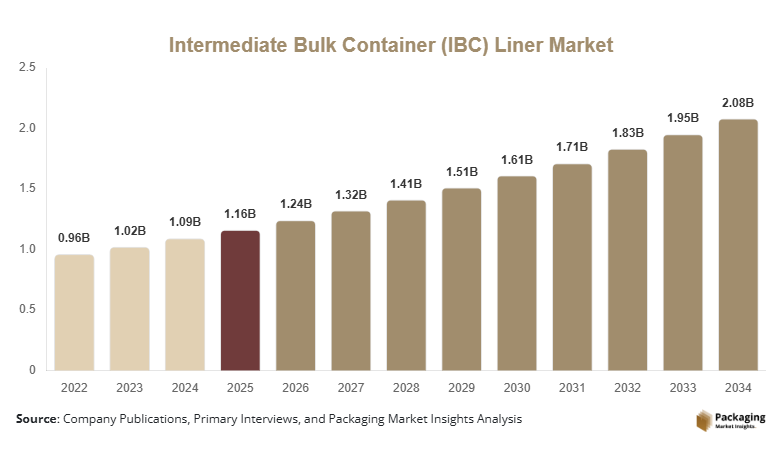
Intermediate Bulk Container (IBC) liner market size is projected at USD 1.24 billion in 2026 and is expected to hit USD 2.08 billion by 2034 with a CAGR of 6.7%. The market is expanding due to increasing adoption of flexible bulk packaging solutions across food, chemical, and pharmaceutical industries. Growing investments in supply chain efficiency, product safety, and contamination-free transportation continue to strengthen demand. Market evaluation includes detailed segmentation by type and application along with competitive landscape analysis covering production capacity, regional performance, and strategic developments.
The Intermediate Bulk Container (IBC) liner market consists of flexible liners installed inside rigid intermediate bulk containers for transporting and storing powders, liquids, and semi-solid materials while preventing contamination and reducing cleaning costs. Global production exceeded 365 million liner units in 2025, while annual shipments surpassed 342 million units, supported by adoption rates above 58% across industrial bulk packaging applications. Food & beverage represented nearly 41% of total consumption, chemicals accounted for approximately 36%, and pharmaceuticals contributed around 15%, with the remaining demand generated by other industrial sectors. Automation and recyclable polymer materials continue improving operational efficiency, reinforcing the Intermediate Bulk Container (IBC) liner market.
Explore more data points, trends and opportunities Download Free Sample Report
Intermediate Bulk Container (IBC) Liner Market Trends
Increasing Adoption of Sustainable Multi-Layer Packaging Solutions
Manufacturers are increasingly introducing recyclable PE-based and EVOH barrier liner structures to reduce packaging waste while maintaining product integrity. More than 148 million recyclable liners were produced during 2025, representing over 46% of global production. Digital manufacturing technologies improved production efficiency by nearly 18%, while automated sealing systems reduced operational losses by 14%. Growing sustainability initiatives continue strengthening the Intermediate Bulk Container (IBC) liner market.
Industrial automation has accelerated the adoption of customized liners with anti-static properties, aseptic filling compatibility, and enhanced oxygen barriers. Smart manufacturing systems are now deployed in approximately 38% of production facilities worldwide, while customized liner penetration exceeded 44% among pharmaceutical and specialty chemical users. Demand from export-oriented industries increased by nearly 11% year-over-year, supporting continuous expansion of the Intermediate Bulk Container (IBC) liner market.
Intermediate Bulk Container (IBC) Liner Drivers
Rising Bulk Transportation Across Food and Chemical Industries
Increasing global trade of liquid ingredients, edible oils, chemicals, and pharmaceutical intermediates is driving higher liner utilization. Bulk material shipments expanded by approximately 8.9% during 2025, while food ingredient exports increased 9.4% and industrial chemical logistics rose 7.8%. Improved contamination control, reduced cleaning costs by nearly 35%, and faster filling cycles continue supporting Intermediate Bulk Container (IBC) liner market growth.
Intermediate Bulk Container (IBC) Liner Restraints
Volatility in Polymer Raw Material Prices
Price fluctuations in polyethylene, EVOH, and specialty barrier materials continue creating procurement challenges. Raw material costs increased between 9% and 15% during recent procurement cycles, while transportation expenses rose approximately 8%. Small manufacturers experienced operating margin reductions of nearly 5%, limiting investments despite increasing demand within the Intermediate Bulk Container (IBC) liner market.
Intermediate Bulk Container (IBC) Liner Opportunities
Expansion of Pharmaceutical and High-Purity Packaging
The pharmaceutical industry continues adopting sterile bulk packaging for APIs and medical ingredients. Pharmaceutical liner demand increased approximately 12% annually, while sterile filling installations expanded by 16%. Global biologics manufacturing capacity exceeded 23 million liters, creating additional opportunities for specialized liner manufacturers and expanding the Intermediate Bulk Container (IBC) liner market.
Challenges in Intermediate Bulk Container (IBC) Liner Market
Maintaining Regulatory Compliance Across Global Supply Chains
Manufacturers must comply with FDA, EU, and food-contact regulations while maintaining consistent quality. Quality inspection expenses increased nearly 10%, regulatory testing volumes expanded 13%, and certification timelines extended by approximately 7%. These factors continue challenging operational efficiency throughout the Intermediate Bulk Container (IBC) liner market.
Report Scope
| Report Metric | Details |
|---|---|
| Market Size in 2025 | USD 1.16 Billion |
| Market Size in 2026 | USD 1.24 Billion |
| Market Size in 2034 | USD 2.08 Billion |
| CAGR | 6.7% (2026-2034) |
| Base Year for Estimation | 2025 |
| Historical Data | 2022-2024 |
| Forecast Period | 2026-2034 |
| Report Coverage | Revenue Forecast, Competitive Landscape, Supply Chain Disruption, Growth Factors, Environment & Regulatory Landscape and Trends |
| Geographies Covered | North America, Europe, APAC, Middle East and Africa, LATAM |
| Countries Covered | U.S., Canada, U.K., Germany, France, Spain, Italy, Russia, Nordic, Benelux, Rest of Europe, China, South Korea, Japan, India, Australia, Singapore, Taiwan, South East Asia, Rest of Asia-Pacific, UAE, Turky, Saudi Arabia, South Africa, Egypt, Nigeria, Rest of MEA, Brazil, Mexico, Argentina, Chile, Colombia, Rest of LATAM |
Explore more data points, trends and opportunities Download Free Sample Report
Intermediate Bulk Container (IBC) Liner Market Segmentation
The market is segmented by type and application based on industrial handling requirements. Form-fit liners accounted for nearly 43% of overall demand, while food & beverage applications represented approximately 41% of market consumption due to growing bulk ingredient transportation.
By Type
Form-fit liners represented approximately 43% of global demand, with production exceeding 156 million units annually. Thickness typically ranges between 75 and 200 microns, providing improved product conformity and reduced residual waste.
Pillow liners contributed around 34% of market volume with annual production exceeding 124 million units. These liners offer economical bulk packaging, compatibility with liquids, and simplified installation for industrial applications.
Baffle liners accounted for nearly 23% of total shipments, with production surpassing 85 million units. Internal baffles improve load stability by nearly 30% while enhancing transportation safety for liquid products.
By Application
Food & beverage generated approximately 41% of demand with more than 141 million linear units consumed annually. Adoption exceeded 63% among edible oil, syrup, dairy ingredient, and beverage concentrate suppliers due to superior hygiene performance.
Chemicals represented roughly 36% of total consumption with annual utilization exceeding 123 million units. Chemical-resistant multilayer liners provide improved barrier protection, reducing contamination risks by nearly 28%.
Pharmaceuticals accounted for nearly 15% of demand, supported by production exceeding 52 million sterile liners annually. High-purity polymers and aseptic filling compatibility continue increasing penetration across API manufacturing facilities.
Intermediate Bulk Container (IBC) Liner Market Segmentations
Type
- Form-Fit Liners
- Pillow Liners
- Baffle Liners
Application
- Food & Beverage
- Chemicals
- Pharmaceuticals
Material
- Polyethylene (PE)
- Polypropylene (PP)
- EVOH Barrier Films
- Multi-Layer Laminates
Intermediate Bulk Container (IBC) Liner Regional Outlook
North America
North America accounted for approximately 31% of global revenue. The United States contributed nearly 79% of regional production, while Canada represented approximately 15%. Regional manufacturing exceeded 108 million liner units, driven by food processing, specialty chemicals, and pharmaceutical industries.
Europe
Europe held nearly 29% of global demand, with Germany, France, Italy, and the United Kingdom leading production. Regional output exceeded 101 million units, while recyclable packaging adoption surpassed 52% across industrial applications.
Asia-Pacific
Asia-Pacific represented approximately 32% of global consumption and remained the fastest-growing region. China generated nearly 47% of regional production, followed by India, Japan, and South Korea. Regional manufacturing exceeded 118 million units, supported by expanding exports and industrialization.
Latin America
Latin America contributed around 5% of market demand. Brazil and Mexico accounted for over 68% of regional production, supported by agriculture, food exports, and chemical manufacturing sectors.
Middle East & Africa
Middle East & Africa represented approximately 3% of global consumption. Saudi Arabia, the UAE, and South Africa remained major contributors as investments in industrial logistics and petrochemical exports increased regional demand.
Top Players in Intermediate Bulk Container (IBC) liner market
- Qbig Packaging
- LC Packaging,
- CDF Corporation,
- Greif Inc.
- Berry Global Inc.
- Sealed Air Corporation
- Arena Products Inc.
- Bulk Lift International LLC,
- Thrace Group
- Powertex Inc.,
- Protective Packaging Ltd.
- Brambles Industrial Packaging
Qbig Packaging's estimated market share is approximately 11%. Strong presence in customized food-grade and chemical IBC liner manufacturing. Focuses on recyclable multilayer technologies, export markets, and automated production systems. Expanding manufacturing capacity and product innovation to strengthen global positioning. CDF Corporation's estimated market share is approximately 9%. Recognized supplier of aseptic and pharmaceutical bulk packaging solutions. Offers high-barrier liners with advanced contamination protection and sterile filling compatibility. Continues investing in sustainable packaging technologies and international distribution expansion.