Insulated Shipping Boxes Market Size and Growth
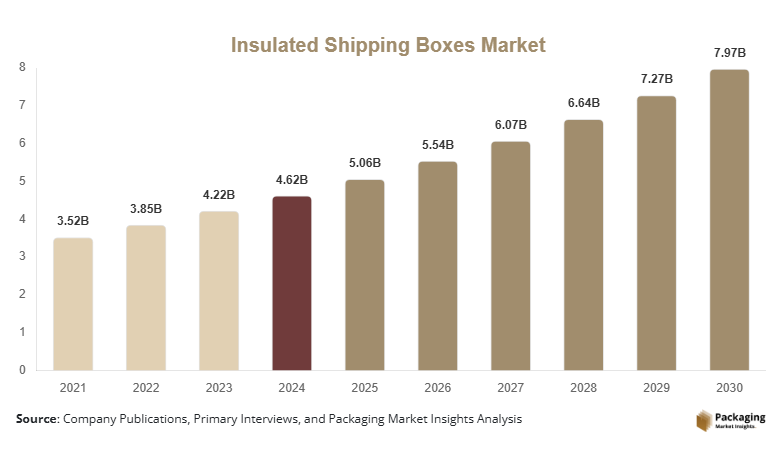
The global insulated shipping boxes market size was valued at approximately USD 4.62 billion in 2024 and is projected to grow from around USD 5.06 billion in 2025 to reach nearly USD 7.96 billion by 2030, expanding at a CAGR of about 9.5% during the forecast period (2025–2030). The market growth was primarily supported by the rapid expansion of temperature-sensitive logistics across pharmaceutical, biotechnology, and perishable food supply chains. Increasing globalization of clinical trials, biologics distribution, and cold-chain food exports significantly strengthened the adoption of insulated shipping solutions during the base year.
Insulated shipping boxes are designed to maintain internal temperature stability during transportation, protecting products from thermal fluctuations, humidity, and external environmental exposure. The market includes a wide range of products, such as EPS foam boxes, vacuum insulated panels (VIP), molded fiber boxes, and hybrid insulation systems. Growing regulatory emphasis on product integrity, especially in healthcare and life sciences logistics, continued to push demand for reliable thermal packaging systems.
Technological improvements in insulation materials, combined with rising sustainability awareness, supported the development of reusable and eco-friendly insulated shipping boxes. Additionally, the acceleration of e-commerce grocery and direct-to-consumer pharmaceutical deliveries further expanded the addressable market.
Key Highlights
- North America accounted for a dominant 38.4% market share in 2025, while the Asia Pacific is expected to register the fastest growth at a CAGR of 11.2%.
- The material, EPS (Expanded Polystyrene), led the market with a 38% share in 2024, while the Aerogel subsegment is expected to grow at a 13.2% CAGR.
- By application, pharmaceuticals & healthcare dominate 41% share in 2024, whereas electronics & semiconductors are anticipated to grow fastest.
- The United States dominated the market with a value of USD 1.52 billion in 2024 and USD 1.66 billion in 2025.
Explore more data points, trends and opportunities Download Free Sample Report
Latest Market Trends
Rising Adoption of Sustainable Insulated Packaging
The Insulated Shipping Boxes Market has increasingly witnessed a shift toward sustainable and recyclable insulation materials. Manufacturers focused on replacing traditional polystyrene foam with molded pulp, starch-based insulation, and recyclable liners. This trend was driven by corporate sustainability targets, packaging waste regulations, and growing environmental awareness among end users. Reusable insulated shipping boxes also gained traction as logistics providers aimed to reduce lifecycle packaging costs and environmental impact.
Integration of Advanced Thermal Performance Designs
Another notable trend shaping the market was the integration of advanced thermal engineering in insulated shipping boxes. Companies increasingly adopted vacuum-insulated panels, phase change materials, and multi-layer hybrid insulation systems to extend temperature control durations. These designs allowed longer transit times without external cooling, supporting long-haul pharmaceutical exports and cross-border food shipments. Improved insulation performance also enabled lighter packaging designs, reducing transportation costs and improving handling efficiency.
Market Drivers
Expansion of Cold Chain Pharmaceuticals
The rapid growth of temperature-sensitive pharmaceutical products significantly drove the Insulated Shipping Boxes Market. Biologics, vaccines, gene therapies, and specialty drugs require strict temperature control throughout transportation. Increasing global distribution of these products strengthened demand for validated insulated shipping boxes capable of maintaining narrow temperature ranges.
Growth of Perishable Food Trade and E-Commerce
The expanding trade of fresh produce, seafood, meat, and dairy products supported market growth. Additionally, the rise of online grocery platforms and meal kit delivery services increased the need for reliable insulated shipping solutions. Insulated shipping boxes ensured product freshness, reduced spoilage, and supported last-mile delivery efficiency, making them a critical component of modern food logistics.
Market Restraint
High Cost of Advanced Insulation Solutions
One of the major restraints affecting the Insulated Shipping Boxes Market was the high cost associated with advanced insulation technologies. Vacuum-insulated panels, phase change materials, and reusable systems involve higher upfront costs compared to conventional foam-based packaging. Small and medium-scale shippers often faced budget constraints, limiting adoption. Additionally, return logistics for reusable boxes added operational complexity, further restraining market penetration in cost-sensitive regions.
Market Opportunities
Growth in Clinical Trial Logistics
The increasing number of global clinical trials presents a significant opportunity for the Insulated Shipping Boxes Market. Clinical trial materials often require controlled temperatures during international transportation. As decentralized and multi-country trials expand, demand for reliable insulated shipping boxes is expected to increase substantially.
Emerging Demand in Developing Economies
Rapid infrastructure development and improving cold chain networks in emerging economies offer new growth opportunities. Countries across Asia Pacific, Latin America, and parts of Africa are expanding pharmaceutical manufacturing and food exports, creating demand for cost-effective insulated shipping solutions tailored to regional logistics conditions.
Report Scope
| Report Metric | Details |
|---|---|
| Market Size in 2024 | USD 4.62 Billion |
| Market Size in 2025 | USD 5.06 Billion |
| Market Size in 2030 | USD 7.96 Billion |
| CAGR | 9.5% (2025-2030) |
| Base Year for Estimation | 2024 |
| Historical Data | 2021-2023 |
| Forecast Period | 2025-2030 |
| Report Coverage | Revenue Forecast, Competitive Landscape, Supply Chain Disruption, Growth Factors, Environment & Regulatory Landscape and Trends |
| Geographies Covered | North America, Europe, APAC, Middle East and Africa, LATAM |
| Countries Covered | U.S., Canada, U.K., Germany, France, Spain, Italy, Russia, Nordic, Benelux, Rest of Europe, China, South Korea, Japan, India, Australia, Singapore, Taiwan, South East Asia, Rest of Asia-Pacific, UAE, Turky, Saudi Arabia, South Africa, Egypt, Nigeria, Rest of MEA, Brazil, Mexico, Argentina, Chile, Colombia, Rest of LATAM |
Explore more data points, trends and opportunities Download Free Sample Report
Segmental Analysis
By Material
The EPS (Expanded Polystyrene) subsegment accounted for a dominant share of approximately 38% of the Insulated Shipping Boxes Market by material in 2024. This leading position was primarily attributed to EPS’s cost efficiency, lightweight structure, and reliable thermal insulation properties, which make it widely suitable for pharmaceutical, food, and industrial shipping applications. Its ease of molding into customized box sizes and compatibility with single-use logistics further supported high adoption across global supply chains, particularly in regions with cost-sensitive cold-chain operations.
The Aerogel subsegment is projected to be the fastest-growing, expanding at a CAGR of 13.2% from 2025 to 2033. This accelerated growth will be driven by the superior thermal resistance, ultra-low thickness, and lightweight characteristics of aerogel materials, which enable longer temperature retention with reduced packaging volume. Increasing demand for high-value biologics, specialty pharmaceuticals, and advanced electronics requiring extended thermal protection will position aerogel-based insulated shipping boxes as a premium growth segment within the market.
By Application
The Pharmaceuticals & Healthcare subsegment held a dominant 41% share of the Insulated Shipping Boxes Market by application in 2024. This dominance was supported by the widespread transportation of temperature-sensitive drugs, vaccines, biologics, and diagnostic materials that require strict compliance with controlled temperature ranges. The global expansion of pharmaceutical manufacturing and distribution networks reinforced the need for validated insulated shipping boxes to ensure product integrity throughout transit.
The Electronics & Semiconductors subsegment is expected to register the fastest growth, with a projected CAGR of 11.6% during 2025–2033. This growth will be fueled by rising global trade of high-precision electronic components that are sensitive to thermal fluctuations and moisture exposure. Increasing production of semiconductors, sensors, and advanced electronic devices will drive demand for insulated shipping boxes capable of providing stable environmental protection during long-distance transportation.
By Closure Type
The Telescopic closure type accounted for a leading 34% share of the Insulated Shipping Boxes Market by closure type in 2024. This segment’s dominance was due to its structural flexibility, allowing adjustable box heights while maintaining insulation integrity. Telescopic closures offer enhanced sealing performance and ease of assembly, making them widely used in pharmaceutical and food logistics where product dimensions and payload volumes vary.
The Vacuum-sealed closure subsegment is anticipated to grow at the fastest rate, recording a CAGR of 12.4% from 2025 to 2033. This growth will be driven by the increasing need for extended thermal retention and minimized air exchange during transportation. Vacuum-sealed closures significantly reduce heat transfer and moisture ingress, making them highly suitable for long-haul shipping of high-value pharmaceuticals, biologics, and specialty chemicals that demand strict temperature stability.
Insulated Shipping Boxes Market Segmentations
By Material
- EPS (Expanded Polystyrene)
- PUF (Polyurethane Foam)
- PIR (Polyisocyanurate)
- Phenolic Foam
- Aerogel
By Application
- Perishables (Food & Beverages)
- Pharmaceuticals & Healthcare
- Electronics & Semi-conductors
- Chemicals & Petrochemicals
- Industrial Products
By Closure Type
- Hinge
- Sliding
- Telescopic
- Vacuum-sealed
Regional Analysis
North America
North America accounted for 38.4% of the Insulated Shipping Boxes Market share in 2025, and the region is expected to grow at a CAGR of 8.6% from 2025 to 2033. The region benefited from a well-established cold chain infrastructure and high adoption of advanced packaging technologies.
The United States dominated the regional market due to its large pharmaceutical manufacturing base and extensive biologics distribution network. Strong regulatory compliance requirements for temperature-sensitive shipments supported consistent demand for high-performance insulated shipping boxes.
Europe
Europe held approximately 27.1% market share in 2025 and is forecast to grow at a CAGR of 8.9% during the forecast period. The region experienced steady growth supported by pharmaceutical exports and stringent food safety regulations.
Germany emerged as the dominant country, driven by its strong pharmaceutical logistics ecosystem and growing emphasis on sustainable packaging solutions. Investments in recyclable insulated materials further strengthened regional demand.
Asia Pacific
Asia Pacific captured nearly 23.6% of the market share in 2025 and is expected to expand at the fastest CAGR of 11.2% through 2033. Rapid industrialization, expanding healthcare access, and rising food exports contributed to growth.
China dominated the regional market due to expanding pharmaceutical manufacturing capacity and rising export of temperature-sensitive products. Government initiatives supporting cold chain infrastructure further accelerated market expansion.
Middle East & Africa
The Middle East & Africa region accounted for 6.4% of the market share in 2025 and is projected to grow at a CAGR of 9.1%. Growth was supported by increasing pharmaceutical imports and improving logistics networks.
Saudi Arabia led regional demand, driven by healthcare investments and rising pharmaceutical distribution requirements under national healthcare development programs.
Latin America
Latin America represented 4.5% of the Insulated Shipping Boxes Market share in 2025 and is forecast to grow at a CAGR of 9.4%. Growth was supported by expanding food exports and pharmaceutical supply chains.
Brazil dominated the region due to its strong agricultural exports and expanding domestic pharmaceutical market, increasing demand for insulated shipping solutions.
Competitive Landscape
The Insulated Shipping Boxes Market is moderately fragmented, with global and regional players focusing on material innovation, sustainability, and thermal performance. One of the leading companies maintained its market position through continuous product innovation and the expansion of reusable insulated packaging solutions. Recent developments included the introduction of recyclable insulated liners and enhanced cold-duration packaging systems. Other key players focused on strategic partnerships with pharmaceutical logistics providers to expand their market presence.
Key Players List
- Sonoco Products Company
- Cold Chain Technologies
- Pelican BioThermal
- Softbox Systems
- Sealed Air Corporation
- TemperPack Technologies
- CSafe Global
- Cryopak Industries
- Va-Q-tec AG
- Intelsius
- Snyder Industries
- Deutsche Post Packaging Solutions
- Ranpak Holdings
- Envirotainer
- Nordic Cold Chain Solutions