Injection Bottles Market Size
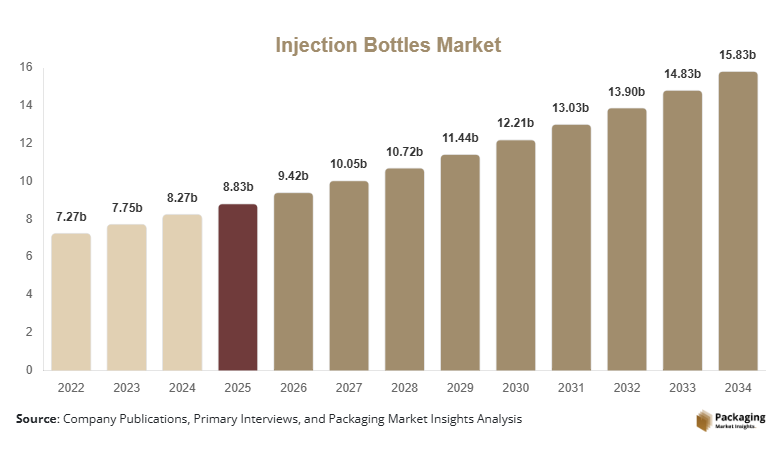
Injection Bottles market size is projected at USD 9.42 billion in 2026 and is expected to hit USD 15.86 billion by 2034 with a CAGR of 6.7%.” The market expansion is supported by rising pharmaceutical production, increasing demand for sterile packaging solutions, and growing adoption of lightweight injection-molded containers. The report provides detailed segmentation, competitive landscape analysis, production trends, technological developments, and regional insights covering historical years 2022–2024 and forecast period 2026–2034. The Injection Bottles Market report evaluates industry performance through quantitative and qualitative analysis, including market revenue, production capacity, material consumption, application demand, and company positioning.
The injection bottles market includes containers manufactured through injection molding technology for pharmaceutical, healthcare, cosmetic, and laboratory applications. These bottles provide durability, dimensional accuracy, contamination protection, and compatibility with advanced filling systems. Global production of injection-molded bottles exceeded 35 billion units in 2025, with pharmaceutical applications contributing nearly 45% of total demand. Plastic injection bottles accounted for approximately 70% market contribution due to cost efficiency, lightweight characteristics, and recyclability advantages. Increasing adoption of sterile packaging systems, rising healthcare expenditure, and expansion of pharmaceutical manufacturing facilities across Asia-Pacific and North America are strengthening the Injection Bottles Market.
Explore more data points, trends and opportunities Download Free Sample Report
Injection Bottles Trends
Increasing Adoption of Sustainable and Lightweight Packaging Solutions
The injection bottles industry is witnessing a shift toward recyclable polymers, bio-based plastics, and lightweight packaging formats. In 2025, more than 40% of newly developed injection bottle designs incorporated reduced material usage technologies, lowering packaging weight by 10–25%. Pharmaceutical and personal care companies are adopting high-density polyethylene (HDPE), polypropylene (PP), and polyethylene terephthalate (PET) injection bottles due to improved chemical resistance and durability. Global production of sustainable plastic packaging exceeded 120 million tons annually, creating additional demand for advanced injection bottle manufacturing technologies and supporting Injection Bottles Market Trend.
Growth of Smart Packaging and Advanced Manufacturing Technologies
Manufacturers are integrating automation, digital inspection systems, and smart manufacturing technologies into injection bottle production. Approximately 60% of large-scale packaging facilities adopted automated injection molding and quality monitoring systems by 2025. Advanced machines improve production efficiency by 30–40% and enable manufacturing speeds exceeding 500 bottles per minute. Increasing demand from pharmaceutical companies requiring precise dimensions, sterile environments, and tamper-resistant packaging is accelerating technology adoption across the Injection Bottles Market.
Injection Bottles Market Drivers
Rising Pharmaceutical and Healthcare Packaging Demand
Growing pharmaceutical production is a major factor driving the Injection Bottles Market Growth. Global pharmaceutical packaging demand exceeded USD 130 billion in 2025, with injectable drugs, oral medicines, and healthcare products generating significant demand for high-quality bottles. Pharmaceutical applications represent nearly 45% of injection bottle consumption, while healthcare product packaging contributes around 30%. Increasing vaccine production, biologics manufacturing, and healthcare infrastructure expansion are encouraging manufacturers to invest in advanced injection bottle production technologies.
Injection Bottles Market Restraints
High Manufacturing Costs and Raw Material Price Volatility
The production of injection bottles faces challenges due to fluctuating polymer prices, energy costs, and advanced machinery investments. Raw materials account for approximately 50–60% of total manufacturing expenses, while modern injection molding equipment investments range between USD 500,000 and USD 5 million. Price volatility of petroleum-based plastics increased production costs by 8–12% during recent years, affecting profit margins for small and medium manufacturers.
Injection Bottles Market Opportunities
Expansion of Pharmaceutical Manufacturing in Emerging Economies
Emerging markets create significant opportunities due to increasing healthcare investments and pharmaceutical manufacturing expansion. Countries such as India, China, Brazil, and Indonesia are increasing pharmaceutical production capacity by 7–10% annually. More than USD 50 billion in pharmaceutical manufacturing investments were announced globally during 2024–2026, increasing demand for sterile, durable, and cost-effective injection bottles.
Challenges in Injection Bottles Market
Regulatory Compliance and Sustainability Requirements
Strict regulations related to pharmaceutical packaging safety, recyclability, and material quality create operational challenges. More than 70% of pharmaceutical packaging manufacturers must comply with international standards related to contamination control and material testing. Developing sustainable alternatives while maintaining barrier properties and product protection remains a major challenge for the Injection Bottles Market.
Report Scope
| Report Metric | Details |
|---|---|
| Market Size in 2025 | USD 8.83 billion |
| Market Size in 2026 | USD 9.42 billion |
| Market Size in 2034 | USD 15.86 billion |
| CAGR | 6.7% (2026-2034) |
| Base Year for Estimation | 2025 |
| Historical Data | 2022-2024 |
| Forecast Period | 2026-2034 |
| Report Coverage | Revenue Forecast, Competitive Landscape, Supply Chain Disruption, Growth Factors, Environment & Regulatory Landscape and Trends |
| Geographies Covered | North America, Europe, APAC, Middle East and Africa, LATAM |
| Countries Covered | U.S., Canada, U.K., Germany, France, Spain, Italy, Russia, Nordic, Benelux, Rest of Europe, China, South Korea, Japan, India, Australia, Singapore, Taiwan, South East Asia, Rest of Asia-Pacific, UAE, Turky, Saudi Arabia, South Africa, Egypt, Nigeria, Rest of MEA, Brazil, Mexico, Argentina, Chile, Colombia, Rest of LATAM |
Explore more data points, trends and opportunities Download Free Sample Report
Injection Bottles Market Segmentation
The Injection Bottles Market segmentation is categorized based on material type and application. Plastic injection bottles dominate with nearly 70% market share due to lightweight design and cost advantages, while pharmaceutical packaging remains the leading application segment with approximately 45% demand contribution. Healthcare and cosmetic applications collectively account for more than 50% of total consumption.
By Type
Plastic Injection Bottles
Plastic injection bottles represent the largest segment with around 70% market share in 2025. These bottles are produced using HDPE, PP, PET, and other polymers, offering high durability, chemical resistance, and lightweight properties. Global production exceeded 25 billion plastic injection bottles annually, with pharmaceutical and personal care industries being major consumers. Advanced molding technologies enable production accuracy below 0.1 mm tolerance and support high-volume manufacturing requirements.
Glass Injection Bottles
Glass injection bottles account for nearly 20% market share and are primarily used for premium pharmaceutical and healthcare applications. These bottles provide superior chemical stability, transparency, and contamination resistance. Annual production exceeds 7 billion units globally, with strong adoption in injectable medicines, laboratory products, and specialty healthcare packaging. Increasing demand for high-value drug packaging continues supporting this segment.
Specialty Injection Bottles
Specialty injection bottles contribute approximately 10% market share and include customized containers designed for specific applications. These bottles incorporate advanced features such as child-resistant closures, dispensing mechanisms, and enhanced barrier properties. Demand is increasing in cosmetics, biotechnology, and specialized pharmaceutical applications requiring customized packaging solutions.
By Application
Pharmaceutical Packaging
Pharmaceutical packaging dominates the application segment with approximately 45% market share. Injection bottles are widely used for syrups, liquid medicines, supplements, and healthcare formulations. Global pharmaceutical production exceeded USD 1.5 trillion in 2025, creating strong demand for reliable packaging solutions. More than 80% of pharmaceutical manufacturers prioritize bottles offering contamination protection, durability, and regulatory compliance.
Healthcare Products
Healthcare products represent around 30% market share, supported by increasing demand for disinfectants, diagnostic solutions, and medical formulations. Production of healthcare packaging products exceeded 40 billion units annually, with injection bottles providing secure storage and transportation capabilities. Hospitals and healthcare facilities increasingly prefer lightweight and break-resistant packaging formats.
Cosmetics & Personal Care
Cosmetics and personal care applications account for approximately 25% market share. Premium skincare, haircare, and beauty product manufacturers are adopting injection bottles due to attractive designs and functional dispensing systems. The global personal care packaging industry exceeded USD 35 billion in 2025, increasing demand for customized injection bottle solutions.
Injection Bottles Market Segmentations
Material Type
- Plastic Injection Bottles
- Glass Injection Bottles
- Specialty Injection Bottles
Application
- Pharmaceutical Packaging
- Healthcare Products
- Cosmetics & Personal Care
- Laboratory & Research Applications
End-User
- Pharmaceutical Companies
- Healthcare Institutions
- Cosmetics Manufacturers
- Research Laboratories
Technology
- Injection Molding Technology
- Advanced Automated Manufacturing Systems
- Sterile Packaging Technology
- Smart Packaging Solutions
Injection Bottles Market Regional Outlook
Asia-Pacific
Asia-Pacific dominates the Injection Bottles Market with nearly 45% share in 2025. China contributes more than 35% of regional production, followed by India, Japan, and South Korea. The region produces over 15 billion injection bottles annually due to strong pharmaceutical manufacturing and expanding healthcare infrastructure. Increasing investments in drug manufacturing facilities are supporting regional growth.
North America
North America accounts for approximately 25% market share, driven by advanced pharmaceutical production and strict packaging standards. The United States contributes nearly 80% of regional demand, supported by biotechnology, healthcare, and specialty pharmaceutical industries. More than 65% of pharmaceutical packaging facilities utilize automated injection bottle production systems.
Europe
Europe represents around 20% market share, supported by pharmaceutical innovation and sustainability initiatives. Germany, France, Italy, and the United Kingdom are major contributors, collectively accounting for more than 60% of regional consumption. Manufacturers are focusing on recyclable materials and energy-efficient production technologies.
Latin America and Middle East & Africa
Latin America and Middle East & Africa collectively hold approximately 10% market share. Brazil, Mexico, Saudi Arabia, and South Africa are key markets due to healthcare expansion and pharmaceutical investments. Regional demand is growing at 5–8% annually, creating opportunities for affordable injection bottle manufacturing solutions.
Top players in Injection Bottles Market
- Amcor plc
- Berry Global Inc.
- Gerresheimer AG
- West Pharmaceutical Services, Inc.
- Schott AG
- Graham Packaging Company
- ALPLA Group
- Silgan Holdings Inc.
- Plastipak Holdings, Inc.
- Comar LLC
- Berry Bramlage
- Origin Pharma Packaging
Amcor plc
-
Amcor holds a strong global position in pharmaceutical and healthcare packaging solutions.
-
The company serves multiple markets with advanced plastic packaging technologies and sustainable material innovations.
-
Its injection bottle solutions support high-volume production with improved recyclability and lightweight designs.
-
Amcor maintains significant market positioning through global manufacturing facilities and partnerships with pharmaceutical companies.
Gerresheimer AG
-
Gerresheimer is a leading provider of pharmaceutical and healthcare packaging solutions with strong expertise in glass and plastic containers.
-
The company focuses on high-quality injection bottles designed for regulated healthcare applications.
-
Its products support sterile packaging requirements and advanced drug delivery systems.
-
Gerresheimer continues expanding production capabilities through technology investments and sustainability-focused manufacturing strategies.