In Mold Labels Market Size and Growth
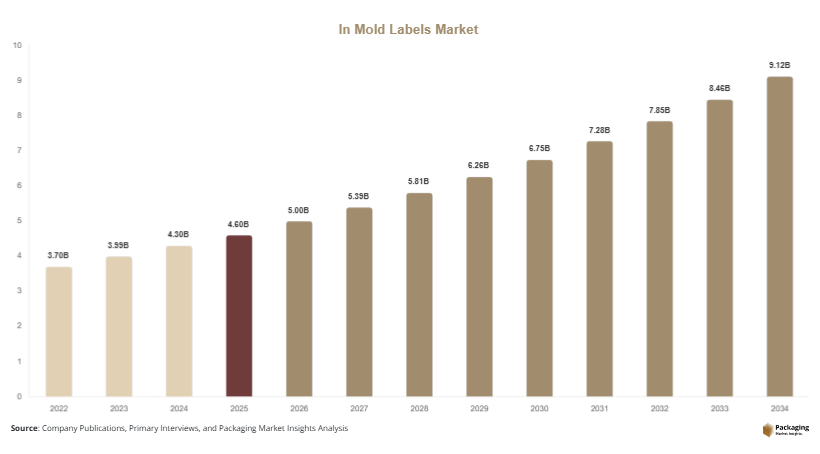
The global in mold labels market size is estimated at USD 4.6 billion in 2025 and is expected to reach USD 5.0 billion in 2026. By 2034, the market is projected to grow to USD 9.8 billion, registering a CAGR of 7.8% during 2025–2034. The demand for in mold labeling is expanding across packaging, automotive, and consumer goods industries due to its ability to combine labeling and molding processes, reducing production time and costs. The in mold labels market is witnessing steady growth as manufacturers increasingly adopt integrated labeling solutions that enhance product aesthetics, durability, and efficiency.
One of the key growth factors driving the in mold labels market is the increasing demand for high-quality and visually appealing packaging. In mold labels provide superior print quality, resistance to wear and tear, and seamless integration with packaging materials. Another significant factor is the rising focus on sustainable packaging solutions. In mold labels are often made from the same material as the container, making them easier to recycle compared to traditional labeling methods. Additionally, the growth of the food and beverage industry is boosting demand for durable and attractive packaging, further supporting market expansion.
Key Highlights:
- The In Mold Labels Market reached a market size of USD 4.6 billion in 2025, supported by rising demand for integrated labeling solutions that enhance durability and product appearance. The market continues to expand due to growing adoption across packaging and consumer goods industries.
- The market is expected to grow to USD 5.0 billion in 2026, driven by increasing investments in advanced manufacturing technologies and automation. Companies are focusing on improving production efficiency and label quality to meet evolving consumer expectations.
- By 2034, the In Mold Labels Market is projected to reach USD 9.8 billion, expanding at a CAGR of 7.8% during 2025–2034. This growth is fueled by continuous innovation and increasing demand for sustainable packaging solutions.
- There is a rising demand for durable and high-quality labeling solutions, as industries seek labels that can withstand moisture, temperature variations, and mechanical stress. This is especially important in food, beverage, and industrial packaging applications.
- The market is witnessing increasing adoption of sustainable and recyclable packaging, with in mold labels offering compatibility with single-material recycling systems. This supports environmental goals and regulatory compliance across regions.
- Additionally, there is strong growth in food, beverage, and consumer goods industries, which require visually appealing and long-lasting packaging solutions. Expanding retail and e-commerce sectors are further contributing to market demand.
Explore more data points, trends and opportunities Download Free Sample Report
Market Trends
Increasing Adoption of Sustainable In Mold Labeling
A major trend in the in mold labels market is the growing adoption of sustainable labeling solutions. Manufacturers are focusing on reducing environmental impact by using recyclable materials and minimizing waste during production. In mold labels are typically made from the same polymer as the packaging container, which simplifies the recycling process. This is particularly important as governments and consumers are placing greater emphasis on sustainability. Companies are also exploring bio-based materials and eco-friendly inks to further enhance the environmental profile of in mold labels. This trend is expected to drive innovation and adoption across various industries.
Integration of Advanced Printing Technologies
Another key trend in the in mold labels market is the integration of advanced printing technologies such as digital printing and high-definition graphics. These technologies enable manufacturers to produce labels with improved clarity, vibrant colors, and complex designs. The ability to customize labels for different products and markets is becoming increasingly important for brand differentiation. Additionally, advancements in printing technology are reducing production time and costs, making in mold labeling more accessible to a wider range of industries. This trend is supporting the growth of the market by enhancing both functionality and aesthetics.
Market Drivers
Growth in Packaging Industry
The rapid growth of the packaging industry is a major driver of the in mold labels market. As demand for packaged goods increases, manufacturers are seeking efficient and cost-effective labeling solutions. In mold labels offer several advantages, including durability, resistance to environmental factors, and seamless integration with packaging materials. These benefits make them an attractive option for industries such as food and beverages, personal care, and household products. The expansion of retail and e-commerce sectors is further driving demand for high-quality packaging solutions, supporting market growth.
Demand for Durable and Long-Lasting Labels
Another important driver of the in mold labels market is the increasing demand for durable and long-lasting labels. Traditional labeling methods can be prone to damage, fading, or peeling, which can affect product appearance and brand image. In mold labels, on the other hand, are embedded into the product during the manufacturing process, providing superior durability and resistance to wear and tear. This makes them suitable for applications where products are exposed to harsh conditions, such as automotive components and industrial packaging. The demand for reliable labeling solutions is driving the adoption of in mold labels.
Market Restraint
High Initial Setup Costs
A key restraint in the in mold labels market is the high initial setup cost associated with the technology. Implementing in mold labeling requires specialized equipment and molds, which can involve significant investment. This can be a barrier for small and medium-sized enterprises that may not have the resources to adopt such technologies. Additionally, the need for precise alignment and process control can increase operational complexity. For example, manufacturers must ensure that labels are correctly positioned during the molding process to achieve the desired results. These challenges can limit market growth, particularly in cost-sensitive regions.
Market Opportunities
Expansion in Emerging Markets
Emerging markets present significant opportunities for the in mold labels market. Rapid industrialization and urbanization in regions such as Asia Pacific and Latin America are driving demand for packaged goods. As consumer purchasing power increases, there is a growing demand for high-quality packaging solutions. In mold labels offer a cost-effective and efficient solution for manufacturers looking to improve product presentation. Companies that invest in expanding their presence in these regions are likely to benefit from increased demand and market growth.
Adoption in Automotive and Industrial Applications
The adoption of in mold labels in automotive and industrial applications is another promising opportunity for the in mold labels market. These industries require labeling solutions that can withstand harsh environmental conditions, including exposure to heat, chemicals, and mechanical stress. In mold labels provide excellent durability and resistance, making them suitable for such applications. The increasing use of plastic components in automotive manufacturing is further driving demand for in mold labeling solutions.
Report Scope
| Report Metric | Details |
|---|---|
| Market Size in 2025 | USD 4.6 Billion |
| Market Size in 2026 | USD 5.0 Billion |
| Market Size in 2034 | USD 9.8 Billion |
| CAGR | 7.8% (2026-2034) |
| Base Year for Estimation | 2025 |
| Historical Data | 2022-2024 |
| Forecast Period | 2026-2034 |
| Report Coverage | Revenue Forecast, Competitive Landscape, Supply Chain Disruption, Growth Factors, Environment & Regulatory Landscape and Trends |
| Geographies Covered | North America, Europe, APAC, Middle East and Africa, LATAM |
| Countries Covered | U.S., Canada, U.K., Germany, France, Spain, Italy, Russia, Nordic, Benelux, Rest of Europe, China, South Korea, Japan, India, Australia, Singapore, Taiwan, South East Asia, Rest of Asia-Pacific, UAE, Turky, Saudi Arabia, South Africa, Egypt, Nigeria, Rest of MEA, Brazil, Mexico, Argentina, Chile, Colombia, Rest of LATAM |
Explore more data points, trends and opportunities Download Free Sample Report
Segmental Analysis
By Type
Injection molding labels dominate the in mold labels market, accounting for approximately 54% share in 2024. These labels are widely used due to their compatibility with high-volume production processes and ability to provide excellent adhesion and durability. Injection molding labels are commonly used in packaging applications such as containers and lids. Their ability to integrate seamlessly with the product enhances both functionality and aesthetics, making them a preferred choice for manufacturers.
The fastest-growing subsegment is blow molding labels, projected to grow at a CAGR of 8.5% during 2025–2034. Growth is driven by increasing demand for lightweight and durable packaging solutions. Blow molding labels are particularly suitable for bottles and containers used in the food and beverage industry. Their ability to provide consistent quality and reduce production costs is supporting market growth.
By Application
Food and beverage packaging dominates the in mold labels market, accounting for approximately 49% share in 2024. The demand for in mold labels in this segment is driven by the need for attractive and durable packaging solutions. These labels provide resistance to moisture, temperature changes, and handling, ensuring that products maintain their appearance throughout their lifecycle. The growing consumption of packaged food is supporting this segment.
The fastest-growing subsegment is personal care and cosmetics, expected to grow at a CAGR of 8.3% during 2025–2034. Growth is driven by increasing demand for premium packaging and brand differentiation. In mold labels allow manufacturers to create visually appealing designs that enhance product appeal. The expansion of the cosmetics industry is supporting this growth.
By End-Use
The consumer goods industry dominates the in mold labels market, accounting for approximately 46% share in 2024. The demand for in mold labels in this segment is driven by the need for efficient and durable labeling solutions. These labels help improve product appearance and brand recognition. The growth of retail and e-commerce sectors is supporting demand in this segment.
The fastest-growing subsegment is automotive industry, projected to grow at a CAGR of 8.1% during 2025–2034. Growth is driven by increasing use of plastic components and the need for durable labeling solutions. In mold labels provide resistance to heat, chemicals, and mechanical stress, making them suitable for automotive applications.
In Mold Labels Market Segmentations
By Type
- Injection Molding Labels
- Blow Molding Labels
- Thermoforming Labels
By Application
- Food & Beverage Packaging
- Personal Care & Cosmetics
- Industrial Packaging
By End-Use
- Consumer Goods Industry
- Automotive Industry
- Industrial Sector
Regional Analysis
North America
North America holds approximately 33% market share in 2025 in the in mold labels market, with a projected CAGR of 7.4% during 2025–2034. The region benefits from advanced manufacturing capabilities and high adoption of innovative packaging solutions. The presence of major consumer goods companies is driving demand for high-quality labeling solutions. Additionally, increasing focus on sustainability is encouraging the adoption of recyclable in mold labels.
The United States dominates the regional market due to its strong packaging industry and technological advancements. A key growth factor is the increasing use of automated manufacturing processes, which improve efficiency and reduce production costs. Canada is also contributing to market growth through investments in sustainable packaging solutions.
Europe
Europe accounts for around 27% market share in 2025, with a projected CAGR of 7.2% in the in mold labels market. The region is characterized by strict environmental regulations and a strong focus on sustainability. Companies are adopting in mold labeling to reduce waste and improve recyclability. The demand for high-quality packaging in the food and beverage industry is driving market growth.
Germany leads the European market due to its strong industrial base and focus on innovation. A unique growth factor is the increasing adoption of eco-friendly labeling solutions, which align with regulatory requirements. Other countries such as France and the UK are also contributing to market expansion.
Asia Pacific
Asia Pacific holds approximately 26% market share in 2025 and is expected to grow at the highest CAGR of 8.6% during 2025–2034 in the in mold labels market. Rapid urbanization and increasing demand for consumer goods are driving market growth. The region is also witnessing growth in manufacturing and packaging industries.
China dominates the regional market due to its large manufacturing base and expanding consumer market. A key growth factor is the increasing demand for cost-effective and high-quality packaging solutions, which supports the adoption of in mold labels. India and Japan are also contributing to market growth.
Middle East & Africa
The Middle East & Africa region accounts for around 7% market share in 2025, with a projected CAGR of 7.9%. Growth is driven by increasing demand for packaged goods and improving industrial infrastructure. The adoption of advanced packaging solutions is gradually increasing in the region.
Saudi Arabia leads the regional market due to investments in industrial development. A unique growth factor is the rising demand for durable labeling solutions in extreme environmental conditions, which require high-performance materials.
Latin America
Latin America holds approximately 7% market share in 2025, with a projected CAGR of 7.5% in the in mold labels market. Growth is supported by increasing demand for consumer goods and expanding retail sectors. The adoption of advanced packaging solutions is contributing to market growth.
Brazil dominates the regional market due to its large consumer base. A key growth factor is the increasing adoption of affordable and efficient labeling technologies, which improve product presentation and durability.
Competitive Landscape
The in mold labels market is moderately competitive, with key players focusing on product innovation and expansion strategies. Major companies include CCL Industries Inc., Multi-Color Corporation, Constantia Flexibles, Coveris Holdings S.A., and Huhtamaki Oyj. These companies are investing in advanced printing technologies and sustainable materials to enhance their product offerings.
Among these, CCL Industries Inc. is a leading player due to its extensive global presence and strong product portfolio. The company recently expanded its production capacity for in mold labels, aiming to meet increasing demand from packaging and consumer goods industries.
Key Players List
- CCL Industries Inc.
- Multi-Color Corporation
- Constantia Flexibles
- Coveris Holdings S.A.
- Huhtamaki Oyj
- Berry Global Inc.
- Amcor plc
- Avery Dennison Corporation
- Fuji Seal International Inc.
- Innovia Films Ltd.
- Taghleef Industries
- RPC Group Plc
- Yupo Corporation
- EVCO Plastics
- Jindal Poly Films Ltd.