Hot Fill Packaging Market Size
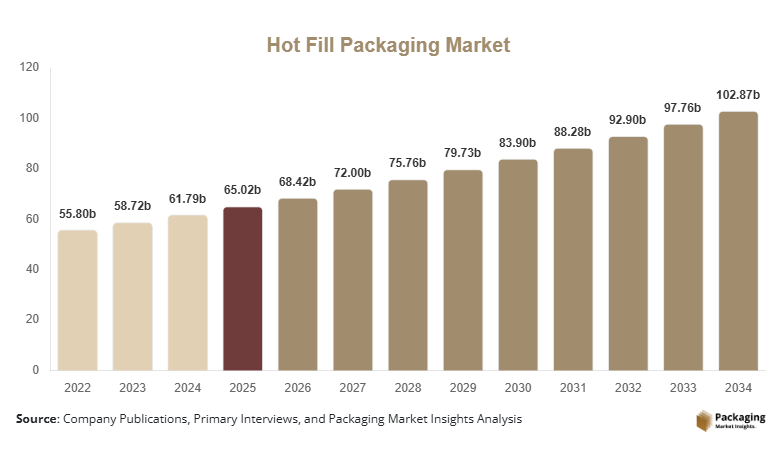
Hot Fill Packaging market size is projected at USD 68.42 billion in 2026 and is expected to hit USD 102.87 billion by 2034 with a CAGR of 5.23%. The report evaluates market performance using historical data from 2022–2024 and the base year 2025 while assessing production capacity, consumption patterns, value chain analysis, segmentation, and the competitive landscape across key manufacturing regions. Quantitative assessment covers more than 35 countries, over 250 manufacturers, and production exceeding 415 billion packaging units, enabling comprehensive analysis of the Hot Fill Packaging market.
The Hot Fill Packaging market refers to packaging solutions designed to withstand filling temperatures generally ranging from 80°C to 95°C for products such as juices, sauces, dairy beverages, ready-to-drink tea, and pharmaceutical liquids. Global production exceeded 415 billion units in 2025, while plastic materials represented nearly 61% of total output, followed by glass at 25% and metal at 14%. Beverage applications accounted for approximately 47% of total consumption, while food applications contributed 39%. Adoption of recyclable packaging exceeded 44%, and lightweight container penetration surpassed 58%, reinforcing the expansion of the Hot Fill Packaging market.
Explore more data points, trends and opportunities Download Free Sample Report
Hot Fill Packaging Trends
Rising Adoption of Lightweight and Recyclable Packaging
Packaging manufacturers are increasingly adopting lightweight PET, recyclable polypropylene, and advanced barrier technologies to reduce material consumption by 12–18% while maintaining thermal resistance above 90°C. Production of recyclable hot-fill containers exceeded 182 billion units in 2025, with recycled resin utilization increasing by 21% year over year. Smart production lines now achieve filling speeds above 42,000 bottles per hour, supporting continuous Hot Fill Packaging market expansion.
The growing demand for ready-to-drink beverages and functional foods has accelerated investments in automated hot-fill facilities. Beverage packaging production surpassed 195 billion units, while digital inspection systems improved defect detection rates beyond 99.5%. More than 63% of newly commissioned filling facilities incorporate AI-enabled quality monitoring, supporting sustainable manufacturing and strengthening the Hot Fill Packaging market.
Hot Fill Packaging Market Drivers
Growing Consumption of Shelf-Stable Food and Beverage Products
Global consumption of shelf-stable beverages increased by 8.7% in 2025, while packaged sauce production expanded by 6.4%. Manufacturers invested more than USD 5.8 billion in automated filling systems, with PET bottle production surpassing 210 billion units annually. Improved distribution networks and increasing urbanization continue to stimulate demand from beverage, dairy, and processed food industries, accelerating Hot Fill Packaging market growth.
Hot Fill Packaging Market Restraints
Volatility in Raw Material Prices
Prices of PET resin fluctuated by approximately 14% during 2025, while aluminum costs increased nearly 11%. Raw materials contribute around 58–65% of total manufacturing costs, reducing operating margins for packaging producers. Compliance with food safety regulations also raises operational expenditure by 7–10%, creating pricing pressure across the Hot Fill Packaging market.
Hot Fill Packaging Market Opportunities
Expansion of Sustainable Packaging Technologies
Demand for recyclable and bio-based packaging is creating substantial investment opportunities. Bio-based polymers now represent nearly 9% of total production, while investments in recycling infrastructure exceeded USD 3.2 billion globally. More than 46% of beverage brands have announced recyclable packaging targets before 2030, creating long-term opportunities throughout the Hot Fill Packaging market.
Challenges in Hot Fill Packaging Market
Balancing Heat Resistance with Lightweight Design
Manufacturers face engineering challenges in reducing package weight while maintaining resistance above 90°C. Research and development spending increased by nearly 13%, while advanced multilayer structures raised production costs by 8–12%. Achieving high-speed manufacturing with reduced material usage remains a significant challenge affecting Hot Fill Packaging market development.
Report Scope
| Report Metric | Details |
|---|---|
| Market Size in 2025 | USD 65.02 billion |
| Market Size in 2026 | USD 68.42 billion |
| Market Size in 2034 | USD 102.87 billion |
| CAGR | 5.23% (2026-2034) |
| Base Year for Estimation | 2025 |
| Historical Data | 2022-2024 |
| Forecast Period | 2026-2034 |
| Report Coverage | Revenue Forecast, Competitive Landscape, Supply Chain Disruption, Growth Factors, Environment & Regulatory Landscape and Trends |
| Geographies Covered | North America, Europe, APAC, Middle East and Africa, LATAM |
| Countries Covered | U.S., Canada, U.K., Germany, France, Spain, Italy, Russia, Nordic, Benelux, Rest of Europe, China, South Korea, Japan, India, Australia, Singapore, Taiwan, South East Asia, Rest of Asia-Pacific, UAE, Turky, Saudi Arabia, South Africa, Egypt, Nigeria, Rest of MEA, Brazil, Mexico, Argentina, Chile, Colombia, Rest of LATAM |
Explore more data points, trends and opportunities Download Free Sample Report
Hot Fill Packaging Market Segmentation
The market is segmented according to material and end-use industry. Plastic packaging dominates with approximately 61% market contribution, followed by glass at 25% and metal at 14%. Beverage applications account for nearly 47%, food applications 39%, and pharmaceutical applications approximately 14% of total demand.
By Material
Plastic remains the largest segment with nearly 61% share and production exceeding 253 billion units annually. PET and polypropylene containers withstand filling temperatures up to 95°C, offer excellent impact resistance, and reduce transportation weight by approximately 30% compared with glass.
Glass accounts for approximately 25% of the market, with annual production exceeding 104 billion units. It provides excellent oxygen barrier performance, chemical stability, and premium product presentation while supporting infinite recyclability.
Metal packaging contributes nearly 14% share with production above 58 billion units. Aluminum and steel containers provide high thermal resistance, durability, and extended shelf life for specialty beverages and processed foods.
By End Use Industry
Food applications account for approximately 39% of demand, supported by sauces, soups, baby food, and processed meals. Production exceeds 162 billion packages, with filling temperatures generally between 85°C and 92°C.
Beverages dominate with around 47% market share and production exceeding 195 billion units. Juice, tea, sports drinks, and dairy beverages increasingly utilize lightweight PET bottles featuring high thermal stability and oxygen barrier protection.
Pharmaceutical applications contribute about 14% of the market, producing more than 58 billion containers annually. Hot-fill technology supports sterile liquid formulations with high packaging integrity and improved product safety.
Hot Fill Packaging Market Segmentations
Material
- Plastic
- Glass
- Metal
End Use Industry
- Food
- Beverages
- Pharmaceuticals
Hot Fill Packaging Regional Outlook
North America
North America accounted for approximately 31% of global revenue in 2025, producing more than 128 billion packaging units. The United States contributed nearly 82% of regional production, supported by strong beverage manufacturing and advanced automation technologies.
Europe
Europe represented around 27% of the global market, with production exceeding 112 billion units. Germany, France, Italy, and the United Kingdom collectively generated over 71% of regional demand through food processing and beverage manufacturing industries.
Asia-Pacific
Asia-Pacific held approximately 34% of global demand, making it the largest regional market. China, India, Japan, and South Korea together produced more than 150 billion units, supported by rising urban populations, packaged food consumption, and expanding beverage industries.
Latin America
Latin America accounted for nearly 5% of global demand. Brazil and Mexico generated over 68% of regional production, driven by increasing investments in beverage bottling and processed food manufacturing.
Middle East & Africa
The Middle East & Africa represented approximately 3% of the market. GCC countries and South Africa remain major contributors as packaged food demand and beverage manufacturing capacity continue to expand.
Top players in Hot Fill Packaging Market
- Amcor plc
- Berry Global Inc.
- ALPLA Group
- Silgan Holdings Inc.
- Gerresheimer AG
- O-I Glass Inc.
- Ardagh Group
- Ball Corporation
- Tetra Pak International S.A.
- Sonoco Products Company
- CCL Industries Inc.
- AptarGroup Inc.
Amcor plc
-
Estimated market share of approximately 10–12%.
-
Global leader with extensive hot-fill PET packaging capabilities.
-
Manufacturing network spans more than 40 countries with strong sustainability investments and advanced lightweight packaging technologies supporting beverage and food applications.
Berry Global Inc.
-
Estimated market share of approximately 8–10%.
-
Strong position in rigid plastic packaging with high-volume production exceeding tens of billions of containers annually.
-
Focuses on recyclable packaging solutions, lightweight container development, and automation for beverage and food manufacturers across North America, Europe, and Asia-Pacific.