Honeycomb Cardboard Market Size and Growth
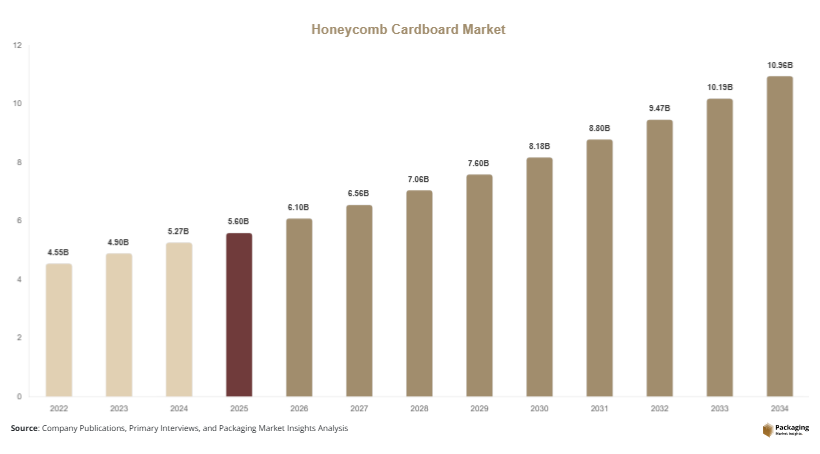
The Honeycomb Cardboard Market size was valued at approximately USD 5.6 billion in 2025 and is projected to reach USD 6.1 billion in 2026. With growing demand for eco-friendly materials and efficient protective packaging, the market is expected to reach USD 11.8 billion by 2034, registering a CAGR of 7.6% during the forecast period (2025–2034). The honeycomb cardboard market is witnessing steady expansion due to its increasing adoption across packaging, furniture, automotive, and construction applications. Honeycomb cardboard is known for its lightweight structure, high strength-to-weight ratio, and recyclability, making it a preferred material in industries seeking cost-efficient and sustainable solutions.
One of the primary growth factors is the increasing demand for sustainable packaging solutions. Honeycomb cardboard is made from recycled paper and offers an environmentally friendly alternative to plastic and foam-based packaging. Governments and regulatory bodies are encouraging the use of recyclable materials, driving demand for honeycomb cardboard across various industries.
Key Highlights:
- The market size reached USD 5.6 billion in 2025 and is projected to grow steadily, reaching USD 11.8 billion by 2034. This reflects increasing adoption across packaging and industrial applications.
- The market is expected to expand at a CAGR of 7.6% during the forecast period from 2025 to 2034. Growth is supported by rising demand for cost-efficient and eco-friendly materials.
- There is rising demand for sustainable and lightweight packaging solutions. This is driven by environmental regulations and the need to reduce transportation costs.
- The increasing adoption in furniture, automotive, and construction industries is further boosting market growth. Honeycomb cardboard is widely used due to its strength, durability, and lightweight structure.
Explore more data points, trends and opportunities Download Free Sample Report
Market Trends
Increasing Adoption of Eco-Friendly Packaging Materials
A significant trend in the honeycomb cardboard market is the growing adoption of eco-friendly packaging materials. As environmental concerns continue to rise, companies are shifting toward sustainable alternatives to reduce their carbon footprint. Honeycomb cardboard, made from recycled paper, is gaining traction as a biodegradable and recyclable packaging solution. Manufacturers are investing in advanced production technologies to enhance material strength while maintaining sustainability. This trend is particularly prominent in industries such as electronics, automotive, and consumer goods, where packaging plays a critical role. The demand for eco-friendly solutions is expected to continue driving innovation and growth in the market.
Expansion of Honeycomb Structures in Industrial Applications
Another key trend is the increasing use of honeycomb structures in industrial applications beyond packaging. Honeycomb cardboard is being widely adopted in furniture manufacturing, automotive interiors, and construction panels. Its lightweight yet strong structure makes it suitable for applications requiring durability and cost efficiency. The material is also being used in protective panels and partitions due to its shock-absorbing properties. As industries seek innovative materials to improve performance and reduce costs, the use of honeycomb cardboard is expected to expand further.
Market Drivers
Rising Demand for Lightweight and Cost-Effective Materials
The increasing demand for lightweight and cost-effective materials is a major driver of the honeycomb cardboard market. Industries such as logistics, automotive, and construction are seeking materials that reduce weight without compromising strength. Honeycomb cardboard provides an ideal solution, offering high load-bearing capacity and durability. Its lightweight nature helps reduce transportation costs and improve efficiency. As companies focus on optimizing costs and improving performance, the demand for honeycomb cardboard is expected to grow steadily.
Growth of E-commerce and Global Supply Chains
The growth of e-commerce and global supply chains is another key driver of the market. The increasing volume of goods being transported requires reliable packaging solutions that can protect products during transit. Honeycomb cardboard offers excellent cushioning and structural support, making it suitable for shipping fragile and heavy items. The expansion of online retail and international trade is driving demand for efficient packaging solutions, supporting market growth.
Market Restraint
Limited Awareness and Competition from Alternative Materials
One of the major restraints in the honeycomb cardboard market is limited awareness among end-users and competition from alternative materials such as plastic, foam, and solid wood. While honeycomb cardboard offers several advantages, some industries are still reliant on traditional materials due to familiarity and established supply chains. This limits the adoption of honeycomb cardboard in certain applications.
For example, in the construction sector, materials such as plywood and metal are often preferred due to their perceived durability and performance. Similarly, plastic packaging continues to dominate in certain industries due to its versatility and water resistance. Manufacturers of honeycomb cardboard need to invest in marketing and education to highlight the benefits of their products. Overcoming these challenges is essential for the market to achieve its full growth potential.
Market Opportunities
Increasing Demand in Furniture and Interior Applications
The growing demand for lightweight and sustainable materials in furniture and interior applications presents significant opportunities for the honeycomb cardboard market. The material is widely used in doors, panels, and partitions due to its strength and low weight. Furniture manufacturers are adopting honeycomb cardboard to reduce material costs and improve product sustainability. This trend is expected to create new growth opportunities in the market.
Development of Advanced Honeycomb Structures
Another opportunity lies in the development of advanced honeycomb structures with enhanced properties. Manufacturers are focusing on improving material strength, moisture resistance, and durability to expand the range of applications. Innovations in production processes are enabling the creation of customized honeycomb structures for specific industrial needs. These advancements are expected to drive adoption and open new growth avenues in the market.
Report Scope
| Report Metric | Details |
|---|---|
| Market Size in 2025 | USD 5.6 Billion |
| Market Size in 2026 | USD 6.1 Billion |
| Market Size in 2034 | USD 11.8 Billion |
| CAGR | 7.6% (2026-2034) |
| Base Year for Estimation | 2025 |
| Historical Data | 2022-2024 |
| Forecast Period | 2026-2034 |
| Report Coverage | Revenue Forecast, Competitive Landscape, Supply Chain Disruption, Growth Factors, Environment & Regulatory Landscape and Trends |
| Geographies Covered | North America, Europe, APAC, Middle East and Africa, LATAM |
| Countries Covered | U.S., Canada, U.K., Germany, France, Spain, Italy, Russia, Nordic, Benelux, Rest of Europe, China, South Korea, Japan, India, Australia, Singapore, Taiwan, South East Asia, Rest of Asia-Pacific, UAE, Turky, Saudi Arabia, South Africa, Egypt, Nigeria, Rest of MEA, Brazil, Mexico, Argentina, Chile, Colombia, Rest of LATAM |
Explore more data points, trends and opportunities Download Free Sample Report
Segmental Analysis
By Type
The continuous honeycomb cardboard segment dominated the market in 2024, accounting for approximately 57% of the total share. This type is widely used due to its structural integrity and versatility. It provides consistent strength and is suitable for large-scale industrial applications. The segment benefits from increasing demand for durable packaging solutions.
The expanded honeycomb cardboard segment is the fastest-growing, expected to register a CAGR of 8.1% during the forecast period. This type offers flexibility and ease of customization, making it suitable for various applications. The increasing demand for tailored packaging solutions is driving growth in this segment.
By Application
The protective packaging segment held the largest market share in 2024, accounting for approximately 49% of the total market. Honeycomb cardboard is widely used for packaging fragile and heavy items due to its cushioning properties. The segment benefits from the growth of e-commerce and logistics industries.
The furniture segment is the fastest-growing, with a projected CAGR of 8.4% during the forecast period. The increasing demand for lightweight and sustainable materials in furniture manufacturing is driving growth in this segment.
By End-Use
The logistics and transportation segment dominated the market in 2024, accounting for approximately 52% of the total share. The need for efficient packaging solutions in supply chains is driving demand for honeycomb cardboard. The material helps reduce transportation costs and improve efficiency.
The construction segment is the fastest-growing, expected to register a CAGR of 8.6% during the forecast period. The increasing adoption of sustainable building materials is driving growth in this segment.
Honeycomb Cardboard Market Segmentations
By Type
- Continuous Honeycomb Cardboard
- Expanded Honeycomb Cardboard
By Application
- Protective Packaging
- Furniture
- Automotive
- Construction
By End-Use
- Logistics & Transportation
- Manufacturing
- Construction
Regional Analysis
North America
North America accounted for approximately 26% of the global honeycomb cardboard market share in 2025 and is expected to register a CAGR of 7.1% during the forecast period. The region benefits from strong demand for sustainable packaging solutions and advanced logistics infrastructure. The increasing focus on reducing plastic usage is driving the adoption of honeycomb cardboard.
The United States dominates the regional market due to its large manufacturing and e-commerce sectors. A unique growth factor is the increasing demand for lightweight packaging in industrial applications, which is driving the use of honeycomb cardboard.
Europe
Europe held around 24% of the market share in 2025 and is projected to grow at a CAGR of 7.0% through 2034. The region is characterized by strict environmental regulations and a strong focus on sustainability. Companies are adopting eco-friendly materials to comply with regulatory requirements.
Germany leads the European market, driven by its strong industrial base. A unique growth factor is the increasing adoption of sustainable construction materials, which is driving demand for honeycomb cardboard.
Asia Pacific
Asia Pacific dominated the global market with a share of approximately 33% in 2025 and is expected to register the highest CAGR of 8.3% during the forecast period. The region is a major hub for manufacturing and packaging industries. Increasing population and economic growth are driving demand for packaging solutions.
China is the dominant country in the region, supported by large-scale manufacturing operations. A key growth factor is the expansion of e-commerce platforms, which require efficient packaging solutions.
Middle East & Africa
The Middle East & Africa region accounted for around 9% of the market share in 2025 and is expected to grow at a CAGR of 6.8% during the forecast period. The market is gradually expanding due to increasing demand for packaging and construction materials.
The United Arab Emirates is a leading country in the region, driven by its growing construction sector. A unique growth factor is the increasing adoption of sustainable building materials.
Latin America
Latin America held approximately 8% of the global market share in 2025 and is projected to grow at a CAGR of 7.2% through 2034. The region is witnessing growth due to increasing industrial activities and demand for packaging solutions.
Brazil dominates the regional market, supported by its manufacturing sector. A key growth factor is the expansion of logistics and transportation industries.
Competitive Landscape
The honeycomb cardboard market is moderately fragmented, with several key players focusing on innovation and sustainability. Companies are investing in advanced manufacturing technologies to improve product performance and expand their product portfolios.
A leading player in the market is Smurfit Kappa Group, which has been actively developing sustainable packaging solutions. The company recently introduced new honeycomb cardboard products designed for industrial applications. Other major players are focusing on expanding their global presence and strengthening their distribution networks.
Key Players List
- Smurfit Kappa Group
- DS Smith Plc
- International Paper Company
- WestRock Company
- Packaging Corporation of America
- Georgia-Pacific LLC
- Stora Enso Oyj
- Oji Holdings Corporation
- Rengo Co., Ltd.
- Cascades Inc.
- Nine Dragons Paper Holdings
- Lee & Man Paper Manufacturing Ltd.
- Honicel Nederland B.V.
- Grigeo AB
- Lsquare Eco-Products Pvt. Ltd.